

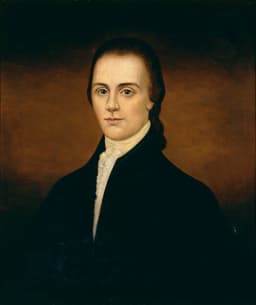
James Littlejohn Busbee (1870–1947), 1908. Wikimedia Commons. Public domain.
1740–1786
Abner Nash
0
recorded events
Connected towns:
New Bern, NCBiography
Abner Nash (1740–1786): The Governor Who Held North Carolina Together
A Revolutionary Executive in a State Under Siege
Born in Amelia County, Virginia, around 1740, the man who would become one of the most tested wartime governors in American history began his career far from battlefields. Abner Nash trained as a lawyer in Virginia, absorbing the legal culture of the colonial Chesapeake gentry before migrating southward to North Carolina, where opportunity and ambition drew many young professionals seeking to establish themselves in a colony with a rapidly expanding backcountry and a perpetual need for educated men of affairs. He settled eventually in the eastern part of the colony, building a legal practice and acquiring the social connections that were essential for political advancement in a province dominated by a relatively small planter elite. Nash married into prominent families and accumulated land, establishing himself as a gentleman of substance in the world around New Bern, which served as the colonial capital. His legal training sharpened a mind already inclined toward public service, and he moved steadily into positions of influence within North Carolina's colonial government. The colony he adopted was a complex and often fractious place, divided between a wealthy eastern establishment and a restive western frontier, tensions that would shape his entire political career and define the challenges he would later face as governor.
Nash's entry into the Revolutionary movement came through the provincial congresses that replaced royal authority in North Carolina during the mid-1770s, institutions that served as both legislative bodies and de facto revolutionary governments. He was elected to these congresses and quickly distinguished himself as a firm Patriot, though not a radical firebrand. His skills were organizational and legislative rather than oratorical, and he proved valuable in the painstaking work of building a new state government from the wreckage of colonial administration. North Carolina's provincial congresses drafted a state constitution, organized militia, and attempted to impose order on a colony that was deeply divided between Loyalist and Patriot sympathies. Nash contributed to this work as a legislator in the new state assembly, serving in both chambers and gaining a reputation as a reliable, capable, and politically connected figure. His years in the legislature during the early war period gave him an intimate understanding of North Carolina's political geography — its regional jealousies, its chronic lack of hard currency, and the extraordinary difficulty of compelling a dispersed rural population to support a war effort that often seemed abstract until the fighting arrived at their doorsteps. By the time the British turned their strategic attention to the southern colonies in 1778 and 1779, Nash was one of the most experienced political operators in the state.
The most consequential chapter of Nash's public life began in June 1780, when the North Carolina legislature elected him governor at a moment of cascading military disaster. The British southern strategy, launched with the capture of Savannah in late 1778 and the fall of Charleston in May 1780, had turned the Carolinas into the war's most violent and contested theater. Nash assumed office just weeks after the devastating American defeat at the Battle of Camden in August 1780, where General Horatio Gates's army was shattered and the last conventional American force in the deep South effectively ceased to exist. North Carolina suddenly lay open to invasion. Nash inherited an empty treasury, a militia system that existed more on paper than in the field, and a civilian population that was exhausted, divided, and in many areas actively hostile to the Patriot cause. His central challenge was to keep the machinery of state government functioning — collecting taxes, organizing supply chains, calling up militia drafts — while British and Loyalist forces operated with increasing boldness across the state. He attempted to do this from New Bern and other locations as the military situation demanded, moving the seat of governance to wherever it could still operate effectively.
The turning point of Nash's governorship came during the winter and spring of 1780–1781, a period that tested every capacity of both military and civilian leadership in the South. In December 1780, General Nathanael Greene arrived to assume command of the shattered Southern Department, and Nash immediately faced the enormous task of supporting Greene's rebuilding effort. Greene needed everything — food, shoes, blankets, horses, wagons, ammunition — and North Carolina's government was the only institution that could theoretically compel the civilian population to provide them. Nash issued requisitions, pleaded with county officials, and attempted to enforce impressment orders on a population that had little left to give. The effort was halting and perpetually insufficient, yet it produced enough support to keep Greene's army in the field during the brilliant campaign of maneuver that culminated at the Battle of Guilford Court House on March 15, 1781. That engagement, fought in the North Carolina Piedmont, cost Cornwallis a quarter of his army and forced the British commander to abandon the Carolina interior for the coast of Virginia, a strategic withdrawal that ultimately led to Yorktown. Nash's contribution was invisible on the battlefield but essential to the outcome: without the threadbare supply lines he organized, Greene could not have sustained his army long enough to fight.
Nash's effectiveness as governor depended heavily on his relationships with other key figures in the Patriot cause, relationships that were often strained by the desperate circumstances of the southern war. His most important partnership was with Nathanael Greene, and the correspondence between the two men reveals both mutual respect and persistent frustration. Greene constantly demanded more than North Carolina could deliver, and Nash constantly promised more than he could extract from a depleted state. The tension was structural, not personal — it reflected the fundamental weakness of a confederal system in which state governments were the primary engines of supply for a national army. Nash also navigated difficult relationships with the North Carolina legislature, which jealously guarded its prerogatives and sometimes obstructed executive action, and with militia commanders whose cooperation was essential but never guaranteed. His dealings with figures like General William Caswell and other state military leaders revealed the tangled web of authority that characterized Revolutionary-era governance, where no single individual commanded enough power to impose order unilaterally. Nash managed these relationships with a lawyer's pragmatism, negotiating, cajoling, and occasionally threatening in order to keep the war effort moving forward.
Nash left the governorship in 1781, succeeded by Alexander Martin, and subsequently served as a delegate to the Continental Congress, where he continued to advocate for North Carolina's interests in the fragile national government. He died in 1786, before the Constitutional Convention addressed many of the structural weaknesses in American governance that his wartime experience had so painfully exposed. His legacy is not that of a celebrated hero but of something arguably more important to understanding how the Revolution was actually won: a civilian administrator who kept a state government functioning under nearly impossible conditions. The American Revolution was not won solely by generals and soldiers; it was sustained by governors, legislators, and local officials who performed the unglamorous work of taxation, supply, and civil administration in states that were simultaneously fighting a war and trying to invent new forms of government. Nash's story illustrates that the real infrastructure of independence was political and bureaucratic as much as military. His tenure as governor demonstrated that the survival of civil authority — messy, inadequate, and perpetually under pressure — was what distinguished the American Revolution from mere rebellion and made lasting independence possible.
WHY ABNER NASH MATTERS TO NEW BERN
Abner Nash's story offers students and visitors a crucial lesson too often missing from Revolutionary War narratives: wars are not won by armies alone. From New Bern and other eastern North Carolina locations, Nash struggled to keep a functioning state government alive while Cornwallis's army burned through the interior and British forces threatened the coast. New Bern, as the hub of North Carolina's colonial and early state administration, was the nerve center from which Nash tried to coordinate supply, communication, and governance across a state that was literally coming apart. Walking New Bern's streets today, visitors can connect to the extraordinary difficulty of maintaining civil order in a place where the Revolution was not a distant abstraction but an immediate, grinding reality demanding impossible choices every day.
TIMELINE
- 1740: Born in Amelia County, Virginia
- 1760s: Migrates to North Carolina and establishes a legal practice
- 1774–1776: Serves in North Carolina's provincial congresses during the break with Britain
- 1777–1779: Serves in the North Carolina state legislature during the early war years
- 1780 (June): Elected Governor of North Carolina amid the British southern campaign
- 1780 (August): Faces the aftermath of the American defeat at the Battle of Camden
- 1780 (December): Begins coordinating supply efforts with General Nathanael Greene
- 1781 (March 15): North Carolina's contributions help sustain Greene's army through the Battle of Guilford Court House
- 1781: Leaves the governorship; succeeded by Alexander Martin
- 1782–1786: Serves as a delegate to the Continental Congress
- 1786: Dies in New York while attending Congress
SOURCES
- Rankin, Hugh F. North Carolina in the American Revolution. North Carolina Division of Archives and History, 1959.
- Ashe, Samuel A. History of North Carolina, Vol. I. Edwards & Broughton, 1908.
- North Carolina Office of Archives and History. "Abner Nash." North Carolina Highway Historical Marker Program. https://www.ncdcr.gov/about/history/division-historical-resources/nc-highway-historical-marker-program
- Showman, Richard K., et al., eds. The Papers of General Nathanael Greene, Vols. VI–VIII. University of North Carolina Press, 1991–1995.
- Powell, William S., ed. Dictionary of North Carolina Biography, Vol. 4. University of North Carolina Press, 1991.