

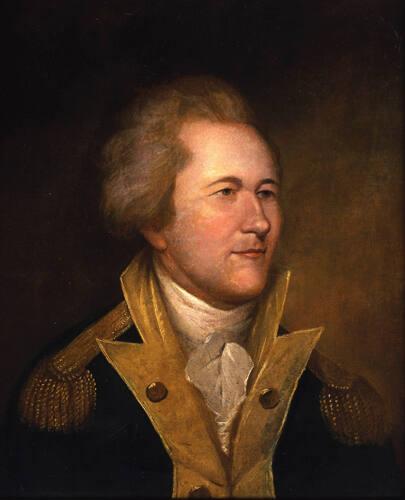
After Charles Willson Peale, 2023. Wikimedia Commons. Public domain.
1755–1804
Alexander Hamilton
1
recorded events
Connected towns:
Albany, NYBiography
Alexander Hamilton (1755–1804)
Continental Army Officer, Washington's Aide-de-Camp, First Secretary of the Treasury
Born on the Caribbean island of Nevis around 1755, the boy who would reshape American finance and governance grew up amid circumstances that seemed designed to crush ambition rather than cultivate it. His parents were unmarried, his father abandoned the family, and his mother died when he was roughly thirteen years old. Left effectively orphaned, Hamilton survived through the patronage of local merchants who recognized his extraordinary intellect and tireless work ethic. He clerked at a trading firm on St. Croix, where he absorbed the mechanics of international commerce, currency exchange, and maritime logistics — knowledge that would later prove indispensable to a new nation struggling to establish economic credibility. A hurricane in 1772 gave him an unlikely opportunity: his published account of the storm so impressed community leaders that they raised funds to send him to the mainland colonies for a proper education. He arrived in New York and enrolled at King's College, present-day Columbia University, plunging into studies in a city already crackling with political tension. In these formative years, Hamilton developed the ferocious reading habits, rhetorical precision, and appetite for argument that would define his public life for decades to come.
The gathering storm of revolution transformed Hamilton from a promising student into a public polemicist almost overnight. While still a teenager at King's College, he authored sophisticated pamphlets defending colonial rights against Parliamentary overreach, drawing on Enlightenment philosophy and English legal tradition with a fluency that astonished readers who assumed the anonymous author must be far older. His 1774 and 1775 pamphlets — particularly "A Full Vindication of the Measures of the Congress" and "The Farmer Refuted" — articulated the constitutional case for resistance with a clarity and intellectual rigor that brought him to the attention of New York's Patriot leadership. Hamilton did not merely theorize about liberty; he acted on it. When British warships threatened New York in 1775, he joined a volunteer militia company and began studying artillery tactics and military engineering with the same obsessive focus he brought to everything. By early 1776, he had raised and organized an independent artillery company, the Provincial Company of Artillery of the Colony of New York, earning a captain's commission before his twenty-first birthday. His transition from pamphleteer to soldier was seamless, driven by a conviction that intellectual argument alone could not secure American independence. The battlefield, he understood, would be the proving ground where abstract principles either survived or perished under fire.
Hamilton's most significant military action came at the Siege of Yorktown in October 1781, where he led one of the war's most dramatic assaults. For years he had chafed in his administrative role at Washington's headquarters, yearning for the battlefield glory he believed essential to his honor and future political standing. Washington finally granted him command of a light infantry battalion, and on the night of October 14, Hamilton led one of three columns in a bayonet assault on Redoubt No. 10, a fortified British position that anchored a critical section of Cornwallis's defensive line. The attack was swift and brutal. Hamilton ordered his men to advance with unloaded muskets, relying entirely on the bayonet to maintain the element of surprise and avoid the confusion of muzzle flashes in darkness. His troops stormed over the abatis and earthworks in roughly ten minutes, overwhelming the defenders and capturing the redoubt with relatively few American casualties. The simultaneous French capture of the adjacent Redoubt No. 9 allowed allied artillery to tighten its stranglehold on Yorktown, making Cornwallis's position untenable. Within days, the British commander opened negotiations for surrender. Hamilton's courage under fire at Yorktown was conspicuous and undeniable, earning him the respect of fellow officers and cementing his reputation as a man willing to risk everything for the cause he championed.
Before Yorktown, Hamilton had already shaped critical moments of the war through his role at Washington's side. During the harrowing retreat across New Jersey in late 1776, Captain Hamilton and his artillery company distinguished themselves in rearguard actions, helping to slow the British pursuit that threatened to destroy the Continental Army entirely. His performance during this desperate period caught Washington's eye, and in March 1777, the commanding general invited Hamilton to join his personal staff as an aide-de-camp with the rank of lieutenant colonel. For the next four years, Hamilton functioned as something close to a chief of staff, drafting orders and correspondence, managing intelligence reports, liaising with French allies, and translating Washington's strategic intentions into precise operational language. He was present at Brandywine, Germantown, and the winter encampment at Valley Forge, witnessing firsthand the logistical failures, congressional neglect, and structural weaknesses that plagued the American war effort. These experiences convinced Hamilton that the Articles of Confederation were fatally inadequate and that only a strong central government with the power to tax, regulate commerce, and maintain a professional military could sustain the republic. The war, in this sense, was Hamilton's political education — a brutal seminar in the consequences of institutional weakness.
The relationships Hamilton forged during the Revolution defined both his wartime service and his postwar trajectory. His bond with George Washington, though sometimes strained by Hamilton's impatience and pride, remained the most consequential partnership of his career. Washington valued Hamilton's intellect, energy, and administrative skill; Hamilton needed Washington's authority, judgment, and unimpeachable reputation. Equally transformative was Hamilton's 1780 marriage to Elizabeth Schuyler, daughter of Major General Philip Schuyler, one of New York's wealthiest and most politically powerful men. The wedding took place in December 1780 at the Schuyler Mansion on Catherine Street in Albany, binding Hamilton to a family whose influence extended across New York's Hudson Valley and into the highest circles of American political life. Through the Schuylers, Hamilton gained access to networks of wealth, land, and social prestige that his Caribbean origins and lack of family fortune could never have provided independently. His friendship with the Marquis de Lafayette, forged during shared hardships at Valley Forge and maintained through decades of transatlantic correspondence, connected him to the broader world of Enlightenment reform. These alliances were not merely personal; they were the architecture of political power in the early republic, and Hamilton cultivated them with strategic brilliance.
Hamilton's life was marked by setbacks, controversies, and moral complexities that complicate any simple heroic narrative. His relationship with Washington fractured temporarily in February 1781 when Hamilton, frustrated by what he perceived as a public rebuke over a trivial delay, resigned from the general's staff in a burst of wounded pride. The rupture revealed Hamilton's volatile temperament and his deep sensitivity about status and honor — anxieties rooted in the shame of his illegitimate birth and impoverished childhood. His postwar career brought further controversy: as Treasury Secretary, his ambitious financial program provoked fierce opposition from Thomas Jefferson and James Madison, who saw his plans for a national bank, federal assumption of state debts, and close ties to commercial interests as betrayals of republican principles. In 1797, Hamilton publicly confessed to an extramarital affair with Maria Reynolds to disprove charges of financial corruption — choosing personal humiliation over professional disgrace in a calculation that stunned contemporaries. His relentless political feuds, sharp tongue, and willingness to destroy rivals through anonymous newspaper attacks earned him powerful enemies. The duel with Aaron Burr on July 11, 1804, which ended Hamilton's life at the age of forty-seven or forty-nine, was the final consequence of a personality that combined extraordinary brilliance with a sometimes ruinous inability to restrain itself.
The war changed Hamilton profoundly, transforming an ambitious young immigrant into a man possessed by a singular vision for national greatness. Before the Revolution, he was brilliant but untested, a prodigy whose talents had been recognized but not yet forged under pressure. The experience of watching the Continental Army nearly disintegrate from lack of supplies, congressional indifference, and the structural impotence of a government that could request but not compel cooperation from the states radicalized his political thinking. He emerged from the war convinced that American independence would be meaningless without a powerful national government capable of projecting strength, managing debt, and earning the respect of European powers. The suffering he witnessed at Valley Forge and Morristown, the mutinies born of unpaid soldiers, the currency collapses that made Continental money worthless — these were not abstract policy problems for Hamilton but lived experiences that burned into his understanding of governance. The war also gave him an enduring sense of urgency. He had seen how fragile the American experiment truly was, how close it had come to failing not because of British military superiority but because of American political dysfunction. That urgency animated everything he did for the rest of his life.
Hamilton's role in the war's aftermath was arguably more consequential than his battlefield service. He practiced law in Albany and New York City, quickly establishing himself as one of the most formidable legal minds in the state. He attended the Annapolis Convention in 1786 and was instrumental in calling for the Philadelphia Convention that produced the Constitution the following year. At Philadelphia, his proposals for an extremely strong central government were too radical for most delegates, but he signed the final document and threw himself into the campaign for ratification with characteristic intensity. Alongside James Madison and John Jay, he authored the Federalist Papers — writing fifty-one of the eighty-five essays in a sustained burst of political philosophy that remains one of the most important commentaries on constitutional governance ever produced. As the first Secretary of the Treasury under President Washington, he designed the financial architecture of the new nation: funding the national debt, assuming state war debts, establishing the First Bank of the United States, creating the United States Mint, and laying the foundations for American manufacturing through his Report on Manufactures. These achievements transformed the fragile confederation of former colonies into a nation capable of sustaining itself economically and commanding respect in international affairs.
Contemporaries recognized Hamilton's genius even as they distrusted his ambitions. Washington regarded him as indispensable, repeatedly turning to Hamilton in moments of crisis and appointing him to the most consequential domestic policy position in the new government. John Adams, who succeeded Washington as president, resented Hamilton's influence within the Federalist Party but could not deny his intellectual dominance. Jefferson and Madison, Hamilton's fiercest political adversaries, understood that they were contending with a mind of the first order, even as they accused him of monarchical sympathies and aristocratic disdain for ordinary citizens. Talleyrand, the French diplomat who knew many of the era's greatest statesmen, reportedly ranked Hamilton alongside Napoleon and the British statesman Charles James Fox as one of the three most remarkable men of the age. Yet Hamilton's reputation was contested from the moment of his death. His widow, Elizabeth Schuyler Hamilton, spent the remaining fifty years of her life collecting his papers, commissioning biographies, and ensuring that his contributions to the founding of the republic would not be forgotten or diminished by political rivals. Her devotion preserved a documentary record that historians have drawn upon ever since, making her one of the most important custodians of American historical memory.
Students and visitors today should know Hamilton because his story illuminates the most essential tensions of the American founding — tensions that remain unresolved in our own time. He was an immigrant who became one of the nation's most powerful architects, a self-made man who married into aristocracy, a visionary who understood that democratic ideals required institutional structures to survive. His life demonstrates that the Revolution was not merely a military struggle but a prolonged argument about what kind of nation would emerge from independence. Hamilton championed a strong federal government, a robust financial system, and an economy driven by commerce and manufacturing — ideas that were fiercely contested in his lifetime and remain subjects of vigorous debate today. His story also reveals the human costs of political ambition: the broken friendships, the public scandals, the duel that ended his life before he turned fifty. For visitors walking the streets of Albany, standing before the Schuyler Mansion where he married Elizabeth, or tracing the routes of his wartime service across New York and New Jersey, Hamilton's story is a reminder that the nation was built not by marble statues but by complicated, brilliant, deeply flawed human beings who wagered their lives on an uncertain experiment in self-governance.
WHY ALEXANDER HAMILTON MATTERS TO ALBANY
Alexander Hamilton's connection to Albany runs through one of the most consequential marriages in American history. When he wed Elizabeth Schuyler at the Schuyler Mansion on Catherine Street in December 1780, he joined a family whose influence shaped New York politics, commerce, and military affairs throughout the Revolutionary era. Albany became a touchstone in Hamilton's life — a place where political alliances were forged, where the Schuyler family's vast networks opened doors that talent alone could not, and where the intersection of personal ambition and public service played out in drawing rooms and along the Hudson Valley's corridors of power. For students visiting Albany today, Hamilton's story illustrates how the Revolution was won not only on battlefields but through the social, economic, and political networks that connected families, communities, and a new nation's emerging leadership class.
TIMELINE
- 1755 (or 1757): Born on the island of Nevis in the British West Indies
- 1773: Arrives in the American colonies and enrolls at King's College (now Columbia University) in New York City
- 1775–1776: Organizes and commands the Provincial Company of Artillery of New York
- 1777: Appointed aide-de-camp to General George Washington with the rank of lieutenant colonel
- 1780: Marries Elizabeth Schuyler at the Schuyler Mansion in Albany, New York
- 1781: Leads the bayonet assault on Redoubt No. 10 at the Siege of Yorktown, October 14
- 1787–1788: Serves as a delegate to the Constitutional Convention and co-authors the Federalist Papers
- 1789–1795: Serves as the first Secretary of the Treasury under President Washington
- 1791: Establishes the First Bank of the United States
- 1804: Mortally wounded in a duel with Aaron Burr at Weehawken, New Jersey, on July 11; dies the following day
SOURCES
- Chernow, Ron. Alexander Hamilton. Penguin Press, 2004.
- National Archives. "Founders Online: Papers of Alexander Hamilton." https://founders.archives.gov/
- Schuyler Mansion State Historic Site. "History of the Schuyler Mansion." New York State Office of Parks, Recreation and Historic Preservation. https://parks.ny.gov/historic-sites/33/details.aspx
- Hamilton, Alexander, James Madison, and John Jay. The Federalist Papers. Various editions; originally published 1787–1788.
- Knott, Stephen F., and Tony Williams. Washington and Hamilton: The Alliance That Forged America. Sourcebooks, 2015.
Events
Dec
1780
Hamilton Marries Elizabeth SchuylerAlbanyContinental Army Officer# Hamilton Marries Elizabeth Schuyler In the winter of 1780, as the American Revolution ground through one of its most uncertain and demoralizing chapters, a wedding at the Schuyler Mansion in Albany, New York, quietly altered the trajectory of the young nation's future. On December 14, Alexander Hamilton, a Continental Army officer serving as aide-de-camp to General George Washington, married Elizabeth Schuyler, the second daughter of Major General Philip Schuyler and Catherine Van Rensselaer Schuyler. The ceremony brought together two vastly different worlds — Hamilton's brilliance forged through hardship and self-invention, and the Schuylers' deep-rooted wealth, influence, and aristocratic standing in New York's colonial elite. The consequences of this union would ripple far beyond the war itself, shaping the political and financial architecture of the United States for decades to come. Alexander Hamilton arrived in the American colonies as a young orphan from the Caribbean island of Nevis, possessing little more than extraordinary intellect and relentless ambition. His talents as a writer and organizer quickly earned him a place at King's College in New York, and when the Revolution erupted, he threw himself into the cause with characteristic intensity. His skill with artillery during the early campaigns caught the attention of General Washington, who appointed Hamilton as his aide-de-camp in 1777. In this role, Hamilton became one of Washington's most trusted advisors, drafting correspondence, managing logistics, and navigating the complex political relationships that held the fragile Continental Army together. Yet for all his ability, Hamilton lacked the one thing that mattered enormously in eighteenth-century American society: family connections and social standing. Elizabeth Schuyler, known to those close to her as Eliza, came from precisely the world Hamilton needed to enter. Her father, Philip Schuyler, was a Major General in the Continental Army who had commanded the Northern Department during the critical Saratoga campaign. Though Schuyler had been controversially replaced by General Horatio Gates before the decisive victory at Saratoga in 1777, his strategic groundwork contributed significantly to that turning point of the war. Beyond his military service, Schuyler was one of the wealthiest landowners in New York, a man of enormous political influence whose family had helped shape the colony for generations. Elizabeth's mother, Catherine Van Rensselaer Schuyler, was herself a member of one of the most powerful Dutch patroon families in the Hudson Valley, reinforcing the family's position at the very apex of New York society. Catherine was known as the formidable matriarch of the Schuyler household, managing the family's vast estates and raising a large family amid the disruptions of war. Hamilton and Elizabeth likely met during the winter of 1780 while Hamilton was stationed with Washington's army and Elizabeth was visiting her father's associates near the military encampment at Morristown, New Jersey. Their courtship was passionate and swift, conducted largely through letters that revealed Hamilton's romantic intensity and Elizabeth's steadfast devotion. Philip Schuyler, despite Hamilton's lack of fortune or pedigree, recognized the young officer's extraordinary potential and gave his blessing to the match. The wedding itself took place during one of the darkest stretches of the war. The Continental Army was plagued by supply shortages, troop desertions, and the still-fresh wound of Benedict Arnold's devastating betrayal just months earlier. Yet the Schuyler family's commitment to American independence remained unwavering, and the celebration at their Albany mansion offered a rare moment of warmth and hope in a season defined by hardship. The marriage proved transformative for Hamilton. His connection to the Schuyler family provided him with the social credibility and political network that his talents alone could not secure. After the war, Hamilton would leverage these advantages alongside his own genius to become the first Secretary of the Treasury, designing the financial systems that stabilized the fledgling republic. Elizabeth, for her part, became far more than a political wife. After Hamilton's tragic death in a duel with Aaron Burr in 1804, she dedicated nearly fifty years to preserving his writings, defending his reputation, and championing charitable causes, including the founding of New York's first private orphanage — a cause deeply personal to a woman who had married a man who once was an orphan himself. The wedding at the Schuyler Mansion was not merely a personal milestone; it was a pivotal moment that helped forge the leadership of a new nation.