

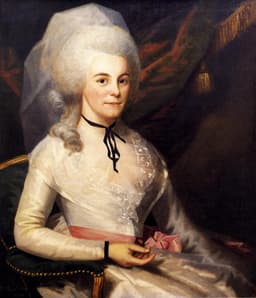
Ralph Earl, circ. Wikimedia Commons. Public domain.
1757–1854
Elizabeth Schuyler Hamilton
1
recorded events
Connected towns:
Albany, NYBiography
Elizabeth Schuyler Hamilton (1757–1854)
Patriot Wife, Legacy Keeper, and Quiet Force of the Founding Era
Born in Albany in 1757, Elizabeth Schuyler entered the world as the second daughter of Philip and Catherine Van Rensselaer Schuyler, placing her squarely within the upper echelon of New York's colonial Dutch aristocracy. Her childhood home, the grand Schuyler Mansion on Catherine Street in Albany, was not merely a family residence but a social institution — a place where powerful men gathered to discuss politics, land, and the growing tensions with the British Crown. Growing up in this environment, Elizabeth absorbed lessons that no formal school could have taught: how to manage a large household, how to read the currents of political conversation, and how to carry herself among ambitious, driven people. Her education, while informal by later standards, was thorough for a woman of her class and era, encompassing reading, writing, domestic economy, and the social graces expected of someone who would one day preside over her own household. The rolling hills above the Hudson River, the rhythms of Albany's Dutch Reformed community, and the steady presence of servants, soldiers, and statesmen all shaped her formation. She was not raised to be ornamental. She was raised to be capable, and that capability would define the rest of her long, extraordinary life.
The American Revolution did not arrive as an abstract cause for the Schuyler family — it arrived in their parlor. When her father, Philip Schuyler, was appointed a major general in the Continental Army in 1775, the family's elegant Albany home transformed into a hub of military planning and political negotiation. Elizabeth, then eighteen, witnessed firsthand the logistical chaos of a fledgling army and the personal toll that war exacted on families of prominence. She watched her father struggle with supply shortages, rivalries among officers, and the political maneuvering of the Continental Congress. The war came even closer when British forces under General Burgoyne advanced down the Hudson Valley in 1777, and the Schuyler family was forced to confront the real possibility of losing their home and their safety. Elizabeth's turning point was not a single dramatic moment but a gradual immersion — she entered the Revolutionary cause not by picking up a musket but by becoming indispensable to the domestic and social machinery that sustained the patriot effort in New York. Her presence at her father's side during these years prepared her for the partnership that would define her public life and taught her that revolution demanded sacrifice not only on battlefields but inside households.
Elizabeth Schuyler's most significant action during the Revolutionary period was her marriage to Alexander Hamilton on December 14, 1780, at the Schuyler Mansion in Albany. While a wedding may seem an unlikely candidate for a political act, this union reshaped the trajectory of the American founding. Hamilton, a brilliant but socially unconnected young officer serving as George Washington's aide-de-camp, gained through Elizabeth access to one of the most powerful family networks in New York. The Schuylers were connected by blood and marriage to the Van Rensselaers, the Van Cortlandts, and the Livingstons — families whose influence stretched across land, commerce, and colonial governance. Elizabeth, in choosing Hamilton, was not simply following romantic impulse. She was entering a partnership with a man whose ambition and intellect were unmistakable but whose origins offered no guarantee of social acceptance. The marriage gave Hamilton the legitimacy he needed to move from military staff work into the arenas of law and politics after the war. For Elizabeth, it meant binding herself to a man whose relentless energy would demand everything she had to give. The ceremony at the Schuyler Mansion was intimate by the standards of the family's social position, but its consequences rippled through the decades that followed.
The years immediately following the war required Elizabeth to navigate a series of demanding transitions as Hamilton's career accelerated with breathtaking speed. She managed their growing household — eventually eight children — while Hamilton built a legal practice in New York City, served as a delegate to the Constitutional Convention in 1787, co-authored the Federalist Papers, and ascended to the position of the nation's first Secretary of the Treasury in 1789. Each of these milestones placed new pressures on Elizabeth, who was expected to maintain a household worthy of a cabinet officer on a government salary that never matched the family's social obligations. She moved between New York and Philadelphia as the seat of government shifted, adjusting to new cities, new social expectations, and the constant scrutiny that accompanied her husband's increasingly controversial public role. Elizabeth was not a passive observer during these years. She managed finances, maintained correspondence with family in Albany, and served as a stabilizing presence for a husband who thrived on conflict and overwork. The decisions Hamilton made during this period — establishing the national bank, assuming state debts, shaping federal economic policy — were possible in part because Elizabeth held the private world together while he reshaped the public one.
The relationships and alliances that defined Elizabeth's role during and after the Revolution were rooted in family but extended well beyond it. Her father, Philip Schuyler, remained a powerful political figure in New York, and her connection to him gave Hamilton a ready-made network of allies in state politics. Her sister Angelica Schuyler Church, who married the wealthy British-born John Barker Church, provided transatlantic social connections and remained one of Elizabeth's closest confidantes throughout her life. Elizabeth also maintained a warm relationship with George and Martha Washington, a bond forged during the war years when Hamilton served on Washington's staff and strengthened during the presidency. These alliances were not merely social — they were structural supports for Hamilton's career and for Elizabeth's own ability to navigate the volatile world of early American politics. At the same time, Elizabeth's loyalties drew her into the bitter partisan conflicts of the 1790s, as Hamilton's Federalist agenda put him at odds with Thomas Jefferson, James Madison, and eventually Aaron Burr. She experienced political friendship and political enmity as deeply personal forces, understanding that in the early republic, alliances could sustain you and rivalries could destroy you.
The greatest personal crisis of Elizabeth's life before Hamilton's death was the public revelation in 1797 of his affair with Maria Reynolds. Hamilton, in an astonishing act of political calculation, published the Reynolds Pamphlet to defend himself against charges of financial corruption by confessing to the extramarital relationship in explicit detail. The pamphlet cleared him of the corruption charge but exposed his wife to public humiliation on a scale almost without precedent in early American political life. Elizabeth's response to this betrayal remains one of the most debated silences in American history — she left no written record of her feelings about the affair, and her decision to remain in the marriage has been interpreted variously as evidence of piety, pragmatism, emotional complexity, or quiet rage. What is clear is that she chose to endure. She did not leave Hamilton, she did not publicly condemn him, and she continued to manage their household and raise their children through the aftermath. The moral complexity of this choice resists easy judgment. Elizabeth's survival of the Reynolds affair reveals a woman who understood that her options were limited by the conventions of her time but who exercised what agency she had with extraordinary discipline and resolve.
The war and its aftermath changed Elizabeth Schuyler Hamilton in ways that accumulated slowly over decades. The young woman who had grown up in the sheltered grandeur of the Schuyler Mansion became, through marriage, a partner to one of the most volatile and brilliant figures in American politics. She endured financial strain, public scandal, the death of her eldest son Philip in a duel in 1801, and finally the death of her husband in his own duel with Aaron Burr on July 11, 1804. Each of these losses stripped away another layer of the security she had known as a Schuyler daughter and replaced it with a harder, more resilient sense of self. By the time Hamilton died, Elizabeth was forty-seven years old, a mother of seven surviving children, and a widow with limited financial resources. The Revolution had promised a new world, and in many ways it had delivered one — but for Elizabeth, that new world was defined as much by grief and endurance as by liberty and opportunity. The war had given her a husband, a cause, and a role in the founding of the nation. It had also given her losses that no political ideal could fully redeem, and a future she would have to build almost entirely on her own.
After Hamilton's death, Elizabeth devoted herself to preserving his legacy with a tenacity that spanned half a century. She worked painstakingly to gather, organize, and protect his papers, understanding that his contributions to the Constitution, the Federalist Papers, and the financial architecture of the United States might be forgotten or minimized by political opponents if she did not act. She enlisted the help of her son John Church Hamilton, who eventually published a multi-volume biography of his father, and she lobbied members of Congress and other public figures to acknowledge Hamilton's role in the founding. But her work extended beyond her husband's reputation. In 1806, Elizabeth helped establish the first private orphanage in New York City, the Orphan Asylum Society, channeling her own experience of loss into institutional action on behalf of children who had no family networks to protect them. She served the organization for decades, bringing to it the same managerial competence and social connections that had sustained her throughout her marriage. This work represented Elizabeth's most independent public contribution, a legacy that belonged to her alone and that reflected a moral seriousness deepened by everything she had endured.
Among contemporaries, Elizabeth Schuyler Hamilton was respected but often overshadowed. In the deeply patriarchal world of the early republic, her contributions were understood primarily through the lens of her relationships — as Philip Schuyler's daughter, as Alexander Hamilton's wife, as a mother of distinguished children. Those who knew her personally recognized her intelligence, her resilience, and her fierce loyalty, but the conventions of the era did not encourage public recognition of women's independent accomplishments. As she aged, however, Elizabeth became something more than a political wife — she became a living relic of the founding generation. By the 1840s, she was one of the last surviving people who had personally known George Washington, who had witnessed the Constitutional debates at close range, and who could speak of the Revolution from direct memory. Politicians, historians, and curious citizens sought her out, recognizing that her presence represented a tangible connection to an era that was rapidly passing into myth. She carried this role with dignity, never seeking celebrity but never retreating from the responsibility of remembrance. Her longevity itself became a kind of testimony to the endurance that had defined her entire life.
Students and visitors today should know Elizabeth Schuyler Hamilton because her story reveals the full human cost and complexity of the American founding. She was not a general, a legislator, or a pamphleteer — she was the person who held the private world together while the public world was being invented. Her life demonstrates that the Revolution was sustained not only by battles and debates but by the labor of women who managed households, raised children, maintained social networks, and absorbed personal losses that rarely appeared in official records. Her fifty-year campaign to preserve Hamilton's papers ensured that future generations would have access to one of the most important documentary records of the founding era. Her work with the Orphan Asylum Society showed that the ideals of the Revolution — care for the vulnerable, the creation of institutions that serve the common good — could be carried forward by people whose names did not appear on declarations or constitutions. Elizabeth's life, stretching from the colonial world of 1757 to the industrializing America of 1854, is a bridge across nearly a century of transformation, and her story asks us to consider whose labor, whose sacrifice, and whose quiet determination made the American experiment possible.
WHY ELIZABETH SCHUYLER HAMILTON MATTERS TO ALBANY
Elizabeth Schuyler Hamilton's story is inseparable from the city of Albany and the Schuyler Mansion that still stands on Catherine Street. It was in that house that she grew up learning the skills of household management and political navigation that would define her adult life. It was in that house that she married Alexander Hamilton in December 1780, a wedding that reshaped the course of the American founding. For students and visitors walking through the Schuyler Mansion today, Elizabeth's presence is everywhere — in the rooms where she watched Continental officers debate strategy, in the spaces where she raised her early family, and in the lasting connection between Albany's Dutch elite and the new nation they helped create. Her story teaches us that the Revolution was made in homes as well as on battlefields.
TIMELINE
- 1757: Born in Albany, New York, the second daughter of Philip and Catherine Van Rensselaer Schuyler
- 1775: Father Philip Schuyler appointed major general in the Continental Army; Schuyler Mansion becomes a center of wartime activity
- 1777: British forces under General Burgoyne advance through the Hudson Valley, threatening the Schuyler family's home and safety
- 1779: Meets Alexander Hamilton, then serving as aide-de-camp to General George Washington
- 1780: Marries Alexander Hamilton on December 14 at the Schuyler Mansion in Albany
- 1789: Hamilton appointed first Secretary of the Treasury; Elizabeth manages the family through his years in national office
- 1797: Hamilton publishes the Reynolds Pamphlet, publicly confessing to an extramarital affair
- 1801: Eldest son Philip Hamilton killed in a duel at age nineteen
- 1804: Alexander Hamilton killed in a duel with Aaron Burr on July 11
- 1806: Co-founds the Orphan Asylum Society, the first private orphanage in New York City
- 1854: Dies in Washington, D.C., on November 9, at the age of ninety-seven
SOURCES
- Chernow, Ron. Alexander Hamilton. Penguin Press, 2004.
- Phelps, Glenn A. "The Domestic Life of Alexander Hamilton." Journal of the Early Republic, Vol. 7, No. 1, 1987.
- New York State Office of Parks, Recreation and Historic Preservation. "Schuyler Mansion State Historic Site." https://parks.ny.gov/historic-sites/33/details.aspx
- Humphreys, Mary Gay. Catherine Schuyler. Charles Scribner's Sons, 1897.
- Knott, Sarah. Sensibility and the American Revolution. University of North Carolina Press, 2009.
Events
Dec
1780
Hamilton Marries Elizabeth SchuylerAlbanySchuyler Family# Hamilton Marries Elizabeth Schuyler In the winter of 1780, as the American Revolution ground through one of its most uncertain and demoralizing chapters, a wedding at the Schuyler Mansion in Albany, New York, quietly altered the trajectory of the young nation's future. On December 14, Alexander Hamilton, a Continental Army officer serving as aide-de-camp to General George Washington, married Elizabeth Schuyler, the second daughter of Major General Philip Schuyler and Catherine Van Rensselaer Schuyler. The ceremony brought together two vastly different worlds — Hamilton's brilliance forged through hardship and self-invention, and the Schuylers' deep-rooted wealth, influence, and aristocratic standing in New York's colonial elite. The consequences of this union would ripple far beyond the war itself, shaping the political and financial architecture of the United States for decades to come. Alexander Hamilton arrived in the American colonies as a young orphan from the Caribbean island of Nevis, possessing little more than extraordinary intellect and relentless ambition. His talents as a writer and organizer quickly earned him a place at King's College in New York, and when the Revolution erupted, he threw himself into the cause with characteristic intensity. His skill with artillery during the early campaigns caught the attention of General Washington, who appointed Hamilton as his aide-de-camp in 1777. In this role, Hamilton became one of Washington's most trusted advisors, drafting correspondence, managing logistics, and navigating the complex political relationships that held the fragile Continental Army together. Yet for all his ability, Hamilton lacked the one thing that mattered enormously in eighteenth-century American society: family connections and social standing. Elizabeth Schuyler, known to those close to her as Eliza, came from precisely the world Hamilton needed to enter. Her father, Philip Schuyler, was a Major General in the Continental Army who had commanded the Northern Department during the critical Saratoga campaign. Though Schuyler had been controversially replaced by General Horatio Gates before the decisive victory at Saratoga in 1777, his strategic groundwork contributed significantly to that turning point of the war. Beyond his military service, Schuyler was one of the wealthiest landowners in New York, a man of enormous political influence whose family had helped shape the colony for generations. Elizabeth's mother, Catherine Van Rensselaer Schuyler, was herself a member of one of the most powerful Dutch patroon families in the Hudson Valley, reinforcing the family's position at the very apex of New York society. Catherine was known as the formidable matriarch of the Schuyler household, managing the family's vast estates and raising a large family amid the disruptions of war. Hamilton and Elizabeth likely met during the winter of 1780 while Hamilton was stationed with Washington's army and Elizabeth was visiting her father's associates near the military encampment at Morristown, New Jersey. Their courtship was passionate and swift, conducted largely through letters that revealed Hamilton's romantic intensity and Elizabeth's steadfast devotion. Philip Schuyler, despite Hamilton's lack of fortune or pedigree, recognized the young officer's extraordinary potential and gave his blessing to the match. The wedding itself took place during one of the darkest stretches of the war. The Continental Army was plagued by supply shortages, troop desertions, and the still-fresh wound of Benedict Arnold's devastating betrayal just months earlier. Yet the Schuyler family's commitment to American independence remained unwavering, and the celebration at their Albany mansion offered a rare moment of warmth and hope in a season defined by hardship. The marriage proved transformative for Hamilton. His connection to the Schuyler family provided him with the social credibility and political network that his talents alone could not secure. After the war, Hamilton would leverage these advantages alongside his own genius to become the first Secretary of the Treasury, designing the financial systems that stabilized the fledgling republic. Elizabeth, for her part, became far more than a political wife. After Hamilton's tragic death in a duel with Aaron Burr in 1804, she dedicated nearly fifty years to preserving his writings, defending his reputation, and championing charitable causes, including the founding of New York's first private orphanage — a cause deeply personal to a woman who had married a man who once was an orphan himself. The wedding at the Schuyler Mansion was not merely a personal milestone; it was a pivotal moment that helped forge the leadership of a new nation.