

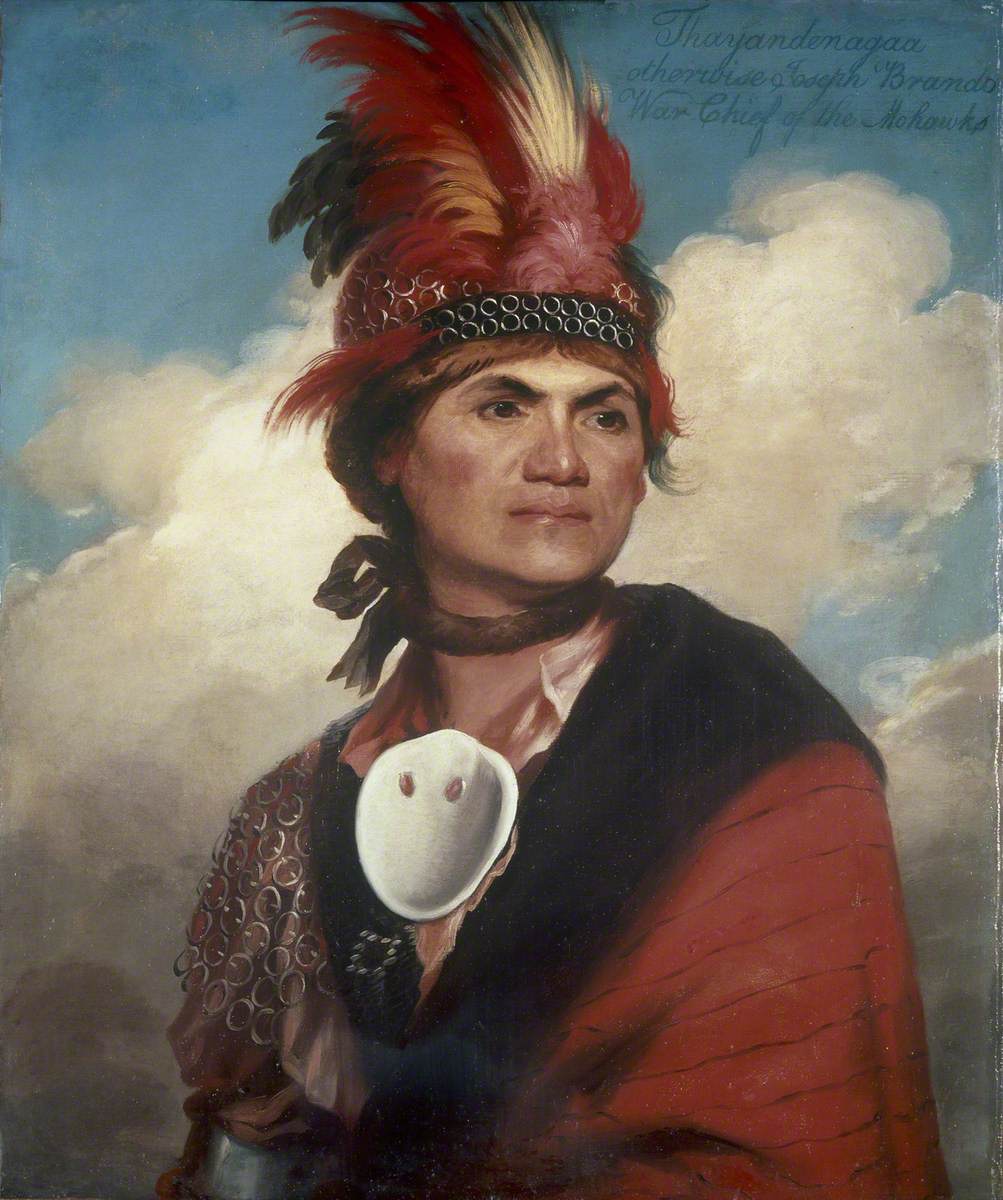
Gilbert Stuart, 1785. Wikimedia Commons. Public domain.
1743–1807
Joseph Brant (Thayendanegea)
0
recorded events
Connected towns:
Albany, NYBiography
Joseph Brant (Thayendanegea)
Mohawk War Chief, British Ally, and Diplomat (c. 1743–1807)
Born around 1743 into the Wolf Clan of the Mohawk nation, the easternmost and most diplomatically influential member of the Haudenosaunee (Iroquois) Confederacy, Thayendanegea — known to the English as Joseph Brant — was shaped from childhood by the collision of Indigenous and colonial worlds. He received a Western education at Eleazar Wheelock's school in Connecticut, where he became fluent in English and converted to Anglicanism, skills that made him an invaluable interpreter and cultural intermediary between the Mohawk people and British colonial authorities. His sister Molly Brant's long-term partnership with Sir William Johnson, the powerful British superintendent of Indian affairs, placed Thayendanegea at the very center of frontier diplomacy. Through Johnson's household and the networks of influence radiating outward from the Mohawk Valley, he came to understand colonial power from the inside. This proximity convinced him early on that the Mohawk nation's survival — its lands, its autonomy, its place within the shifting constellation of empires — depended on maintaining a strong alliance with the British Crown. When revolution fractured that colonial order, Thayendanegea was already positioned as the leader most prepared to act on that conviction.
When the Revolutionary crisis erupted, Thayendanegea moved swiftly to secure the alliance he believed essential to his people's survival. In 1775, he traveled to London itself, meeting with British officials and King George III's ministers to reaffirm Mohawk loyalty and extract promises of mutual support. Upon his return to North America, he became one of the most effective military commanders operating on the British side of the war. Leading combined forces of Mohawk warriors and Loyalist rangers, he launched devastating raids across the New York and Pennsylvania frontier that destroyed settlements, disrupted food production, and killed hundreds of colonists. The Wyoming Valley massacre of July 1778 in Pennsylvania and the Cherry Valley raid of November 1778 in New York were among the most destructive operations of the frontier war, and though Thayendanegea's precise role at Wyoming remains debated by historians, his name became inextricable from both events. These campaigns were not random acts of violence — they were strategically calculated operations that forced the Continental Army to divert thousands of soldiers away from the main theaters of war, culminating in the Sullivan-Clinton campaign of 1779, a massive American retaliatory expedition that devastated Haudenosaunee homelands.
The stakes Thayendanegea faced were nothing less than existential. He understood, with a clarity that many of his contemporaries shared, that American independence and westward expansion threatened the complete dispossession of Haudenosaunee lands. His alliance with Britain was not born of blind loyalty but of cold strategic calculation — the Crown, for all its failures, had at least attempted to regulate colonial encroachment through instruments like the Proclamation of 1763. Yet the cost of his choice was staggering. The Revolution shattered the ancient Haudenosaunee Confederacy itself, splitting it along lines that had never before divided its member nations. The Oneida and Tuscarora sided with the Americans; the Mohawk, Seneca, Cayuga, and Onondaga largely followed Thayendanegea and the British. For the first time, the Great Law of Peace that bound the Six Nations together could not hold. Haudenosaunee fought Haudenosaunee. Villages burned. The Sullivan-Clinton campaign of 1779 destroyed over forty Haudenosaunee towns. Thayendanegea was fighting not only for Mohawk lands but for the survival of a political and cultural order that had endured for centuries — and he was watching it come apart in real time.
The legacy of Thayendanegea resists simple categories. After the American victory, Britain's treaty promises proved hollow — the 1783 Treaty of Paris ceded Haudenosaunee territory to the United States without consultation. Thayendanegea led his people to a British land grant along the Grand River in Ontario, where he spent his remaining years working to secure compensation for Mohawk losses, mediating between Indigenous nations and British authorities, and translating the New Testament and the Anglican Book of Common Prayer into the Mohawk language. He died in 1807 at Burlington, Ontario. To American frontier settlers, he was a figure of terror; to the Mohawk and many Haudenosaunee people, he was a leader who navigated impossible choices with extraordinary intelligence and conviction. His story demands that we reckon with the Revolution's deepest contradiction: the movement that proclaimed liberty and self-determination simultaneously destroyed the liberty and self-determination of the Indigenous nations whose lands it claimed. Thayendanegea saw that contradiction more clearly than most, and he staked everything on resisting it.
WHY JOSEPH BRANT (THAYENDANEGEA) MATTERS TO ALBANY
Albany sat at the crossroads of the world Thayendanegea fought to preserve. For generations, the city had served as a critical meeting ground between Haudenosaunee nations and European colonial powers, the place where treaties were negotiated, alliances forged, and trade conducted. The Mohawk Valley stretching westward from Albany was the heartland of the conflict Thayendanegea waged — the frontier settlements his forces raided, the homelands the Sullivan-Clinton campaign destroyed, and the diplomatic networks that collapsed during the Revolution all radiated from this region. To study the Revolution from Albany is to stand at the exact point where American independence and Indigenous dispossession became inseparable realities. Thayendanegea's story challenges visitors to understand that the Revolution was not one war but many, and that its consequences looked radically different depending on which side of the frontier you stood.
TIMELINE
- c. 1743: Born into the Wolf Clan of the Mohawk nation in the Ohio country or the Mohawk Valley
- c. 1761–1763: Attends Eleazar Wheelock's Moor's Charity School in Lebanon, Connecticut
- 1775: Travels to London to meet with British officials and reaffirm the Mohawk–Crown alliance
- 1777: Fights at the Battle of Oriskany in August, where Haudenosaunee warriors face Oneida allies of the Americans — the Confederacy fractures
- 1778: Leads or participates in raids on the Wyoming Valley, Pennsylvania (July) and Cherry Valley, New York (November)
- 1779: The Sullivan-Clinton campaign destroys over forty Haudenosaunee towns in retaliation for frontier raids
- 1783: Treaty of Paris cedes Haudenosaunee lands to the United States without Indigenous consultation
- 1784: Leads Mohawk loyalists to the Grand River land grant in Ontario, founding what becomes the Six Nations of the Grand River
- 1785–1807: Works as diplomat, translator, and advocate for Mohawk land claims and compensation in postwar Ontario
- 1807: Dies on November 24 at Burlington, Ontario
SOURCES
- Kelsay, Isabel Thompson. Joseph Brant, 1743–1807: Man of Two Worlds. Syracuse University Press, 1984.
- Taylor, Alan. The Divided Ground: Indians, Settlers, and the Northern Borderland of the American Revolution. Alfred A. Knopf, 2006.
- Graymont, Barbara. The Iroquois in the American Revolution. Syracuse University Press, 1972.
- Smithsonian National Museum of the American Indian. "Nation to Nation: Treaties Between the United States and American Indian Nations." https://americanindian.si.edu/nationtonation/