

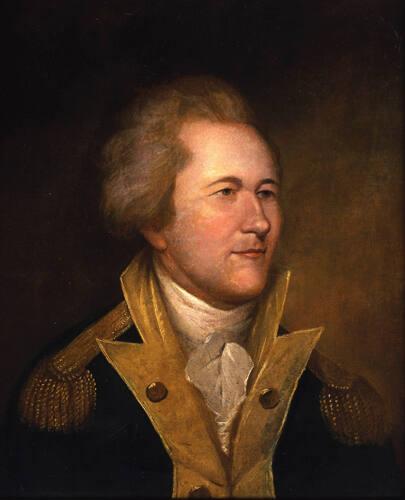
After Charles Willson Peale, 2023. Wikimedia Commons. Public domain.
1755–1804
Alexander Hamilton
7
recorded events
Connected towns:
Morristown, NJBiography
Alexander Hamilton: Washington's Indispensable Pen at Morristown
Born on the island of Nevis in the British West Indies around January 11, 1755, the boy who would become one of America's most consequential founders entered the world under circumstances that would have crushed a lesser spirit. His parents, Rachel Fawcett Lavien and James Hamilton, never married in the eyes of the law, a stigma that followed him throughout his life. His father abandoned the family when Alexander was young, and his mother died when he was approximately thirteen, leaving him an orphan in a Caribbean trading port. Yet the hardship forged an extraordinary resilience and ambition. Taken in by relatives and mentored by a local merchant, the young Hamilton devoured every book he could find, taught himself accounting, and demonstrated a facility with language that astonished adults around him. When he published a vivid letter describing a devastating hurricane that struck St. Croix in 1772, local benefactors recognized his brilliance and pooled funds to send him to the North American colonies for a formal education. He arrived in New York and enrolled at King's College — now Columbia University — carrying little more than his intellect, his pen, and a burning determination to rise above the circumstances of his birth into a life of consequence.
The young collegian's transformation into a revolutionary began almost immediately upon his arrival in New York. Hamilton plunged into the political debates swirling through the colonies in the early 1770s, publishing anonymous pamphlets defending the Continental Congress and challenging Loyalist arguments with a sophistication that led many readers to assume the author was a seasoned lawyer, not a teenager. When fighting erupted in 1775, Hamilton joined a New York militia company and began studying artillery tactics with characteristic intensity. By March 1776, he had been commissioned as captain of a New York provincial artillery company, and he drilled his men into one of the most disciplined units in the Continental forces. His battery performed with distinction during the desperate fighting around New York City in the summer and fall of 1776, holding positions under fire during the retreat across New Jersey. At the battles of Trenton and Princeton in the winter of 1776–1777, Hamilton's artillery company fought with conspicuous valor, and the young captain came to the direct attention of General George Washington. The commander-in-chief, desperately in need of talented staff officers who could write clearly, think strategically, and manage the crushing volume of headquarters correspondence, saw in Hamilton exactly the man he required. The invitation to join Washington's military family would change both their lives.
Hamilton's most significant contribution during the war years was not a single battlefield charge but rather his sustained intellectual labor as Washington's chief aide-de-camp, a role he assumed in March 1777 and held for four grueling years. At Morristown during both the first encampment in early 1777 and the brutal second encampment of 1779–1780, Hamilton functioned as the nerve center of Washington's headquarters. He drafted the commander's most important letters — anguished appeals to Congress for supplies, carefully calibrated orders maintaining discipline among starving troops, and sophisticated diplomatic communications with French allies whose support was critical to the cause. He processed intelligence reports flowing in from spy networks operating across New Jersey, distilling raw information into actionable analysis. He translated correspondence from French officers, negotiated with state officials, and managed the flow of paperwork that kept a disintegrating army nominally functional. This was not glamorous work, but it was indispensable. Without Hamilton's pen, Washington's strategic vision would have remained trapped inside a single man's mind, unable to reach the dozens of correspondents whose cooperation was required to keep the Revolution alive through its darkest seasons.
The key moments that Hamilton shaped at Morristown reveal a mind operating on multiple levels simultaneously. During the first winter encampment of 1777, he helped Washington organize the army's intelligence network operations, processing reports from agents monitoring British movements in and around New York City and ensuring that critical information reached the right commanders at the right time. When the army returned to Morristown for the catastrophic winter of 1779–1780 — the so-called Hard Winter, when temperatures plunged to historic lows and snowdrifts buried the camp — Hamilton drafted Washington's increasingly desperate correspondence warning Congress that the army was on the verge of dissolution. When Benedict Arnold's treason was discovered in September 1780, Hamilton was among the aides who helped manage the frantic crisis at headquarters, coordinating the immediate military response and ensuring that the conspiracy had not spread further. He also produced a penetrating analysis of the Continental currency collapse of 1780, a document that revealed his already formidable grasp of fiscal policy and foreshadowed his later career as the architect of American financial systems.
The relationships Hamilton formed during the Morristown years defined both his wartime service and his postwar trajectory. His bond with Washington was the most consequential — a complex, almost filial relationship between an older commander who needed brilliance and a younger officer who craved a father figure, though neither man would have described it in such sentimental terms. Among his fellow aides-de-camp, including John Laurens and the Marquis de Lafayette, Hamilton forged intense friendships rooted in shared idealism and shared suffering. Laurens, the passionate South Carolinian, became perhaps the closest friend of Hamilton's life, and their correspondence reveals a depth of emotional intimacy remarkable for the era. But the most personally transformative relationship of the Morristown period began in the winter of 1780, when Hamilton met Elizabeth Schuyler, the daughter of Major General Philip Schuyler, one of New York's most powerful men. Elizabeth — known as Eliza — had come to Morristown to visit relatives, and the courtship that followed was swift and ardent. Their marriage in December 1780 gave Hamilton not only a devoted life partner but also entry into one of the most influential families in New York, an alliance that would prove essential to his political ambitions.
Yet the Morristown years also exposed the tensions, frustrations, and moral complexities that shadowed Hamilton throughout his career. Despite his extraordinary responsibilities, he held only the rank of lieutenant colonel, and he chafed bitterly at what he perceived as a subordinate role unworthy of his abilities. He longed for a field command, for the chance to earn military glory on the battlefield rather than behind a desk. His relationship with Washington, though deeply productive, was not without friction; Hamilton could be arrogant, impatient, and dismissive of the political constraints under which the commander operated. The young aide also carried the permanent wound of his illegitimate birth, a vulnerability that made him hypersensitive to slights and ferociously protective of his personal honor — a trait that would ultimately contribute to his death. His analysis of the Continental currency crisis, while intellectually brilliant, also revealed an elitism that troubled some contemporaries: Hamilton trusted centralized expertise over democratic deliberation, a philosophical orientation that would later put him at odds with Jeffersonian republicans who feared concentrated power as much as they feared governmental weakness.
The war changed Alexander Hamilton in ways both visible and profound. The young man who had arrived in Morristown in 1777 as a talented but relatively untested artillery officer departed the experience as a seasoned political thinker with a comprehensive diagnosis of what ailed the American experiment. Watching soldiers starve because Congress could not compel states to contribute supplies radicalized him against the decentralized government structure of the Articles of Confederation. Drafting hundreds of letters begging for resources that never arrived taught him that voluntarism and goodwill were insufficient foundations for a nation. Processing intelligence reports showed him how information flowed — and failed to flow — through bureaucratic systems, lessons he would later apply to building federal institutions. The Morristown winters also hardened him emotionally. He learned to function under extreme pressure, to suppress personal frustration in service of larger objectives, and to channel his anger into analytical writing rather than impulsive action. The marriage to Eliza Schuyler grounded him, giving him a personal stability he had never known, but the war's deprivations also instilled a permanent anxiety about security — financial, political, and national — that drove his relentless ambition for the rest of his life.
Hamilton's role in the war's resolution and aftermath was as consequential as his service during the conflict itself. He finally received the field command he craved at the Battle of Yorktown in October 1781, leading a daring nighttime assault on British Redoubt Number Ten that helped seal the American victory. But his greater contributions came after the guns fell silent. Drawing directly on the lessons of Morristown — the paralysis of weak government, the catastrophe of worthless currency, the danger of an army unsupported by effective institutions — Hamilton became the foremost advocate for replacing the Articles of Confederation with a stronger framework. He was instrumental in calling the Constitutional Convention of 1787, where he argued passionately for a vigorous national government. He then co-authored the Federalist Papers with James Madison and John Jay, producing some of the most brilliant political philosophy in the English language. As the nation's first Secretary of the Treasury under President Washington, he designed the financial architecture of the new republic — the national bank, the assumption of state debts, the customs service — systems built to prevent the fiscal catastrophes he had witnessed firsthand at Morristown.
Contemporaries saw Hamilton with a mix of admiration and unease. His intellectual brilliance was universally acknowledged; even his political enemies conceded that his mind worked at a level few could match. Washington trusted him more deeply than almost any other subordinate, repeatedly turning to him in moments of crisis both during and after the war. Fellow officers who served alongside him at Morristown remembered his tireless energy, his ability to draft a complex letter in minutes that would have taken others hours, and his occasionally insufferable confidence in his own judgment. But Hamilton also provoked intense opposition. Thomas Jefferson and his allies viewed Hamilton's vision of centralized financial power as a betrayal of the Revolution's democratic promise, and the political battles between Hamiltonians and Jeffersonians defined the first decade of the new republic. His personal life generated scandal — most notably his public confession of an extramarital affair in 1797 — and his combative temperament created enemies at every stage of his career. He died on July 12, 1804, mortally wounded in a duel with Vice President Aaron Burr, a shocking end that contemporaries mourned as both a personal tragedy and a cautionary tale about the culture of honor that pervaded the founding generation.
Students and visitors today should know Alexander Hamilton because his story illuminates the uncomfortable truth that revolutions are sustained not only by courage on the battlefield but by the grinding, unglamorous work of administration, logistics, and political persuasion. At Morristown, Hamilton did not fire a single cannon — he wrote letters, processed intelligence, analyzed currency crises, and pleaded with indifferent politicians for bread and blankets. That work was as essential to American independence as any bayonet charge. His life also demonstrates how personal experience shapes political philosophy: the young man who watched an army starve because government was too weak to feed it became the architect of a federal system designed to ensure that such failures could never recur. Hamilton's journey from Caribbean orphan to founding father remains one of the most extraordinary stories of social mobility in American history, a testament to the power of intellect, ambition, and sheer force of will. His flaws — his arrogance, his elitism, his fatal attachment to personal honor — are as instructive as his achievements, reminding us that the people who built the nation were brilliant, complicated, and deeply human.
WHY ALEXANDER HAMILTON MATTERS TO MORRISTOWN
Alexander Hamilton's story is inseparable from Morristown. It was at the Ford Mansion and in the surrounding encampments that the young aide-de-camp witnessed the near-collapse of the American cause — not from British military might, but from the failure of the Continental Congress to sustain its own army. The desperate letters he drafted at Washington's headquarters, the intelligence reports he processed from New Jersey spy networks, and the fiscal analysis he produced during the currency crisis of 1780 all grew from the Morristown experience. Visitors who walk through the Ford Mansion today are standing in the rooms where Hamilton's political philosophy was forged. His courtship of Elizabeth Schuyler adds a deeply personal dimension to the site. Morristown made Hamilton the thinker who would later reshape American government, and his presence there reminds us that the Revolution's most consequential battles were sometimes fought with pen and paper.
TIMELINE
- 1755: Born on the island of Nevis in the British West Indies (exact date debated; traditionally January 11)
- 1772: Publishes a letter describing a hurricane on St. Croix; benefactors fund his passage to New York for education
- 1776: Commissioned as captain of a New York artillery company; fights at Trenton and Princeton
- 1777: Appointed aide-de-camp to General Washington; serves during the first Morristown encampment and intelligence network operations
- 1779–1780: Endures the Hard Winter during the second Morristown encampment; drafts analysis of the Continental currency collapse
- 1780: Courts and becomes engaged to Elizabeth Schuyler at Morristown; helps manage the crisis following Benedict Arnold's treason
- 1780: Marries Elizabeth Schuyler in Albany, New York, in December
- 1781: Leads the assault on Redoubt Number Ten at the Battle of Yorktown
- 1787–1788: Co-authors the Federalist Papers; serves as delegate to the Constitutional Convention
- 1789–1795: Serves as the first Secretary of the Treasury of the United States
- 1804: Mortally wounded in a duel with Vice President Aaron Burr on July 11; dies July 12 in New York
SOURCES
- Chernow, Ron. Alexander Hamilton. Penguin Press, 2004.
- Founders Online, National Archives. The Papers of Alexander Hamilton. https://founders.archives.gov/about/Hamilton
- Fleming, Thomas. The Forgotten Victory: The Battle for New Jersey, 1780. Reader's Digest Press, 1973.
- Morristown National Historical Park, National Park Service. Ford Mansion and Museum Exhibits. https://www.nps.gov/morr/
- Syrett, Harold C., and Jacob E. Cooke, eds. The Papers of Alexander Hamilton, 27 vols. Columbia University Press, 1961–1987.
Events
Jan
1777
First Winter Encampment at MorristownMorristownAide-de-Camp# The First Winter Encampment at Morristown, 1777 In the closing days of 1776, the American cause had seemed all but lost. The Continental Army had suffered a devastating string of defeats in New York, losing Long Island, Manhattan, and Fort Washington in rapid succession before retreating across New Jersey with a dwindling force that barely resembled an army at all. Yet in a stunning reversal, General George Washington led his troops across the ice-choked Delaware River on Christmas night and struck the Hessian garrison at Trenton, following that triumph days later with a bold victory at Princeton. These engagements electrified a weary nation and breathed life back into the revolutionary movement, but they did not change the fundamental reality confronting Washington: his army was exhausted, undersupplied, and shrinking by the day. He needed a place to rest, rebuild, and prepare for the campaigns ahead. In early January 1777, he marched the Continental Army to Morristown, New Jersey, and established winter quarters there — a decision that would prove as consequential as any battlefield maneuver of the war. The choice of Morristown was deliberate and strategically shrewd. The town sat nestled behind the Watchung Mountains, a rugged ridgeline that formed a natural defensive barrier against any British advance westward from their stronghold in New York City. The surrounding countryside was home to a thriving iron industry capable of producing weapons, tools, and other materiel the army desperately needed. Local sympathies ran largely toward the patriot cause, meaning Washington could expect cooperation rather than hostility from the civilian population. Upon arrival, Washington initially established his headquarters at Jacob Arnold's Tavern on the town green, positioning himself at the center of the small community. Colonel Jacob Ford Jr., a prominent local militia officer, had offered his family's handsome mansion as a resource for the army, but Ford died of illness on January 11, 1777, shortly after the encampment began. His widow, Theodosia Ford, graciously shared the Ford Mansion with Washington's military household during portions of the encampment, a sacrifice of privacy and comfort that typified the burdens the war placed on ordinary civilians. The army that straggled into Morristown was in wretched condition. Many soldiers had marched through snow and ice without shoes, leaving bloody footprints on frozen roads. Clothing was threadbare, rations were scarce, and morale — despite the recent victories — was fragile. Compounding these miseries, enlistment terms were expiring for large numbers of troops, threatening to dissolve the army entirely. Perhaps most alarming of all, smallpox was tearing through the ranks with terrifying speed, incapacitating soldiers more efficiently than British muskets ever had. Washington recognized that disease posed an existential threat to his force and made the bold and controversial decision to inoculate the entire army against smallpox through variolation, a procedure that involved deliberately introducing a mild form of the virus to build immunity. The practice was medically risky — some soldiers would sicken and a few would die from the inoculation itself — and it temporarily weakened the army at a moment when it could scarcely afford further losses. Yet Washington understood that the alternative, allowing the disease to rage unchecked, was far worse. The mass inoculation campaign was carried out with as much secrecy as possible to prevent the British from learning how vulnerable the army was during the process. Throughout the winter and into the spring, Washington and his senior officers worked tirelessly to reorganize and rebuild. Nathanael Greene, one of Washington's most trusted generals, oversaw critical logistics and camp organization, ensuring that supplies flowed and order was maintained among troops scattered across local homes and farms. Alexander Hamilton, the brilliant young officer who had distinguished himself at Trenton and Princeton, served as one of Washington's aides-de-camp during this period, helping manage the enormous volume of correspondence and administrative work required to hold the army together. By the time the Continental Army broke camp in May 1777 and marched toward the campaigning season ahead, it was a fundamentally different force than the one that had limped into Morristown four months earlier. The inoculation program had produced a healthier army largely immune to the scourge that had decimated its ranks. New recruits had been enlisted, units reorganized, and supply lines strengthened. The first winter encampment at Morristown is often overshadowed in popular memory by the later, more famous suffering at Valley Forge, but its importance to the survival of the Revolution can hardly be overstated. It was here that Washington demonstrated the organizational leadership and willingness to make difficult decisions that would define his command throughout the war, transforming a battered collection of survivors into an army capable of continuing the fight for American independence.
Jan
1777
Washington Establishes Headquarters at Ford MansionMorristownAide-de-camp stationed at headquarters# Washington Establishes Headquarters at Ford Mansion By the winter of 1777, the American Revolution had entered a grueling phase that tested the resolve of every patriot who believed in the cause of independence. The Continental Army, though buoyed by surprising victories at Trenton and Princeton earlier that year, remained an exhausted, undersupplied force struggling to hold together against the most powerful military in the world. General George Washington, the Commander-in-chief of the Continental forces, faced the monumental challenge of keeping his army intact through the brutal winter months while simultaneously planning the strategic moves that would sustain the war effort into the following year. It was under these pressing circumstances that Washington chose Morristown, New Jersey, as the site for his first winter encampment and requisitioned the stately home of the recently deceased Colonel Jacob Ford Jr. as his military headquarters. The Ford Mansion was one of the finest homes in Morristown, a Georgian-style residence that reflected the prominence of the Ford family in the community. Colonel Jacob Ford Jr. had been a committed patriot who served the Revolutionary cause with distinction, but he had died of pneumonia earlier in 1777, leaving behind his widow, Theodosia Ford, and their children. When Washington arrived and requisitioned the home for military use, Theodosia found herself confined to just two rooms of her own residence while the commanding general and his extensive military staff occupied the remainder of the house. Her sacrifice, though rarely celebrated in the grand narratives of the Revolution, was emblematic of the countless personal costs borne by civilians whose lives were upended by the demands of war. Theodosia endured the loss of her privacy and domestic autonomy without formal compensation, a quiet testament to the burdens that fell disproportionately on women and families during the conflict. Inside the Ford Mansion, Washington transformed a family home into a nerve center of military operations. From its rooms, he directed intelligence-gathering efforts, coordinated correspondence with the Continental Congress, and began laying the groundwork for the spring campaign that would carry the war forward. The headquarters buzzed with the activity of aides, officers, and couriers. Among those stationed at the mansion was Alexander Hamilton, who served as one of Washington's most trusted aides-de-camp. Hamilton, still in his early twenties, had already distinguished himself through his sharp intellect and tireless work ethic, and his time at the Ford Mansion deepened the professional relationship with Washington that would shape both of their legacies. Hamilton drafted letters, managed communications, and helped translate Washington's strategic vision into actionable orders, honing the administrative and political skills that would later make him one of the young nation's most influential founders. Martha Washington also played a vital role at the headquarters, as she did during several winter encampments throughout the war. Far from serving merely as a domestic companion, Martha functioned as a headquarters manager, overseeing the daily operations of the household, managing supplies, and helping to maintain the morale of both the staff and the soldiers who visited. Her presence lent a sense of stability and normalcy to what was otherwise a tense and uncertain environment, and her tireless efforts behind the scenes contributed meaningfully to the functioning of Washington's command. The choice of Morristown itself was strategic. Nestled among the Watchung Mountains, the town offered natural defensive advantages that made it difficult for the British to launch a surprise attack. Its location also allowed Washington to monitor British movements in and around New York City while maintaining lines of communication with Congress and other Continental forces. The winter encampment at Morristown gave the army a critical period of rest and reorganization, even as soldiers continued to suffer from shortages of food, clothing, and essential supplies. The establishment of Washington's headquarters at the Ford Mansion matters in the broader story of the Revolution because it illustrates how the war was sustained not only on battlefields but also in the administrative and strategic work conducted during the difficult months between campaigns. It reveals the human dimensions of the conflict, from the personal sacrifices of a widow like Theodosia Ford to the tireless labors of young officers like Hamilton. Morristown became a proving ground for leadership, endurance, and the unglamorous but essential work of holding a revolution together when its survival was far from certain.
Jan
1777
Morristown Intelligence Network OperationsMorristownAide-de-camp involved in processing intelligence reports# Morristown Intelligence Network Operations In the winter of 1777, the American Revolution hung in a precarious balance. George Washington's Continental Army, buoyed by its stunning surprise victories at Trenton and Princeton in the closing days of 1776, had proven that it could strike decisively against professional British and Hessian forces. Yet those triumphs, while invaluable to American morale, did not change the fundamental reality that the British still controlled New York City and much of New Jersey, possessed a far superior navy, and commanded troops whose training and equipment outstripped anything the Continental Army could yet muster. Washington understood that the survival of the patriot cause depended not only on the strength of arms but on the strength of information. When he chose Morristown, New Jersey, as the site of his first major winter encampment, he was making a decision that was as much about intelligence as it was about rest and resupply. Morristown offered a combination of geographic advantages that made it an ideal base for espionage operations. The town sat behind the natural defensive barrier of the Watchung Mountains, a chain of ridgelines that shielded the Continental Army from sudden British assault while also providing elevated observation points from which American scouts could monitor enemy movements across the plains below. The roads leading into and out of Morristown connected to a web of smaller routes through the New Jersey countryside, allowing agents and messengers to travel discreetly between patriot headquarters and the British-held territories around New York and along the Jersey coast. Washington, who had long recognized the critical importance of timely and accurate intelligence, seized upon these advantages to establish and expand a network of spies, scouts, and informants whose work would profoundly shape the course of the war. From his headquarters in Morristown, Washington personally directed much of this intelligence activity, demonstrating a hands-on approach to espionage that distinguished him from many commanders of his era. He recruited agents, devised cover stories, evaluated the reliability of reports, and issued detailed instructions about what kinds of information he most urgently needed — troop strengths, supply shipments, fortification construction, and any signs of impending British offensives. Working closely alongside him was Alexander Hamilton, the young and brilliant aide-de-camp whose role extended well beyond clerical duties. Hamilton helped process and analyze the intelligence reports that flowed into headquarters, distilling raw information into actionable assessments that informed Washington's strategic planning. Meanwhile, Martha Washington, who joined her husband at Morristown during the encampment, played an important role as headquarters manager, helping to maintain the social and organizational fabric of the command post from which these sensitive operations were coordinated. Her presence also helped project an image of stability and normalcy that belied the covert activities unfolding behind closed doors. The intelligence gathered through the Morristown networks provided Washington with a clearer picture of British intentions and capabilities than his adversaries likely suspected. Spies moved between American and British lines at considerable personal risk, gathering details about enemy troop movements and defensive preparations that allowed Washington to make informed decisions about when to engage and when to avoid confrontation. This flow of information shaped the Continental Army's strategic choices throughout 1777, a year that would see both devastating setbacks, including the loss of Philadelphia, and the momentous American victory at Saratoga — a triumph that ultimately brought France into the war as an ally. The Morristown intelligence operations matter in the broader story of the Revolution because they reveal a dimension of Washington's leadership that is often overshadowed by battlefield narratives. Washington was not merely a general who commanded troops in the field; he was a sophisticated spymaster who understood that wars are won as much through knowledge as through firepower. The networks he built and refined during the winter of 1777 laid the groundwork for even more elaborate espionage efforts later in the war, including the famous Culper Ring that would operate out of New York. In this sense, Morristown was not just a place where a weary army rested — it was the birthplace of American military intelligence, a tradition whose origins in that small New Jersey town continue to resonate through the centuries.
Dec
1779
The Hard Winter: Second Encampment at MorristownMorristownAide-de-Camp# The Hard Winter: Second Encampment at Morristown By the winter of 1779, the American Revolution had entered a grueling phase of attrition. The initial fervor of independence had cooled, and the Continental Army found itself locked in a war that seemed to have no clear end. The British occupied New York City, the Continental Congress struggled to fund the war effort, and the French alliance forged in 1778 had yet to deliver decisive results on the battlefield. It was in this climate of exhaustion and uncertainty that General George Washington made the decision to encamp his army at Morristown, New Jersey, for the second time. He had wintered there in early 1777 and knew the location's strategic advantages — its proximity to the British in New York, the natural protection offered by the Watchung Mountains, and the network of roads that allowed for communication and movement. What Washington could not have anticipated was that the winter of 1779–80 would become the most punishing ordeal his army had ever faced, surpassing even the legendary suffering at Valley Forge. Washington established his headquarters at the Ford Mansion, the home of the widow Theodosia Ford, while approximately 10,000 soldiers set about constructing a vast encampment of over 1,000 log huts at Jockey Hollow, a few miles to the southwest. The encampment sprawled across farmland and forest, including property belonging to local families such as that of Temperance "Tempe" Wick, a young civilian woman whose family farm was directly affected by the military presence. The army's arrival transformed the rural landscape into a military city, straining relationships with the local population while also making the community an unwitting participant in the Revolution's survival. The weather that winter was unprecedented in its severity. Between November and April, twenty-eight blizzards lashed the region, burying the encampment under snowdrifts that reached six feet in places. New York Harbor froze solid, an event so rare that no one alive could recall it ever happening before. The extreme cold compounded an already dire supply crisis. Nathanael Greene, serving as Quartermaster General, bore the enormous responsibility of keeping the army fed, clothed, and equipped, but the supply system — undermined by inflation, congressional dysfunction, and logistical breakdown — collapsed entirely. Soldiers subsisted on half-rations, then quarter-rations, and then nothing at all. Private Joseph Plumb Martin, one of the war's most vivid chroniclers, later recorded eating birch bark and roasted shoe leather simply to survive. The physical suffering was matched by a crisis of morale. Soldiers had not been paid in months, and many were dressed in little more than rags. Discipline frayed as desperation set in. Baron Friedrich Wilhelm von Steuben, the Prussian-born Inspector General who had reshaped the army's training at Valley Forge, worked relentlessly to maintain order and military discipline within the camp, but even his efforts could not prevent the unrest from boiling over. On May 25, 1780, two Connecticut regiments paraded under arms and refused to obey orders, demanding food and back pay. Officers managed to suppress the mutiny before it spread, but the incident sent shockwaves through the army's leadership, including Washington's trusted aide-de-camp, Alexander Hamilton, who witnessed firsthand how close the army stood to complete dissolution. Despite everything, the vast majority of soldiers stayed. They endured the cold, the hunger, and the silence from a government that seemed to have forgotten them. They stayed without pay, without adequate clothing, and without any guarantee that the Revolution would succeed. This collective act of endurance is one of the most extraordinary and underappreciated episodes in American military history. While Valley Forge has claimed the greater share of public memory, Morristown was objectively worse — colder, longer, and more deprived. The encampment at Morristown also had lasting consequences for the war. The near-mutiny forced Congress and state governments to confront the army's desperate condition, prompting renewed, if still insufficient, efforts to reform supply and finance. The survival of the Continental Army through this winter preserved the Revolution at a moment when it could easily have collapsed from within. When the soldiers finally broke camp in the spring of 1780, they carried with them not only the scars of a brutal season but also a hardened resolve that would sustain the fight through its remaining years, all the way to the decisive victory at Yorktown in 1781. Morristown was not a battle, but it was a test of endurance that proved as consequential as any clash of arms in the struggle for American independence.
Feb
1780
Alexander Hamilton Courts Elizabeth SchuylerMorristownSuitor who courted Elizabeth Schuyler# Alexander Hamilton Courts Elizabeth Schuyler at Morristown The winter of 1779–1780 was one of the most brutal the Continental Army ever endured, and yet it was against this backdrop of extraordinary suffering that one of the most consequential romances in American history unfolded. Alexander Hamilton, the brilliant and ambitious young aide-de-camp to General George Washington, met and courted Elizabeth Schuyler during the army's second winter encampment at Morristown, New Jersey. Their courtship, which blossomed amid dances, social gatherings, and the grinding misery of a starving army, would bind Hamilton to one of the most powerful families in New York and help shape the political trajectory of the young republic. By the time the Continental Army settled into its winter quarters at Morristown in December 1779, Hamilton had already distinguished himself as one of Washington's most trusted and capable staff officers. Still in his early twenties, the West Indian-born Hamilton had served at Washington's side for nearly three years, drafting correspondence, managing logistics, and acting as an essential liaison between the Commander-in-Chief and Congress. He was restless, intellectually voracious, and keenly aware that his lack of family wealth and social standing in America placed him at a disadvantage. A strategic marriage could change that, and Hamilton made no secret in letters to friends that he was looking for a wife who combined beauty, sense, and good family connections. Elizabeth Schuyler — called Eliza or Betsey by those close to her — arrived in Morristown as part of the social circle that gathered around the army's winter headquarters. She and her sisters had traveled from Albany, New York, drawn by the lively society that formed each winter when officers, their wives, and prominent civilians congregated near the encampment. Eliza was the daughter of Major General Philip Schuyler, one of the wealthiest and most influential men in New York, and her presence in Morristown immediately placed her at the center of the small but vibrant social world that revolved around Washington's headquarters. Martha Washington, who had joined her husband for the winter as she customarily did, hosted gatherings and informal entertainments that brought officers and young women of good families together. It was in this environment — at the home of Dr. Jabez Campfield, where Eliza was lodging, and at the various dances and dinners that punctuated the long winter months — that Hamilton pressed his suit. The contrast between the elegance of these social occasions and the desperate conditions endured by the rank and file could hardly have been starker. The winter of 1779–1780 proved even more severe than the legendary winter at Valley Forge two years earlier. Record snowfall buried the crude log huts at Jockey Hollow, where thousands of enlisted soldiers huddled with inadequate clothing, dwindling food supplies, and little firewood. Men starved, deserted, and in some cases mutinied. Officers, meanwhile, attended balls and evening gatherings just miles away, a disparity that underscored the rigid class divisions within the Continental Army and the broader society it fought to create. Despite the hardship surrounding them, Hamilton's courtship of Eliza moved swiftly. His letters from this period reveal a man deeply smitten, blending romantic ardor with his characteristic wit and intellectual energy. Eliza, for her part, was drawn to Hamilton's charm, intelligence, and evident ambition. By the spring of 1780, the couple was engaged, and they married on December 14, 1780, at the Schuyler family estate in Albany. The marriage mattered far beyond the personal happiness of the two individuals. By joining the Schuyler family, Hamilton gained access to a network of political influence, wealth, and social respectability that would prove indispensable in the years ahead. Philip Schuyler became a powerful ally, and the Schuyler connections helped Hamilton build the political base from which he would later serve as the nation's first Secretary of the Treasury and architect of its financial system. Eliza herself would become a fierce protector of Hamilton's legacy, spending the fifty years she survived him preserving his papers and championing his contributions to the founding of the United States. What began as a wartime romance in a freezing New Jersey encampment ultimately helped shape the political and financial foundations of the new nation.
Mar
1780
Continental Currency CollapseMorristownAide-de-camp who drafted analysis of the fiscal crisis**The Continental Currency Collapse at Morristown, 1780** The winter encampment at Morristown, New Jersey, in early 1780 is often overshadowed in popular memory by the more famous suffering at Valley Forge two years earlier, yet in many ways the crisis that gripped the Continental Army at Morristown was more dangerous and more revealing of the structural weaknesses that threatened the American cause. At the heart of that crisis was the catastrophic depreciation of Continental currency, the paper money that Congress had been printing since 1775 to finance the war. By the opening months of 1780, it took roughly forty dollars in Continental paper to purchase what a single dollar in hard coin could buy — and by the close of that year, the ratio would plunge to a staggering one hundred to one. The phrase "not worth a Continental" became a bitter joke among soldiers and civilians alike, and it captured a truth that endangered the entire Revolution. The roots of the collapse stretched back to the earliest days of the war. When the Continental Congress declared independence, it possessed no power to levy taxes on the states, and so it resorted to the printing press. Between 1775 and 1779, Congress authorized more than two hundred million dollars in paper currency, flooding the economy with money that was backed by little more than the promise of future redemption. At first the notes circulated with reasonable confidence, but as the war dragged on, as military setbacks shook public faith, and as British counterfeiting operations pumped additional fake bills into circulation, trust in the currency eroded steadily. Inflation accelerated, and by 1779 the spiral had become uncontrollable. Nowhere was the human cost of this fiscal disaster more acutely felt than at Morristown during the brutal winter of 1779–1780. Nathanael Greene, serving as Quartermaster General, bore the impossible responsibility of feeding, clothing, and equipping an army of roughly ten thousand men. Greene found that local farmers and merchants in New Jersey simply refused to accept Continental paper in exchange for grain, meat, or forage. They had learned through painful experience that bills accepted one week might lose half their value the next. Greene's supply wagons returned empty, and soldiers went days without adequate food, huddling in makeshift huts through what was recorded as one of the coldest winters of the eighteenth century. Commander-in-Chief George Washington, headquartered at the Ford Mansion in Morristown, watched the crisis with growing alarm. Martha Washington, who had joined her husband at the winter encampment as she did during several winters of the war, helped manage the household operations at headquarters and witnessed firsthand the desperation that pervaded the camp. Washington wrote urgent letters to Congress and to state governors, warning that the army was on the verge of dissolution — not from enemy action, but from neglect and insolvency. When voluntary commerce failed entirely, Washington was forced to resort to a measure he despised: the compulsory requisitioning of supplies from the surrounding countryside, issuing certificates of future payment to farmers whose goods were effectively seized. It was a practice that strained the relationship between the army and the civilian population it claimed to protect. Meanwhile, Alexander Hamilton, serving as Washington's aide-de-camp, turned his formidable intellect toward diagnosing the crisis. Hamilton drafted detailed analyses of the fiscal collapse, arguing that the Continental government's inability to tax, borrow reliably, or maintain a sound currency represented a fatal flaw in the existing political structure. His writings during this period planted the intellectual seeds for ideas he would champion for the rest of his career — a national bank, federal taxation, and a consolidated fiscal system — concepts that would eventually find expression in the Constitution of 1787 and in Hamilton's later tenure as the first Secretary of the Treasury. The currency collapse of 1780 matters because it revealed that winning battles was not enough to win a war. Without a functioning economy and a credible government capable of financing its obligations, the Revolution could starve in the field. The crisis ultimately prompted Congress to begin reforming its financial practices, appointing Robert Morris as Superintendent of Finance in 1781 and seeking critical foreign loans from France and the Netherlands. In this sense, the suffering at Morristown was not merely a footnote to military history; it was a turning point in American political thought, demonstrating the necessity of a stronger central government and a sound fiscal foundation — lessons that would shape the nation long after the last shots of the Revolution had been fired.
Sep
1780
Benedict Arnold's Treason DiscoveredMorristownAide-de-camp who helped manage the crisis at headquarters# Benedict Arnold's Treason Discovered By the autumn of 1780, the American Revolution had entered one of its darkest chapters, and the Continental Army knew darkness intimately. The soldiers encamped at Morristown, New Jersey, had barely survived what history would remember as the Hard Winter — a season of brutal cold, starvation, inadequate shelter, and dwindling supplies that tested the resolve of every man who shivered through it. Desertion had thinned the ranks. The Pennsylvania Line seethed with grievances over unpaid wages and broken enlistment promises. Morale was a fragile, threadbare thing. It was into this atmosphere of exhaustion and fragility that the most devastating betrayal of the entire Revolutionary War landed like a thunderclap. Benedict Arnold had once been among the most celebrated officers in the Continental Army. His extraordinary courage at the Battles of Saratoga in 1777, where his aggressive leadership on the field proved instrumental in securing the decisive American victory that brought France into the war as an ally, had made him a genuine hero of the Revolution. George Washington himself had championed Arnold repeatedly, defending him against political enemies in Congress and entrusting him with significant commands. Yet Arnold harbored deep resentments. He felt overlooked for promotion, believed Congress had failed to adequately recognize his sacrifices, and chafed under accusations of financial impropriety during his tenure as military governor of Philadelphia. These personal grievances, combined with mounting debts and the influence of his loyalist-sympathizing wife, Peggy Shippen Arnold, gradually corroded his allegiance to the American cause. By 1779, Arnold had secretly opened communications with the British through Major John André, the charming and capable head of British intelligence in New York. The negotiations escalated through coded letters and intermediaries until Arnold secured command of West Point, the strategically vital fortress perched above the Hudson River in New York. Control of the Hudson was essential to the American war effort — it connected New England to the rest of the states, and its loss could effectively sever the rebellion in two. Arnold offered to surrender West Point, along with its garrison, to the British in exchange for twenty thousand pounds and a commission as a British officer. The conspiracy unraveled in September 1780 through a combination of chance and vigilance. Major André, returning to British lines after a clandestine meeting with Arnold, was stopped near Tarrytown, New York, by American militiamen. Concealed in his stockings were documents in Arnold's handwriting detailing West Point's defenses, troop dispositions, and vulnerabilities. André was detained, and word of the capture traveled swiftly up the chain of command. When Arnold learned that André had been taken, he fled immediately, escaping down the Hudson River to the British warship HMS Vulture before he could be arrested. At the Ford Mansion in Morristown, which served as Continental Army headquarters, George Washington absorbed the news with visible anguish. Alexander Hamilton, serving as Washington's trusted aide-de-camp, helped manage the immediate crisis — dispatching urgent orders to secure West Point, coordinating communications, and working to assess the full scope of the conspiracy. Martha Washington, who had been managing the domestic operations of the headquarters and sustaining the social fabric that held the officer corps together through that punishing winter, witnessed firsthand the shock that rippled through the command. Washington reportedly said little at first, the weight of personal betrayal compounding the strategic emergency. Major André was tried by a military tribunal, convicted of espionage, and hanged on October 2, 1780, despite widespread sympathy for his bearing and dignity. Arnold, safely behind British lines, received his commission and his money, though neither the sum nor the respect he had imagined. He would lead British raids against American positions for the remainder of the war, despised by both sides — a traitor to one, never fully trusted by the other. The discovery of Arnold's treason cut deeper than any battlefield defeat could have. If a hero of Saratoga, a man Washington had personally elevated and defended, could sell the cause for British gold, then what held the Continental Army together at all? The question echoed through the camps and headquarters with terrible force. Yet the answer had already been written — not in proclamations or treaties, but in the frozen footprints at Morristown, in the soldiers who had starved and stayed, in the officers who had endured insult and neglect without turning their coats. What held the army together was a commitment that transcended personal grievance, a stubborn belief in something larger than any single man's ambition or resentment. Arnold's treason, paradoxically, clarified that conviction. The Revolution would survive not because its leaders were flawless, but because enough ordinary people refused to abandon it.