

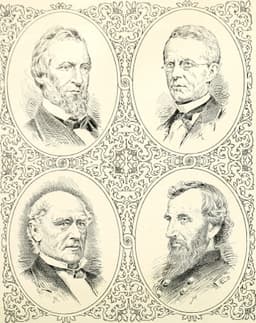
Internet Archive Book Images, 1908. Wikimedia Commons. No restrictions.
1732–1786
General Alexander McDougall
1
recorded events
Connected towns:
Newburgh, NYBiography
General Alexander McDougall (1732–1786)
Continental Army General, Son of Liberty, and Champion of the Officers' Cause
Born in the Scottish island of Islay in 1732, Alexander McDougall arrived in colonial New York as a young child, carried across the Atlantic by a family of modest means seeking opportunity in the New World. Growing up on the streets and docks of Manhattan, he received little formal education but possessed a sharp, restless intelligence and an appetite for self-improvement that would define his entire life. He went to sea as a young man, commanding merchant vessels during the Seven Years' War and earning enough through privateering and trade to establish himself as a respectable New York merchant by the 1760s. His humble origins gave him an instinctive sympathy for popular causes and a deep suspicion of aristocratic privilege, sentiments that would draw him inexorably into radical politics. McDougall immersed himself in the contentious world of colonial New York, where competing factions of merchants, landowners, and tradesmen jostled for influence. His commercial success provided him the independence to speak freely, and his seafaring years had hardened him into a man unafraid of confrontation. These formative experiences — poverty, self-education, the rough democracy of maritime life — shaped a figure uniquely positioned to bridge the worlds of popular protest and military command.
McDougall first rose to public prominence not as a soldier but as a firebrand pamphleteer and leader of the Sons of Liberty in New York. In December 1769, he published a broadside titled "To the Betrayed Inhabitants of the City and Colony of New York," attacking the colonial assembly for capitulating to British authority. The pamphlet electrified the city and enraged the authorities, who arrested McDougall in February 1770 and imprisoned him for months. Rather than silencing him, his imprisonment transformed him into a celebrated martyr for colonial rights, frequently compared in radical newspapers to the English radical John Wilkes. He was jailed a second time for his political activities, only deepening his reputation as a man willing to suffer for principle. When the crisis between the colonies and Britain finally erupted into open warfare in 1775, McDougall's transition from political agitator to military officer felt almost inevitable. His organizational abilities, his network of political connections, and his proven willingness to challenge authority made him a natural candidate for command. He was appointed colonel of the 1st New York Regiment, stepping onto a stage where his political instincts would prove as valuable as any tactical skill on the battlefield.
McDougall's most important contributions to the Continental Army were organizational, political, and administrative rather than defined by dramatic battlefield victories. He rose steadily through the ranks, achieving the rank of major general, and served in a variety of capacities that reflected Washington's trust in his judgment and reliability. He commanded forces in the defense of the Hudson Highlands, a strategically vital corridor that controlled communication and supply lines between New England and the rest of the states. His management of troops, supplies, and fortifications in this critical region demonstrated the kind of unglamorous but essential competence that kept the Continental Army functioning through years of deprivation. McDougall understood, perhaps better than many of his fellow officers, that the Revolution would be won not only through battles but through the grinding persistence of maintaining an army in the field against enormous logistical odds. He repeatedly used his political connections to lobby state and congressional leaders for supplies and support, blurring the line between military command and political advocacy in ways that sometimes made civilian authorities uncomfortable. His willingness to engage in this kind of advocacy foreshadowed the central role he would play in the most dangerous civil-military crisis of the entire war.
The specific turning point that defines McDougall's place in Revolutionary history came in January 1783, at the winter cantonment near Newburgh, New York, where the Continental Army waited restlessly for a peace treaty that seemed perpetually just beyond reach. Officers who had served for years on promises of back pay and lifetime pensions at half pay confronted the grim reality that a financially crippled Congress might simply disband the army without honoring its commitments. McDougall was chosen to chair a committee of officers tasked with traveling to Philadelphia to present their grievances directly to Congress, a mission that carried enormous weight for thousands of men who had sacrificed years of their lives. The committee arrived in Philadelphia and presented a formal petition outlining the officers' demands, warning Congress in measured but unmistakable terms that the army's patience was not infinite. Congress received the delegation with sympathy but offered no concrete resolution, paralyzed by its own lack of taxing authority and the reluctance of individual states to fund national obligations. McDougall's committee returned to Newburgh empty-handed, and the failure of this legitimate, orderly channel of redress contributed directly to the explosive frustration that produced the anonymous Newburgh Addresses of March 1783 — documents that hinted at mutiny and military defiance of civilian authority.
McDougall's relationships with other prominent figures reveal the complex web of alliances and tensions that characterized the Revolution's final chapter. He maintained a respectful working relationship with General George Washington, who recognized McDougall's political acumen even as he carefully managed the volatile situation at Newburgh. McDougall also interacted with nationalist members of Congress, including Robert Morris, the superintendent of finance, and Alexander Hamilton, who were privately sympathetic to the army's grievances and saw them as potential leverage for strengthening the national government's power to tax. This convergence of military frustration and nationalist political ambition gave the Newburgh crisis its particularly dangerous character — the possibility that legitimate grievances might be manipulated for larger political ends. Washington's dramatic personal appearance before his officers on March 15, 1783, defused the immediate threat, reaffirming the principle of military subordination to civilian authority in a moment of extraordinary emotional power. McDougall himself was not among those who flirted with insubordination; his role had been that of a legitimate advocate working through proper channels. Yet his committee's failure demonstrated that even the most reasonable and orderly petition could be swallowed by the dysfunction of a government too weak to fulfill its own promises, a lesson that would inform the constitutional debates of the years ahead.
McDougall's legacy illuminates one of the Revolution's most underappreciated themes: the tension between the citizen-soldiers who fought the war and the civilian government they served. His career arc — from immigrant child to self-made merchant, from street-level radical to major general, from battlefield commander to congressional petitioner — encapsulates the extraordinary range of roles that the Revolution demanded of its participants. His story at Newburgh reminds us that the founding of the American republic was not a smooth, inevitable triumph but a process marked by genuine crises in which the entire experiment might have collapsed under the weight of broken promises and institutional weakness. After the war, McDougall returned to New York, where he served as a state senator and became the first president of the Bank of New York in 1784, continuing to shape the commercial and political life of the city he had fought to liberate. His death in June 1786, just as the nation was beginning to grapple with the constitutional inadequacies the Newburgh crisis had exposed, meant he did not live to see the stronger federal government that emerged from the Philadelphia Convention of 1787. Yet the grievances he carried to Congress in 1783 were among the forces that made that convention necessary, binding his story permanently to the larger narrative of American self-governance.
WHY GENERAL ALEXANDER MCDOUGALL MATTERS TO NEWBURGH
Alexander McDougall's story matters to Newburgh because it reveals the human cost of political failure at a moment when the Revolution hung in the balance. Students and visitors standing at the Newburgh cantonment site should understand that the Newburgh Conspiracy did not emerge from nowhere — it grew from the bitter disappointment of men like the officers McDougall represented, men who had been promised compensation and received nothing. McDougall's journey from the cantonment to the halls of Congress and back again traces a direct line between the frustrations of the winter camp and the crisis that nearly shattered the principle of civilian control over the military. His story teaches us that democracy requires not just lofty ideals but the willingness to honor concrete obligations to those who defend it.
TIMELINE
- 1732: Born on the island of Islay, Scotland; emigrates to New York as a young child
- 1756–1763: Serves as a privateer and merchant captain during the Seven Years' War, building his fortune
- 1769: Publishes "To the Betrayed Inhabitants of the City and Colony of New York," becoming a leading Son of Liberty
- 1770: Arrested and imprisoned for seditious libel; celebrated as a martyr for colonial rights
- 1775: Appointed colonel of the 1st New York Regiment at the outbreak of the Revolutionary War
- 1777: Promoted to brigadier general; commands forces defending the Hudson Highlands
- 1777: Elevated to the rank of major general in the Continental Army
- 1783 (January): Chairs the officers' committee that travels to Philadelphia to petition Congress for back pay and pensions
- 1783 (March): The Newburgh Conspiracy unfolds following the committee's failure; Washington intervenes to defuse the crisis
- 1784: Becomes the first president of the Bank of New York
- 1786: Dies in New York City on June 9
SOURCES
- Martin, James Kirby, and Mark Edward Lender. A Respectable Army: The Military Origins of the Republic, 1763–1789. Harlan Davidson, 2006.
- Kohn, Richard H. "The Inside History of the Newburgh Conspiracy: America and the Coup d'Etat." William and Mary Quarterly, vol. 27, no. 2, 1970.
- Champagne, Roger J. Alexander McDougall and the American Revolution in New York. Union College Press, 1975.
- National Archives. "Memorial of the Officers of the Army to Congress, January 1783." Founders Online, National Archives. https://founders.archives.gov
- Schecter, Barnet. The Battle for New York: The City at the Heart of the American Revolution. Walker & Company, 2002.
Events
Jan
1783
Officers' Committee Travels to Congress to Demand PayNewburghContinental Army General# Officers' Committee Travels to Congress to Demand Pay By the winter of 1783, the American Revolution was drawing to a close, but the Continental Army faced a crisis that had nothing to do with the British. Years of broken promises, deferred wages, and mounting frustration had pushed the officer corps to the brink of open revolt. The war had been won in practical terms — the decisive victory at Yorktown had come more than a year earlier in October 1781, and peace negotiations were well underway in Paris — yet the men who had sacrificed years of their lives to secure American independence found themselves destitute, unpaid, and increasingly ignored by the civilian government they had fought to establish. It was against this backdrop that a committee of Continental Army officers, led by General Alexander McDougall, undertook a journey from the army's encampment at Newburgh, New York, to the halls of Congress in Philadelphia, hoping to secure what they believed they were owed. General Alexander McDougall was a fitting choice to lead the delegation. A Scottish-born New Yorker, McDougall had been a prominent figure in the revolutionary cause long before the war began, having gained fame as a leader of the Sons of Liberty in New York City during the resistance to British taxation in the late 1760s. He had served throughout the war as a Continental Army general and understood both the political landscape and the depth of suffering among his fellow officers. Joining him were Colonel Matthias Ogden of New Jersey and Colonel John Brooks of Massachusetts, representing a broad coalition of aggrieved officers from across the army. Together, they carried a formal petition that outlined three central demands: the payment of back wages that had gone unfulfilled for months and in some cases years, the honoring of half-pay pensions for life that Congress had promised officers in 1780 as an inducement to keep them in service, and a full and fair settlement of all outstanding accounts between the army and the government. The committee arrived in Philadelphia in late January 1783 and presented its case before Congress with urgency and conviction. McDougall reportedly warned members of Congress that the army's patience was running dangerously thin, and that the consequences of continued neglect could be severe. The officers' frustrations were not abstract — many had gone deep into personal debt to sustain themselves during the war, and they watched as Congress struggled even to fund its own basic operations. The problem, however, was not one of willingness alone but of structural incapacity. Under the Articles of Confederation, Congress had no power to levy taxes and depended entirely on voluntary contributions from the individual states, contributions that were arriving slowly or not at all. The national treasury was nearly empty, and Congress simply could not make good on its promises, no matter how justified the officers' claims might be. After weeks of fruitless negotiation and deliberation, the committee returned to Newburgh in February 1783 bearing no resolution and little hope. The news landed like a thunderclap among the officers encamped along the Hudson River. The failure of the congressional mission did not merely disappoint the army — it radicalized a significant portion of it. Within weeks, anonymous letters began circulating through the Newburgh encampment, urging officers to take more drastic action, including the possibility of refusing to disband when peace came or even marching on Congress to compel payment by force. These inflammatory writings, sometimes attributed to Major John Armstrong Jr., an aide to General Horatio Gates, set the stage for what became known as the Newburgh Conspiracy, one of the most dangerous moments in the young republic's history. The episode matters profoundly because it tested the foundational principle of civilian control over the military. It was only through the personal intervention of General George Washington, who addressed his officers in an emotional meeting on March 15, 1783, that the conspiracy was defused and the army chose loyalty to republican government over armed coercion. McDougall's failed mission to Congress, therefore, was not merely a bureaucratic errand — it was the spark that nearly ignited a military coup against the very democracy the Revolution had created.