

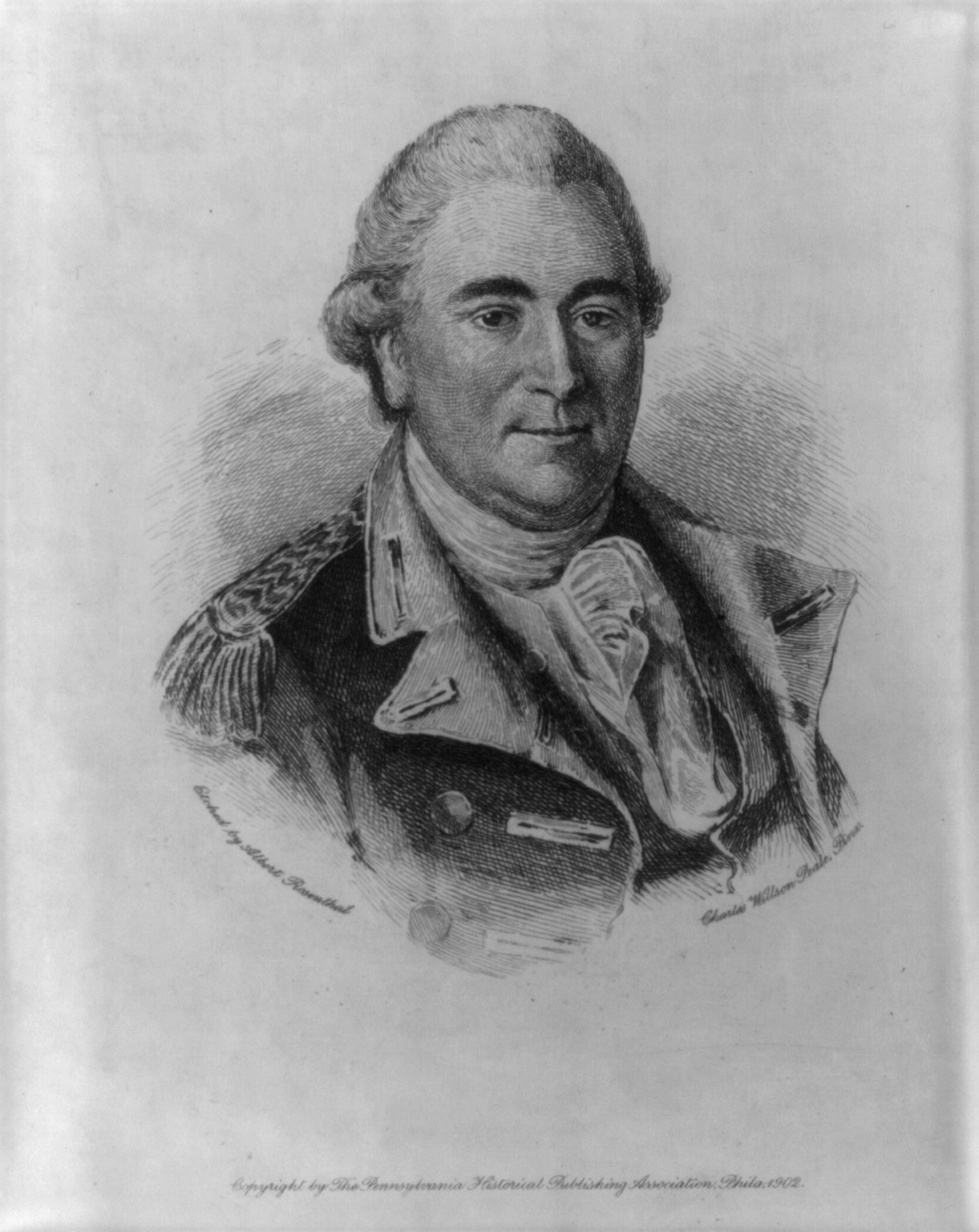
Miscellaneous Items in High Demand, PPOC, Library of Congress, 1902. Wikimedia Commons. Public domain.
1745–1796
Anthony Wayne
6
recorded events
Connected towns:
Stony Point, NYBiography
Anthony Wayne (1745–1796)
Continental Army General, Commander of the Light Infantry Corps
Born in 1745 in Chester County, Pennsylvania, the man who would earn the nickname "Mad Anthony" grew up in a world of practical enterprise and frontier ambition. His father, Isaac Wayne, was a prosperous farmer and tanner who had served during the French and Indian War, giving the younger Wayne an early familiarity with military culture and the demands of leadership. Rather than following a purely agricultural path, Wayne trained as a surveyor and spent time in Nova Scotia working as a land agent, experiences that sharpened his eye for terrain — a skill that would prove critical on battlefields from the Hudson Highlands to the Ohio frontier. He also managed the family tannery, developing the organizational habits of a businessman accustomed to directing labor and managing complex operations. Wayne had no formal military education, but he possessed something that textbooks could not easily teach: a physical fearlessness combined with an instinct for aggressive, decisive action. These qualities, forged in the competitive world of colonial Pennsylvania commerce and frontier surveying, would make him one of George Washington's most valued combat commanders when the crisis of revolution arrived.
When the Revolution erupted in 1775, Wayne threw himself into the patriot cause with characteristic intensity, raising a regiment of Pennsylvania volunteers and receiving a colonel's commission early in 1776. His first major test came during the ill-fated American invasion of Canada, a campaign that tested even the most capable officers. Wayne participated in the grueling retreat from Quebec and the fighting withdrawal to Fort Ticonderoga, where disease, exhaustion, and British pressure threatened to destroy the northern army entirely. Through this crucible, Wayne demonstrated both his courage under fire and his ability to maintain unit cohesion in desperate circumstances — qualities that distinguished him from officers who performed well only in favorable conditions. His conduct during the Canadian campaign caught the attention of senior commanders, and he emerged from the disaster with his reputation not merely intact but enhanced. Washington, who was constantly searching for subordinates willing to fight aggressively while maintaining discipline under pressure, recognized in Wayne a kindred spirit. By the time the war's center of gravity shifted to the Middle Atlantic states in 1777, Wayne had earned command of the Pennsylvania Brigade, positioning him at the heart of some of the conflict's most consequential engagements.
Wayne's rise through the Continental Army's ranks was forged in a crucible of both triumph and humiliation. At the Battle of Brandywine in September 1777, he commanded the Pennsylvania Line with determination as Washington's army attempted to block the British advance on Philadelphia. Days later, however, came the debacle at Paoli, where British forces under Major General Charles Grey surprised Wayne's encampment in a devastating night bayonet attack that killed and wounded dozens of his men. The "Paoli Massacre," as patriots called it, stung Wayne deeply, and he demanded — and received — a court-martial that cleared him of negligence. The experience left an indelible mark: Wayne learned firsthand the terrifying effectiveness of a disciplined bayonet assault conducted under cover of darkness, a lesson he would reverse with devastating effect at Stony Point. He fought aggressively at Germantown in October 1777 and endured the bitter winter at Valley Forge, where Baron von Steuben's training program transformed the Continental Army into a more professional fighting force. Wayne absorbed these lessons and applied them rigorously, emerging from Valley Forge as one of the army's most effective and reliable division commanders.
The defining moment of Wayne's Revolutionary War career came on the night of July 15–16, 1779, at Stony Point, a fortified British outpost on the west bank of the Hudson River. Washington had personally reconnoitered the position earlier that summer, assessing its formidable defenses — rocky bluffs, abatis, and a garrison of over six hundred British regulars. He then assigned Wayne to command the newly organized Light Infantry Corps and tasked him with planning and executing the assault. Wayne's plan was audacious: his troops would attack at midnight using bayonets only, with muskets unloaded to prevent accidental discharges that could alert the garrison. Two assault columns would converge on the fortress from the north and south simultaneously while a diversionary force fired muskets from the center to draw British attention. The attack succeeded brilliantly. Despite being struck in the head by a musket ball during the advance, Wayne pressed forward and led his men over the walls. The entire garrison was killed or captured — over five hundred prisoners along with cannon, stores, and ammunition — at a cost of fewer than one hundred American casualties. Congress awarded Wayne a gold medal, one of only a handful bestowed during the entire war.
Wayne's success at Stony Point did not occur in isolation but was embedded in a web of relationships and strategic calculations that shaped the war's broader trajectory. Washington's decision to assign Wayne the light infantry command reflected deep personal trust; the commander-in-chief needed an officer bold enough to attempt the assault yet disciplined enough to execute the intricate plan without deviation. The victory at Stony Point also inspired Lieutenant Colonel Henry Lee's subsequent raid on Paulus Hook, New Jersey, in August 1779, demonstrating that the Continental Army could strike British outposts with precision and ferocity. When Rochambeau's French army marched past Stony Point in 1781 on its way to Yorktown, the site stood as a tangible reminder of American offensive capability. Wayne himself served at Yorktown, contributing to the campaign that ended the war, and later commanded forces in Georgia during the southern campaign's final phases. Throughout these operations, Wayne worked closely with Washington, Lafayette, and other senior officers, earning their respect through consistent performance. His willingness to take calculated risks — and his ability to execute them — made him an indispensable figure in an army that often struggled with cautious or incompetent subordinate leadership.
Wayne's legacy extends far beyond the Revolution itself, offering a window into what the war demanded of its officers and what it produced for the new nation. His postwar career was arguably as consequential as his wartime service: appointed to command the Legion of the United States in 1792, he rebuilt an American army that had been humiliated by the Northwestern Confederacy of Indian nations, trained it with the rigor he had learned at Valley Forge, and defeated the confederacy decisively at the Battle of Fallen Timbers in 1794. That victory opened the Ohio country to American settlement and established federal military authority on the frontier. Wayne died in 1796 at Presque Isle (modern Erie, Pennsylvania) while returning from the frontier, his career spanning the full arc from colonial rebellion to national expansion. His story illustrates a critical truth about the American Revolution: the war was won not by gentleman amateurs but by officers who learned their craft through bitter experience, who converted failure into tactical innovation, and who carried the Revolution's military lessons into the uncertain decades that followed independence.
WHY ANTHONY WAYNE MATTERS TO STONY POINT
Anthony Wayne's story matters to students and visitors because it embodies the transformation at the heart of the American Revolution — the evolution of citizen soldiers into a disciplined fighting force capable of defeating professional troops on their own terms. The midnight assault on Stony Point, conceived and commanded by Wayne, demonstrated that the Continental Army could plan and execute complex offensive operations requiring extraordinary coordination, courage, and restraint. For visitors to Stony Point, walking the ground where Wayne's light infantry crept through marshes and scaled rocky bluffs in silence makes the human cost and achievement of the Revolution tangible. Wayne's wound during the assault, his insistence on being carried forward into the fort, and his immediate report to Washington remind us that the Revolution was won by individuals willing to risk everything for a cause still far from certain victory.
TIMELINE
- 1745: Born January 1 in Easttown Township, Chester County, Pennsylvania
- 1765–1766: Works as a surveyor and land agent in Nova Scotia
- 1776: Commissioned as colonel of the Fourth Pennsylvania Battalion; serves in the invasion of Canada and retreat to Ticonderoga
- 1777: Commands the Pennsylvania Line at the Battles of Brandywine and Germantown; his camp is surprised at Paoli on September 20
- 1777–1778: Endures the winter encampment at Valley Forge with the Continental Army
- 1779: Washington assigns Wayne to command the Light Infantry Corps; leads the bayonet assault on Stony Point on the night of July 15–16; Congress awards him a gold medal
- 1781: Serves in the Yorktown campaign; subsequently commands operations in Georgia
- 1792: Appointed commander of the Legion of the United States
- 1794: Defeats the Northwestern Confederacy at the Battle of Fallen Timbers on August 20
- 1796: Dies December 15 at Presque Isle, Pennsylvania, while returning from the frontier
SOURCES
- Nelson, Paul David. Anthony Wayne: Soldier of the Early Republic. Indiana University Press, 1985.
- Stille, Charles J. Major-General Anthony Wayne and the Pennsylvania Line in the Continental Army. J.B. Lippincott Company, 1893.
- Johnston, Henry P. The Storming of Stony Point on the Hudson, Midnight, July 15, 1779. James T. White & Co., 1900.
- National Park Service. "Stony Point Battlefield State Historic Site." https://parks.ny.gov/historic-sites/stonypointbattlefield
- Library of Congress. "George Washington Papers: Correspondence with Anthony Wayne, 1776–1796." https://www.loc.gov/collections/george-washington-papers/
Events
Jun
1779
Washington Assigns Wayne to Command Light Infantry CorpsStony PointContinental Army General# Washington Assigns Wayne to Command the Light Infantry Corps By the summer of 1779, the American Revolution had entered a phase of strategic frustration. The Continental Army, still recovering from the brutal winter at Valley Forge and the indecisive Battle of Monmouth the previous year, faced a British force that continued to hold New York City and its surrounding approaches with formidable strength. General George Washington, ever searching for an opportunity to strike a meaningful blow against the British without risking a catastrophic defeat, turned his attention to the Hudson River Valley, a region of immense strategic importance. Control of the Hudson meant control of the lines of communication and supply between New England and the rest of the colonies, and the British understood this as well as Washington did. In late May of 1779, British forces under Sir Henry Clinton had seized the rocky promontory of Stony Point, a commanding position on the western bank of the Hudson River in New York. The British quickly fortified the site, establishing a garrison and constructing defensive works that gave them a threatening foothold along the vital waterway. Washington recognized that allowing the British to consolidate their hold on Stony Point unchallenged could shift the balance of power along the Hudson, and he began formulating plans for a response. It was in this context that Washington made a decision that would prove pivotal. He formally assigned Brigadier General Anthony Wayne to command the newly organized Continental Light Infantry Corps, an elite formation of approximately 1,350 carefully selected soldiers drawn from multiple regiments across the Continental Army. These were not ordinary line troops. They were picked men chosen for their physical fitness, discipline, courage, and ability to move quickly over difficult terrain. The Light Infantry Corps was designed specifically for rapid offensive operations — the kind of swift, decisive action that could exploit a momentary weakness in the enemy's defenses before reinforcements could arrive. By placing Wayne at the head of this force, Washington signaled not only his confidence in Wayne's aggressive temperament and tactical ability but also his intention to use the corps for a specific and dangerous purpose. Though the formal orders left room for flexibility, there was an implicit understanding between the two men that Wayne and his light infantry would be directed against Stony Point. Wayne was a fitting choice for such a command. Known for his fiery disposition and willingness to take bold risks, he had already earned a reputation as one of the Continental Army's most combative officers. His leadership at Brandywine, Germantown, and Monmouth had demonstrated both his courage under fire and his capacity to inspire troops in desperate circumstances. Washington needed a commander who would not hesitate when the moment came, and Wayne embodied that quality. Equally important to the operation's eventual success was the intelligence work already underway before Wayne formally assumed command. Captain Allan McLane, a resourceful and daring Continental Army officer who had distinguished himself in reconnaissance and irregular warfare, was actively scouting the defenses at Stony Point. McLane's scouts, working alongside cavalry elements, gathered critical information about the fort's layout, the strength and disposition of its garrison, the nature of its fortifications, and the surrounding terrain. This intelligence would prove indispensable in planning an assault that required precision, surprise, and an intimate understanding of the ground over which the attackers would advance. The assignment of Wayne to command the Light Infantry Corps was not merely an administrative decision — it was the opening act of one of the most celebrated operations of the entire Revolutionary War. The intelligence collected by McLane and others would be synthesized into a daring plan of attack, and Wayne would lead his men in a nighttime bayonet assault on Stony Point that stunned the British and electrified the American cause. But all of that lay ahead. In the moment of Wayne's appointment, what mattered most was that Washington had matched the right commander to the right mission at the right time, setting in motion a chain of events that would demonstrate the Continental Army's growing capacity for bold, professional military operations against a formidable enemy.
Jul
1779
Washington Personally Reconnoiters Stony PointStony PointContinental Army General# Washington Personally Reconnoiters Stony Point By the summer of 1779, the American War for Independence had entered a frustrating period of strategic stalemate along the Hudson River Valley. The British, under their broader strategy of controlling the Hudson and severing New England from the rest of the colonies, had seized Stony Point in early June. This rocky promontory jutting into the Hudson River at its narrowest navigable point, roughly thirty-five miles north of New York City, gave the British a commanding position that threatened American communications and supply lines. The garrison there, fortified with earthworks, abatis — sharpened logs arranged as defensive barriers — and well-positioned artillery, represented both a tactical problem and a symbolic affront to American morale at a time when the Continental cause badly needed a bold victory. George Washington, the Commander-in-Chief of the Continental Army, understood that simply observing the British presence from a distance would not be sufficient to plan a credible assault against such a fortified position. In a decision that was remarkably unusual for a leader of his rank and responsibility, Washington personally rode out to reconnoiter Stony Point and evaluate the British defenses with his own eyes. Commanders-in-chief rarely exposed themselves to the risks of forward reconnaissance, yet Washington recognized that the stakes of this particular operation demanded his direct assessment. He needed to judge for himself whether the fortification could realistically be taken by assault or whether the cost in lives would be too great to justify the attempt. After carefully studying the terrain, the arrangement of the defensive works, and the approaches available to an attacking force, Washington concluded that the fort was indeed assailable. His confidence in this judgment would prove essential, as it gave him the conviction to authorize what would become one of the most daring operations of the entire war. Washington's reconnaissance did not occur in a vacuum. Captain Allan McLane, a resourceful and daring Continental Army officer known for his intelligence-gathering abilities, had already undertaken his own covert mission to gather critical information about the British defenses. McLane infiltrated Stony Point in disguise, moving close enough to confirm the specific layout of the abatis barriers, map the positions of sentries, and document their patrol schedules. This intelligence was invaluable, providing the granular operational detail that would allow an assault force to navigate the defenses under cover of darkness. McLane's courage and ingenuity in obtaining this information exemplified the kind of unconventional initiative that the Continental Army increasingly relied upon to offset its disadvantages in manpower and material against the professional British military. With Washington's personal assessment confirming the feasibility of an attack and McLane's intelligence providing the tactical specifics, Washington turned to Brigadier General Anthony Wayne to develop a detailed assault plan. Wayne, whose aggressive temperament would soon earn him the enduring nickname "Mad Anthony," threw himself into the planning with characteristic intensity. The operation he designed called for a nighttime bayonet assault, with muskets unloaded to ensure silence during the approach — a plan of extraordinary audacity that demanded perfect discipline from the troops involved. The reconnaissance and planning culminated in the storming of Stony Point on the night of July 16, 1779, when Wayne led his forces in a brilliantly executed assault that captured the fort in under thirty minutes. The victory electrified the American public and provided a desperately needed boost to Continental morale during a long and uncertain war. It demonstrated that American soldiers could match British regulars in the most demanding form of combat and that bold, carefully planned operations could yield dramatic results. Washington's willingness to personally assess the objective before committing his men reflected a leadership philosophy grounded in prudence, responsibility, and an intimate understanding of the battlefield — qualities that repeatedly distinguished him throughout the Revolutionary War and helped sustain the fragile American cause through its darkest years.
Jul
1779
Wayne's Midnight Assault on Stony PointStony PointContinental Army General**Wayne's Midnight Assault on Stony Point** By the summer of 1779, the American Revolution had reached a frustrating stalemate in the northern theater. After the British defeat at Saratoga in 1777 and the bitter winter at Valley Forge, General George Washington's Continental Army had grown more disciplined and professional, yet it lacked the strength to challenge the main British garrison in New York City directly. The British, for their part, had shifted much of their strategic focus to the southern colonies, but they remained aggressive along the Hudson River corridor, which they viewed as vital to splitting the rebellious states in two. In late May 1779, British forces under Sir Henry Clinton seized Stony Point, a rocky promontory jutting into the Hudson River about thirty-five miles north of New York City. The British fortified the position heavily, installing batteries and surrounding the works with two rows of sharpened wooden obstacles called abatis. A garrison of roughly 625 troops, commanded by Lieutenant Colonel Henry Johnson of the 17th Regiment of Foot, held the point. The capture of Stony Point, along with the nearby fort at Verplanck's Point on the opposite bank, threatened American control of the vital King's Ferry crossing and posed a broader danger to Washington's strategic position in the Hudson Highlands. Washington was determined to respond. He turned to one of his most aggressive and capable subordinates, Brigadier General Anthony Wayne, a Pennsylvanian already earning the reputation that would later cement his nickname "Mad Anthony." Washington ordered Wayne to study the fortification and devise a plan for its recapture. After careful reconnaissance, including intelligence gathered by Captain Allen McLane, who personally scouted the British defenses, Wayne proposed an audacious nighttime bayonet assault. The plan was bold and dangerous in the extreme: the attacking force would advance with unloaded muskets, relying entirely on the bayonet to prevent accidental discharges that would reveal their position and sow confusion in the darkness. Wayne organized his 1,350-man light infantry corps into two assault columns. The right column, which Wayne personally led, would strike the southern face of the fortification, while the left column, commanded by Colonel Richard Butler, would attack from the north. A smaller diversionary force under Major Hardy Murfree would advance along the causeway at the center, firing their muskets to draw British attention and create the illusion of a frontal assault. Preceding each of the main columns were volunteer units known as "forlorn hopes" — soldiers who accepted the near-suicidal task of leading the way, hacking through the abatis under enemy fire to clear a path for the troops behind them. Lieutenant Colonel François de Fleury, a French volunteer serving with the Continental Army, led the forlorn hope of the right column, while Lieutenant George Knox led the volunteers on the left. The assault began around half past midnight on July 16, 1779. The forlorn hopes plunged into the abatis, chopping through the sharpened stakes while British defenders poured musket fire down upon them. Behind them, the main columns surged forward with bayonets fixed, scrambling up the rocky slopes in disciplined silence. The fighting was fierce but remarkably swift. Within approximately forty-five minutes, both columns had breached the fortifications and converged inside the works. François de Fleury became the first allied soldier to enter the main British fortification, hauling down the enemy flag. The British garrison suffered 63 killed, 70 wounded, and 472 captured, while American losses were comparatively light at 15 killed and 83 wounded. Wayne himself was struck by a musket ball that grazed his head during the final moments of the assault. Believing the wound might be fatal, he reportedly asked his aides to carry him into the fort so he could die, if die he must, inside the captured works. The wound proved superficial, and Wayne survived to fight many more battles. The victory at Stony Point electrified the American cause at a moment when morale desperately needed lifting. Although Washington ultimately decided the position was too exposed to hold permanently and ordered the fortifications demolished, the strategic and psychological impact of the assault was significant. It demonstrated that the Continental Army could execute complex, disciplined operations against fortified positions, validating the training reforms instituted by Baron von Steuben at Valley Forge. Congress awarded Wayne a gold medal, and both de Fleury and Butler received silver medals for their roles. The assault at Stony Point stands as one of the most brilliantly executed small-unit actions of the entire Revolutionary War, a testament to careful planning, bold leadership, and the growing professionalism of the American soldier.
Jul
1779
Congress Awards Gold and Silver Medals for Stony PointStony PointContinental Army General**Congress Awards Gold and Silver Medals for Stony Point** In the summer of 1779, the American Revolutionary War had reached a frustrating stalemate in the northern theater. The British, having abandoned Philadelphia the previous year, had consolidated their forces in and around New York City. As part of their strategy to control the Hudson River—a vital artery linking New England to the rest of the colonies—British forces seized Stony Point, a rocky promontory jutting into the Hudson River about thirty miles north of New York. The British fortified the position heavily, garrisoning it with roughly six hundred troops and establishing it as a threatening outpost that menaced American communications and supply lines. General George Washington, keenly aware of the strategic significance of the Hudson Highlands, began formulating a plan to retake the position. For this daring mission, he turned to one of his most aggressive and capable subordinates: Brigadier General Anthony Wayne. On the night of July 16, 1779, Wayne led approximately 1,350 soldiers of the Corps of Light Infantry in a meticulously planned assault on Stony Point. The attack was remarkable for its audacity and discipline. Washington and Wayne ordered that the assault be carried out almost entirely with bayonets, with muskets unloaded to prevent premature firing that would alert the garrison and sow confusion among the attackers. The troops advanced in two columns through marshland and up steep, rocky terrain under cover of darkness. Lieutenant Colonel François-Louis Teissèdre de Fleury, a French volunteer officer who had already distinguished himself in earlier campaigns, led one of the forlorn hope parties—the small advance units tasked with breaching the British abatis and outer defenses first, at tremendous personal risk. Major John Stewart led the other forlorn hope. Both men charged into the teeth of British fire and hand-to-hand resistance, clearing the way for the main assault columns. Wayne himself was struck in the head by a musket ball during the advance but refused to withdraw, reportedly asking to be carried forward so he could die, if he must, inside the fort. The wound proved superficial, and within approximately thirty minutes the entire British garrison was killed, wounded, or captured. The Americans suffered relatively light casualties, and the victory was resounding. The Continental Congress responded to the triumph at Stony Point with a series of unprecedented honors. Wayne was awarded a gold medal, only the fourth such medal bestowed by Congress during the entire war, placing him in extraordinarily distinguished company. Fleury and Stewart each received silver medals in recognition of their exceptional bravery in leading the forlorn hopes. Perhaps even more groundbreaking, Congress authorized the first cash bonuses for enlisted soldiers who had demonstrated valor during the assault, establishing an early precedent for recognizing the courage of common soldiers, not merely officers, in American military tradition. The value of the goods captured at Stony Point was also distributed among the troops, further rewarding their sacrifice and daring. These awards carried significance far beyond the personal honor of the recipients. The Continental Congress understood that the medals and bonuses served as a powerful political statement. At a time when many European observers doubted the fighting capability of the Continental Army and when domestic morale was strained by years of hardship, inflation, and inconclusive campaigning, the victory at Stony Point and the formal recognition that followed demonstrated that American soldiers could execute complex offensive operations with skill and discipline rivaling any professional European army. News of the medals was circulated both domestically and abroad, reinforcing the narrative that the American cause was legitimate and its army formidable. For French allies who had entered the war the previous year, the performance of their countryman Fleury alongside American troops underscored the strength of the Franco-American alliance. Though the position at Stony Point was ultimately abandoned by the Americans shortly after its capture—Washington deemed it too difficult to hold against a determined British counterattack—the battle's impact on morale and reputation proved lasting. The congressional medals became enduring symbols of what the Continental Army could achieve, and the precedent of rewarding enlisted valor helped shape an American military culture that, in principle, honored courage regardless of rank.
Aug
1779
Lee Raids Paulus HookStony PointContinental Army General**The Raid on Paulus Hook: August 19, 1779** By the summer of 1779, the American War of Independence had entered a phase of strategic frustration for both sides. The British held New York City and its surrounding fortifications, while General George Washington's Continental Army maintained a watchful arc around the occupied metropolis, probing for vulnerabilities without possessing the strength for a full assault. It was in this context that two daring raids — separated by just five weeks — demonstrated that American soldiers could match British regulars in discipline, planning, and close-quarters combat. The first, led by Brigadier General Anthony Wayne against the British garrison at Stony Point, New York, on July 16, 1779, electrified the patriot cause. The second, conducted by Lieutenant Colonel Henry "Light-Horse Harry" Lee against the fortified post at Paulus Hook, New Jersey, on August 19, proved that Stony Point was no fluke. Paulus Hook was a low, sandy peninsula jutting into the Hudson River at a point directly across from the southern tip of Manhattan — the site of present-day Jersey City. The British had fortified it with earthworks, a blockhouse, and a series of abatis, the sharpened-stake barriers that served as the eighteenth-century equivalent of barbed wire. A surrounding tidal creek and marsh made the position nearly an island at high tide, accessible only by a narrow causeway. The garrison, composed of several hundred British and Hessian troops, served as an outpost defending the western approaches to New York. The post's apparent impregnability made it a tempting target for an audacious commander looking to repeat Wayne's triumph. Henry Lee was exactly such a commander. Just twenty-three years old, the Virginia-born cavalry officer had already earned a reputation for boldness and intelligence-gathering. Serving under Washington's direct eye, Lee commanded a mixed unit of Continental light dragoons and infantry that would later become famous as "Lee's Legion." Studying Wayne's methods at Stony Point, Lee recognized a tactical template he could adapt: a secretive night march, strict orders for silence, unloaded muskets to prevent accidental discharges that would forfeit surprise, and an assault carried out primarily with the bayonet. On the night of August 18–19, Lee led roughly three hundred troops on a grueling approach march through miles of swampy terrain west of the Hudson. Delays, wrong turns, and the difficulty of navigating salt marshes in darkness consumed precious hours. By the time the assault force reached the causeway and waded through the tidal creek — some men chest-deep in water — it was well past midnight. Nevertheless, the attack achieved total surprise. Lee's men stormed the outer works with bayonets fixed and muskets unloaded, overwhelming the defenders in fierce hand-to-hand fighting. Within approximately thirty minutes, the Americans had captured 158 British and Hessian prisoners. A small contingent of Hessians barricaded inside the blockhouse held out and could not be dislodged, but Lee, knowing that British reinforcements could cross the Hudson from Manhattan at any moment, wisely chose to withdraw with his prisoners rather than linger. The retreat proved almost as harrowing as the approach. Exhausted and burdened with captives, Lee's column had to march rapidly northward to avoid being cut off. They succeeded, reaching the safety of American lines with their prisoners intact and having suffered remarkably few casualties — estimates suggest roughly two Americans killed and perhaps three wounded. Congress recognized the achievement by awarding Henry Lee a gold medal, one of only a handful bestowed during the entire war. The honor deliberately echoed the gold medal Congress had already voted for Anthony Wayne after Stony Point, and contemporaries understood the pairing as a powerful statement. Together, the two raids demonstrated that the Continental Army's light infantry had matured into a professional fighting force capable of executing complex operations under the most demanding conditions. In the broader arc of the Revolutionary War, the twin victories at Stony Point and Paulus Hook did not alter the strategic balance around New York, but they accomplished something arguably more important in 1779: they sustained American morale during a long and indecisive middle period of the conflict. They proved that disciplined Continental soldiers could penetrate fortified British positions, and they burnished the reputations of two officers — Wayne and Lee — who would go on to play significant roles in the war's later campaigns, particularly in the southern theater where the conflict would ultimately be decided.
Aug
1781
Rochambeau's Army Marches Past Stony Point Toward YorktownStony PointContinental Army General# Rochambeau's Army Marches Past Stony Point Toward Yorktown By the summer of 1781, the American Revolution had dragged on for six grueling years, and the prospects for a decisive victory remained frustratingly uncertain. The war in the northern states had largely settled into a strategic stalemate, with the British firmly entrenched in New York City and General George Washington's Continental Army watching them from positions across the Hudson Highlands. Meanwhile, the conflict's center of gravity had shifted southward, where British forces under General Lord Cornwallis were campaigning aggressively through the Carolinas and into Virginia. It was against this backdrop that one of the most consequential military movements of the entire war unfolded — a bold, sweeping march of allied French and American forces from the Hudson Valley through New Jersey and onward to Virginia, passing directly through the strategic corridor near Stony Point, New York. The march was the product of a dramatic shift in planning between Washington and the Comte de Rochambeau, the experienced French general commanding roughly 5,000 troops that had arrived in America the previous year. For months, Washington had favored a joint assault on British-held New York City, believing it to be the key to ending the war. Rochambeau, however, argued persuasively that the real opportunity lay to the south, where Cornwallis had positioned his army at Yorktown, Virginia, on a peninsula bordered by the York River and the Chesapeake Bay. Word arrived that a powerful French fleet under Admiral de Grasse was sailing from the Caribbean toward the Chesapeake, and this intelligence tipped the balance. Washington agreed to the southern strategy, and in late August 1781, the combined allied force of approximately 7,000 men — French regulars and American Continentals alike — began their march south in what would become one of the great logistical feats of the war. The route they followed took them across the Hudson River at King's Ferry, the vital crossing point situated between Stony Point on the western bank and Verplanck's Point on the eastern side. This passage was no ordinary river crossing; it was a strategic lifeline that had been fiercely contested throughout the war. Two years earlier, in July 1779, Continental Army General Anthony Wayne had led one of the conflict's most celebrated operations — a daring nighttime bayonet assault on the British fortification at Stony Point. Wayne's forces stormed the rocky promontory in a meticulously planned attack, capturing the garrison and reasserting American control over this critical stretch of the Hudson. Though Washington ultimately chose not to hold Stony Point permanently, Wayne's assault demonstrated American resolve and helped ensure that the British could not consolidate control over the Hudson corridor. The fact that allied forces could cross freely at King's Ferry in 1781 was a direct consequence of the strategic environment that Wayne's bold action had helped preserve. As Rochambeau's well-disciplined French troops and Washington's Continentals filed past Stony Point and across the river, they did so with extraordinary secrecy. Washington went to considerable lengths to deceive the British commander in New York, Sir Henry Clinton, into believing that the allied army was preparing to attack Manhattan rather than marching to Virginia. False camps, misleading dispatches, and carefully staged movements kept Clinton guessing until it was too late for him to intervene effectively. Once across the Hudson, the allied column pressed southward through New Jersey and continued into Pennsylvania, Delaware, and Maryland before reaching Virginia. Their arrival, combined with de Grasse's naval control of the Chesapeake, sealed Cornwallis's fate. The Siege of Yorktown began in late September, and on October 19, 1781, Cornwallis surrendered his entire army — effectively ending major combat operations in the Revolutionary War. The march past Stony Point thus represents a pivotal moment in which earlier sacrifices and victories converged to make final triumph possible. The corridor that Wayne's courage had helped keep open in 1779 became the very pathway through which the armies that won American independence made their decisive journey south, linking one chapter of heroism to another in the long struggle for a new nation.
Stories