

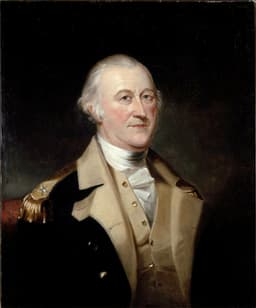
Thomas Sully, after Charles Willson Peale, circ. Wikimedia Commons. Public domain.
1727–1800
Artemas Ward
1
recorded events
Connected towns:
Cambridge, MABiography
Artemas Ward: The General Before Washington
Born in Shrewsbury, Massachusetts, on November 26, 1727, the man who would become the first commander of American Revolutionary forces grew up in a world defined by local politics, Puritan civic duty, and the rhythms of rural New England life. Artemas Ward was the son of Nahum Ward, a prosperous farmer and local officeholder, and his upbringing instilled in him a deep sense of public obligation. He attended Harvard College, graduating in 1748, and quickly established himself as a figure of consequence in Worcester County. Ward served in the Massachusetts General Court and held various town offices, building the kind of political network that would later prove essential. His military education began during the French and Indian War, where he served as a colonel in the provincial forces and gained firsthand experience of the logistical chaos and command challenges inherent in colonial warfare. That conflict left him with both practical knowledge and chronic health problems — likely kidney stone ailments — that would shadow him for the rest of his life. Yet these years of civic and military service forged a man whom Massachusetts leaders would instinctively turn to when crisis arrived.
When tensions between the American colonies and the British Crown erupted into open conflict in April 1775, Ward was not a young firebrand spoiling for battle. He was a forty-seven-year-old veteran in fragile health, living quietly in Shrewsbury. Yet the Massachusetts Provincial Congress recognized his experience and appointed him commander of the colony's militia forces, a decision that thrust him into the most consequential military role in North America. Following the battles of Lexington and Concord on April 19, 1775, thousands of militiamen from across New England poured into the countryside surrounding Boston, where British forces under General Thomas Gage were now effectively trapped. Ward arrived in Cambridge to assume command of this sprawling, disorganized mass of armed citizens. The challenge was staggering: he had no formal army, no centralized supply system, and no unified chain of command. Militiamen from Massachusetts, Connecticut, New Hampshire, and Rhode Island each answered to their own officers and operated under their own colonial commissions. Ward's first significant role was to impose some semblance of order on this chaos, establishing his headquarters in Cambridge and beginning the immense work of transforming a spontaneous uprising into a functional siege.
Ward's most important actions during the war occurred during the critical weeks between late April and early July 1775, a period when the fate of the American resistance hung in the balance. His primary strategic decision was to establish and maintain a continuous line of siege works encircling British-held Boston, stretching from Roxbury in the south through Cambridge and up to the Mystic River. This was no simple task. Ward had to allocate men, ammunition, and provisions across miles of defensive positions while managing competing egos and colonial rivalries. He enforced discipline as best he could, issuing orders regarding camp sanitation, guard rotations, and the prohibition of unauthorized forays that might provoke a British counterattack before the Americans were ready. Crucially, Ward chose a strategy of containment rather than assault. He understood that his untrained forces could not take Boston by storm but could keep the British bottled up while the Continental Congress deliberated. This restraint, unglamorous as it was, prevented a premature catastrophe and preserved the military option for the Continental Congress. Ward also worked to establish rudimentary supply lines and coordinate with colonial governments to keep provisions flowing to the camps.
The defining turning point of Ward's tenure came on June 17, 1775, with the Battle of Bunker Hill — one of the bloodiest engagements of the entire war. Ward had sanctioned the fortification of Breed's Hill on the Charlestown peninsula, a bold move designed to tighten the noose around Boston and force the British hand. When British forces launched a frontal assault on the American positions, the fighting was savage. The Americans, though ultimately driven from the hill, inflicted devastating casualties on the British regulars, killing or wounding over a thousand men, including many officers. Ward coordinated reinforcements and supply efforts from Cambridge during the battle, though his physical ailments prevented him from taking the field personally — a fact that later drew criticism. The aftermath of Bunker Hill transformed the political landscape: it demonstrated that colonial militia could stand against professional soldiers, and it accelerated the Continental Congress's decision to create a unified Continental Army. On June 15, 1775, Congress had already appointed George Washington as commander in chief. When Washington arrived in Cambridge on July 2, 1775, Ward formally relinquished overall command, ending a tenure of roughly ten weeks that had shaped the entire trajectory of the siege.
Ward's relationship with George Washington was respectful but distant, and it reflected deeper tensions within the American command structure. Washington, a Virginian, had been chosen partly to give the Revolution a continental rather than purely New England character, and his appointment inevitably diminished Ward's authority. Ward served as second in command and was given responsibility for the right wing of the siege lines at Roxbury, a significant but subordinate role. The two men differed in temperament and style — Washington was vigorous, imposing, and consumed by ambition for the cause, while Ward was cautious, ailing, and rooted in the political culture of Massachusetts. Ward maintained cordial relations with other New England leaders, including General Israel Putnam and Dr. Joseph Warren, who was killed at Bunker Hill. His rapport with the Massachusetts Provincial Congress, which had appointed him, remained strong, and he continued to serve as a bridge between civilian authority and military operations. However, as Washington reshaped the army according to his own vision, Ward found his influence steadily eroding. He resigned his Continental commission in March 1777, citing his persistent health problems, and returned to Massachusetts.
The legacy of Artemas Ward is one of quiet, essential service that history has largely overshadowed. He was not a brilliant tactician or a charismatic leader, and he left no dramatic battlefield victories to burnish his reputation. What he did was arguably more difficult: he held together a fragile, improvised army during the most uncertain weeks of the American Revolution, when there was no Continental Army, no commander in chief, and no guarantee that the colonies would unite behind the cause. His decision to contain the British in Boston rather than risk a disastrous assault showed strategic wisdom that preserved American military strength at a moment when it could easily have been squandered. After leaving the army, Ward continued in public service, sitting in the Continental Congress from 1780 to 1781 and later serving two terms in the United States House of Representatives. He died on October 28, 1800, in Shrewsbury. Ward's story reminds us that revolutions are not won only by the famous figures who receive the credit, but also by the steady, unglamorous leaders who hold the line when everything is uncertain and the outcome is far from assured.
WHY ARTEMAS WARD MATTERS TO CAMBRIDGE
Cambridge was the birthplace of the American siege of Boston, and Artemas Ward was the man who made it work. When he arrived in the town in late April 1775, he found not an army but a sprawling encampment of angry, disorganized militiamen from across New England. It was in Cambridge that Ward established his headquarters, organized the siege lines, and maintained the fragile discipline that kept thousands of armed men focused on a common purpose. Students and visitors walking through Cambridge today are walking through the ground where the Continental Army was born — not on the day Washington arrived, but in the weeks before, when Ward shaped raw chaos into something that could be handed over and built upon. His story teaches us that the Revolution's survival depended on leaders who did unglamorous, essential work in moments of extreme uncertainty, and that Cambridge was the stage where that work began.
TIMELINE
- 1727: Born November 26 in Shrewsbury, Massachusetts
- 1748: Graduates from Harvard College
- 1755–1757: Serves as a colonel in Massachusetts provincial forces during the French and Indian War
- 1762: Elected to the Massachusetts General Court, beginning a long career in colonial politics
- 1775 (April): Appointed commander of Massachusetts militia forces following the battles of Lexington and Concord
- 1775 (April–May): Establishes headquarters in Cambridge and organizes siege lines around British-held Boston
- 1775 (June 17): Oversees American efforts during the Battle of Bunker Hill from Cambridge
- 1775 (July 2): Relinquishes overall command to George Washington upon his arrival in Cambridge
- 1777 (March): Resigns Continental Army commission due to ill health
- 1780–1781: Serves as a delegate to the Continental Congress
- 1791–1795: Serves two terms in the United States House of Representatives
- 1800: Dies October 28 in Shrewsbury, Massachusetts
SOURCES
- Martyn, Charles. The Life of Artemas Ward: The First Commander-in-Chief of the American Revolution. Artemas Ward, 1921.
- French, Allen. The Siege of Boston. Macmillan, 1911.
- Massachusetts Historical Society. Papers and correspondence relating to Artemas Ward. https://www.masshist.org
- Fischer, David Hackett. Paul Revere's Ride. Oxford University Press, 1994.
- National Park Service. "Siege of Boston." Boston National Historical Park. https://www.nps.gov/bost/
Events
Jul
1775
Washington Takes Command of Continental ArmyCambridgeFormer Commander# Washington Takes Command of the Continental Army On July 3, 1775, beneath the spreading branches of an elm tree on Cambridge Common, George Washington formally assumed command of the Continental Army, stepping into what would become one of the most consequential roles in American history. The ceremony itself was remarkably understated—no grand parade, no elaborate protocol, no thundering cannon salute. In many ways, the simplicity of the moment mirrored the raw, unfinished nature of the cause it represented. The American colonies had taken up arms against the most powerful empire on earth, and now a Virginia planter and former militia officer was being asked to forge a fighting force capable of winning their independence. The events leading to this moment had unfolded with breathtaking speed. Just months earlier, in April 1775, the battles of Lexington and Concord had shattered any remaining hope for a peaceful resolution between the colonies and Great Britain. Thousands of militiamen from across New England had subsequently converged on the outskirts of Boston, where British forces were garrisoned, forming a loose and sprawling siege. Command of these assembled forces had fallen to Artemas Ward, a Massachusetts general who did his best to impose some measure of coordination on what was essentially a collection of independent militia units answering to their own colonial governments. Ward was a competent and respected officer, but the Continental Congress recognized that the struggle required a unified command under a leader who could represent all thirteen colonies, not just New England. In June 1775, Congress appointed George Washington as Commander-in-Chief, a choice driven by his military experience during the French and Indian War, his imposing personal bearing, and the political necessity of selecting a Virginian to bind the southern colonies more tightly to what had so far been a predominantly northern conflict. When Washington arrived in Cambridge and surveyed the army he had inherited, the challenges before him were staggering. The force numbered perhaps 16,000 men, but it was an army in name only. Soldiers were poorly supplied, many lacking adequate weapons, ammunition, and even basic clothing. Enlistments were set to expire within months, meaning Washington faced the very real possibility that his army might simply dissolve before it ever engaged the enemy in a decisive action. There was no clear organizational structure, no standardized system of discipline, and no reliable chain of command. Militiamen who had answered the call in a burst of patriotic fervor were unaccustomed to the rigid demands of professional soldiering. Washington threw himself immediately into the monumental task of imposing order on this chaos. He established clearer lines of authority, worked to standardize training and discipline, and began the painstaking process of securing supplies and reinforcements. He also had to navigate delicate political relationships, managing the expectations of Congress while earning the trust and loyalty of officers like Ward, who might have resented being superseded. His wife, Martha Washington, would later join him in Cambridge, providing personal support and helping to sustain morale among the officers and their families during the long, grueling months of the siege. The work of transforming this ragged collection of militias into something resembling a professional army consumed the next eight months, culminating in a masterstroke in March 1776 when Washington used artillery hauled from Fort Ticonderoga to fortify Dorchester Heights, forcing the British to evacuate Boston without a major battle. It was a stunning early achievement, but it was only the beginning of a war that would stretch on for years. Washington's assumption of command at Cambridge matters far beyond its immediate military significance. It represented the moment when the colonial resistance ceased to be a regional uprising and became a unified national endeavor. By placing one man at the head of a single Continental Army, the Congress signaled that the thirteen colonies would fight together or not at all. Washington's willingness to accept that burden—and his relentless determination during those first desperate months in Cambridge—set the tone for everything that followed. The revolution might have begun at Lexington and Concord, but it was under that elm tree in Cambridge that it found its leader.