

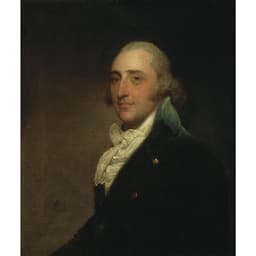
Gilbert Stuart, 1794. Wikimedia Commons. Public domain.
1732–1782
Charles Lee
1
recorded events
Connected towns:
Cambridge, MABiography
Charles Lee: The Brilliant, Impossible Second in Command
Born in 1732 in Dernhall, Cheshire, England, the man who would become one of the most controversial generals of the American Revolution grew up in a world of military privilege and intellectual ambition. Charles Lee was the son of Colonel John Lee and Isabella Bunbury, members of the English gentry with deep connections to the British military establishment. Educated at schools in England and later in Switzerland, Lee developed early fluencies in French and Latin, along with an appetite for classical learning that would mark him throughout his life. He received a commission as an ensign in his father's regiment, the 55th Foot, at the age of just fourteen. This was not unusual for sons of the officer class, but Lee took to soldiering with a fervor that went beyond mere obligation. His restless intellect, biting wit, and impatient temperament were evident from adolescence. He devoured military treatises, studied the campaigns of Frederick the Great, and formed opinions about strategy and tactics that he was never shy about sharing. These formative years produced a man of genuine talent and equally genuine abrasiveness—qualities that would define his entire career.
Lee's journey toward the American cause was neither sudden nor straightforward. After serving with distinction in the French and Indian War—where he fought at Ticonderoga in 1758 and was adopted into a Mohawk tribe, who named him "Boiling Water" for his volatile temperament—Lee traveled across Europe as a soldier of fortune. He served in the Portuguese army against Spain, accompanied the Polish king Stanisław II, and fought with the Russian army against the Turks. By the early 1770s, Lee had settled in Virginia, purchasing an estate and cultivating relationships with colonial leaders who shared his growing hostility toward British imperial policy. His motivations were a complex blend of genuine political conviction and personal grievance; he felt the British army had denied him the promotions his talents deserved. When tensions escalated after Lexington and Concord in April 1775, Lee threw himself into the patriot cause with characteristic intensity. He lobbied delegates at the Continental Congress, published pamphlets attacking British tyranny, and offered his unmatched professional military expertise to an army desperately in need of it. Congress appointed him a major general in June 1775, making him the third-ranking officer in the Continental Army.
His most significant early contribution came during the Siege of Boston, where Lee served as Washington's second in command beginning in the summer of 1775. In Cambridge, Massachusetts, Lee threw himself into the unglamorous but critical work of transforming a chaotic assemblage of militia companies into something resembling a disciplined fighting force. He supervised the construction of defensive works, advised on the placement of artillery, and drafted plans for fortifications along the lines surrounding British-held Boston. His professional eye was invaluable; Lee understood European siege warfare in ways that virtually no American-born officer could match. He brought knowledge of entrenchment design, fields of fire, supply logistics, and the organization of command structures that he had absorbed through decades of campaigning across multiple continents. Washington relied heavily on Lee's technical expertise during these months, even as he grew wary of his subordinate's sharp tongue and barely concealed ambition. The siege operations around Cambridge represented Lee at his most useful—a period when his knowledge genuinely advanced the American cause and his personality had not yet fully undermined his effectiveness within the command hierarchy.
Beyond Cambridge, Lee shaped several critical moments in the early years of the war. In early 1776, Congress dispatched him to New York City to organize the defense of that strategically vital port. Lee's plans for fortifying Manhattan and the surrounding area demonstrated genuine strategic insight, even if many of his recommendations were later abandoned or modified. He was subsequently sent south to command the defense of Charleston, South Carolina, where in June 1776, British naval forces under Sir Peter Parker launched an assault on the fortified position at Sullivan's Island. Though Lee was skeptical about the viability of the palmetto-log fort commanded by Colonel William Moultrie, the stunning American victory was partly credited to Lee's overall command of the department. He returned north with an enhanced reputation, celebrated in newspapers and toasted at dinners. Yet even in triumph, Lee's judgment was already showing fractures. His strategic assessments often contained brilliance mixed with overconfidence, and he had a habit of issuing orders in ways that alienated subordinate officers. These moments revealed a pattern: Lee performed best when his expertise was channeled through a defined role, and worst when ambition and ego clouded his tactical instincts.
The relationships that defined Lee's role in the Revolution were marked by admiration, rivalry, and eventual rupture. His connection with George Washington was the most consequential. Washington initially valued Lee's expertise and sought his counsel on matters ranging from troop discipline to grand strategy. The two men exchanged respectful correspondence in the war's early months, and Washington appears to have genuinely appreciated having a professional soldier at his side during the uncertain days in Cambridge. However, Lee's respect for Washington was always conditional and increasingly grudging. He confided to friends and fellow officers that he considered Washington an amateur, a Virginia planter elevated beyond his abilities by political considerations rather than military merit. Lee cultivated allies in Congress, including Benjamin Rush and others who harbored their own doubts about Washington's generalship. He also maintained a sprawling correspondence with British officers, European military figures, and political leaders, positioning himself as the indispensable man of the Revolution. His relationships with subordinates were similarly fraught; he could be generous and inspiring one moment, caustic and dismissive the next. He was famously accompanied everywhere by a pack of dogs, which he reportedly preferred to human company.
The controversies surrounding Charles Lee constitute one of the most dramatic stories of the entire Revolution. In December 1776, while commanding a separate wing of the Continental Army during Washington's desperate retreat across New Jersey, Lee inexplicably lingered at a tavern in Basking Ridge, miles from his troops. On December 13, a British patrol led by Colonel William Harcourt captured him in his nightclothes—a humiliating scene that became the subject of gleeful British propaganda and American dismay. Lee spent over a year as a prisoner of war, during which time his behavior became genuinely treasonous. Documents discovered long after the war revealed that Lee had drafted a plan for British General William Howe outlining how to defeat the American forces—a document known as the "Lee Plan," which was found among Howe's papers in 1858. Whether this constituted deliberate betrayal or a desperate gambit by a prisoner seeking to manipulate his captors remains debated, but the document's existence cast a permanent shadow over Lee's legacy. His exchange in April 1778 brought him back to the Continental Army, but the man who returned was even more erratic and bitter than the one who had been captured.
The war transformed Charles Lee from an ambitious but capable officer into a deeply embittered and unstable figure. His captivity left psychological marks that were visible to everyone around him. Where he had once been merely arrogant, he now seemed genuinely unmoored—vacillating in his judgments, paranoid about rivals, and increasingly contemptuous of the cause he had once championed. The most dramatic evidence of this transformation came at the Battle of Monmouth on June 28, 1778, where Lee commanded the advance force under Washington's orders to attack the retreating British column. Instead of pressing the assault, Lee ordered a confused and unauthorized retreat that nearly turned into a rout. Washington rode to the front and confronted Lee in one of the war's most famous encounters, reportedly addressing him in language that, as one witness recalled, made "the leaves shake on the trees." Lee was court-martialed, found guilty of disobedience, misbehavior before the enemy, and disrespect toward the commander in chief, and suspended from command for twelve months. The man who had once dreamed of leading the Continental Army now found himself cast out from it entirely, his reputation shattered among the very people he had sought to lead.
Lee's role in the war's resolution was defined almost entirely by his absence from it. Following his suspension after Monmouth, Lee retired to his estate in Virginia's Shenandoah Valley, nursing his grievances and writing intemperate letters to Congress and anyone else who would listen. He demanded vindication, insulted Washington in print, and challenged officers who criticized him to duels—he was wounded in one such encounter with John Laurens, a young aide to Washington, in December 1778. Congress eventually dismissed him from the army altogether in January 1780, ending any possibility of rehabilitation. Lee spent his final years in increasingly eccentric isolation, living in squalor on his Virginia property, surrounded by his beloved dogs and a growing pile of unpaid debts. He traveled to Philadelphia in 1782, apparently hoping to restore some connection to public life, but his health had deteriorated badly. He died on October 2, 1782, at a Philadelphia inn, without the comfort of family or the honors that attended other generals of the Revolution. He was only fifty years old. His will reportedly requested that he not be buried in any churchyard, as he had kept such bad company while living.
Contemporaries struggled to render a consistent verdict on Charles Lee. Those who had known him early in the war remembered a man of extraordinary learning, sharp strategic vision, and genuine passion for liberty. John Adams, who had championed Lee's appointment in 1775, never entirely abandoned his belief that Lee possessed rare military gifts. Others were less charitable. Alexander Hamilton, who witnessed the debacle at Monmouth firsthand, considered Lee a coward at best and a traitor at worst. Washington himself said relatively little about Lee publicly, but his private correspondence suggests a deep and lasting anger toward his former subordinate. The discovery of the "Lee Plan" in the nineteenth century further complicated assessments, leading many historians to view Lee as a man whose personal flaws crossed the line from mere arrogance into active betrayal. Yet even his harshest critics acknowledged that Lee's early contributions—his work in Cambridge, his organizational efforts in New York and Charleston—had been genuinely important. He occupied a strange position in Revolutionary memory: too talented to ignore, too flawed to celebrate, and too contradictory to reduce to a simple narrative of heroism or villainy.
Students and visitors today should know Charles Lee because his story complicates the Revolution in ways that are essential for understanding it honestly. Lee reminds us that the American cause attracted people of vastly different motivations—genuine idealism, personal ambition, professional frustration, and philosophical conviction could all coexist within a single individual. His career raises uncomfortable but important questions about loyalty, competence, and the gap between expertise and leadership. Lee knew more about professional warfare than almost anyone in the Continental Army, yet knowledge alone proved insufficient without the character and judgment to wield it wisely. His story also illuminates the fragile, improvised nature of the American command structure, where personalities clashed constantly and the line between strategic disagreement and insubordination was often dangerously thin. For anyone seeking to understand why the Revolution succeeded, Lee's example is instructive: the cause survived not because its leaders were uniformly virtuous or competent, but because the movement proved resilient enough to absorb even the failures of its most talented and most difficult participants. His is a cautionary tale wrapped inside an essential one.
WHY CHARLES LEE MATTERS TO CAMBRIDGE
Cambridge was where Charles Lee's expertise mattered most and where his flaws were still manageable. During the Siege of Boston in 1775, Lee helped transform raw militia into a functional army, designed fortifications, and provided the kind of professional military knowledge that Washington's forces desperately needed. Walking the streets of Cambridge today, visitors can imagine a restless, dog-accompanied English officer barking orders at bewildered New England farmers, convinced he knew better than everyone around him—and often being right. Lee's time in Cambridge represents the Revolution at its most improvised: an army built from scratch by imperfect people making extraordinary sacrifices. His story challenges us to see beyond simple heroism and reckon with the messy, human reality of how independence was actually won.
TIMELINE
- 1732: Born in Dernhall, Cheshire, England, to Colonel John Lee and Isabella Bunbury
- 1746: Receives first military commission as an ensign in the 55th Regiment of Foot
- 1758: Fights at the Battle of Ticonderoga during the French and Indian War; adopted by Mohawk tribe
- 1765–1770: Serves as a soldier of fortune in Poland, Turkey, and across Europe
- 1773: Settles in Virginia, purchasing land and aligning with the patriot cause
- 1775: Appointed major general by the Continental Congress; serves as Washington's second in command during the Siege of Boston in Cambridge
- 1776: Commands the Southern Department; present at the successful defense of Charleston in June
- 1776: Captured by British forces at Basking Ridge, New Jersey, on December 13
- 1778: Exchanged in April; court-martialed after the Battle of Monmouth on June 28
- 1780: Dismissed from the Continental Army by Congress in January
- 1782: Dies on October 2 in Philadelphia, Pennsylvania
SOURCES
- Alden, John Richard. General Charles Lee: Traitor or Patriot? Louisiana State University Press, 1951.
- Papas, Phillip. Renegade Revolutionary: The Life of General Charles Lee. New York University Press, 2014.
- "The Lee Papers, 1754–1811." Collections of the New-York Historical Society, Vols. 4–7. New-York Historical Society, 1871–1874.
- Fischer, David Hackett. Washington's Crossing. Oxford University Press, 2004.
- National Archives. "General Court-Martial of Major General Charles Lee, 1778." Founders Online. https://founders.archives.gov
Events
Jul
1775
Siege of Boston Command OperationsCambridgeSecond in Command# The Siege of Boston: Command Operations at Cambridge, 1775 When George Washington arrived in Cambridge, Massachusetts, on July 2, 1775, he found not a disciplined army but a sprawling, loosely organized collection of militia companies camped in a rough arc around the British-held city of Boston. The events that had brought the colonies to this moment were still startlingly fresh. Just weeks earlier, in April, the battles of Lexington and Concord had erupted when British regulars marched into the Massachusetts countryside to seize colonial arms stores. Militia companies from across New England had then converged on the outskirts of Boston, bottling up the British garrison under General Thomas Gage. The bloody and costly Battle of Bunker Hill on June 17 had demonstrated both the ferocity of colonial resistance and the terrible price of disorganized command. It was against this backdrop that the Continental Congress appointed Washington as commander-in-chief of a newly conceived Continental Army, tasking him with the seemingly impossible job of transforming regional passion into a coherent military force. Cambridge became the nerve center of this effort. Washington established his headquarters there and set about building a command structure nearly from scratch. At his side were several officers who would shape the early character of the war. Charles Lee, a former British officer with European combat experience, served as Washington's second in command and brought a professional military sensibility that the fledgling army desperately needed, though his sharp temperament and political ambitions would later prove troublesome. Horatio Gates, another veteran of the British army, took on the critical role of adjutant general, responsible for imposing order on the army's administrative chaos — organizing muster rolls, standardizing procedures, and attempting to bring regularity to a force that had none. Joseph Reed served as Washington's secretary, handling the enormous volume of correspondence that flowed between Cambridge and the Continental Congress, colonial governors, and supply agents. Samuel Osgood worked as an aide, contributing to the daily operational demands of a headquarters managing thousands of men across miles of defensive lines. The siege itself stretched for eight grueling months, and it was defined far less by dramatic combat than by the grinding realities of logistics and human management. Washington coordinated a defensive perimeter that extended from Roxbury in the south to Chelsea in the north, a line designed to contain the British within Boston while preventing any breakout into the surrounding countryside. The challenges he faced were relentless. Supplies of powder, shot, food, and clothing were chronically short, and the mechanisms for procuring and distributing them were primitive at best. Perhaps even more daunting was the problem of enlistments. Most soldiers had signed on for short terms, and as those terms expired, entire units simply went home, forcing Washington to recruit and integrate replacements while maintaining the siege. He was also confronted with the deep cultural and political differences among thirteen colonial militias, each accustomed to its own traditions of leadership, discipline, and service. Forging these disparate groups into something resembling a unified army required not just military skill but immense diplomatic patience. The siege finally broke in March 1776 when Washington executed a bold overnight operation, fortifying Dorchester Heights with cannons that had been hauled overland from Fort Ticonderoga. The guns, positioned above Boston Harbor, made the British position untenable, and General William Howe chose to evacuate the city rather than risk another frontal assault like Bunker Hill. The British departure was a pivotal early victory for the American cause, though greater trials lay ahead as the war shifted to New York and beyond. The significance of the Cambridge headquarters period extends well beyond the liberation of Boston. It was during these months that the Continental Army began to take shape as an institution, however imperfect. Washington learned hard lessons about supply chains, political management, and the limitations of volunteer soldiers — lessons that would inform his leadership for the rest of the war. The siege demonstrated that the Revolution would not be won through a single dramatic stroke but through sustained endurance, careful organization, and the slow, difficult work of building a nation's army from the ground up.