

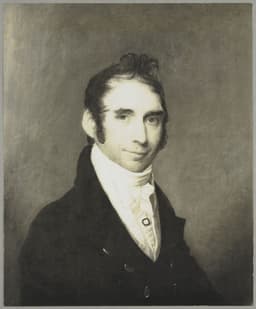
Gilbert Stuart, circ. Wikimedia Commons. Public domain.
1744–1809
John Walker
0
recorded events
Connected towns:
Charlottesville, VABiography
John Walker (1744–1809): Planter, Patriot, and Witness to Revolution
Born in 1744 into the upper echelons of Albemarle County's planter aristocracy, John Walker was shaped by privilege, connection, and the expectation of public service that defined Virginia's colonial elite. His father, Dr. Thomas Walker, was no ordinary country gentleman — he was a physician, explorer, and land speculator whose 1750 expedition through the Cumberland Gap made him one of Virginia's most recognized frontiersmen. The elder Walker also served as guardian to the young Thomas Jefferson after the death of Jefferson's father, a role that intertwined the Walker and Jefferson families for decades. John grew up at Belvoir, the family estate near Charlottesville, and was educated at the College of William and Mary, where he deepened his friendship with Jefferson. At William and Mary, Walker absorbed the classical education and Enlightenment thinking that shaped an entire generation of Virginia's Revolutionary leaders. Upon returning to Albemarle County, he assumed management of Belvoir and its enslaved workforce, stepping into his expected role as a planter and local officeholder. His social position, family name, and education made his entry into public life virtually inevitable, and the dense web of relationships connecting Virginia's gentry ensured that Walker would be close to the center of colonial politics long before revolution was in the air.
Walker's entry into the Revolutionary cause followed the pattern of many Virginia planters who moved from local governance into broader political engagement as the crisis with Britain deepened in the 1770s. He served in various capacities in Virginia's colonial and then revolutionary government, representing Albemarle County's planter interests as the colony transitioned from royal authority to self-governance. His prominence in local affairs and his family connections positioned him naturally among those who supported the Patriot cause, and he held the rank of colonel in the Virginia militia, a title that reflected both his social standing and his willingness to shoulder military responsibility during the conflict. While Walker was not a battlefield commander in the mold of Washington or Greene, his militia service placed him within the broader mobilization effort that sustained Virginia's contribution to the war. His political career gained national dimensions when he was selected as a delegate to the Continental Congress in 1780, representing Virginia at a moment when the war's outcome remained deeply uncertain. This appointment reflected the trust that Virginia's leadership placed in Walker as a reliable, well-connected representative capable of navigating the complex politics of the Continental Congress during one of the war's most trying periods.
Walker's most consequential actions during the Revolution were political rather than military, but they were no less essential to the Patriot cause. As a Continental Congress delegate in 1780, he participated in the body's ongoing struggle to finance the war, coordinate military strategy across thirteen fractious states, and maintain the fragile unity that held the American cause together. The Congress Walker joined was beleaguered — plagued by inflation, supply shortages, and the lingering damage of Benedict Arnold's betrayal — and delegates like Walker performed the unglamorous but critical work of keeping the machinery of revolution functioning. Back in Virginia, his role in the state legislature connected him to the debates over governance, taxation, and military recruitment that shaped how the state sustained its war effort. Walker also managed his Belvoir plantation throughout the conflict, navigating the economic disruptions that wartime brought to Virginia's planter class, including the difficulties of trade, the depreciation of currency, and the constant demand for supplies to support Continental and militia forces. His willingness to serve in multiple capacities — legislator, militia officer, congressional delegate — exemplified the layered commitment that Virginia's gentry brought to the Revolutionary cause, even when their contributions lacked the dramatic visibility of battlefield heroism.
The most dramatic moment of Walker's Revolutionary experience came in June 1781, when the war arrived with terrifying speed at Charlottesville's doorstep. The Virginia legislature had relocated from Richmond to Charlottesville, believing the small town in the piedmont to be safely removed from British forces operating in the eastern part of the state. They were wrong. On June 4, 1781, Lieutenant Colonel Banastre Tarleton led a daring cavalry raid aimed at capturing Governor Thomas Jefferson and the assembled legislators. Walker was among those present in Charlottesville that morning, and he was among those who narrowly escaped as Tarleton's dragoons swept into town. The legislators scattered in haste, some fleeing on horseback, others on foot through the surrounding countryside. The raid was a humiliation for Virginia's government, but the escape of Walker and most of his fellow legislators meant that the state's political leadership survived intact, able to reconvene and continue directing Virginia's war effort. For Walker, the experience was a stark reminder that the Revolution was not merely an abstract political contest — it was a conflict that could arrive at one's own doorstep with little warning, threatening personal liberty and life itself.
Walker's relationships with other prominent Virginians placed him at the intersection of some of the Revolution's most important personal and political networks. His friendship with Thomas Jefferson, rooted in childhood and deepened at William and Mary, was the most significant of these connections and gave Walker a proximity to power that few Virginians outside Jefferson's inner circle enjoyed. Through his father's role as Jefferson's guardian, Walker had access to a relationship that was almost familial in its intimacy. He also moved within the broader circle of Virginia's Revolutionary leadership, interacting with figures like James Madison and other legislators who shaped the state's political direction during and after the war. Walker's brief service in the United States Senate in 1790, when he was appointed to fill an unexpired term, demonstrated his continued relevance in Virginia politics even as the Revolutionary generation began transitioning into the politics of the new republic. However, his most famous personal relationship — with Jefferson — ultimately became his most painful. A scandal involving Jefferson's alleged advances toward Walker's wife, Betsey, became public in the early nineteenth century, poisoning the friendship irrevocably and casting a shadow over Walker's later years that has complicated his historical reputation ever since.
Walker's legacy offers a valuable lens for understanding the American Revolution as it was experienced by the vast majority of its participants — not as commanding generals or celebrated statesmen, but as men of local prominence who served in multiple, overlapping roles to sustain the cause of independence. His story reminds us that the Revolution depended on planters who managed estates while serving in legislatures, who held militia commissions while sitting in Congress, and who risked capture by British cavalry while conducting the ordinary business of governance. Walker's presence at Charlottesville during Tarleton's raid connects him to one of the most vivid episodes of the war in Virginia, and his lifelong entanglement with Jefferson illuminates the deeply personal nature of political life in Revolutionary America, where public service and private relationships were inseparable. His Belvoir estate, his Albemarle County roots, and his family connections all anchor him in the specific landscape of piedmont Virginia, making him a representative figure of the planter class that drove the Revolution in the South. Walker died in 1809, the same year as his former friend's retirement from the presidency, a coincidence that underscores how closely their lives ran in parallel even as they ended in estrangement.
WHY JOHN WALKER MATTERS TO CHARLOTTESVILLE
John Walker's story brings the American Revolution directly to Charlottesville's landscape. His Belvoir estate was one of the most prominent plantations in Albemarle County, and his presence in town during Tarleton's dramatic June 1781 raid connects him to the single most harrowing day Charlottesville experienced during the entire war. For students and visitors exploring Revolutionary history in the region, Walker represents the planter-politicians who formed the backbone of Virginia's war effort — men whose names appear in legislative records and militia rosters rather than on monuments, but without whom independence could not have been achieved. His complicated friendship with Jefferson also reveals that the Revolution was shaped by personal loyalties, rivalries, and betrayals as much as by ideology, offering a richer and more human picture of the founding era.
TIMELINE
- 1744: Born in Albemarle County, Virginia, to Dr. Thomas Walker and Mildred Thornton Meriwether Walker
- 1764: Graduated from the College of William and Mary, where he formed a close friendship with Thomas Jefferson
- 1769: Married Elizabeth "Betsey" Moore, daughter of a prominent Virginia family
- 1775–1781: Served in the Virginia legislature and held the rank of colonel in the Virginia militia during the Revolutionary War
- 1780: Selected as a delegate to the Continental Congress, representing Virginia during a critical phase of the war
- 1781: Narrowly escaped capture during Banastre Tarleton's raid on Charlottesville on June 4
- 1790: Appointed to the United States Senate to fill the unexpired term of William Grayson
- 1802–1805: The Walker-Jefferson scandal became public, permanently damaging the relationship between the two men
- 1809: Died in Albemarle County, Virginia
SOURCES
- Malone, Dumas. Jefferson and His Time, Vol. 1: Jefferson the Virginian. Little, Brown and Company, 1948.
- Kranish, Michael. Flight from Monticello: Thomas Jefferson at War. Oxford University Press, 2010.
- Dabney, Virginius. "The Walker-Jefferson Scandal." The Virginia Magazine of History and Biography, Vol. 65, No. 4 (1957).
- Library of Virginia. "John Walker (1744–1809)." Dictionary of Virginia Biography. https://www.lva.virginia.gov/
- Journals of the Continental Congress, 1774–1789. Library of Congress. https://www.loc.gov/collections/journals-of-the-continental-congress/