

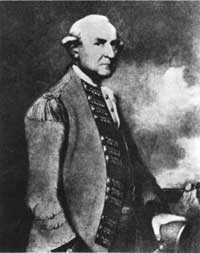
Unknown, 2006. Wikimedia Commons. Public domain.
1738–1805
Lord Charles Cornwallis
2
recorded events
Connected towns:
Wilmington, DEBiography
Lord Charles Cornwallis: The Flanking General of Brandywine
Born on the last day of 1738 into one of England's most distinguished aristocratic families, Charles Cornwallis grew up amid the privileges and expectations of the British peerage. His father, the first Earl Cornwallis, ensured that young Charles received an education befitting his station, first at Eton and then at a military academy in Turin, Italy, where he studied the art of warfare on the European continent. These formative years instilled in him not only the technical skills of an officer but a restless energy and personal courage that would define his entire career. When the Seven Years' War erupted across Europe, Cornwallis was still a young man, yet he saw extensive action in Germany, fighting in pitched battles that taught him the brutal realities of maneuvering large formations under fire. He emerged from that conflict hardened, experienced, and respected — a junior officer who had proven himself capable of leading men in the chaos of European warfare. His combination of noble birth, professional training, and genuine combat experience made him precisely the kind of officer the British Army valued most, and his rise through the ranks seemed assured long before the American crisis transformed his destiny entirely.
The American Revolution did not begin as a straightforward assignment for Cornwallis. Unlike some British officers who viewed colonial service as beneath them, Cornwallis had actually shown sympathy in Parliament for certain American grievances, and he had been among the few peers who voted against the Stamp Act in 1765. Yet when the rebellion escalated from political protest into open warfare after 1775, Cornwallis's sense of duty to the Crown overcame whatever reservations he may have harbored about the conflict's wisdom. He accepted a commission as a major general and sailed for North America in early 1776, joining the massive British expeditionary force that was assembling to crush the rebellion decisively. His arrival coincided with the campaign for New York, where the full weight of British military power was brought to bear against Washington's Continental Army. During that campaign, Cornwallis demonstrated the aggressive, personally engaged style of command that would characterize all his American operations. His relentless pursuit of Washington's retreating forces across New Jersey in late 1776 showcased both his energy and his willingness to push his troops to the breaking point. The turning point for Cornwallis was not a single moment but a gradual transformation — from a sympathetic parliamentarian into one of Britain's most determined and dangerous field commanders on American soil.
The Battle of Brandywine on September 11, 1777, stands as Cornwallis's most significant military action during the American Revolution and arguably the most tactically polished battlefield performance of his entire career. On that day, he commanded the main British striking force — the flanking column — in a carefully orchestrated turning movement designed to collapse Washington's defensive position along Brandywine Creek in southeastern Pennsylvania. While a diversionary force under the Hessian general Wilhelm von Knyphausen engaged the Americans frontally at Chadd's Ford, Cornwallis led approximately eight thousand troops on a grueling seventeen-mile march through the northern countryside, crossing the Brandywine at Trimble's Ford and Jefferis' Ford — unmarked crossings that American intelligence had catastrophically failed to cover. The march required discipline, endurance, and precise timing, and Cornwallis delivered on all counts. By late afternoon, his column had crossed the creek and formed for battle on Osborne's Hill, directly threatening the exposed American right wing. The attack that followed was devastating. American units under Generals Sullivan, Stirling, and Stephen attempted to form a defensive line but were overwhelmed by the weight and coordination of Cornwallis's assault. The American right crumbled, and only desperate rearguard actions and the fading light prevented a complete rout.
The flanking maneuver at Brandywine succeeded not merely because of Cornwallis's personal leadership but because of the broader intelligence and planning that made the march possible. Local Loyalists familiar with the northern countryside provided critical knowledge of the unmarked fords and the roads connecting them — information that Washington's own intelligence network had failed to secure or, worse, had actively denied existed. Cornwallis's column moved through terrain that the Americans believed impassable for a large military formation, and the surprise was nearly total when his troops appeared on the American right flank in the late afternoon. The battle's aftermath was equally consequential. Washington's army, though battered, managed to retreat in sufficient order to fight again, but the road to Philadelphia was now open. Within weeks, the British occupied Wilmington, Delaware, and then marched into Philadelphia itself, capturing the rebel capital. Cornwallis played a direct role in this sequence: his victory at Brandywine made Howe's advance on Wilmington and Philadelphia not just possible but inevitable. The flanking attack had broken the one defensive line that stood between the British army and its strategic objective.
Cornwallis's effectiveness at Brandywine and throughout the war was shaped profoundly by his relationships with other commanders, both cooperative and contentious. His most important professional relationship during the Philadelphia campaign was with General Sir William Howe, the British commander-in-chief, who devised the overall plan for the Brandywine flanking movement. Cornwallis and Howe shared an understanding of aggressive maneuver warfare, and at Brandywine their collaboration produced a battle plan reminiscent of Frederick the Great's oblique attack — a diversionary fixing force combined with a powerful flanking blow. Yet Cornwallis also served alongside officers whose caution frustrated him. His relationship with General Sir Henry Clinton, who succeeded Howe as commander-in-chief, would later prove far more strained. On the American side, Cornwallis's most enduring adversary was George Washington himself, a commander whose resilience repeatedly denied Cornwallis the decisive victory that seemed within reach. The Hessian officers who served alongside Cornwallis, including Knyphausen at Brandywine, were essential partners whose professionalism made combined operations possible. These alliances and rivalries shaped the war's trajectory as much as any single battle, and Cornwallis operated within a command structure that was often as politically fraught as the battlefields were physically dangerous.
For all his tactical brilliance at Brandywine, Cornwallis's American career was marked by setbacks, controversies, and moral complexities that complicate any simple portrait of the man. His aggressive pursuit of Washington across New Jersey in late 1776 ended in humiliation when Washington's surprise attack at Trenton on December 26 reversed British momentum and reinvigorated the American cause. Cornwallis was, by some accounts, preparing to return to England when the Trenton disaster forced him back into the field. Later, when the war shifted to the southern theater, his victories at Camden and Guilford Courthouse came at terrible cost — Pyrrhic triumphs that bled his army while failing to pacify the countryside. The moral dimensions of the southern campaign were particularly troubling: British and Loyalist forces under commanders associated with Cornwallis engaged in brutal reprisals against rebel civilians, and the war in the Carolinas became a vicious cycle of atrocity and retaliation. Whether Cornwallis personally sanctioned such conduct or merely failed to prevent it remains a matter of historical debate. His strategic decisions in the south — particularly the fateful march into Virginia that led to Yorktown — drew sharp criticism from Clinton and other senior officers who believed Cornwallis had abandoned his responsibilities in the Carolinas.
The war changed Cornwallis in ways that are difficult to quantify but impossible to ignore. The officer who arrived in North America in 1776 was confident, energetic, and convinced of British military superiority. The general who surrendered at Yorktown in 1781 had been humbled by an enemy he had repeatedly underestimated and by a war that defied conventional European military logic. The American landscape itself — vast, poorly mapped, and populated by civilians whose loyalties were uncertain — challenged everything Cornwallis had learned in the manicured battlefields of Germany. At Brandywine, local knowledge had been his weapon; in the Carolinas, the lack of reliable local intelligence and the hostility of the population became his undoing. Personal tragedy compounded his professional difficulties: his beloved wife, Jemima, died in England in 1779 while he was serving in America, and by some accounts her death cast a shadow over his remaining years in the war. Friends and subordinates noted that Cornwallis became more reckless after her passing, as though personal grief fueled the aggressive impulses that had always characterized his command. The war stripped away the certainties of his earlier career and left him a more complex, perhaps more fatalistic figure.
Cornwallis's role in the war's resolution is defined by the single most consequential event of his military life: the surrender at Yorktown, Virginia, on October 19, 1781. Cornered on the peninsula by a combined Franco-American force under Washington and the French general Rochambeau, and cut off from naval relief by the French fleet under Admiral de Grasse, Cornwallis found himself in an impossible position. His army, weakened by disease and constant skirmishing, could neither break out nor hold indefinitely. The formal surrender of approximately seven thousand British troops effectively ended major combat operations in the American Revolution, though the peace treaty would not be signed until 1783. Cornwallis himself did not personally hand over his sword — he claimed illness and sent his deputy, General Charles O'Hara, to perform the ceremony, a gesture that some interpreted as a final act of defiance and others as simple humiliation. The road from Brandywine to Yorktown traced a devastating arc: the same officer who had delivered Britain's most decisive tactical victory in 1777 presided over the strategic catastrophe that lost the war. Yet the British government did not treat Cornwallis as a scapegoat. The blame for Yorktown was distributed widely, and Cornwallis retained enough political and military credibility to secure prestigious appointments after the war.
Among his contemporaries, Cornwallis emerged from the American Revolution with his reputation remarkably intact. British officers and politicians largely blamed the war's failure on strategic miscalculations by the ministry and on the intervention of France, rather than on the battlefield performance of commanders like Cornwallis. His aggressive energy, personal bravery, and tactical skill were widely acknowledged, and even American officers who had faced him at Brandywine and elsewhere respected his abilities. Washington himself reportedly regarded Cornwallis as the most dangerous of the British generals he had confronted. In Parliament, Cornwallis was treated not as a defeated commander but as a proven leader who deserved greater responsibilities. The Crown appointed him Governor-General of India in 1786, where he prosecuted the Third Anglo-Mysore War and implemented sweeping administrative reforms that reshaped British colonial governance. He later served as Lord Lieutenant of Ireland during the turbulent 1790s and returned to India for a second appointment as Governor-General in 1805, the year of his death. His post-American career was, by any measure, more consequential than his American service, yet it was Brandywine and Yorktown that fixed his place in the historical imagination of two nations.
Students and visitors today should know Cornwallis because his story illuminates the human dimensions of the American Revolution in ways that abstract discussions of liberty and tyranny cannot. He was not a cartoon villain but a capable, courageous officer serving a cause he believed in, and his tactical brilliance at Brandywine demonstrates that American independence was never inevitable — it was won against formidable opponents who came terrifyingly close to crushing the rebellion. The flanking march at Brandywine, made possible by local Loyalist knowledge of unmarked fords, reminds us that the Revolution was also a civil war, with Americans on both sides of the conflict. Cornwallis's arc from Brandywine's victor to Yorktown's vanquished encapsulates the larger arc of the war itself: early British dominance giving way to strategic overextension and ultimate defeat. For visitors to the Brandywine battlefield and to Wilmington, Delaware — the town that fell to British occupation as a direct consequence of Cornwallis's flanking attack — his presence is woven into the landscape. Understanding Cornwallis means understanding what the Continental Army was up against, and why the American victory, when it finally came, was so extraordinary an achievement against one of the eighteenth century's most formidable military professionals.
WHY LORD CHARLES CORNWALLIS MATTERS TO WILMINGTON
Wilmington fell to British occupation as a direct consequence of Cornwallis's flanking victory at Brandywine on September 11, 1777. His seventeen-mile march through the northern countryside — guided by Loyalist knowledge of unmarked fords — collapsed the American defensive line and opened the road to both Wilmington and Philadelphia. For students and visitors walking these grounds today, Cornwallis's story is a reminder that the Revolution's outcome was never guaranteed. A skilled, aggressive enemy came within hours of destroying Washington's army. Wilmington's occupation was not an abstraction but a lived reality for its residents, and understanding the British general who made it happen deepens our appreciation for both the vulnerability and the resilience of the American cause. Cornwallis's presence here connects battlefield tactics to community consequences.
TIMELINE
- 1738: Born December 31 into the British aristocracy, son of the first Earl Cornwallis
- 1757–1762: Serves in the Seven Years' War in Germany, gaining extensive combat experience
- 1765: Votes against the Stamp Act in the House of Lords, showing early sympathy for colonial grievances
- 1776: Arrives in North America as a major general; participates in the New York campaign and pursues Washington across New Jersey
- 1777: Commands the decisive flanking column at the Battle of Brandywine on September 11, routing the American right wing and opening the road to Wilmington and Philadelphia
- 1780: Wins a major victory at the Battle of Camden in South Carolina, destroying an American army under General Gates
- 1781: Fights the costly Battle of Guilford Courthouse in March; marches into Virginia and is besieged at Yorktown
- 1781: Surrenders to the combined Franco-American force at Yorktown on October 19, effectively ending the war
- 1786–1793: Serves as Governor-General of India, implementing major administrative and military reforms
- 1805: Dies on October 5 in Ghazipur, India, during his second appointment as Governor-General
SOURCES
- Wickwire, Franklin and Mary. Cornwallis: The American Adventure. Houghton Mifflin, 1970.
- McGuire, Thomas J. The Philadelphia Campaign, Volume I: Brandywine and the Fall of Philadelphia. Stackpole Books, 2006.
- Harris, Michael C. Brandywine: A Military History of the Battle that Lost Philadelphia but Saved America, September 11, 1777. Savas Beatie, 2014.
- National Park Service. "Brandywine Battlefield." https://www.nps.gov/places/brandywine-battlefield.htm
- Cornwallis, Charles. Correspondence of Charles, First Marquis Cornwallis. Edited by Charles Ross. John Murray, 1859.
Events
Sep
1777
Battle of BrandywineWilmingtonBritish General# The Battle of Brandywine In the late summer of 1777, the American Revolution hung in a precarious balance. After evacuating New Jersey earlier that year, British Commander-in-Chief General Sir William Howe devised an ambitious plan to capture Philadelphia, the seat of the Continental Congress and the symbolic capital of the fledgling American nation. Rather than march overland through New Jersey, where Washington's forces could harass his columns, Howe chose a bolder approach. He loaded approximately 15,000 British and Hessian troops onto a massive fleet and sailed south from New York, up the Chesapeake Bay, and landed at the Head of Elk in Maryland in late August. From there, his army began its march northeastward toward Philadelphia, setting the stage for one of the war's most consequential engagements. General George Washington, Commander-in-Chief of the Continental Army, recognized that he could not simply abandon Philadelphia without a fight. Doing so would devastate American morale and hand the British an enormous political victory. He positioned his army of roughly 11,000 men along the eastern bank of Brandywine Creek, approximately ten miles northwest of Wilmington, Delaware, choosing the waterway as a natural defensive line. Washington concentrated his forces around Chadd's Ford, the most obvious crossing point, and placed Major General John Sullivan in command of the right wing to guard the army's northern flank. It was a reasonable defensive arrangement, but it suffered from a critical vulnerability: Washington and his officers had incomplete knowledge of the fords further upstream, leaving potential crossing points unguarded and unmonitored. On September 11, 1777, Howe exploited that vulnerability with a plan that demonstrated tactical brilliance. He divided his army into two wings, a risky maneuver that could have proven disastrous if Washington had detected it in time. One column, composed of roughly 7,000 troops under the Hessian General Wilhelm von Knyphausen, advanced directly toward Chadd's Ford, engaging the Americans in a conspicuous frontal demonstration designed to fix Washington's attention and hold his forces in place. Meanwhile, Lord Charles Cornwallis led the main striking force of approximately 8,000 men on an arduous flanking march of nearly seventeen miles to the north and east, crossing the Brandywine at unguarded fords well above the American positions. Throughout the morning and into the early afternoon, conflicting intelligence reports reached Washington — some warning of a flanking column, others denying it — and the resulting confusion paralyzed the American command at the critical moment when decisive action might have altered the outcome. By late afternoon, Cornwallis's column had completed its march and descended upon the American right flank with devastating force. Sullivan's division, caught in the process of hastily repositioning, bore the brunt of the attack and was driven from the field in disorder. The situation threatened to become a complete rout, one that could have destroyed the Continental Army and effectively ended organized American resistance in the northern theater. It was at this desperate moment that Continental Army General Nathanael Greene performed one of the war's most remarkable feats of leadership. Greene force-marched his division nearly four miles in approximately forty-five minutes to establish a defensive line that checked the British advance and allowed the shattered American units to withdraw. His disciplined rearguard action prevented the defeat from becoming a catastrophe. The battle exacted a heavy toll on the American side. Continental forces suffered approximately 1,300 casualties — killed, wounded, and captured — making Brandywine the largest single-day land battle of the Revolutionary War in the northern theater. British losses, while lighter, were not insignificant. Two weeks later, Howe's army marched into Philadelphia unopposed, forcing the Continental Congress to flee to York, Pennsylvania. Yet the Battle of Brandywine, despite being a clear American defeat, carried significance beyond its immediate military outcome. Washington's army survived to fight another day, and the experience revealed both the weaknesses in American intelligence-gathering and the extraordinary resilience of commanders like Greene, whose performance at Brandywine cemented his reputation as one of the Continental Army's most dependable generals. The lessons learned in the rolling hills along the Brandywine would inform Washington's subsequent decisions, including his bold strike at Germantown just weeks later, and ultimately contributed to the evolution of the Continental Army into a more effective fighting force capable of enduring the long struggle ahead.
Sep
1777
Local Knowledge and the Brandywine Flanking RouteWilmingtonBritish General**Local Knowledge and the Brandywine Flanking Route** In the late summer of 1777, the American Revolution entered one of its most critical phases. British General Sir William Howe, having abandoned his overland approach through New Jersey, transported his army by sea to the northern reaches of the Chesapeake Bay, landing at Head of Elk, Maryland, in late August. His objective was the rebel capital of Philadelphia, and to reach it, his forces would have to cross the Brandywine Creek, a waterway that wound through the rolling hills and farmland of southeastern Pennsylvania and northern Delaware. General George Washington, anticipating this route, positioned his Continental Army along the creek's eastern bank, anchoring his defenses at Chadds Ford, where the main road to Philadelphia crossed the water. Washington believed that by guarding the known fords, he could force a costly frontal engagement on favorable ground. What he did not fully appreciate was how deeply local knowledge — and local loyalties — would undermine his defensive plan. As British forces advanced through the Delaware Valley toward the Brandywine, their scouts and intelligence officers actively sought information from the surrounding population. The region was home to a complex patchwork of political sympathies. While many residents supported the Patriot cause, a significant number remained loyal to the Crown, and others, particularly among the area's substantial Quaker community, held pacifist convictions that nonetheless sometimes translated into quiet cooperation with British authorities. In the days before the battle, Loyalist sympathizers — including Quaker farmers who had spent their lives working the land along the Brandywine — provided British officers with detailed intelligence about the creek's geography. Crucially, they revealed the existence of northern fords, including Jefferis' Ford and Trimble's Ford, that were either lightly guarded or entirely unprotected by Washington's forces. These crossings, well known to locals but overlooked in American defensive planning, offered a viable route for a large body of troops to cross the Brandywine far upstream and swing around the American right flank. Lord Charles Cornwallis, one of Howe's most capable and aggressive subordinates, was entrusted with exploiting this intelligence. On the morning of September 11, 1777, Howe divided his army into two columns. One, under the Hessian general Wilhelm von Knyphausen, advanced directly toward Chadds Ford to pin Washington's attention with a diversionary attack. Meanwhile, Cornwallis led a force of roughly eight thousand troops on a long, sweeping march to the north, crossing the unguarded fords and descending on the American right flank near Birmingham Meeting House. Washington received conflicting reports throughout the day about the movement of this column, and by the time the threat became unmistakable, it was nearly too late. The Continental forces under General John Sullivan scrambled to reposition, but Cornwallis struck with devastating effect in the late afternoon. The American right crumbled, and only determined rearguard fighting — including a fierce stand by troops under General Nathanael Greene — prevented the retreat from becoming a total rout. The Battle of Brandywine was a decisive British victory and opened the road to Philadelphia, which Howe's forces occupied on September 26, 1777. For the Americans, the defeat was a bitter lesson in the importance of thorough reconnaissance and the dangers of underestimating the enemy's access to local intelligence. Washington and his officers were criticized for failing to adequately scout and defend the northern fords, and the role played by Loyalist informants became a lasting source of controversy and resentment in the Delaware Valley. Neighbors accused neighbors of betrayal, and the memory of who had aided the British lingered in local communities for generations. In the broader story of the Revolution, the Brandywine flanking route illustrates how the war was shaped not only by armies and generals but also by the divided loyalties of ordinary civilians. The intelligence provided by local farmers and Loyalist sympathizers was as consequential as any tactical decision made on the battlefield. It reminds us that the American Revolution was, at its heart, a civil conflict, fought within communities as much as between nations, and that the knowledge of a few individuals about the fords of a quiet creek could alter the course of history.