

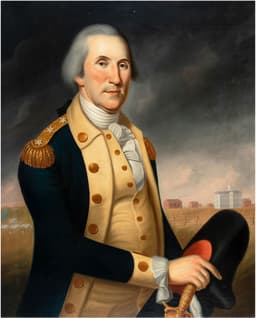
Charles Peale Polk / After Charles Willson Peale, circ. Wikimedia Commons. Public domain.
1734–1781
James Caldwell
8
recorded events
Connected towns:
Elizabeth, NJBiography
James Caldwell (1734–1781): The Fighting Parson of Elizabethtown
Born in 1734 in Charlotte County, Virginia, the man who would become one of the most celebrated patriot ministers of the American Revolution came from modest backcountry origins. Young James Caldwell made his way north to attend the College of New Jersey — the institution that would later become Princeton University — where he immersed himself in the rigorous theological and classical curriculum that had already produced a generation of influential Presbyterian clergymen. His education at Princeton placed him squarely within a network of intellectually combative, politically engaged ministers who viewed religious liberty and civil liberty as inseparable causes. Ordained as a Presbyterian minister, Caldwell received a call in 1762 to lead the First Presbyterian Church of Elizabethtown, one of the oldest and most prestigious congregations in New Jersey. The appointment placed him at the center of a thriving colonial town with deep ties to both the mercantile economy of New York and the political culture of the mid-Atlantic colonies. Caldwell proved a magnetic preacher whose sermons drew large and devoted congregations, and his parsonage quickly became a gathering place for the leading families of Essex County. The social and intellectual world he built around his church would soon become the foundation for revolution.
As the imperial crisis deepened in the early 1770s, Caldwell transformed his pulpit into one of the most potent instruments of patriot advocacy in New Jersey. His sermons on colonial rights and resistance to Parliamentary taxation were widely discussed, and his moral authority as a clergyman lent weight to the political arguments circulating through the taverns and meetinghouses of northeastern New Jersey. He served on the local Committee of Safety, the extralegal body that organized resistance and enforced patriot discipline in the Elizabethtown area, and he used his extensive network of congregational and ministerial contacts to build support for the Continental cause across multiple communities. When open warfare erupted in 1775, Caldwell did not hesitate to take on a direct military role. He accepted appointment as chaplain to Colonel Elias Dayton's 3rd New Jersey Regiment, one of the state's first Continental formations, and accompanied the troops as they mustered and prepared for the campaigns ahead. His energy, organizational talent, and combative temperament were immediately evident, earning him the nickname "the Fighting Parson" — a title that reflected not hand-to-hand combat but the fierce, tireless spirit he brought to every dimension of the patriot effort, from recruiting to morale to logistics.
Caldwell's most important contributions to the war lay in his dual role as spiritual leader and political organizer in one of the most contested regions of the conflict. Northeastern New Jersey, with its proximity to British-held New York, was a perpetual battleground where raids, skirmishes, and intelligence operations defined daily life. Caldwell served as a critical link between the civilian population and the Continental military establishment, rallying communities that were exhausted by years of foraging, occupation, and divided loyalties. His chaplaincy with the 3rd New Jersey Regiment kept him close to the fighting, and his presence among the troops bolstered the morale of soldiers who were often poorly supplied and far from home. He also played a significant role in sustaining the infrastructure of patriot communication and propaganda. In 1779, the establishment of the New Jersey Journal — a patriot newspaper — provided a new outlet for the kind of political messaging that Caldwell had long championed from the pulpit. His influence extended well beyond the walls of the First Presbyterian Church, reaching into the militia musters, the county committees, and the broader network of Presbyterian congregations that formed the backbone of New Jersey's resistance to British authority.
The events of 1780 brought catastrophe to Caldwell and his family, and seared his name into the memory of the Revolution in New Jersey. On June 7, 1780, British and Hessian forces launched a major raid on Connecticut Farms — the village now known as Union — as part of a broader advance toward the patriot stronghold at Morristown. During the attack, a British soldier shot and killed Caldwell's wife, Hannah, as she sheltered with her children in a parsonage. The precise circumstances of her death remained a subject of bitter controversy: patriots accused the British of deliberate murder, while British officers claimed it was an accident of war. Regardless, Hannah Caldwell's death became one of the most inflammatory incidents of the entire conflict in New Jersey, galvanizing patriot sentiment and deepening the hatred between the two sides. Shortly after, during the Battle of Springfield on June 23, 1780, Caldwell was present as chaplain to the patriot forces defending against the renewed British advance. During this same period of violence, the First Presbyterian Church of Elizabethtown — the physical and spiritual center of Caldwell's life's work — was burned, likely by British or Loyalist forces targeting the symbols of patriot resistance.
Caldwell's relationships with other patriot leaders placed him at the heart of a network that sustained the revolution in New Jersey through its darkest years. His close association with Colonel Elias Dayton, commander of the 3rd New Jersey Regiment, gave him direct access to the military chain of command and allowed him to serve as an intermediary between soldiers and civilians in the Elizabethtown area. His standing among Presbyterian clergy connected him to a broader intercolonial network of ministers who used their pulpits and their congregational structures to support the war effort — a network that stretched from New England to the Carolinas. Caldwell's prominence, however, also made him extraordinarily vulnerable. British and Loyalist forces in the region specifically targeted patriot leaders and their families, and the destruction visited upon the Caldwell household was part of a deliberate strategy to break the morale of the resistance. The tragic arc of his final years — his wife's murder, the burning of his church, and his own violent death — illustrates the intensely personal nature of the war in the mid-Atlantic, where neighbors fought neighbors and the line between military and civilian life was almost nonexistent.
The story of James Caldwell's death adds a final, troubling dimension to his legacy and to the history of the Revolution itself. On November 24, 1781, at Elizabethtown Point, Caldwell was shot and killed by a Continental sentry named James Morgan. Morgan claimed that Caldwell had refused to submit his belongings for inspection, but many contemporaries believed that the sentry had been bribed by Loyalist agents to assassinate the minister. Morgan was tried by court-martial, convicted of murder, and hanged in January 1782. The killing — whether an act of conspiracy, insubordination, or tragic misunderstanding — underscored a painful reality: the Revolution consumed its own as readily as it destroyed its enemies. Caldwell's life and death became a powerful symbol of the sacrifices demanded by the war, particularly in communities like Elizabethtown that endured years of sustained violence. His legacy endures not as a story of battlefield glory but as a testament to the moral courage, personal loss, and unresolved ambiguity that characterized the American struggle for independence in the places where the fighting was closest to home.
WHY JAMES CALDWELL MATTERS TO ELIZABETH
James Caldwell's story reveals what the American Revolution truly looked like in the towns where it was fought — not as a distant contest of armies but as an intimate, devastating struggle that reached into churches, homes, and families. His First Presbyterian Church was the institutional heart of Elizabethtown's resistance, and its destruction by fire embodied the cost of that defiance. The murder of his wife Hannah at Connecticut Farms and his own killing at Elizabethtown Point made the Caldwell family a symbol of the war's toll on New Jersey's civilian communities. For students and visitors exploring the revolutionary landscape of Elizabeth today, Caldwell's life connects the places that still mark the town — the church site, the waterfront, the surrounding communities — to the human experiences of courage, grief, and sacrifice that gave those places their enduring meaning.
TIMELINE
- 1734: Born in Charlotte County, Virginia
- 1762: Called as pastor of the First Presbyterian Church of Elizabethtown, New Jersey
- 1775: Appointed chaplain to Colonel Elias Dayton's 3rd New Jersey Regiment
- 1779: The New Jersey Journal is established, amplifying patriot messaging in the Elizabethtown area
- 1780, June 7: Wife Hannah Caldwell killed by a British soldier during the raid on Connecticut Farms
- 1780, June 23: Serves as chaplain to patriot forces at the Battle of Springfield
- 1780: First Presbyterian Church of Elizabethtown burned during the British incursions
- 1781, November 24: Shot and killed by Continental sentry James Morgan at Elizabethtown Point
- 1782, January: James Morgan convicted of murder and hanged
SOURCES
- Hatfield, Edwin F. History of Elizabeth, New Jersey. Carlton and Lanahan, 1868.
- Fleming, Thomas. New Jersey: A History. W.W. Norton, 1984.
- Stryker, William S. The Battle of Monmouth. Princeton University Press, 1927.
- Thayer, Theodore. Colonial and Revolutionary Morris County. Morris County Heritage Commission, 1975.
- New Jersey Historical Society. Caldwell Family Papers and related manuscripts. Newark, New Jersey.
Events
Apr
1775
Elizabethtown Militia MobilizationElizabethChaplain to the 3rd New Jersey Regiment# Elizabethtown Militia Mobilization, 1775 In the spring of 1775, the small but politically active town of Elizabethtown, New Jersey, stood at a crossroads that mirrored the crisis facing all thirteen colonies. For months, tensions between the American colonies and the British Crown had been escalating through acts of parliamentary taxation, colonial protest, and increasingly sharp rhetoric on both sides. Elizabethtown, situated along the Arthur Kill waterway and serving as one of New Jersey's most prominent communities, had already become a hub of patriot organizing. Local leaders had established committees of correspondence and committees of safety, mirroring similar bodies across the colonies, which served as shadow governments coordinating resistance to British policy. These committees kept Elizabethtown in close communication with patriot networks throughout New Jersey and beyond, ensuring that when the moment of crisis arrived, the town would not be caught unprepared. That moment came in late April 1775, when riders carried the stunning news southward from Massachusetts: on April 19, British regulars and colonial militiamen had exchanged gunfire at Lexington and Concord. The shots that echoed across the Massachusetts countryside reverberated with extraordinary speed through the colonies, and when word reached Elizabethtown, the town's response was swift and decisive. Militia companies mustered throughout the community, drawing men from farms, workshops, and homes into organized military formations. This was not an improvised reaction but the culmination of months of quiet preparation. The committees of correspondence and safety had already identified leaders, stockpiled supplies, and cultivated a spirit of readiness among the population. Elizabethtown's militia drew on a reservoir of experienced soldiers, men who had served in earlier colonial conflicts, as well as well-connected civic leaders who understood the gravity of the moment. At the center of this mobilization stood Colonel Elias Dayton, who organized the local forces into what would eventually become part of the 3rd New Jersey Regiment, a unit destined to serve the Continental cause throughout the war. Dayton's leadership gave the militia a professional backbone, transforming volunteers into something resembling a disciplined fighting force. Supporting this military effort were figures whose influence extended well beyond the battlefield. James Caldwell, a fiery Presbyterian minister, served as chaplain to the 3rd New Jersey Regiment, lending moral authority and spiritual encouragement to the patriot cause. Caldwell's presence reflected the deep intertwining of religious conviction and revolutionary fervor that characterized many New Jersey communities. Meanwhile, William Livingston, a delegate to the Continental Congress, worked to organize New Jersey's broader defensive posture, ensuring that local mobilizations like Elizabethtown's fit into a colony-wide strategy of military preparedness. Livingston's efforts helped channel grassroots energy into a coordinated framework that would prove essential in the difficult years ahead. The mobilization fundamentally transformed Elizabethtown's character. What had been a center of political dissent and civilian organizing became, almost overnight, a military staging area. The town's geographic position made this transformation both strategically valuable and deeply dangerous. Situated directly across the Arthur Kill from territories that would soon fall under firm British control, Elizabethtown occupied a front line that never truly quieted during the war. It served simultaneously as a base for patriot operations, including patrols, intelligence gathering, and offensive raids, and as a vulnerable target for British and Loyalist attacks. The militia units formed during those urgent days in 1775 would remain the backbone of the town's defense for years to come, providing the manpower necessary for garrison duty, coastal surveillance, and resistance to the punishing British raids that would repeatedly test the community's resolve. Elizabethtown's rapid mobilization mattered beyond its local significance because it demonstrated that New Jersey, a colony sometimes characterized as divided in its loyalties, could produce swift and organized military resistance. As one of the first communities in the colony to mobilize for the Continental cause, Elizabethtown helped set the tone for New Jersey's broader participation in the Revolution. The networks of leadership, military organization, and community solidarity forged in those early weeks of mobilization would be tested repeatedly as the war dragged on, but they proved remarkably durable. In this way, the events of late April 1775 in Elizabethtown were not merely a reaction to distant gunfire in Massachusetts but the beginning of a long and costly commitment to the cause of American independence, one that would shape the town's identity for generations to come.
Jan
1776
Formation of the 3rd New Jersey RegimentElizabethRegimental chaplain# The Formation of the 3rd New Jersey Regiment In the closing months of 1775 and the opening weeks of 1776, as the American colonies moved inexorably from protest toward full-scale war with Great Britain, communities throughout New Jersey faced a momentous decision. The fighting at Lexington, Concord, and Bunker Hill had already bloodied the ground of Massachusetts, and the Continental Congress was working urgently to transform a scattered collection of local militias into something resembling a professional army. It was within this climate of uncertainty, fear, and fierce determination that Colonel Elias Dayton organized the 3rd New Jersey Regiment of the Continental Army, drawing its ranks heavily from the men of Elizabethtown and its surrounding communities. What had begun as informal gatherings of local militia companies now took on the weight of a formal military commitment to a cause that would demand everything from those who answered its call. Elizabethtown, known today as Elizabeth, was already a hub of revolutionary sentiment in New Jersey. Its residents had watched with growing alarm as British policies tightened around the colonies, and many of its leading citizens had spoken openly in favor of resistance. Colonel Dayton, a respected figure in the community, was a natural choice to lead the new regiment. His ability to recruit locally meant that the men who filled the regiment's companies were not strangers to one another. They were neighbors, fellow parishioners, and relatives, bound together by ties that predated their military service. This gave the 3rd New Jersey a cohesion rooted in community, but it also meant that every casualty the regiment suffered would be felt with particular sharpness back home. Among the most notable figures attached to the regiment was Reverend James Caldwell, the fiery Presbyterian minister who served as its chaplain. Caldwell was already well known in Elizabethtown for his passionate advocacy of the patriot cause from the pulpit, and his decision to take on a formal role with the Continental Army only deepened the connection between the town's spiritual life and its military struggle. His wife, Hannah Caldwell, remained in the community as a civilian, embodying the quiet endurance of the countless women who kept families and households together while their husbands served. The Caldwells would both become tragic figures of the Revolution — Hannah was killed by a British soldier during a raid on Connecticut Farms in 1780, and James was shot and killed the following year under disputed circumstances — but in the early days of the regiment's formation, they represented the idealism and sacrifice that motivated Elizabethtown's commitment to independence. The 3rd New Jersey Regiment would go on to serve throughout the war, compiling a record that reflected the full breadth of the Continental Army's experience. The regiment participated in the defense of New York, endured the grueling campaigns across New Jersey as Washington's army struggled to survive, and eventually saw action in engagements in the southern theater. These were not abstract battles for the people of Elizabethtown. Every dispatch, every rumor, every returning soldier carried news that touched families directly. The regiment's journey mirrored the arc of the war itself — from the desperate early days when the cause of independence seemed fragile, through the grinding middle years of attrition and endurance, to the eventual triumph that few could have confidently predicted in 1776. The formation of the 3rd New Jersey Regiment mattered because it marked the moment when a community's resistance became institutionalized. Militia service had been familiar, local, and often temporary. Enlistment in the Continental Army was something fundamentally different. It meant placing oneself under the authority of a national command, marching far from home, and committing to a conflict whose duration no one could foresee. For Elizabethtown, the regiment formalized a sacrifice that would stretch across eight long years of war. Sons, husbands, and fathers left behind families who faced their own dangers, as New Jersey's position between British-held New York and the American capital at Philadelphia made it one of the most contested and ravaged landscapes of the entire conflict. In the broader story of the American Revolution, the 3rd New Jersey Regiment represents something essential: the transformation of local grievance into national purpose. Through figures like Dayton and Caldwell, and through the ordinary soldiers whose names have largely been lost to history, Elizabethtown gave tangible form to the ideals that the Continental Congress had expressed in words. The cost was staggering, measured in lives lost, families shattered, and a community forever changed. But the regiment's service helped secure the independence that its members had pledged to defend, linking one New Jersey town permanently to the founding of a nation.
Feb
1779
Establishment of the New Jersey JournalElizabethPresbyterian Minister**The New Jersey Journal: A Patriot Voice in the Shadow of British Raids** In the winter of 1779, the American Revolution had already been raging for nearly four years, and the state of New Jersey had become one of the most contested and war-ravaged territories in the new nation. Situated between the major British stronghold in New York City and the Continental Congress's shifting seats of power, New Jersey's communities endured a relentless cycle of raids, occupations, and skirmishes that left civilian life in a state of perpetual disruption. Roads were dangerous, towns were scarred by fire and plunder, and reliable information was scarce. It was against this turbulent backdrop that Shepard Kollock, a printer and committed patriot, published the first issue of the New Jersey Journal on February 16, 1779, from his press in Chatham, New Jersey. What began as a modest wartime publication would grow into one of the most important newspapers serving the patriot cause in the state, a lifeline of information and solidarity for communities struggling to hold together under extraordinary pressure. Kollock was no stranger to the demands of wartime publishing. By establishing his press in Chatham, he positioned himself in a relatively secure location inland from the most dangerous coastal areas, yet close enough to the centers of conflict to gather and disseminate news effectively. The newspaper served an immediate and vital purpose: it became an organ of communication for the patriot movement, publishing accounts of military operations, congressional proceedings, government proclamations, and sharp political commentary that reinforced the ideological foundations of the revolutionary struggle. In a region where British raids had destroyed or disrupted most civilian infrastructure, Kollock's Journal provided a critical link between the scattered communities of northeastern New Jersey and the broader world of patriot politics and military strategy. As the war progressed, the Journal was relocated to Elizabethtown, a move that placed Kollock and his press even closer to the front lines. Elizabethtown, situated along the Arthur Kill waterway that separated New Jersey from British-held Staten Island, was a frequent target of enemy incursions. The town and its surrounding area witnessed some of the most harrowing episodes of the war in New Jersey. The Journal documented these events with an immediacy that gave its readers not only information but a sense of shared experience and purpose. Among the most significant events it covered were the devastating raids on Elizabethtown, the fierce battles at Connecticut Farms and Springfield in 1780, and the tragic killing of Hannah Caldwell, the wife of the prominent Presbyterian minister James Caldwell. Hannah Caldwell was shot by a British soldier during the raid on Connecticut Farms, an act that shocked patriot communities and became a powerful symbol of British cruelty against civilians. James Caldwell himself was a towering figure in the local patriot movement, a fiery minister whose support for the revolutionary cause earned him the enmity of the British and whose personal loss at the hands of the enemy deepened the community's resolve to resist. Beyond its role as a chronicle of war, the New Jersey Journal served essential practical functions. It published legal notices, commercial advertisements, and government orders, helping to sustain the ordinary mechanisms of civic and economic life even amid the chaos of conflict. In doing so, the Journal was more than a newspaper; it was an institution that helped maintain the social fabric of a community under siege. The survival of the New Jersey Journal throughout the war was itself a remarkable achievement. Operating a printing press within range of British raiders required not only courage but resourcefulness. The physical dangers were real, as the British understood the power of patriot publications to rally support and sustain morale. That Kollock managed to keep his press running and his newspaper circulating was a testament to his determination and to the collective will of Elizabethtown's patriot community to maintain their voice in the public sphere. In the broader story of the American Revolution, the New Jersey Journal stands as a reminder that the fight for independence was waged not only on battlefields but also in the pages of newspapers, where printers like Shepard Kollock fought with ink and type to keep the flame of liberty burning in the hearts of their readers.
Jan
1780
Burning of the First Presbyterian ChurchElizabethPastor of the destroyed church# The Burning of the First Presbyterian Church, Elizabethtown, 1780 On the bitterly cold night of January 25, 1780, a British raiding force crossed the frozen Arthur Kill from Staten Island and descended upon the town of Elizabethtown, New Jersey. Their targets were not military fortifications or Continental Army supply depots but the homes, farms, and civic institutions of a civilian population that had thrown its support behind the patriot cause. Among the buildings put to the torch that night was the First Presbyterian Church, the spiritual and institutional heart of Elizabethtown's revolutionary community. The destruction of this house of worship was no accident of war. It was a deliberate act of retribution, aimed squarely at the congregation and, above all, at the man who led it — the Reverend James Caldwell, one of the most outspoken and defiant patriot voices in all of New Jersey. Caldwell was no ordinary clergyman. Since the early days of the conflict, he had used his pulpit to rally his congregation and the broader community to the cause of American independence. His fiery sermons blended scripture with revolutionary politics, and his influence extended well beyond the walls of his church. He served as a chaplain to Continental troops and worked tirelessly to organize supplies and support for the patriot militia. British commanders and local Loyalists regarded him as a dangerous agitator, a man whose words carried the force of action. The church over which he presided had become a symbol of organized resistance in Elizabethtown, a gathering place where political conviction and religious faith reinforced one another. By targeting the building itself, the British sought to strike at the morale of the community and to send a clear message that no institution, however sacred, would be spared if it served the rebel cause. The raid of January 25 was part of a broader pattern of British incursions into Elizabethtown during the harsh winter of 1779–1780. The freezing of the Arthur Kill, the narrow tidal strait separating New Jersey from Staten Island, gave British and Loyalist forces a natural bridge into patriot territory. Throughout that winter, raiding parties crossed the ice to burn homes, seize livestock, destroy property, and harass civilians. These attacks were designed to exhaust and demoralize a population already worn down by years of war, shortages, and uncertainty. Elizabethtown, situated so close to British-held Staten Island, bore the brunt of this campaign. The burning of the First Presbyterian Church was the most symbolically devastating of these raids, but it was far from the only act of destruction visited upon the town during those months. The consequences of the church's destruction reverberated far beyond the loss of a single building. Along with the structure itself, records and property stored within it were consumed by the flames, erasing pieces of the community's institutional memory. Yet rather than breaking the spirit of Elizabethtown's patriots, the burning of the church deepened their anger and hardened their resolve. The attack confirmed for many what they already believed — that the British were willing to wage war not just against armies but against the very fabric of civilian life. The war would continue to exact a terrible personal toll on James Caldwell and his family. His wife, Hannah Caldwell, a civilian and mother, would herself become a casualty of the conflict, killed later in 1780 during another British raid in the area. Her death, combined with the destruction of the church, transformed the Caldwell family into powerful symbols of patriot suffering and sacrifice. James Caldwell continued to serve the cause until his own tragic death, and the story of what was done to his church and his family became a rallying point for those who argued that the struggle for independence was not merely a political contest but a fight for the survival of communities, families, and the freedoms they held dear. The First Presbyterian Church would eventually be rebuilt, a testament to the resilience of the congregation and the town. But the memory of its burning endured as one of the defining episodes of the Revolutionary War in New Jersey, a reminder that the conflict's costs were measured not only in battles lost and won but in the destruction of the institutions that held communities together. In the broader story of the American Revolution, the burning of the church in Elizabethtown stands as a vivid example of how the war reached into every corner of colonial life, sparing nothing — not homes, not farms, and not even houses of worship.
Jun
1780
Battle of Connecticut FarmsElizabethHusband of Hannah Caldwell; patriot leader in the area# Battle of Connecticut Farms By the spring of 1780, the American Revolution had reached a precarious moment. General George Washington's Continental Army, encamped at Morristown in the hills of northern New Jersey, had endured one of the most brutal winters of the war — a season even harsher, by many accounts, than the famous winter at Valley Forge two years earlier. Food was scarce, pay was months in arrears, and morale had cratered to the point that portions of the army had briefly mutinied. From their stronghold on Staten Island and in New York City, British commanders watched these developments closely, looking for an opportunity to exploit American weakness. It was in this atmosphere of desperation and vulnerability that General Wilhelm von Knyphausen, a seasoned Hessian officer commanding British and German forces on Staten Island, devised a plan to strike at Washington's army by advancing through the northeastern New Jersey corridor toward Morristown. On June 7, 1780, Knyphausen launched his operation, sending approximately 5,000 British and Hessian troops across the narrow waterway separating Staten Island from the New Jersey mainland. The force landed near Elizabethtown — present-day Elizabeth — and began pushing inland along the road that led through the small village of Connecticut Farms, known today as Union. Knyphausen likely hoped that the reports of American demoralization were accurate and that his advance would meet little resistance, perhaps even encouraging widespread desertion from Washington's ranks. If the road to Morristown could be opened, the consequences for the Continental cause might be devastating. What Knyphausen encountered, however, was far from a demoralized enemy. New Jersey militia units, joined by Continental troops, rallied quickly to contest the British advance. Fighting erupted along the route as American forces used the terrain to slow and harass the larger British column. The resistance was spirited and effective, and as the day wore on, it became clear that Knyphausen's gamble had not paid off. The Americans held firm enough to prevent any meaningful breakthrough toward Morristown, and the British force was ultimately compelled to withdraw back through Elizabethtown and return to their boats on Staten Island. The cost of the engagement, however, was devastating for Connecticut Farms itself. During the fighting, much of the village was put to the torch, its homes, barns, and buildings consumed by flames in the chaos of battle. The destruction of a civilian settlement deepened the bitterness that already characterized the war in New Jersey, a state that had seen more than its share of raids, foraging expeditions, and violent skirmishes since 1776. But it was one particular act of violence that would sear the Battle of Connecticut Farms into the collective memory of the region for generations. Hannah Caldwell, the wife of Reverend James Caldwell, was sheltering inside the parsonage with her children when a British soldier fired into the building, killing her. Reverend Caldwell was a well-known patriot leader in the Elizabethtown area, a fiery Presbyterian minister whose outspoken support for the Revolution had made him a prominent figure in the community. The killing of his wife — an unarmed woman seeking only to protect her children — became an immediate and enduring symbol of British cruelty. News of Hannah Caldwell's death spread rapidly through New Jersey and beyond, galvanizing patriot sentiment at a moment when the American cause badly needed renewed determination. The consequences of her death and of the battle itself became apparent just two weeks later, when British forces again advanced into New Jersey at the Battle of Springfield on June 23, 1780. This time, American resistance was even fiercer. Reverend Caldwell himself was said to have rallied the troops, and the memory of what had happened at Connecticut Farms fueled the determination of militia and Continentals alike. The British were decisively repulsed at Springfield, and the defeat effectively ended any serious British attempt to penetrate New Jersey and reach Washington's army at Morristown. In the broader story of the Revolutionary War, the Battle of Connecticut Farms matters because it illustrates the critical role that local resistance and civilian sacrifice played in sustaining the American cause during its darkest hours. The burning of a village and the killing of Hannah Caldwell reminded Americans throughout the region of the stakes of the conflict, transforming private grief into public resolve. The events of June 1780 in northeastern New Jersey demonstrated that even when the Continental Army was at its weakest, the spirit of resistance could not be so easily extinguished.
Jun
1780
Murder of Hannah CaldwellElizabethPresbyterian Minister# The Murder of Hannah Caldwell By the spring of 1780, the people of northeastern New Jersey had endured nearly five years of a war that touched their daily lives with a cruelty few other regions of the American colonies could match. Situated between the British stronghold of New York City and the Continental Army's positions in the New Jersey highlands, the communities along the corridor from Elizabethtown to Springfield found themselves caught in a relentless cycle of raids, foraging expeditions, and retaliatory violence. It was in this volatile landscape that one of the war's most emotionally charged incidents took place — the killing of Hannah Caldwell, an event that would transform a minister's wife into a martyr and rally an entire region against the British cause. Hannah Caldwell was the wife of Reverend James Caldwell, the Presbyterian minister of Elizabethtown who had earned the nickname the "Fighting Parson" for his outspoken support of the American Revolution. Reverend Caldwell was no mere spiritual leader content to confine his patriotism to the pulpit. He served as a commissary to the Continental Army and used his considerable influence to encourage resistance among the citizens of New Jersey. His activism made the Caldwell family a conspicuous target, and the dangers of their position were well known. Yet Hannah remained in the area, caring for their children and maintaining whatever semblance of domestic normalcy was possible in a war zone. On June 7, 1780, a large British and Hessian force under the command of the Prussian-born General Wilhelm von Knyphausen advanced from the coast into New Jersey, pushing through the small settlement of Connecticut Farms on the road toward Springfield. Their objective was to probe American defenses and potentially strike a decisive blow against Washington's army. As the fighting swept through Connecticut Farms, Hannah Caldwell took shelter in the parsonage with her children, hoping that the walls of her home would provide safety from the violence raging outside. They did not. A British soldier fired into the building, and Hannah was struck and killed. The precise circumstances of her death — whether the shot was a deliberate act of murder targeting the wife of a known rebel leader or a tragic accident amid the chaos of battle — remain a matter of historical debate. But for the American patriots of New Jersey and beyond, there was no ambiguity whatsoever. Hannah Caldwell had been murdered in cold blood. The news of her death spread with extraordinary speed, amplified by the patriot press. Shepard Kollock, the printer and publisher of the New Jersey Journal based in the region, played a crucial role in disseminating the story. His newspaper and others described the killing in vivid, anguished terms — a defenseless mother slain in her own home while protecting her children. The account became one of the most widely circulated atrocity stories of the entire war, hardening public opinion against the British and galvanizing communities that had grown weary of the conflict. The propaganda value of Hannah's death was immense, but it resonated so deeply because it reflected a genuine and widespread reality: the war in New Jersey had long since ceased to distinguish between soldiers and civilians. The consequences of her killing were felt almost immediately. When Knyphausen's forces launched a second advance just sixteen days later, culminating in the Battle of Springfield on June 23, 1780, the memory of Hannah Caldwell burned fiercely in the hearts of the American defenders. Militia and Continental soldiers alike fought with a determination fueled not only by strategic necessity but by personal outrage. The British were repulsed at Springfield and withdrew permanently from the interior of New Jersey, marking the last significant British offensive in the northern states. Hannah Caldwell's death mattered because it crystallized something that the people of New Jersey had experienced for years but that the broader American public had not always fully grasped — that this war exacted its heaviest toll not only on battlefields but in homes, churches, and farmsteads. Her story became emblematic of the suffering endured by civilians caught in the grinding machinery of eighteenth-century warfare. In the long narrative of the American Revolution, her name endures as a reminder that the cost of independence was paid not only by those who carried muskets but also by those who simply tried to survive behind the doors of their own homes.
Jun
1780
Battle of SpringfieldElizabethChaplain supporting patriot forces during the battle# The Battle of Springfield By the spring of 1780, the Revolutionary War in the northern colonies had settled into an uneasy and grinding pattern of attrition. The British, headquartered in New York City, maintained a powerful garrison but had been unable to deliver a decisive blow against General George Washington's Continental Army, which was encamped in the hills around Morristown, New Jersey. The winter of 1779–1780 had been brutally harsh — one of the worst of the century — and Washington's forces had suffered terribly from cold, hunger, and dwindling morale. British commanders saw an opportunity. If they could break through the New Jersey interior and strike the weakened American camp at Morristown, they might shatter the Continental Army's presence in the region and shift the momentum of the war. The task of leading this offensive fell to Hessian General Wilhelm von Knyphausen, a seasoned commander of the German mercenary troops fighting on behalf of the British Crown. Knyphausen's first attempt came in early June 1780, when British and Hessian forces crossed from Staten Island through the town of Elizabethtown and advanced toward the small village of Connecticut Farms, just south of Springfield. The assault on Connecticut Farms proved devastating for the local population and became a rallying point for American resistance. During the attack, Hannah Caldwell, the wife of Reverend James Caldwell, a well-known Presbyterian chaplain who actively supported the patriot cause, was killed. Accounts held that she was shot through a window of her own home while caring for her children. Her death shocked and enraged communities throughout New Jersey. The destruction of Connecticut Farms and the killing of a minister's wife galvanized the militia and deepened the resolve of those fighting to defend their homes. Knyphausen, meeting stiffer resistance than expected and failing to achieve his objective, pulled back to Elizabethtown to regroup. Just sixteen days later, on June 23, 1780, Knyphausen launched a second and more determined assault. Once again, British and Hessian forces crossed from Staten Island, marched through Elizabethtown, and advanced toward Springfield with the aim of pushing through to Morristown. This time, however, the American defenders were ready and deeply motivated. Continental troops and New Jersey militia took up strong defensive positions along the roads and bridges leading into Springfield. Reverend James Caldwell, grief-stricken but undeterred by the murder of his wife, was present among the patriot forces, serving as a chaplain and providing encouragement to the soldiers in the field. The fighting was fierce. American forces held their ground with remarkable determination, repelling repeated attempts by the British to break through their lines. Knyphausen, recognizing that his forces could not achieve their objective, ordered a retreat. Before withdrawing, however, the British set fire to Springfield, burning much of the village in a final act of destruction. The retreating column marched back through Elizabethtown and crossed to Staten Island, leaving behind a trail of devastation. The Battle of Springfield proved to be the last significant British offensive operation in the northern theater of the Revolutionary War. Its failure confirmed what many strategists on both sides had begun to suspect: that the war in the North had reached a stalemate. The British could hold New York City and conduct raids along the coast, but they could not penetrate the New Jersey interior or dislodge the Continental Army from its strongholds. After Springfield, British attention and resources shifted increasingly toward the southern colonies, where commanders hoped to find greater loyalist support and more favorable conditions for a decisive campaign. For Elizabethtown, the battle marked the painful culmination of years of suffering. Situated directly between British-held Staten Island and the American positions in the New Jersey highlands, the town had served as a corridor for advancing and retreating armies throughout the war. Its residents had endured repeated raids, occupations, property destruction, and the constant anxiety of living on the front lines of the conflict. Having been traversed by enemy forces twice in just over two weeks, the community bore deep scars. The deaths of civilians like Hannah Caldwell and the burning of neighboring Springfield stood as stark reminders that the Revolutionary War was not only fought on distant battlefields but also in the streets, farms, and homes of ordinary people whose lives were forever changed by the struggle for American independence.
Nov
1781
Killing of Reverend James CaldwellElizabethVictim; shot by Continental sentry at Elizabethtown Point# The Killing of Reverend James Caldwell By the autumn of 1781, the Revolutionary War had already exacted an extraordinary toll on the community of Elizabethtown, New Jersey. Situated perilously close to British-occupied Staten Island, the town had endured years of raids, skirmishes, and the slow erosion of civil order that comes when a community is caught between two armies. No family embodied the suffering and resilience of Elizabethtown more completely than the Caldwells. Reverend James Caldwell, the fiery Presbyterian minister who served as both a spiritual leader and a driving force behind the patriot cause in northeastern New Jersey, had already lost his wife, Hannah Caldwell, to the violence of the conflict. In June 1780, during a British raid on the village of Connecticut Farms, a British soldier had fired into the Caldwell home and killed Hannah, a mother of nine children, in an act that shocked communities on both sides of the war. Her death became a rallying symbol for the patriot movement in New Jersey, deepening the resolve of those who fought against the Crown and intensifying the bitter, personal nature of the war in the region. James Caldwell, grief-stricken but undeterred, continued his work as a patriot leader, serving as a commissary for the Continental Army and using his considerable influence to sustain morale among soldiers and civilians alike. It was against this backdrop that on November 24, 1781 — just weeks after the momentous American and French victory at Yorktown, which had effectively decided the war's outcome — Reverend Caldwell arrived at a checkpoint at Elizabethtown Point. There, a Continental sentry named James Morgan confronted him. What happened next became the subject of immediate controversy and has never been resolved with certainty. Morgan claimed that Caldwell had been carrying a package and had refused to submit it for inspection, as military protocol at the checkpoint required. According to Morgan, the confrontation escalated, and he shot Caldwell in the course of enforcing his duty. But many who knew Caldwell and the circumstances of the encounter found this account deeply unconvincing. The reverend was well known to the soldiers in the area and had long worked alongside the Continental Army. Why would he refuse a routine inspection, and why would a sentry resort so quickly to lethal force against a prominent allied figure? Suspicion quickly fell on a darker explanation. Many patriots believed that Morgan had been bribed or otherwise induced by Loyalist agents to assassinate Caldwell. The reverend's outspoken support for the Revolution and his influence over the people of Elizabethtown had made him a marked man in the eyes of local Tories, and the war in New Jersey had already demonstrated that both sides were willing to use covert violence to eliminate troublesome leaders. Whether Morgan acted out of personal malice, military insubordination, or as an instrument of a Loyalist conspiracy, the result was the same: one of the patriot cause's most devoted champions lay dead, killed not by the enemy but by a fellow American. The aftermath was swift and severe. Morgan was arrested and subjected to a court-martial, during which he was convicted of murder. On January 29, 1782, he was hanged in Westfield, New Jersey, before a large crowd of spectators who came to witness the grim conclusion of the affair. The execution served both as a punishment and as a statement by military authorities that the killing of a patriot leader under such circumstances would not go unanswered, regardless of the killer's allegiance. The deaths of both Hannah and James Caldwell stand as one of the most poignant and disturbing episodes of the Revolutionary War in New Jersey. That Hannah was killed by a British soldier and James by an American one encapsulated the savage, intimate character of the conflict as it was experienced in communities like Elizabethtown, where the lines between friend and enemy, soldier and civilian, were never entirely clear. Their story reminds us that the Revolutionary War was not only a grand struggle for independence fought on famous battlefields but also a deeply personal and often brutal conflict that tore through families, congregations, and neighborhoods. The Caldwell tragedy illustrates how the war's violence reached into every corner of daily life, claiming even those who had devoted themselves most fully to the cause of liberty. For the people of Elizabethtown, the loss of both Caldwells was not an abstraction of war but an intimate wound that defined their experience of the Revolution for generations to come.