

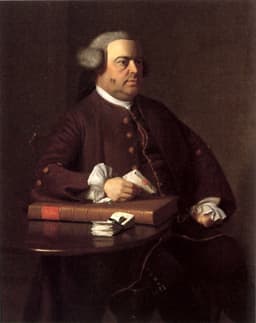
John Singleton Copley, 1763. Wikimedia Commons. Public domain.
1738–1789
Ethan Allen
3
recorded events
Biography
Ethan Allen (1738–1789)
Green Mountain Boys Commander, Vermont Land Speculator, Patriot Leader
Born in Litchfield, Connecticut, in 1738, the man who would become the embodiment of Vermont's fierce independence grew up on the rough edges of New England's expanding frontier. Allen's father died when Ethan was seventeen, cutting short any hopes of a Yale education and forcing him into the role of family provider. He moved through Connecticut and western Massachusetts, farming, operating an iron furnace, and reading voraciously in philosophy, theology, and history — building a self-taught intellect that matched his famously large physical frame. By the late 1760s, he had turned his restless energy toward the New Hampshire Grants, the disputed territory between New York and New Hampshire where cheap land beckoned ambitious settlers. There he found both his fortune and his cause. New York's colonial government claimed jurisdiction over the Grants and threatened to invalidate the titles of settlers who had purchased land under New Hampshire charters. Allen threw himself into their defense with a combative zeal that mixed genuine conviction with personal financial interest, since he and his brothers had speculated heavily in Grants land. His personality — boisterous, profane, physically intimidating, and relentlessly self-promoting — made him the natural champion of a frontier community that needed exactly that kind of defiant voice.
In 1769, Allen organized the Green Mountain Boys, an extralegal militia that became the instrument of settler resistance against New York's authority in the Grants. Operating outside any recognized governmental structure, the Boys used intimidation, property destruction, and occasional acts of violence to drive off New York sheriffs, surveyors, and settlers who represented the competing land claims. New York's royal governor placed a bounty on Allen's head, which only enhanced his reputation among the Grants settlers. When the shots at Lexington and Concord in April 1775 transformed colonial resistance into open warfare, Allen pivoted with remarkable speed from fighting New York to fighting the British Crown. He recognized immediately that Fort Ticonderoga, the crumbling but strategically vital British post on Lake Champlain, was ripe for capture — and that taking it would serve both the patriot cause and Vermont's independent ambitions. Within weeks of the news reaching the Grants, Allen was marshaling the Green Mountain Boys for an operation that would become one of the war's most celebrated early strikes. His ability to repurpose a frontier militia organized for a land dispute into a fighting force for revolution demonstrated both his opportunism and his genuine patriotic commitment.
The capture of Fort Ticonderoga on May 10, 1775, was Allen's masterpiece — a bold, improvised action that succeeded through surprise, audacity, and sheer force of personality. Leading eighty-three Green Mountain Boys across Lake Champlain in the predawn darkness, Allen stormed the fort's south gate before the small British garrison could mount any defense. According to legend, he demanded the fort's surrender "in the name of the Great Jehovah and the Continental Congress," though the precise words remain debated. What is not debated is the result: the British surrendered without a shot, and the Americans gained control of a strategic position commanding the Lake Champlain corridor between New York and Canada. The operation was complicated by the arrival of Benedict Arnold, who carried a commission from the Massachusetts Committee of Safety to lead the same attack, creating an awkward shared command that foreshadowed later tensions. Two days after Ticonderoga fell, Seth Warner led a Green Mountain Boys detachment to seize the nearby British garrison at Crown Point, completing American control of the lake's southern narrows. The cannon captured at Ticonderoga would eventually be hauled overland to Boston by Henry Knox, where they forced the British evacuation of the city in March 1776.
Allen's success at Ticonderoga, however, bred a dangerous overconfidence. Emboldened by the ease of that victory and eager to expand the American position northward, he joined the Continental invasion of Canada in the fall of 1775. On September 25, he led an unauthorized and poorly planned assault on Montreal with a small, mixed force of roughly one hundred Americans and Canadian sympathizers. The attack was reckless — Allen had insufficient troops, no artillery, and no coordinated support — and a British counterforce under General Guy Carleton quickly overwhelmed his detachment. Allen was captured and began a harrowing captivity that lasted nearly three years. He was shackled, confined aboard British prison ships, transported to England and then back to North America, and held under brutal conditions in New York City. His ordeal transformed him from a regional militia commander into a symbol of patriot suffering and British cruelty. When he was finally exchanged in May 1778, he returned to a war that had moved far beyond the frontier skirmishing he knew best, and to a Vermont that had declared its own independence but still lacked recognition from the Continental Congress.
Allen's relationships with other key figures of the Revolution were characteristically complicated. His partnership with Benedict Arnold at Ticonderoga was marked by mutual resentment over command authority, a conflict that revealed Allen's inability to subordinate his ego to formal military hierarchy. Seth Warner, Allen's lieutenant and a steadier, less flamboyant leader, proved more effective as a conventional military commander — Congress chose Warner over Allen to lead the Green Mountain Boys regiment that was formally mustered into Continental service. Allen's post-captivity dealings were even more controversial. Beginning in 1780, he and his brother Ira entered into secret negotiations with Frederick Haldimand, the British governor of Canada, ostensibly discussing terms under which Vermont might return to British allegiance. Whether Allen genuinely considered a British alliance or was cynically using the threat to pressure Congress into recognizing Vermont statehood remains one of the war's enduring debates. Most historians conclude that the Haldimand negotiations were primarily a leverage play — Allen wielded the specter of defection as a diplomatic tool to advance Vermont's interests against both British Canada and an indifferent Continental Congress.
Allen's legacy is inseparable from the larger story of how the American Revolution created not just a nation but also the competing local identities within it. He died on February 12, 1789, just two years before Vermont was finally admitted to the Union as the fourteenth state in 1791 — a vindication of the cause to which he had devoted his adult life. During his final years, he published a narrative of his captivity that became a popular patriotic text, as well as Reason the Only Oracle of Man, a deist philosophical treatise that scandalized orthodox New England. He was, in many ways, an uncomfortable figure: too undisciplined for the Continental Army, too self-interested for pure patriotism, too radical in his religious views for respectable society. Yet his story captures something essential about the Revolution — that it was driven not only by high-minded constitutional principles but also by rough-edged men on contested frontiers who fought for land, autonomy, and the right to define their own communities. Allen embodied the revolutionary spirit in its rawest form: defiant, ungovernable, and determined to answer to no authority that he had not chosen for himself.
WHY ETHAN ALLEN MATTERS TO CROWN POINT
Ethan Allen never personally set foot in Crown Point as a conqueror, but its capture on May 12, 1775, was a direct consequence of his leadership. When Allen and the Green Mountain Boys stormed Fort Ticonderoga two days earlier, they cracked open the entire Lake Champlain corridor, making the seizure of Crown Point's garrison by Seth Warner both possible and inevitable. Together, these two actions gave the Americans control of the strategic waterway connecting New York to Canada, shaping the military geography of the northern war for years to come. For students visiting Crown Point today, Allen's story illustrates how a single bold stroke by frontier irregulars — men fighting outside any official command structure — could alter the strategic balance of an entire continent. His connection to Bennington is equally foundational: the Green Mountain Boys he organized there in 1769 provided the militia infrastructure that made Vermont's decisive contribution at the 1777 Battle of Bennington possible.
TIMELINE
- 1738: Born on January 21 in Litchfield, Connecticut
- 1769: Organizes the Green Mountain Boys to resist New York's authority over the New Hampshire Grants
- 1775: Leads the Green Mountain Boys in the capture of Fort Ticonderoga on May 10
- 1775: Seth Warner and the Green Mountain Boys seize Crown Point on May 12, completing American control of Lake Champlain
- 1775: Captured by the British on September 25 during a failed attack on Montreal
- 1778: Exchanged as a prisoner of war in May and returns to Vermont
- 1779: Publishes A Narrative of Colonel Ethan Allen's Captivity, a widely read account of his imprisonment
- 1780–1783: Engages in controversial secret negotiations with British officials in Canada regarding Vermont's political future
- 1785: Publishes Reason the Only Oracle of Man, a deist philosophical work
- 1789: Dies on February 12 in Burlington, Vermont
SOURCES
- Bellesiles, Michael A. Revolutionary Outlaws: Ethan Allen and the Struggle for Independence on the Early American Frontier. University Press of Virginia, 1993.
- Allen, Ethan. A Narrative of Colonel Ethan Allen's Captivity. Philadelphia: Robert Bell, 1779. Available via Library of Congress Digital Collections.
- Randall, Willard Sterne. Ethan Allen: His Life and Times. W. W. Norton & Company, 2011.
- Shapiro, Darline. "Ethan Allen: Philosopher-Theologian to a Generation of American Freethinkers." William and Mary Quarterly, vol. 21, no. 2, 1964.
- Fort Ticonderoga Association. "The Capture of Fort Ticonderoga, 1775." https://www.fortticonderoga.org
Events
Jan
1770
Green Mountain Boys OrganizedBenningtonGreen Mountain Boys Commander# The Organization of the Green Mountain Boys In the years leading up to the American Revolution, the rugged hills and dense forests of what is now Vermont became the stage for a fierce territorial dispute that would ultimately forge one of the most celebrated fighting forces of the Revolutionary War. The story of the Green Mountain Boys begins not with the struggle against British tyranny, but with a bitter conflict over land ownership between two rival colonial governments — a conflict that produced a band of determined men whose skills in irregular warfare would prove invaluable to the cause of American independence. The roots of the dispute stretched back to the 1740s and 1750s, when Benning Wentworth, the royal governor of New Hampshire, began issuing land grants for territory west of the Connecticut River, in the region that came to be known as the New Hampshire Grants. Settlers poured into the area, cleared farms, built homes, and established communities under the authority of these grants. However, in 1764, King George III ruled that the western boundary of New Hampshire was the Connecticut River, effectively placing the Grants territory under the jurisdiction of New York. The colonial government of New York promptly began issuing its own land patents for the same territory, often to wealthy speculators, and demanded that settlers who held New Hampshire titles either vacate their lands or purchase new patents from New York at considerable expense. For families who had spent years carving homesteads out of the wilderness, this was an intolerable injustice. It was in this atmosphere of growing resentment and fear of dispossession that Ethan Allen emerged as the charismatic and defiant leader the settlers needed. Allen, a tall, bold, and outspoken figure originally from Connecticut, arrived in the Grants in the late 1760s and quickly became the most prominent voice of resistance against New York's authority. In 1770, he was formally appointed by settlers to lead the defense of their land claims, and he organized the loosely affiliated resisters into a more cohesive paramilitary force known as the Green Mountain Boys. Operating primarily out of the Catamount Tavern in Bennington — a gathering place marked by a stuffed catamount mounted on a tall pole, its snarling face pointed symbolically toward New York — Allen and his men launched a campaign of intimidation and resistance against New York officials, surveyors, and settlers who attempted to enforce or benefit from New York's competing land claims. They drove off New York-appointed sheriffs, tore down the houses of those holding New York titles, and administered rough frontier justice to anyone who defied their authority. New York's governor placed a bounty on Allen's head, but the dense forests and the loyalty of the local population made him virtually untouchable. When the tensions between the American colonies and Great Britain erupted into open warfare in April 1775, the Green Mountain Boys were uniquely positioned to contribute to the patriot cause. Their experience in frontier organization, guerrilla tactics, and defiance of established authority translated seamlessly into revolutionary military action. On May 10, 1775, Ethan Allen led approximately eighty Green Mountain Boys in a daring predawn raid on Fort Ticonderoga, the strategically vital British garrison on Lake Champlain. The fort was captured without a shot being fired, and Allen famously demanded its surrender "in the name of the Great Jehovah and the Continental Congress." The cannons seized at Ticonderoga were later hauled to Boston by Henry Knox and used to force the British evacuation of that city. Two years later, in August 1777, members of the Green Mountain Boys played a critical role in the Battle of Bennington, where American forces under General John Stark defeated a detachment of British General John Burgoyne's army, a victory that helped set the stage for the pivotal American triumph at Saratoga. The organization of the Green Mountain Boys thus represents a remarkable transformation — from a regional militia born of a land dispute into a revolutionary fighting force whose actions shaped the outcome of the war for American independence and laid the foundation for Vermont's identity as an independent republic and, eventually, the fourteenth state.
May
1775
Fort Ticonderoga Captured by Green Mountain BoysBenningtonGreen Mountain Boys Commander# The Capture of Fort Ticonderoga, 1775 In the weeks following the battles of Lexington and Concord in April 1775, the American colonies found themselves in open conflict with Great Britain, yet the Continental forces faced a critical shortage of artillery and military supplies. Fort Ticonderoga, a strategically vital stone fortress situated on the western shore of Lake Champlain in northeastern New York, held a substantial store of cannons, mortars, and other munitions that the fledgling rebellion desperately needed. Originally built by the French as Fort Carillon during the French and Indian War, Ticonderoga had changed hands multiple times before falling under British control. By the spring of 1775, however, the fort's garrison had dwindled to a small and complacent detachment of roughly fifty soldiers under the command of Captain William Delaplace, who had little reason to expect an attack from the colonial population. This combination of strategic value and weak defense made the fort an irresistible target for bold colonial leaders eager to strike an early blow against British authority. Ethan Allen, a charismatic and fiercely independent frontiersman, commanded the Green Mountain Boys, a militia originally organized in the territory that would eventually become Vermont. The Green Mountain Boys had formed in the early 1770s primarily to resist land claims made by New York over the region known as the New Hampshire Grants, and their members were experienced woodsmen accustomed to operating outside the boundaries of formal authority. When word spread that Ticonderoga was vulnerable, Allen quickly began organizing an expedition to seize the fort. At nearly the same time, Benedict Arnold — then a captain in the Connecticut militia who had received a commission from the Massachusetts Committee of Safety to undertake the very same mission — arrived to claim command of the operation. Arnold was ambitious, well-educated in military matters, and held legitimate authorization, but the Green Mountain Boys refused to serve under anyone other than Allen. The two men reached an uneasy compromise, agreeing to enter the fort side by side, though the precise nature of their shared authority remained a source of tension throughout the operation. In the predawn hours of May 10, 1775, Allen, Arnold, and a force of approximately eighty Green Mountain Boys and Connecticut volunteers crossed Lake Champlain and approached the fort's south entrance. The element of surprise was total. A single sentry attempted to fire his musket, which misfired, and the Americans rushed through the open wicket gate into the fort's interior. Allen reportedly demanded the surrender of the garrison "in the name of the Great Jehovah and the Continental Congress," though the precise wording of his declaration has been debated by historians ever since. Captain Delaplace, roused from sleep, quickly recognized the hopelessness of his situation and surrendered the fort without a shot being fired. The entire operation was accomplished with no casualties on either side, a remarkable outcome that spoke both to the audacity of the attackers and the unpreparedness of the defenders. The consequences of the capture proved far more significant than the small skirmish itself might suggest. The fort yielded approximately sixty usable cannons along with quantities of powder, shot, and other supplies. The following winter, Colonel Henry Knox undertook an extraordinary logistical feat, transporting those heavy guns nearly three hundred miles overland through snow and ice from Ticonderoga to the siege lines around Boston. When General George Washington placed the cannons on Dorchester Heights in March 1776, the British position in Boston became untenable, and General William Howe evacuated the city — a pivotal early victory for the American cause made possible by the weapons seized at Ticonderoga. The capture also established the Green Mountain Boys as a credible military force and elevated Ethan Allen to the status of folk hero across the colonies. It demonstrated that determined colonial fighters could seize the initiative against British forces rather than merely reacting defensively. As one of the first major American offensive actions of the Revolutionary War, the taking of Fort Ticonderoga provided both tangible military resources and an invaluable boost to colonial morale at a moment when the outcome of the rebellion remained deeply uncertain.
May
1775
Seth Warner Seizes Crown PointCrown PointGreen Mountain Boys Commander# Seth Warner Seizes Crown Point In the spring of 1775, the American colonies teetered on the edge of full-scale war with Great Britain. The battles of Lexington and Concord on April 19 had shattered any remaining illusion of peaceful reconciliation, and across New England, militiamen and irregular fighters began looking for ways to strike at British military power. Among the most strategically important targets in the northern colonies were the old fortifications along the Lake Champlain corridor in New York, a waterway that had served as a vital military highway between Canada and the American interior since the French and Indian War. It was in this context that one of the early, decisive moves of the American Revolution unfolded — not with a dramatic battle, but with a quiet and almost bloodless seizure that would have enormous consequences for the rebel cause. On May 10, 1775, Ethan Allen, the bold and outspoken commander of the Green Mountain Boys, led a daring predawn raid on Fort Ticonderoga, catching the small British garrison completely off guard and capturing the fortress without a single casualty on either side. The Green Mountain Boys were a militia originally formed in the disputed territory known as the New Hampshire Grants, the land that would eventually become Vermont, and they were no strangers to defiance of authority. Allen's capture of Ticonderoga was a stunning early triumph for the patriot cause, but the work along Lake Champlain was not yet finished. Just twelve miles to the north sat another fortification of considerable importance: Crown Point. Two days after the fall of Ticonderoga, on May 12, 1775, Colonel Seth Warner led a detachment of Green Mountain Boys northward to Crown Point to complete what Allen had begun. Warner, a seasoned and respected officer within the Green Mountain Boys, was known for his steadiness and tactical competence — qualities that complemented Allen's more flamboyant style of leadership. When Warner and his men arrived at Crown Point, they found a British garrison of only nine soldiers, a skeleton force that had no realistic hope of mounting a defense against the approaching rebels. The British troops offered no resistance, and the fort passed into American hands without a shot being fired. Though the seizure of Crown Point lacked the dramatic flair of Allen's surprise attack on Ticonderoga, its strategic significance was immense. Together, the two captures gave the Americans undisputed control of the Lake Champlain corridor, a critical north-south route that could serve as either an invasion path from Canada or a defensive barrier against British forces moving south. Equally important was the military hardware the Americans found within the walls of both forts. Combined, the captured fortifications yielded over one hundred pieces of artillery — cannons, mortars, and howitzers — at a time when the Continental forces were desperately short of heavy weapons. The true impact of these captured guns would not be felt for several months, but when it came, it proved decisive. In the winter of 1775–1776, General Henry Knox of the Continental Army undertook an extraordinary logistical feat, organizing the transport of dozens of heavy cannons from Ticonderoga and Crown Point across nearly three hundred miles of frozen wilderness to the outskirts of Boston. When these guns were placed on Dorchester Heights overlooking the city and its harbor, the British position became untenable. In March 1776, the British evacuated Boston entirely, a pivotal early victory for the American cause that owed its success, in no small part, to the artillery secured months earlier by men like Seth Warner and Ethan Allen. The seizure of Crown Point reminds us that not every critical moment in a revolution arrives with the thunder of musket fire. Sometimes, the course of history turns on quiet acts of initiative carried out by determined individuals who understand the broader stakes of their actions. Seth Warner's march to Crown Point was one such moment — a small event with outsized consequences that helped shape the early trajectory of American independence.