

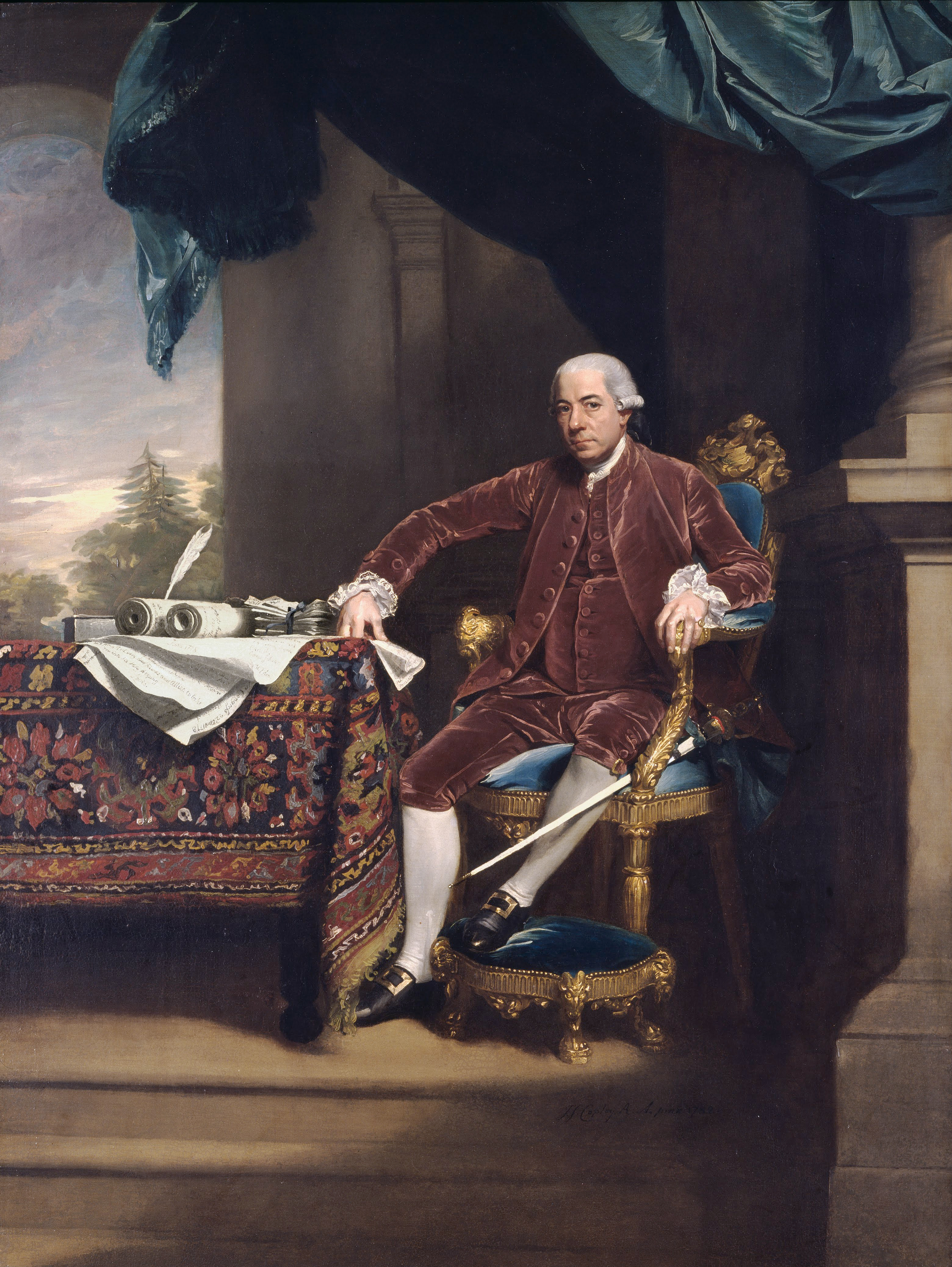
John Singleton Copley, 1782. Wikimedia Commons. Public domain.
1725–1781
Fielding Lewis
2
recorded events
Connected towns:
Fredericksburg, VABiography
Fielding Lewis (1725–1781)
Virginia Planter, Gunnery Manufactory Operator, and Private Financier of the Revolution
Among the wealthiest planters in the Fredericksburg region of colonial Virginia, Fielding Lewis was born around 1725 and spent the decades before the Revolution building a diversified commercial empire that included plantations, a mercantile business, ferry operations, and extensive land investments. His marriage in 1750 to Betty Washington — George Washington's younger sister — wove him into the most powerful family network in Virginia and gave him a deeply personal stake in the conflict that would soon engulf the colonies. Lewis was no aristocratic idler; he was a careful, methodical businessman whose operations generated the kind of substantial financial reserves that most Virginia planters, despite their outward wealth, simply did not possess. By the mid-1770s, as tensions with Britain accelerated toward open warfare, Lewis occupied a rare position: he had both the capital and the practical manufacturing knowledge to translate private wealth into military capacity. Fredericksburg itself was a thriving commercial town on the Rappahannock River, well situated for manufacturing and distribution, and Lewis understood the strategic possibilities that intersection of location and resources presented.
When war came in 1775, Lewis moved quickly from political sympathy to direct material action. He helped establish and personally financed a gunnery manufactory at Fredericksburg — one of the very few facilities in the American South capable of producing muskets, rifles, and other firearms for Continental and Virginia state forces. The manufactory was not a small workshop; it operated throughout the war, turning out weapons that equipped Virginia troops during years when European imports were uncertain, supply ships were vulnerable to the Royal Navy, and the Continental Congress's supply system was chronically underfunded and disorganized. Lewis advanced his own personal credit repeatedly to keep the operation running when the state of Virginia failed to deliver promised payments. He purchased raw materials, paid gunsmiths, and absorbed operating costs out of his own accounts, petitioning the Virginia government again and again for reimbursement that arrived late, arrived partially, or never arrived at all. The manufactory's output was a critical lifeline for Virginia's military capacity, and Lewis bore the financial weight of that lifeline largely alone.
The human cost of Lewis's commitment was staggering and deeply personal. He was not a young soldier risking his body on a battlefield — he was a middle-aged planter and family man risking the accumulated wealth of a lifetime, the security of his wife and children, and the estate he had spent decades building. Every advance of personal credit, every unpaid invoice from the state treasury, every month the manufactory operated at a loss pushed Lewis closer to financial catastrophe. He knew the risk, and he continued anyway, driven by a sense of duty that his family connection to George Washington only deepened. His wife Betty managed the household at Kenmore, their elegant home outside Fredericksburg, while her husband poured the family's resources into a war effort whose outcome remained uncertain for years. Lewis was fighting not with a musket but with his ledger book, and the enemy was not only British tyranny but the chronic insolvency of the new republic he was trying to build. By the war's final years, his health was failing alongside his finances.
Fielding Lewis died in December 1781, just two months after the decisive American victory at Yorktown — a victory his manufactory had helped make possible by arming Virginia troops who fought in the Southern campaigns. He died deeply in debt, his personal fortune entirely consumed by public service that the state of Virginia never adequately repaid. His estate at Kenmore had to be sold to satisfy creditors, leaving his family without the home he had built for them. Lewis's fate was not unique; it reflected a painful pattern repeated across the new nation, in which private citizens who committed their capital to the Revolutionary cause found themselves financially ruined while the republic they had funded moved on without settling its debts. Yet Lewis's case stands out for its scale and its poignancy — a man who gave everything he had, received almost nothing in return, and died before he could see whether the nation he had bankrolled would even survive. His story is a necessary corrective to any vision of the Revolution as a cost-free triumph.
WHY FIELDING LEWIS MATTERS TO FREDERICKSBURG
Fredericksburg was not simply a quiet colonial town during the Revolution — it was a manufacturing center whose gunnery manufactory, financed by Fielding Lewis, produced firearms that armed Virginia soldiers throughout the war. Students and visitors who walk the streets of Fredericksburg today should understand that the Revolution was won not only by generals and soldiers but by private citizens who staked their personal fortunes on American independence. Lewis's story teaches a difficult truth: that republics are often built on the sacrifices of individuals who are never repaid. His home, Kenmore, still stands as a historic site in Fredericksburg, a tangible connection to a man who gave his wealth, his health, and ultimately his life to a cause larger than himself.
TIMELINE
- c. 1725: Born in Virginia; grows up in the planter class of the colonial Chesapeake region
- 1750: Marries Betty Washington, younger sister of George Washington, strengthening his ties to Virginia's most prominent family
- 1750s–1770s: Builds a substantial fortune through plantations, mercantile operations, ferry service, and land investments in the Fredericksburg area
- 1775: Helps establish and personally finances the Fredericksburg gunnery manufactory to produce firearms for Continental and Virginia forces
- 1775–1781: Advances personal credit repeatedly to keep the manufactory operating as state reimbursements are delayed or withheld
- 1770s–1780s: Petitions the Virginia government multiple times for repayment of funds spent on arms production; receives little or no adequate compensation
- 1781 (October): British forces surrender at Yorktown, a victory made possible in part by the arms Lewis's manufactory supplied to Virginia troops
- 1781 (December): Dies deeply in debt, his personal fortune exhausted by wartime expenditures
- Post-1781: Kenmore, the Lewis family estate in Fredericksburg, is sold to pay creditors
SOURCES
- Waterman, Thomas Tileston. The Mansions of Virginia, 1706–1776. University of North Carolina Press, 1946.
- Goolrick, John T. The Life of General Hugh Mercer, with a Brief History of Fielding Lewis and the Gunnery at Fredericksburg. Privately published, 1906.
- George Washington's Fredericksburg Foundation. "Kenmore & George Washington's Ferry Farm: The Story of Fielding and Betty Lewis." https://www.kenmore.org
- Harwell, Richard Barksdale. Washington's Southern Tour, 1791. Harvard University Press, 1948.
- Virginia General Assembly. Petitions and claims records relating to Fielding Lewis and the Fredericksburg Manufactory. Library of Virginia, Richmond, VA.
Events
Oct
1775
Fielding Lewis Opens Gunnery ManufactoryFredericksburgVirginia Planter# Fielding Lewis Opens Gunnery Manufactory In the spring and summer of 1775, as the American colonies lurched from political resistance toward open warfare, communities across Virginia began preparing for a conflict that many now viewed as inevitable. The battles of Lexington and Concord in April had transformed what had been a war of words into a shooting war, and the Second Continental Congress was moving toward organizing a Continental Army under the command of Virginia's own George Washington. Yet one of the most pressing challenges facing the patriot cause was a severe shortage of arms and ammunition. The colonies had long depended on British manufactures for their firearms and military supplies, and with trade disrupted and royal governors actively working to seize colonial powder magazines, the need for domestic production became urgent. It was against this backdrop that Fielding Lewis, a wealthy Virginia planter and prominent citizen of Fredericksburg, stepped forward to establish a gunnery manufactory that would serve the revolutionary cause for the duration of the war. Fielding Lewis was no ordinary planter. A man of considerable means and deep connections to Virginia's ruling gentry, he was married to Betty Washington Lewis, the sister of George Washington. This family tie placed Lewis at the very heart of the patriot network in Virginia, but his commitment to the cause went far beyond familial loyalty. Lewis was a dedicated patriot who had long been involved in local governance and civic life in Fredericksburg, and when the Virginia government encouraged the establishment of arms manufacturing within the colony, Lewis answered the call with both his energy and his personal wealth. On the outskirts of Fredericksburg, he opened a manufactory dedicated to producing firearms, ammunition, and other military hardware desperately needed by both the Continental Army and Virginia's own state forces. The operation Lewis established was significant not only for what it produced but for what it represented. At a time when the colonies possessed very little industrial capacity for arms production, every manufactory that could turn out muskets, rifles, or cartridges was a strategic asset. Fredericksburg's location along the Rappahannock River made it a practical site for such an enterprise, offering access to transportation routes and a regional labor force. Lewis oversaw the recruitment of gunsmiths, laborers, and craftsmen to keep the manufactory running, and he managed the complex logistics of sourcing raw materials during a time of widespread scarcity. The guns and supplies produced at the Fredericksburg manufactory flowed to Continental and Virginia troops who might otherwise have gone without adequate arms. What made Lewis's contribution especially remarkable, and ultimately tragic, was the personal cost he bore. The Virginia government's encouragement of the manufactory did not always translate into reliable financial support. Throughout the war, Lewis poured his own personal fortune into sustaining the operation, covering costs for materials, wages, and upkeep that the cash-strapped revolutionary government could not or did not reimburse in a timely manner. By the war's end, the manufactory had consumed the vast majority of Lewis's wealth. The man who had been one of Fredericksburg's most prosperous citizens found himself financially ruined, his sacrifice a quiet testament to the kinds of private contributions that made American independence possible but that rarely received the recognition afforded to battlefield heroes. Betty Washington Lewis shared in her husband's sacrifices and supported the patriot cause in her own right, managing the household and family affairs while Fielding devoted himself to the manufactory. Together, they embodied the kind of committed patriot family whose efforts on the home front were essential to sustaining the war effort across its long and uncertain years. The story of Fielding Lewis and the Fredericksburg gunnery manufactory matters because it illuminates a dimension of the Revolutionary War that is often overshadowed by accounts of battles and generalship. Independence was won not only on the battlefield but in workshops, forges, and manufactories where ordinary citizens translated their political convictions into material support. Lewis's willingness to risk everything he had built over a lifetime stands as a powerful reminder that the cost of liberty was borne broadly and deeply, often by individuals whose names history has nearly forgotten.
Dec
1781
Fielding Lewis Dies in Financial RuinFredericksburgVirginia Planter# Fielding Lewis Dies in Financial Ruin On December 21, 1781, just two months after the momentous American victory at Yorktown that effectively sealed the outcome of the Revolutionary War, Fielding Lewis died at his home in Fredericksburg, Virginia. He was fifty-six years old, physically worn down by years of relentless labor and emotionally burdened by a financial catastrophe largely of his own patriotic making. The man who had once been among the wealthiest planters in the region left behind a family mired in debt and a beloved estate, Kenmore Plantation, encumbered by obligations that would take years to untangle. His story stands as one of the Revolution's most poignant and troubling illustrations of the personal cost borne by private citizens who placed the cause of independence above their own material security. Fielding Lewis had married Betty Washington Lewis, the only sister of General George Washington, in 1750, and the couple had built a life of considerable prominence in Fredericksburg. Kenmore Plantation, with its elegant Georgian mansion, was a testament to their prosperity and social standing. Lewis was a successful planter and merchant, deeply embedded in Virginia's colonial gentry. When the Revolution began, he was well positioned to contribute to the Patriot cause not merely with words or political influence but with tangible resources. And contribute he did, on a scale that would ultimately destroy him. As the war intensified, Virginia desperately needed arms and ammunition. Lewis took on the critical responsibility of establishing and overseeing a manufactory of arms in Fredericksburg, a gunnery operation that produced muskets, rifles, and other military supplies for Virginia's militia and Continental forces. This was not a casual investment. Lewis poured his own personal fortune into the enterprise, advancing enormous sums to purchase raw materials, pay workers, and keep the operation running during a period when the state government was itself struggling to finance the war effort. He also supplied provisions and equipment to troops passing through the region, drawing on his own credit and resources when public funds were unavailable or delayed. The Virginia government acknowledged its debts to Lewis in principle but failed to reimburse him adequately in practice. Wartime inflation ravaged the value of whatever payments he did receive, and the state's finances were in such disarray that legitimate claims from private creditors were perpetually deferred. Lewis found himself caught in a devastating bind: he had spent real wealth in service to the Revolution, but the compensation he received, when it came at all, was paid in depreciated currency worth a fraction of what he was owed. By the time the war reached its climax at Yorktown, Lewis was financially ruined. The debts he had accumulated on behalf of the state had become personal liabilities, and Kenmore Plantation itself was at risk. Betty Washington Lewis, who had supported her husband's sacrifices throughout the war, was left to manage the consequences of his generosity after his death. She spent years petitioning the Virginia government and later the federal government for restitution, but full justice was never achieved in her lifetime. The Lewis family's plight was not unique — many private citizens who had extended credit, supplies, or services to the Revolutionary cause found themselves abandoned by the governments they had helped to create — but few cases were as dramatic or as closely connected to the leadership of the Revolution itself. That the brother-in-law of George Washington could die in financial ruin while serving the same cause Washington commanded in the field exposed an uncomfortable truth about the new nation's willingness to honor its debts to its own supporters. The death of Fielding Lewis raises enduring questions about the obligations a nation owes to the individuals who sacrifice for its founding. The Revolution was won not only on battlefields but in manufactories, warehouses, and private accounts where men and women like Fielding and Betty Washington Lewis risked everything they had. That their sacrifices went largely uncompensated reminds us that the cost of American independence was distributed unevenly, and that the ideals of the Revolution were not always matched by the gratitude of the republic it produced.
Stories