

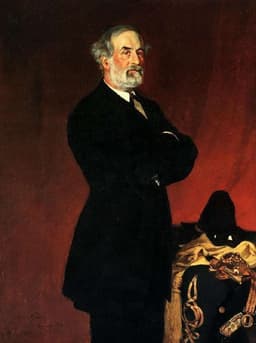
Frank Buchser, 1869. Wikimedia Commons. Public domain.
1752–1821
Frank Lee
0
recorded events
Connected towns:
Mount Vernon, VABiography
Frank Lee (c. 1752–1821): The Invisible Center of Mount Vernon
The Butler Who Made Washington's World Possible
Born into slavery at Mount Vernon around the early 1750s, Frank Lee entered a world whose boundaries were defined entirely by the property claims of others. He was the legal property of the Washington family, and as George Washington consolidated control of the estate through his marriage to Martha Custis in 1759 and his inheritance of Mount Vernon's expanding operations, Frank Lee grew up within a household that was rapidly becoming one of the most prominent in Virginia. Little is recorded about his parents or earliest years — the documentary record for enslaved childhoods is almost always a void — but what is clear is that Frank and his brother William Lee were identified early as possessing unusual intelligence, composure, and social acuity. These qualities did not earn them freedom or opportunity in any conventional sense; instead, they marked the brothers for service in the most visible and demanding positions within the plantation's hierarchy. Frank was groomed for the role of butler, a position requiring not merely physical labor but the ability to read social situations, manage complex logistics, and perform an exacting standard of hospitality. His formation of character occurred entirely within a system designed to suppress that character's independent expression. Whatever ambitions, frustrations, or inner life he cultivated during these years went unrecorded, as was the design of the institution that held him.
The Revolutionary cause arrived at Mount Vernon not as an invitation extended to Frank Lee but as a seismic disruption of the household in which he was already deeply embedded. When George Washington accepted command of the Continental Army in June 1775 and departed for Massachusetts, the daily management of Mount Vernon's domestic world shifted dramatically. William Lee accompanied Washington to war, serving as his personal valet through nearly every major campaign of the conflict. Frank Lee remained behind, and this division of the brothers' fates became the defining structural fact of his Revolutionary experience. His turning point was not a moment of ideological awakening or voluntary enlistment; it was the moment when Washington's absence transformed Mount Vernon from a functioning plantation household into a symbolic stage that had to operate flawlessly without its master present. Frank Lee became the principal figure responsible for maintaining the mansion's readiness, its hospitality, and its reputation during years when Martha Washington moved between Mount Vernon and the army's winter encampments. The Revolution did not recruit Frank Lee — it conscripted his labor more thoroughly than before, demanding that he sustain the domestic infrastructure of a household whose owner was now the most famous man in America, all while his own status remained that of human property.
Frank Lee's most significant contribution to the Revolutionary era was not a single dramatic action but a sustained performance of managerial excellence that made Mount Vernon function as a political institution. The butler's role at a household of Mount Vernon's stature was essentially that of a chief operating officer for the domestic sphere: overseeing the dining room, coordinating the work of other enslaved household workers, managing the presentation of food and drink, and ensuring that every guest — whether a Virginia planter, a French diplomat, a Continental Army officer, or a political ally — experienced the household as a place of order, abundance, and refinement. This was not incidental to Washington's political power; it was foundational to it. Eighteenth-century political authority was built substantially through hospitality, and the quality of a gentleman's table communicated his fitness for leadership. Frank Lee managed this table with a skill that contemporaries took for granted precisely because it was performed by an enslaved man whose competence was attributed to his owner's household rather than to his own abilities. His most significant action, then, was the continuous, invisible labor of making Washington's world appear effortless — a performance so successful that it erased its own performer from the historical narrative for more than two centuries.
Throughout the Revolutionary War years and the decades that followed, Frank Lee shaped the key moments of Mount Vernon's social life in ways that directly influenced political outcomes. When Washington returned from the war in December 1783, Mount Vernon became a destination for an unceasing stream of visitors — veterans, politicians, foreign dignitaries, and curious admirers who arrived expecting to see the home of the man who had won American independence. Frank Lee managed the household through this relentless period of visitation, which Washington himself described as resembling a "well-resorted tavern" in its constant demands. During the years of the Constitutional Convention in 1787 and Washington's presidency from 1789 to 1797, Mount Vernon continued to function as a satellite of American political life, and Frank Lee's management ensured its operations met the extraordinary expectations placed upon it. He oversaw meals for dozens of guests, coordinated with cooks, servers, and housekeepers who were themselves enslaved, and maintained standards of service that reflected — and actively constructed — Washington's public image. Every smoothly executed dinner, every properly attended guest chamber, every seamless evening of entertainment bore Frank Lee's invisible hand. He shaped these moments not through speeches or votes but through the unglamorous mastery of domestic logistics under conditions of permanent unfreedom.
The relationships that defined Frank Lee's role were structured entirely by the institution of slavery, yet they were far more complex than the simple binary of owner and owned. His relationship with his brother William was perhaps the most significant personal bond in his life, yet the war separated them for years, sending William to battlefields across the eastern seaboard while Frank remained at Mount Vernon. The brothers occupied parallel positions of prominence within Washington's world — William as the personal attendant who rode beside the general, Frank as the household manager who kept the home functioning — and their shared status as enslaved men at the top of a coerced labor hierarchy created a bond that was simultaneously one of family intimacy and shared oppression. Frank Lee's relationship with Martha Washington was also central to his daily existence, as she directed much of the household's domestic life and relied on his competence during George's prolonged absences. His interactions with the constant stream of visitors placed him in contact with many of the Revolution's principal figures, yet these interactions were always mediated by his enslaved status. He served men who debated liberty and rights at the very table he managed, and the nature of that service — deferential, skilled, silent — ensured that none of those men recorded his contributions or acknowledged his presence as anything other than furniture.
The moral complexity of Frank Lee's life is inseparable from the moral complexity of the Revolution itself, and any honest accounting of his story must confront the profound contradiction he embodied daily. He was a man of evident skill and intelligence who was legally defined as property. He performed work that required sophistication, judgment, and social awareness, yet he received no compensation, no public acknowledgment, and no legal recognition of his personhood. The setback that defined his existence was not a single failure or controversy but the permanent condition of enslavement — a system that converted his every achievement into someone else's credit. Washington's reputation for gracious hospitality was built substantially on Frank Lee's labor, yet the historical record attributes that hospitality entirely to Washington's character and Martha's management. There is also the painful question of agency and collaboration: Frank Lee's excellent service sustained the household of a slaveholder and enhanced the prestige of a man who profited from enslaved labor. This was not a choice made freely, and framing it as collaboration misunderstands the coercive structure within which he operated. Yet the moral weight of the situation — a man's skill used to burnish the image of the system that oppressed him — remains one of the most uncomfortable truths of the Revolutionary period.
The war changed Frank Lee in ways that the historical record does not allow us to trace with precision, but the structural changes to his world are clear enough to suggest their personal impact. The Revolution transformed Mount Vernon from a prosperous Virginia plantation into one of the most politically significant private residences in the Atlantic world, and Frank Lee's role expanded correspondingly. Before the war, he managed a prominent household; after it, he managed what was effectively a national shrine in active operation. The volume of visitors increased dramatically, the political stakes of every social interaction grew higher, and the expectations placed upon the household's performance became almost impossibly demanding. Washington's letters from this period reveal constant anxiety about the state of Mount Vernon's hospitality and its readiness for visitors, anxiety that fell directly upon the enslaved workers who produced that hospitality. For Frank Lee, the war's personal consequences likely included increased labor, heightened scrutiny, and the bitter irony of watching a nation celebrate its freedom while he remained in bondage. Whether he also experienced moments of hope — perhaps hearing revolutionary rhetoric and imagining its application to his own condition — we cannot know, because the system that held him also silenced him.
In the war's aftermath and during the years of Washington's presidency, Frank Lee continued to serve as butler at Mount Vernon, maintaining the household during Washington's frequent absences in New York and Philadelphia. The post-war period brought no resolution to Frank Lee's condition; if anything, it deepened the contradictions of his situation. Washington, now the president of a republic founded on principles of liberty and equality, continued to hold human beings as property and to rely on their coerced labor for the functioning of his household. Frank Lee's role in the war's resolution was to ensure that the home to which Washington returned — first after the war, then after the presidency — functioned as the embodiment of republican virtue and gentlemanly refinement that Washington's public image required. When Washington retired permanently to Mount Vernon in March 1797, Frank Lee was there, managing the household through the final years of Washington's life. Washington's death on December 14, 1799, and the provisions of his will — which stipulated that his own enslaved people would be freed upon Martha's death — set the stage for Frank Lee's eventual emancipation. Martha Washington freed Washington's enslaved people in January 1801, likely including Frank Lee, though the precise circumstances and timing of his freedom remain imperfectly documented.
How contemporaries saw Frank Lee is a question that reveals as much about those contemporaries as it does about the man himself. The surviving record contains only the most incidental references to him — mentions in Washington's correspondence, notations in plantation records, the kind of documentary traces that confirm a person's existence without illuminating their humanity. Visitors to Mount Vernon occasionally noted the quality of the household's service without naming the individuals who provided it. This was not accidental; the social conventions of slaveholding Virginia rendered enslaved workers invisible even when they stood at the center of the room. Frank Lee's immediate legacy was therefore one of enforced anonymity — a man whose daily presence shaped the experiences of some of the most powerful people in the Atlantic world, yet whose name appeared in their letters and diaries rarely, if at all. Among the enslaved community at Mount Vernon, his legacy may have been very different; as butler, he occupied a position of relative authority and visibility that likely carried significant social meaning within the plantation's internal hierarchy. But that community's own records and oral traditions were not preserved by the institutions that controlled them, and Frank Lee's reputation among his peers remains largely inaccessible.
Students and visitors today should know Frank Lee because his story demolishes the comfortable myth that the American Revolution was a straightforward triumph of liberty over tyranny. His life reveals that the Revolution's most cherished symbols — Washington's dignity, Mount Vernon's hospitality, the image of republican virtue — were produced in significant part by the labor of people who were denied the very freedoms those symbols represented. Understanding Frank Lee requires confronting the fact that American independence was built not only on battlefields and in legislative chambers but in dining rooms and kitchens, by people whose contributions were designed to be invisible. His story is not a footnote to the Revolution; it is a central chapter that was deliberately suppressed. Knowing his name and his role challenges students to think critically about whose labor creates political power, whose contributions get recorded in history, and whose freedom matters in a society that proclaims freedom as its founding value. Frank Lee was not a passive victim; he was a skilled, intelligent man who navigated an oppressive system with competence and endurance. His life demands that we expand our understanding of who made the Revolution possible and at what cost that revolution was achieved, not only on distant battlefields but within the very household of the man who led it.
WHY FRANK LEE MATTERS TO MOUNT VERNON
Frank Lee's story is essential to understanding what Mount Vernon actually was — not merely George Washington's private home but a political stage whose effectiveness depended on the coerced labor of enslaved people. As butler, Frank Lee managed the household's public face, ensuring that the dining room, guest chambers, and social operations functioned at the highest level during decades of intense political activity. Students and visitors walking through Mount Vernon's mansion today are moving through spaces that Frank Lee organized and controlled daily. His story connects the grand narrative of the Revolution to the intimate, uncomfortable reality of the labor system that sustained it. To visit Mount Vernon without knowing Frank Lee is to see only the performance Washington intended — not the human cost of producing it.
TIMELINE
- c. 1752: Born into slavery at Mount Vernon, Virginia, property of the Washington family
- 1759: George Washington marries Martha Custis and assumes control of Mount Vernon's enslaved workforce, including Frank and William Lee
- 1760s–1770s: Rises to position of butler at Mount Vernon, overseeing domestic operations of the mansion household
- 1775: George Washington departs for command of the Continental Army; Frank Lee remains at Mount Vernon managing household operations during wartime
- 1783: Washington returns to Mount Vernon after the war; Frank Lee manages the household through an era of unprecedented visitation
- 1787–1789: Continues as butler during the period of the Constitutional Convention and Washington's election to the presidency
- 1789–1797: Maintains Mount Vernon's domestic operations during Washington's presidential years and frequent absences
- 1797: Washington retires permanently to Mount Vernon; Frank Lee serves through the final years of Washington's life
- 1799: George Washington dies on December 14; his will provides for the emancipation of his enslaved people upon Martha Washington's death
- 1801: Martha Washington frees the enslaved people owned by George Washington; Frank Lee likely gains his freedom
- 1821: Frank Lee dies, though the precise date and circumstances are not well documented
SOURCES
- Mary V. Thompson. "The Only Unavoidable Subject of Regret": George Washington, Slavery, and the Enslaved Community at Mount Vernon. University of Virginia Press, 2019.
- Mount Vernon Ladies' Association. "Lives Bound Together: Slavery at George Washington's Mount Vernon." https://www.mountvernon.org/george-washington/slavery/
- Henry Wiencek. An Imperfect God: George Washington, His Slaves, and the Creation of America. Farrar, Straus and Giroux, 2003.
- Fritz Hirschfeld. George Washington and Slavery: A Documentary Portrayal. University of Missouri Press, 1997.
- Mount Vernon Ladies' Association. "Frank Lee." The Digital Encyclopedia of George Washington. https://www.mountvernon.org/library/digitalhistory/digital-encyclopedia/