

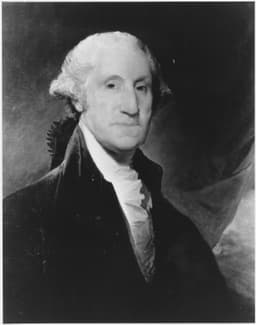
Unknown authorUnknown author or not provided, betw. Wikimedia Commons. Public domain.
1732–1799
General George Washington
4
recorded events
Connected towns:
Wilmington, DEBiography
General George Washington (1732–1799)
Commander-in-Chief, Continental Army, and First President of the United States
Born on February 22, 1732, in Westmoreland County, Virginia, the man who would become the indispensable figure of the American Revolution grew up among the planter gentry of the Northern Neck, a tidewater world shaped by tobacco, land speculation, and English social aspirations. His father, Augustine Washington, died when George was eleven, cutting short any prospect of the English education his older half-brothers had enjoyed. Instead, young Washington trained as a surveyor, tramping through the Shenandoah Valley at sixteen and developing the physical toughness and appetite for western lands that would define his early adulthood. His older brother Lawrence's connections to the powerful Fairfax family opened doors to Virginia's colonial establishment, and Washington proved adept at moving through that world, combining genuine frontier competence with social ambition. By his early twenties he had secured appointment as a militia officer, a role that thrust him into the opening clashes of what became the French and Indian War. These formative years produced a man who understood both the Virginia backcountry and the drawing rooms of Williamsburg, a dual fluency that would prove essential when the colonies needed a leader who could command respect across regional and class lines.
Washington's path toward revolution was neither sudden nor ideological in the way that animated figures like Samuel Adams or Thomas Jefferson. His political awakening grew from practical grievances rooted in his life as a Virginia planter and land speculator. British restrictions on western settlement, trade policies that squeezed colonial agriculture, and the broader assertion of parliamentary authority over the colonies all struck at interests Washington understood personally. He served in the Virginia House of Burgesses from 1758 onward, growing increasingly frustrated with imperial policy through the Stamp Act crisis and the Townshend Acts. By the early 1770s, he had concluded that British policy was fundamentally incompatible with colonial rights, and he became an early supporter of nonimportation agreements and intercolonial cooperation. When the First Continental Congress met in Philadelphia in 1774, Washington attended as a Virginia delegate, already recognized as one of the wealthiest and most respected men in the colonies. His military experience during the French and Indian War, his imposing physical presence, and his status as a Virginian — critical for binding the southern colonies to what had been largely a New England dispute — made him the obvious choice when the Second Continental Congress needed a commander for the new Continental Army in June 1775.
His most significant military achievement may not have been any single battle but rather the sheer act of keeping the Continental Army alive as a fighting force through years of defeat, deprivation, and political uncertainty. The campaign of 1777, culminating in the Battle of Brandywine on September 11, illustrates this broader achievement in microcosm. Faced with William Howe's army marching north from Head of Elk, Maryland, toward Philadelphia — the seat of the Continental Congress and the symbolic capital of the Revolution — Washington chose to make a stand along Brandywine Creek rather than surrender the city without a fight. The decision reflected his understanding that political realities demanded a defense of Philadelphia, even if pure military logic might have counseled retreat. When the battle ended in defeat due to intelligence failures about the northern fords, Washington managed what was arguably more important than victory: he kept his army together. The Continental Army retreated in relatively good order, regrouped, and attacked again at Germantown less than a month later. This capacity to absorb punishment and return to the field was Washington's particular genius, a strategic patience that kept the Revolution viable until circumstances shifted decisively in America's favor.
The Battle of Brandywine itself revealed both Washington's strengths and his vulnerabilities as a commander. He deployed his forces along Chadds Ford, the main crossing point on Brandywine Creek, anticipating a frontal British assault. But Howe, an experienced and resourceful general, divided his army. Hessian forces under General Wilhelm von Knyphausen demonstrated at Chadds Ford, fixing Washington's attention, while a powerful flanking column under Lord Cornwallis marched north to cross at Jefferis Ford, several miles beyond the American right. Washington received contradictory intelligence reports throughout the morning — some warning of the flanking movement, others denying it — and the confusion cost him precious hours. When Cornwallis's column finally appeared on the American right and rear in the early afternoon, Washington scrambled to redeploy units to meet the threat, but the response came too late to prevent the right flank from collapsing. The fighting retreat that followed, particularly the rearguard action conducted by Nathanael Greene's division, prevented a complete rout. Three weeks later, on October 4, Washington launched his counterattack at Germantown, a bold if ultimately unsuccessful assault that demonstrated the army's resilience and impressed European observers, including the French court already weighing an American alliance.
Washington's effectiveness depended heavily on the relationships he built and the alliances he navigated — both military and political. At Brandywine, young Major General the Marquis de Lafayette, who had arrived in America only weeks earlier and whom Washington was already treating with paternal warmth, received his baptism of fire and a musket ball through his calf while trying to rally retreating troops. The bond between Washington and Lafayette, forged partly in that September chaos, would become one of the most consequential personal relationships of the war, ultimately helping to cement the French alliance that transformed the conflict. Nathanael Greene, whose division's fighting retreat saved the army at Brandywine, was Washington's most trusted battlefield subordinate, a self-taught military thinker from Rhode Island whose loyalty never wavered even during the army's darkest moments. Washington also had to manage a fractious relationship with the Continental Congress, which expected him to defend Philadelphia but often failed to provide the men and resources necessary to do so. His careful deference to civilian authority — maintaining the principle even when congressional interference frustrated his plans — established a precedent for civil-military relations that would echo far beyond the Revolution.
The Brandywine campaign also exposed failures and controversies that clouded Washington's record and fueled criticism from political rivals and discontented officers. The intelligence breakdown that left the American right flank exposed to Cornwallis's flanking march represented a serious failure of staff work, reconnaissance, and command judgment. Washington relied on local guides and scouts who provided contradictory information about the fords north of Chadds Ford, and his headquarters lacked the systematic intelligence apparatus needed to resolve the confusion quickly. The loss of Philadelphia that followed Brandywine gave ammunition to critics in Congress and the army who questioned Washington's fitness for command, contributing to the so-called Conway Cabal of late 1777 and early 1778, an ill-defined movement among certain officers and congressmen to replace Washington with Horatio Gates, the victor at Saratoga. Washington weathered this political storm through a combination of dignified restraint and the loyalty of key supporters, but the episode revealed how precarious his position could be. The moral complexity of his situation extended beyond battlefield decisions: he commanded an army fighting for liberty while himself enslaving over a hundred people at Mount Vernon, a contradiction that he acknowledged only obliquely during his lifetime.
The cumulative weight of the 1777 campaign — the defeat at Brandywine, the loss of Philadelphia, the failed counterattack at Germantown, and the grueling winter at Valley Forge — changed Washington profoundly as both a commander and a man. The young officer who had once sought glory and bristled at perceived slights had become, by necessity, a leader who measured success not in dramatic victories but in the survival and cohesion of his army. Valley Forge, where roughly twelve thousand soldiers endured a winter of hunger, disease, and desertion from December 1777 through June 1778, became the crucible in which Washington's army was transformed. Baron von Steuben's drill program professionalized the Continental infantry, while Washington himself used the winter to address the intelligence and staff failures that had plagued him at Brandywine. He emerged from Valley Forge with a harder, more disciplined army and a deeper understanding of the kind of war he was fighting — not a war of decisive battles but a war of endurance, in which keeping an army in the field was itself the strategic objective. The experience also deepened his conviction that the states needed to support the army more effectively, a frustration that would shape his postwar political thinking.
Washington's role in the war's resolution extended far beyond the celebrated victory at Yorktown in October 1781, where Franco-American forces trapped Cornwallis's army and effectively ended major combat operations. The years between Valley Forge and Yorktown required the same grinding patience and political skill that had characterized the 1777 campaign, as Washington managed a fragile alliance with France, suppressed mutinies among his own troops, and kept pressure on British forces while waiting for the decisive moment. When that moment came, Washington demonstrated the strategic boldness that his critics claimed he lacked, marching his army from the Hudson Valley to Virginia in a swift, deceptive movement that caught the British off guard. After the war, his most important act may have been his resignation of command in December 1783, voluntarily surrendering military power to civilian authority in a gesture that astonished European observers accustomed to victorious generals seizing political control. This act, more than any battlefield triumph, established the principle that would define American governance: the military serves the republic, not the other way around.
Contemporaries recognized Washington's unique stature even before the war ended, though their assessments varied widely. To most Americans, he was the indispensable man — the figure whose personal authority, physical courage, and stubborn determination had held the Revolution together through its darkest years. King George III reportedly said that if Washington voluntarily relinquished power after the war, he would be the greatest man in the world. European military professionals, initially skeptical of this self-taught colonial commander, came to respect his ability to maintain an army under conditions that would have destroyed most forces. His former adversaries acknowledged his strategic judgment; even those who had defeated him at Brandywine recognized that his army's survival after that battle demonstrated a resilience that ultimately proved more important than any single engagement. Among his own officers and soldiers, he inspired a loyalty that transcended rational calculation — men who had starved at Valley Forge and frozen at Morristown continued to serve under him because they believed in both the cause and the man. When the new nation needed a president in 1789, there was never any serious alternative. Washington served two terms, established the precedents that defined the office, and retired to Mount Vernon in 1797, dying on December 14, 1799.
Students and visitors today should know Washington not as the marble demigod of myth but as a flesh-and-blood leader who made serious mistakes, learned from them, and persevered through circumstances that would have broken lesser figures. The Brandywine campaign offers a particularly instructive lens: here was a commander who chose to fight a battle he was not certain he could win, who suffered a defeat caused partly by his own intelligence failures, who lost the capital city he had been charged to defend, and who nevertheless kept his army together, attacked again three weeks later, survived a brutal winter, and ultimately won the war. That trajectory — from failure through resilience to eventual success — is more inspiring and more honest than any story of unbroken triumph. For young people especially, Washington's example teaches that leadership is not about avoiding mistakes but about how one responds to them. His connection to Wilmington, Delaware, where he established supply operations during the Brandywine campaign and through which the consequences of his defeat rippled directly, makes these lessons tangible, rooting the grand narrative of the Revolution in specific streets, creeks, and landscapes that visitors can still walk today.
WHY GENERAL GEORGE WASHINGTON MATTERS TO WILMINGTON
George Washington's connection to Wilmington, Delaware, is written in the geography of the Brandywine campaign itself. In the late summer of 1777, Washington used Wilmington as a supply base while positioning his army to block the British advance on Philadelphia. When his defeat at Brandywine Creek on September 11 shattered the American defensive line, the British marched directly through the region, and Wilmington fell under occupation along with Philadelphia. For students and visitors walking Wilmington's streets today, Washington's story transforms the local landscape into a classroom where the Revolution's highest stakes — the survival of an army, the defense of a capital, the resilience of a cause — played out in real time. His failures and his persistence here remind us that the Revolution was won not by flawless heroes but by imperfect leaders who refused to quit.
TIMELINE
- 1732: Born February 22 in Westmoreland County, Virginia
- 1754–1758: Serves in the French and Indian War, including Braddock's expedition to Fort Duquesne and command of Virginia frontier defenses
- 1759: Marries Martha Dandridge Custis and settles at Mount Vernon; elected to the Virginia House of Burgesses
- 1775: Appointed Commander-in-Chief of the Continental Army by the Second Continental Congress, June 15
- 1776: Leads the army through the New York campaign and the crossing of the Delaware; victories at Trenton and Princeton
- 1777: Uses Wilmington, Delaware, as a campaign supply base; defeated at the Battle of Brandywine, September 11; launches counterattack at Germantown, October 4; enters winter quarters at Valley Forge, December
- 1778: Army emerges from Valley Forge retrained; fights the British to a standstill at Monmouth, June 28
- 1781: Franco-American forces under Washington compel British surrender at Yorktown, Virginia, October 19
- 1783: Resigns his military commission and returns to Mount Vernon, December 23
- 1789: Inaugurated as the first President of the United States, April 30; serves two terms
- 1799: Dies at Mount Vernon, December 14
SOURCES
- Chernow, Ron. Washington: A Life. Penguin Press, 2010.
- McGuire, Thomas J. The Philadelphia Campaign, Volume I: Brandywine and the Fall of Philadelphia. Stackpole Books, 2006.
- Harris, Michael C. Brandywine: A Military History of the Battle that Lost Philadelphia but Saved America, September 11, 1777. Savas Beatie, 2014.
- Lengel, Edward G. General George Washington: A Military Life. Random House, 2005.
- George Washington Papers, Library of Congress. The George Washington Papers at the Library of Congress, 1741–1799. https://www.loc.gov/collections/george-washington-papers/
Events
Aug
1777
Washington Uses Wilmington as Campaign Supply BaseWilmingtonCommander-in-Chief, Continental Army# Washington Uses Wilmington as Campaign Supply Base In the summer of 1777, the American Revolution entered one of its most precarious phases. British General William Howe, commander of the Crown's forces in North America, had embarked on a bold campaign to capture Philadelphia, the seat of the Continental Congress and the symbolic capital of the fledgling American republic. Rather than marching overland through New Jersey, Howe chose to transport his army by sea, sailing south from New York and up the Chesapeake Bay with roughly 15,000 troops. When reports reached General George Washington that the British fleet had been spotted entering the Chesapeake in late August, the Continental Army's commander-in-chief knew he would need to position his forces to defend the approaches to Philadelphia. Central to that effort was establishing a reliable supply and logistics base, and Washington turned to the small but strategically vital town of Wilmington, Delaware. Wilmington's geographic advantages made it a natural choice. Situated at the confluence of the Brandywine Creek and the Christina River, with navigable access to the Delaware River, the town served as a critical node in the region's transportation network. Supplies could be brought in by water and distributed overland to Continental forces assembling in the surrounding countryside. In the weeks leading up to the anticipated confrontation with Howe's army, Washington directed that Wilmington serve as his primary supply base, a decision that reflected both careful logistical planning and an intimate understanding of the regional landscape. The resources available in and around Wilmington were of particular importance. The Brandywine Valley, stretching northwest from the town, was home to a thriving milling industry that had long been one of the most productive in the American colonies. Flour mills along the Brandywine processed grain from the rich agricultural lands of southeastern Pennsylvania and northern Delaware, producing vast quantities of flour that could feed Washington's troops. Equally vital were the gunpowder mills operating along the creek, which manufactured the ammunition that the Continental Army desperately needed. Paper mills in the area also contributed essential materiel, producing the paper required for military correspondence, currency, and official documents that kept the machinery of revolution functioning. Together, these industries transformed the Brandywine corridor into something approaching an industrial base for the Continental cause. Washington's quartermaster and commissary officers worked to stockpile provisions and organize supply lines radiating outward from Wilmington as the army prepared to make its stand along the Brandywine. The Continental Army, numbering approximately 11,000 men, was positioned to block the British advance toward Philadelphia, and maintaining those soldiers in fighting condition required a constant flow of food, ammunition, and equipment. Wilmington's role as a supply hub was therefore not merely convenient but essential to the army's operational readiness. The significance of this logistical decision became painfully clear in the aftermath of the Battle of Brandywine on September 11, 1777. Howe outmaneuvered Washington by sending a flanking column under General Charles Cornwallis around the Continental Army's right wing, resulting in an American defeat. The Continental forces were compelled to retreat, and Washington was unable to prevent the British from eventually occupying Philadelphia on September 26. The loss of Wilmington and its surrounding supply infrastructure to British control represented a tangible blow to American logistics, depriving the Continental Army of the mills and river access that had sustained its preparations. In the broader narrative of the Revolutionary War, Washington's use of Wilmington as a campaign supply base illustrates a dimension of the conflict that is often overshadowed by battlefield drama. Wars are won and lost not only through tactics and courage but through the unglamorous work of supply chain management, provisioning, and industrial capacity. Washington's attention to these details, even when his efforts were ultimately overtaken by British military maneuvers, demonstrated the kind of strategic thinking that would sustain the Continental Army through years of hardship and eventually carry it to victory.
Sep
1777
Battle of BrandywineWilmingtonCommander-in-Chief, Continental Army# The Battle of Brandywine In the late summer of 1777, the American Revolution hung in a precarious balance. After evacuating New Jersey earlier that year, British Commander-in-Chief General Sir William Howe devised an ambitious plan to capture Philadelphia, the seat of the Continental Congress and the symbolic capital of the fledgling American nation. Rather than march overland through New Jersey, where Washington's forces could harass his columns, Howe chose a bolder approach. He loaded approximately 15,000 British and Hessian troops onto a massive fleet and sailed south from New York, up the Chesapeake Bay, and landed at the Head of Elk in Maryland in late August. From there, his army began its march northeastward toward Philadelphia, setting the stage for one of the war's most consequential engagements. General George Washington, Commander-in-Chief of the Continental Army, recognized that he could not simply abandon Philadelphia without a fight. Doing so would devastate American morale and hand the British an enormous political victory. He positioned his army of roughly 11,000 men along the eastern bank of Brandywine Creek, approximately ten miles northwest of Wilmington, Delaware, choosing the waterway as a natural defensive line. Washington concentrated his forces around Chadd's Ford, the most obvious crossing point, and placed Major General John Sullivan in command of the right wing to guard the army's northern flank. It was a reasonable defensive arrangement, but it suffered from a critical vulnerability: Washington and his officers had incomplete knowledge of the fords further upstream, leaving potential crossing points unguarded and unmonitored. On September 11, 1777, Howe exploited that vulnerability with a plan that demonstrated tactical brilliance. He divided his army into two wings, a risky maneuver that could have proven disastrous if Washington had detected it in time. One column, composed of roughly 7,000 troops under the Hessian General Wilhelm von Knyphausen, advanced directly toward Chadd's Ford, engaging the Americans in a conspicuous frontal demonstration designed to fix Washington's attention and hold his forces in place. Meanwhile, Lord Charles Cornwallis led the main striking force of approximately 8,000 men on an arduous flanking march of nearly seventeen miles to the north and east, crossing the Brandywine at unguarded fords well above the American positions. Throughout the morning and into the early afternoon, conflicting intelligence reports reached Washington — some warning of a flanking column, others denying it — and the resulting confusion paralyzed the American command at the critical moment when decisive action might have altered the outcome. By late afternoon, Cornwallis's column had completed its march and descended upon the American right flank with devastating force. Sullivan's division, caught in the process of hastily repositioning, bore the brunt of the attack and was driven from the field in disorder. The situation threatened to become a complete rout, one that could have destroyed the Continental Army and effectively ended organized American resistance in the northern theater. It was at this desperate moment that Continental Army General Nathanael Greene performed one of the war's most remarkable feats of leadership. Greene force-marched his division nearly four miles in approximately forty-five minutes to establish a defensive line that checked the British advance and allowed the shattered American units to withdraw. His disciplined rearguard action prevented the defeat from becoming a catastrophe. The battle exacted a heavy toll on the American side. Continental forces suffered approximately 1,300 casualties — killed, wounded, and captured — making Brandywine the largest single-day land battle of the Revolutionary War in the northern theater. British losses, while lighter, were not insignificant. Two weeks later, Howe's army marched into Philadelphia unopposed, forcing the Continental Congress to flee to York, Pennsylvania. Yet the Battle of Brandywine, despite being a clear American defeat, carried significance beyond its immediate military outcome. Washington's army survived to fight another day, and the experience revealed both the weaknesses in American intelligence-gathering and the extraordinary resilience of commanders like Greene, whose performance at Brandywine cemented his reputation as one of the Continental Army's most dependable generals. The lessons learned in the rolling hills along the Brandywine would inform Washington's subsequent decisions, including his bold strike at Germantown just weeks later, and ultimately contributed to the evolution of the Continental Army into a more effective fighting force capable of enduring the long struggle ahead.
Sep
1777
Lafayette Wounded at BrandywineWilmingtonCommander-in-Chief, Continental Army# Lafayette Wounded at Brandywine On September 11, 1777, along the banks of Brandywine Creek in southeastern Pennsylvania, one of the most consequential battles of the American Revolution unfolded, and with it, a moment that would help define the war's most celebrated foreign alliance. The Battle of Brandywine was a major engagement in which the British army, commanded by General Sir William Howe, sought to outmaneuver General George Washington's Continental Army and open the road to Philadelphia, the young nation's capital and the seat of the Continental Congress. Among the thousands of American soldiers who took the field that day was a nineteen-year-old French aristocrat named Marie-Joseph Paul Yves Roch Gilbert du Motier, better known to history as the Marquis de Lafayette, who had crossed the Atlantic at his own expense to volunteer his services to the American cause of liberty. Lafayette had arrived in America only months earlier, driven by youthful idealism, a thirst for military glory, and a genuine sympathy for the principles of republican self-governance. The Continental Congress, initially skeptical of yet another foreign officer seeking a commission, was nevertheless impressed enough by his willingness to serve without pay that they granted him the honorary rank of major general in July 1777. Washington, who met Lafayette shortly thereafter, took an almost immediate liking to the earnest young Frenchman, though he had not yet had the opportunity to observe him under fire. Brandywine would provide that test. The battle itself was a disaster for the American side. Howe executed a flanking maneuver reminiscent of his tactics at the Battle of Long Island the previous year, sending a large column under General Charles Cornwallis on a wide march to the north to cross the Brandywine at an unguarded ford and strike the American right wing. Washington, receiving conflicting intelligence reports throughout the day, was slow to recognize the threat. When Cornwallis's forces finally crashed into the American right, held by troops under General John Sullivan, the effect was devastating. Sullivan's division buckled under the assault, and soldiers began to retreat in growing disorder. It was in this moment of crisis that Lafayette distinguished himself. Riding into the chaos of the collapsing right wing, the young Frenchman attempted to rally the retreating troops, exposing himself to enemy fire with a disregard for personal safety that bordered on recklessness. During these efforts, a musket ball struck him in the left calf, and he bled considerably before the wound was even noticed. According to accounts that have become part of Revolutionary War lore, Lafayette was so absorbed in trying to restore order among the fleeing soldiers that he did not immediately realize the severity of his injury. Only when his boot filled with blood and his aides urged him to withdraw did he consent to leave the field. Lafayette was transported to a field hospital in the Wilmington, Delaware, area, where surgeons treated his wound. Washington himself reportedly instructed the physicians to care for Lafayette as though he were his own son, a sentiment that reflected the deep personal bond already forming between the two men. The injury, while painful and requiring weeks of recovery, was not life-threatening, and Lafayette would return to active duty before the end of the year. The significance of Lafayette's conduct at Brandywine extended far beyond the battlefield. His willingness to shed blood for the American cause at such a young age won him the admiration of Continental soldiers and officers alike and proved that his commission was no mere ceremonial gesture. More importantly, it cemented his relationship with Washington in a bond of mutual affection and respect that would endure for over two decades, until Washington's death in 1799. Their friendship became one of the most storied partnerships of the Revolution, and it bore strategic fruit as well, for Lafayette's continued advocacy in France helped secure the formal French alliance that would ultimately prove decisive in winning American independence. What began with a wound on a chaotic September afternoon near Brandywine Creek would ripple outward to shape the fate of nations.
Oct
1777
American Counterattack at GermantownWilmingtonCommander-in-Chief, Continental Army# The American Counterattack at Germantown, 1777 In the autumn of 1777, the American cause stood at a precarious crossroads. General George Washington, Commander-in-Chief of the Continental Army, had just suffered a stinging defeat at the Battle of Brandywine on September 11, where British forces under General Sir William Howe had outmaneuvered the Americans through a flanking march that rolled up the Continental right wing. The loss opened the road to Philadelphia, and by late September the British had marched triumphantly into the young nation's capital. Congress fled first to Lancaster and then to York, Pennsylvania, and many observers on both sides of the Atlantic wondered whether the rebellion was finally collapsing. Washington withdrew his battered army into the countryside, regrouping and assessing his dwindling options. Yet rather than retreat into winter quarters or adopt a purely defensive posture, Washington made a decision that would define the character of the Continental Army: he resolved to attack. The target was Germantown, a small village just northwest of Philadelphia where Howe had stationed a substantial portion of his forces. Washington devised an ambitious plan calling for four separate columns to converge on the British encampment simultaneously in a coordinated predawn assault, striking from multiple directions to overwhelm the enemy before they could organize a defense. It was the kind of complex operation that tested the limits of even the most seasoned professional armies, and Washington was asking it of an army that had been in retreat for weeks. The attack was launched on the morning of October 4, 1777, just three weeks after the humiliation at Brandywine. In the early hours, the plan appeared to be working. American advance units achieved surprise and drove British pickets backward through the village streets, generating real momentum and genuine alarm among the British command. Then the fog intervened. A dense morning mist, thickened by the smoke of musket and cannon fire, descended over the battlefield and turned the intricate four-column assault into a nightmare of confusion. Units lost contact with one another, took wrong turns along unfamiliar roads, and fell behind the timetable that synchronization demanded. Most disastrously, American columns mistook one another for the enemy and opened fire on their own comrades, sowing panic and disorder through the ranks. A determined British garrison barricaded inside the stone Chew House, a sturdy mansion along the main line of advance, further disrupted the American momentum as some commanders insisted on reducing this strongpoint rather than bypassing it. What had begun as a promising offensive disintegrated into a confused retreat, and Washington was forced to pull his men back, having suffered roughly a thousand casualties. By any conventional measure, Germantown was a defeat. Yet its consequences reached far beyond the casualty lists. The mere fact that Washington had attacked — that a supposedly broken army had mounted a sophisticated, multi-pronged offensive against a professional British force just weeks after a major loss — sent a powerful message to allies and enemies alike. In France, news of Germantown, arriving alongside reports of the American victory at Saratoga in New York, helped convince King Louis XVI and his ministers that the Americans were serious and capable belligerents worthy of a formal alliance. The Franco-American treaty that followed in 1778 would ultimately prove decisive to the war's outcome. On a strategic level, the attack at Germantown also imposed real constraints on British operations. Howe, now aware that Washington remained aggressive and unpredictable, could not safely extend his lines beyond the Philadelphia-Wilmington corridor without risking another sudden blow. This limited the British ability to exploit their occupation of the capital and kept Washington's army intact as a fighting force that shadowed and pressured the enemy throughout the winter. When Washington led his weary troops into Valley Forge for the brutal months ahead, they carried with them not just the memory of defeat but the knowledge that they had dared to strike back, a spirit of defiance that would sustain the Continental Army through its darkest season and into the campaigns that eventually won American independence.