

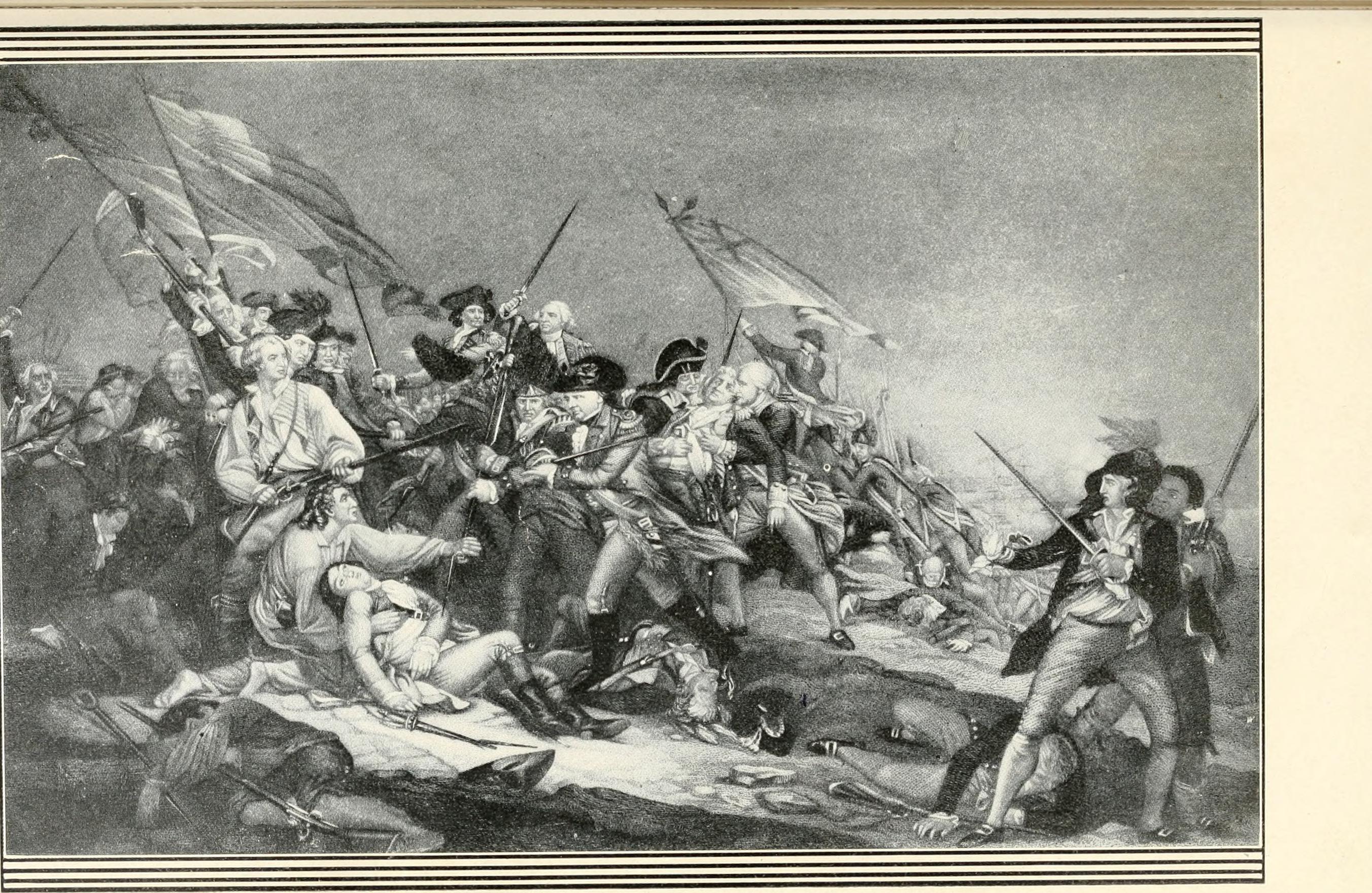
Internet Archive Book Images, 1914. Wikimedia Commons. No restrictions.
1751–1781
Jordan Freeman
1
recorded events
Connected towns:
Groton, CTBiography
Jordan Freeman (1751–1781)
Free Black Soldier, Fort Griswold Defender, Patriot Martyr
In the coastal Connecticut town of Groton, where the Thames River meets Long Island Sound, a free Black man named Jordan Freeman made his life in a society that offered him conditional belonging at best. Born around 1751, Freeman lived in a New England world where free Black men occupied an ambiguous position — legally free, yet denied the full rights and social standing afforded to their white neighbors. The precise details of his early life remain undocumented, a silence common to the historical record for Black Americans of the eighteenth century, but free Black men in coastal Connecticut communities typically sustained themselves through maritime trades, farming, or domestic service. Some had established genuine standing within their towns, even as the law and custom drew sharp lines around their participation in civic life. What is clear is that by September 1781, Freeman had committed himself to the defense of his community against British invasion. When the garrison at Fort Griswold mustered to resist a major assault, Freeman stood among the defenders — a free man choosing to risk everything for a cause that promised liberty in terms the new republic had not yet defined for people who looked like him.
On September 6, 1781, a British force under the command of the traitor Benedict Arnold descended on the Connecticut coast, targeting the towns of New London and Groton. While Arnold's troops burned New London across the river, a detachment of approximately eight hundred British regulars and Loyalist troops advanced on Fort Griswold, a hilltop fortification defended by fewer than one hundred sixty men — a mixed garrison of white militia soldiers, free Black men, and enslaved men drawn from Groton and surrounding towns. The defenders fought with extraordinary tenacity as the British stormed the walls, and the battle devolved into savage close-quarters combat as the attackers breached the fortifications. It was during this desperate fighting that Jordan Freeman, according to the tradition long preserved in Groton's community memory, encountered Major William Montgomery, the British officer leading the assault over the walls, and killed him with a spear or pike — a polearm of the kind defenders would seize when a musket could not be reloaded in time. Montgomery's death at Freeman's hands was a pivotal moment in the battle, and it enraged the British troops who witnessed it, contributing directly to the fury that consumed the attackers in the minutes that followed.
The killing of Montgomery did not save the fort. The defenders, overwhelmed and outflanked, eventually surrendered — but the surrender did not end the violence. British soldiers, infuriated by their losses and by the fierce resistance, turned on the garrison in what became known as the Fort Griswold Massacre, bayoneting wounded and unarmed men in an act of retribution that shocked even contemporaries accustomed to the brutalities of war. Jordan Freeman was among the roughly eighty-five defenders killed in the battle and its aftermath. He died fighting for a community that had accepted him as a neighbor and a soldier, if not as a fully equal citizen. The stakes he faced were layered in ways his white comrades did not share: he fought as a free man in a society where Black freedom was fragile, where enslaved people labored in the very towns he was defending, and where the Revolution's rhetoric of liberty had not been reconciled with the reality of racial hierarchy. Freeman wagered his life on a cause that had not yet decided whether its promises extended to him, and he lost that wager on the bloodied ground inside the fort's walls.
Freeman's name is inscribed on the Groton Monument, the granite obelisk erected in 1830 to honor the defenders who fell at Fort Griswold. That inscription is itself a significant act of recognition, given that many Black soldiers who served in the Revolution were excluded from official commemorations or remembered only as anonymous contributors to a white narrative of independence. In later decades, historians and community advocates have worked to reclaim Freeman's story, situating him within the broader history of African American military service and sacrifice during the founding era. His action against Major Montgomery — a moment of individual courage that altered the course of a battle — has become one of the most frequently cited episodes in the scholarship on Black soldiers in the Revolution. Freeman's story challenges any simple telling of the American founding. He reminds us that the Revolution was fought not only by those who stood to inherit its full benefits, but also by men whose very presence in the ranks posed an unanswered question about the nation's commitment to its own ideals.
WHY JORDAN FREEMAN MATTERS TO GROTON
Jordan Freeman's story is inseparable from the ground where it happened. Students and visitors who stand inside the walls of Fort Griswold in Groton can see the terrain where Freeman fought and died, and they can find his name carved into the Groton Monument alongside the names of every other defender who fell on September 6, 1781. His story teaches us that the American Revolution was not fought by a single kind of person — it was fought by free Black men, enslaved men, farmers, and sailors who stood together in a desperate garrison. Freeman's courage, and his death, force us to confront the distance between the Revolution's ideals and its realities, and to remember that the people who paid the highest price for American liberty were not always the people who received its full rewards.
TIMELINE
- 1751: Jordan Freeman is born; the circumstances and exact location of his birth are not documented in surviving records.
- 1770s: Freeman lives as a free Black man in Groton, Connecticut, during the years leading up to the Revolutionary War.
- September 6, 1781: British forces under Benedict Arnold attack New London and Groton, Connecticut, targeting Fort Griswold on Groton Heights.
- September 6, 1781: Freeman fights in the defense of Fort Griswold as part of a mixed garrison of white militia, free Black men, and enslaved men.
- September 6, 1781: Freeman kills British Major William Montgomery with a spear during the assault on the fort, according to longstanding tradition.
- September 6, 1781: Freeman is killed during the Battle of Fort Griswold or in the massacre that follows the garrison's surrender.
- 1830: The Groton Monument is erected on Groton Heights; Freeman's name is inscribed among the fallen defenders.
SOURCES
- Buel, Joy Day, and Richard Buel Jr. The Way of Duty: A Woman and Her Family in Revolutionary America. W.W. Norton & Company, 1984.
- Kaplan, Sidney, and Emma Nogrady Kaplan. The Black Presence in the Era of the American Revolution. University of Massachusetts Press, 1989.
- Fort Griswold Battlefield State Park. "The Battle of Groton Heights." Connecticut Department of Energy and Environmental Protection. https://portal.ct.gov/DEEP/State-Parks/Parks/Fort-Griswold-Battlefield-State-Park
- Nell, William Cooper. The Colored Patriots of the American Revolution. Robert F. Wallcut, 1855.
- Decker, Robert Owen. The Whaling City: A History of New London. New London County Historical Society, 1976.
Events
Sep
1781
Jordan Freeman Kills Major MontgomeryGrotonFree Black Soldier**The Battle of Fort Griswold and the Courage of Jordan Freeman** On September 6, 1781, the coastal town of Groton, Connecticut, became the site of one of the most brutal engagements of the Revolutionary War. The assault on Fort Griswold, led by British forces under the broader command of the infamous turncoat Benedict Arnold, resulted in a fierce and bloody confrontation that would claim the lives of dozens of American defenders. Among those who fought and died that day was Jordan Freeman, a free Black soldier whose act of defiance against a charging British officer became one of the most striking moments of the battle and a powerful symbol of the diverse coalition of Americans who took up arms in the fight for independence. The attack on Groton and the neighboring town of New London was part of a British effort to destroy supplies and disrupt American operations along the Connecticut coast. Benedict Arnold, once one of the Continental Army's most talented generals before his betrayal of the American cause, led approximately 1,700 British troops in a raid targeting the ports and storehouses of the region. While Arnold personally directed the burning of New London on the west side of the Thames River, a detachment of British regulars crossed to the eastern bank to assault Fort Griswold, the primary defensive fortification protecting Groton Heights. The fort was garrisoned by a relatively small force of local militia, men drawn from the surrounding communities who had assembled hastily to defend their homes. Among them was Jordan Freeman, a free Black man who served alongside his white neighbors in the militia ranks. The British force that attacked Fort Griswold was led in part by Major William Montgomery, an experienced officer who commanded one of the columns tasked with storming the fortification's walls. The defenders, though outnumbered, put up a determined resistance, pouring musket fire and cannon shot into the advancing British troops as they crossed the open ground surrounding the fort. The fighting was intense and came at great cost to the attackers. As Major Montgomery attempted to scale the walls of the fort during the assault, Jordan Freeman reportedly confronted him directly and killed him with a spear, striking down one of the most prominent British officers on the field. Montgomery's death in the act of breaching the defenses was a dramatic moment in a battle already marked by extraordinary violence. The fall of Major Montgomery and the heavy casualties suffered by the British during the assault may have contributed to what happened next. After the garrison eventually surrendered, British soldiers carried out acts of retaliatory violence against the American defenders, killing many who had already laid down their arms. The massacre at Fort Griswold became one of the most notorious episodes of the war, fueling outrage throughout Connecticut and the broader American cause. Jordan Freeman himself did not survive the battle. He was killed during the fighting, giving his life in defense of the fort and the ideals of the Revolution. Freeman's sacrifice, and his presence on the battlefield, speaks to a reality of the Revolutionary War that is sometimes overlooked. The forces that fought for American independence were not monolithic. Free Black men like Jordan Freeman served in militia units and Continental forces throughout the war, contributing to a cause whose promises of liberty and equality were not yet extended to all. Freeman's name is inscribed on the Groton Monument, a tall granite obelisk erected on the site of Fort Griswold to honor the defenders who fell there. His inclusion alongside the other names on the monument is a recognition that his service and sacrifice were equal to those of any other soldier who fought and died that day. The Battle of Fort Griswold and Jordan Freeman's role in it matter not only as a chapter in the military history of the Revolution but as a reminder of the complex and often contradictory nature of the founding era. Freeman fought as a free man for a nation still grappling with the institution of slavery, and his courage in the face of a determined enemy deserves to be remembered as part of the full and honest story of American independence.