

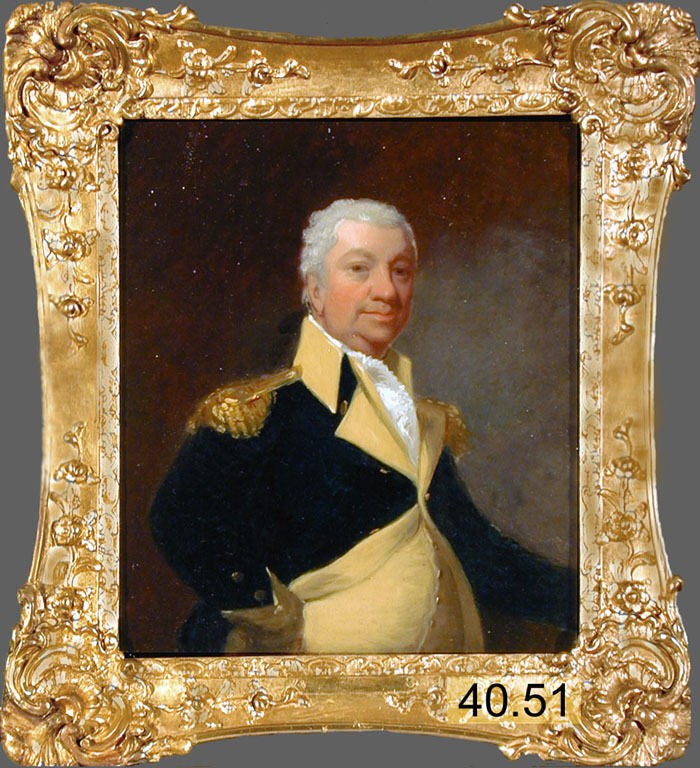
After Gilbert Stuart, 1805. Wikimedia Commons. Public domain.
1750–1806
Henry Knox
2
recorded events
Connected towns:
Crown Point, NYBiography
Henry Knox: The Bookseller Who Armed a Revolution
A stout, gregarious boy growing up on the wharves of Boston, Henry Knox was born on July 25, 1750, into a family of modest Scottish-Irish origins. His father, a shipbuilder, abandoned the family when Henry was still young, forcing the boy to leave the Boston Latin School at age twelve to support his mother. He found work in a bookshop, and it was there — surrounded by volumes on mathematics, fortification, and European warfare — that Knox began the relentless self-education that would define his life. He devoured the treatises of Vauban and Muller, absorbing the technical intricacies of siege engineering and ballistics with the appetite of a scholar and the instinct of a practitioner. By his early twenties, Knox had opened his own bookstore, the London Book-Store, which became a gathering place for both British officers and Boston intellectuals. His physical presence was as commanding as his intellect: tall, broad-shouldered, and weighing well over two hundred pounds, he projected an air of confident authority that belied his lack of formal training. In these years before the Revolution, Knox was quietly assembling a body of knowledge that no other American possessed in such depth — the science of artillery.
The spark that transformed Knox from curious bookseller to committed revolutionary came with the escalating tensions in Boston during the early 1770s. He witnessed the Boston Massacre of 1770 firsthand, reportedly stepping forward to urge restraint as British soldiers fired into the crowd — an experience that hardened his political sympathies without extinguishing his intellectual respect for military discipline. Knox joined a local militia company, the Boston Grenadier Corps, where he drilled with other young Patriots and put his theoretical knowledge into practice for the first time. When the battles of Lexington and Concord erupted on April 19, 1775, Knox's path was sealed. He and his young wife, Lucy Flucker — the daughter of the royal secretary of the province, whose Loyalist family was horrified by the match — slipped out of British-occupied Boston, reportedly smuggling his sword sewn into the lining of Lucy's cloak. Knox made his way to the American camp at Cambridge, where the ragged Continental Army was besieging the British garrison. There, amid the chaos of an army that barely existed on paper, Knox presented himself and his extraordinary expertise to the commanding general, George Washington, who immediately recognized what he had found.
Knox's most significant contribution to the Revolution — and one of the most remarkable logistical feats of the entire war — was the "Noble Train of Artillery," executed in the brutal winter of 1775 to 1776. Washington, frustrated by the stalemate around Boston and lacking the heavy guns needed to break it, dispatched Knox to Fort Ticonderoga and nearby Crown Point to retrieve the cannons captured by Ethan Allen, Benedict Arnold, and Seth Warner's forces the previous May. Knox arrived at Ticonderoga in early December 1775 and immediately set about cataloging and organizing roughly sixty tons of artillery: cannons, mortars, howitzers, and supplies. The journey that followed was staggering in its ambition. Knox's men loaded the weapons onto flat-bottomed boats to cross Lake George, then transferred them to custom-built ox-drawn sleds for the overland haul through the frozen Berkshire Mountains of western Massachusetts. They crossed rivers where the ice cracked beneath them, hauled cannons up mountain passes in driving snow, and navigated roads that were little more than frozen mud tracks. The entire operation covered approximately three hundred miles and took nearly three months to complete, arriving in the American camp by late January and into February 1776.
The artillery Knox delivered transformed the strategic equation around Boston in a single dramatic stroke. On the night of March 4, 1776, Washington ordered the fortification of Dorchester Heights, the commanding elevated ground south of Boston Harbor. Working through the darkness with a speed that stunned both armies, American troops hauled Knox's cannons into position on the heights, constructing earthworks reinforced with barrels and bales of hay to shield the guns. When dawn broke on March 5, British General William Howe found himself staring up at an American battery that could destroy his fleet and rain fire upon the city. Howe reportedly exclaimed that the rebels had done more in one night than his own army could have accomplished in months. A planned British counterattack was thwarted by a violent storm, and Howe concluded that Boston was no longer tenable. On March 17, 1776, the British evacuated the city entirely, sailing for Halifax with over a thousand Loyalist refugees. Washington promoted Knox to colonel of the Continental Regiment of Artillery, and the young bookseller's reputation was made. The date of the British departure is still celebrated in Boston as Evacuation Day, a living echo of Knox's achievement.
Knox's relationship with George Washington became one of the defining partnerships of the American Revolution, characterized by deep mutual trust, intellectual rapport, and genuine affection. Washington, who was often guarded in his personal relationships and wary of the rivalries that plagued his officer corps, found in Knox a subordinate who combined loyalty with competence — a rare combination in the Continental Army. Knox, for his part, revered Washington without becoming a sycophant, offering candid military counsel and executing orders with tireless energy. Their bond was forged in the shared hardships of the war's early years and strengthened through crisis after crisis. Knox also cultivated productive relationships with other key figures, including Nathanael Greene, with whom he shared a self-educated background and a pragmatic approach to warfare, and the Marquis de Lafayette, who admired Knox's technical mastery. His marriage to Lucy Flucker Knox was itself an alliance that bridged the war's social divisions: Lucy, whose Loyalist parents eventually fled to England, became one of the most prominent women in the Continental Army's social world, managing the Knox household through years of uncertainty and personal loss.
Knox's career was not without setbacks, controversies, and moral complexity. His management of the artillery corps was sometimes hampered by chronic shortages of powder, trained gunners, and reliable equipment — frustrations that tested even his legendary optimism. After the war, Knox became deeply entangled in speculative land ventures in Maine, where he acquired enormous tracts of territory through his wife's Flucker family claims and through government grants. His efforts to develop these lands brought him into bitter conflict with frontier settlers who had already established homesteads there, and Knox's aggressive pursuit of his property rights — including eviction proceedings against impoverished families — cast a shadow over his reputation as a champion of liberty. Critics then and later questioned how a man who had fought for republican principles could behave as a feudal landlord, displacing the very class of people who had formed the backbone of the Revolutionary army. Knox also faced accusations of financial mismanagement during his tenure as Secretary of War, though these were never fully substantiated. His physical decline in later years, marked by increasing weight and decreasing mobility, became a source of private suffering that contrasted painfully with his earlier vitality and energy.
The war transformed Henry Knox from an ambitious young tradesman into a figure of national consequence, but the personal costs were severe. He and Lucy lost several of their thirteen children in infancy and childhood — a grief that was common in the era but no less devastating for its frequency. The years of campaigning kept Knox away from his family for long stretches, and the financial sacrifices of military service left him in precarious economic circumstances even as his public stature grew. Knox emerged from the war with a broader vision of what the new nation required: a professional military establishment, a system of coastal fortifications, and a national military academy — ideas that were decades ahead of their time but that would eventually be realized. He also developed a more sober understanding of the fragility of republican government, having witnessed firsthand the Continental Army's near-collapse from congressional neglect, supply failures, and mutinies. The bookseller who had entered the war with romantic enthusiasm about the cause of liberty left it with a harder, more pragmatic appreciation of the institutional structures needed to sustain a free society. His wartime experience made him a committed nationalist, convinced that only a strong central government could protect the republic he had helped create.
Knox played a significant role in the war's final act and in the turbulent transition to peacetime governance. At the Siege of Yorktown in October 1781, he directed the American and French artillery bombardment that forced the surrender of Lord Cornwallis's army, a technical triumph that demonstrated how far the Continental artillery had come under his leadership. After the war, Knox helped defuse the Newburgh Conspiracy of 1783, in which disgruntled officers threatened to march on Congress over unpaid wages — a crisis that could have destroyed the republic before it fully began. He served as the last Secretary of War under the Articles of Confederation, beginning in 1785, and was retained in that position by President Washington when the new federal government took shape under the Constitution in 1789. In this role, Knox advocated for a national militia system, pushed for the construction of coastal defenses, and managed the young nation's troubled relations with Native American nations — policies that were often contradictory, combining genuine diplomatic overtures with the relentless pressure of westward expansion. He resigned from the cabinet in 1794 and retired to his estate in Thomaston, Maine.
Knox's contemporaries regarded him with a mixture of admiration, affection, and occasional bemusement. Washington valued him as one of the indispensable men of the Revolution, and their correspondence reveals a warmth that Washington extended to few others. Fellow officers respected Knox's technical brilliance and his ability to improvise solutions under impossible conditions, even as some grumbled about his appetite for rank and recognition. His enormous physical size — he weighed over three hundred pounds in his later years — made him a memorable and sometimes comic figure in an era that prized physical vigor, but it also lent him a presence that commanded attention in any room. John Adams, never generous with praise, acknowledged Knox's contributions to the war effort, while Alexander Hamilton worked closely with him on matters of national defense. Knox died on October 25, 1806, at the age of fifty-six, from complications after swallowing a chicken bone — an oddly prosaic end for a man whose life had been defined by grand ambitions and dramatic achievements. He was buried in Thomaston, far from the Boston streets where his extraordinary journey had begun.
Students and visitors today should know Henry Knox because his story challenges comfortable assumptions about who gets to shape history. He had no aristocratic pedigree, no military academy education, no inherited wealth or social connections — only an insatiable curiosity and the nerve to act on what he had learned. In an era when military command was often reserved for gentlemen of breeding, Knox earned his place through sheer intellectual force and practical ingenuity. His story is also a reminder that wars are not won solely by battlefield heroism; they are won by logistics, by planning, by the unglamorous work of moving supplies across impossible terrain in terrible weather. The Noble Train of Artillery was not a cavalry charge or a dramatic last stand — it was months of freezing, exhausting labor that made everything else possible. Knox's later career, with its mix of public service and private ambition, its idealism and its contradictions, reflects the complexity of the founding generation itself. He was neither a flawless hero nor a simple villain, but a brilliant, flawed, enormously energetic man who helped create a nation and then struggled, like his contemporaries, to define what that nation would become.
WHY HENRY KNOX MATTERS TO CROWN POINT
Henry Knox's connection to Crown Point lies at the heart of one of the Revolution's most consequential turning points. When Seth Warner and the Green Mountain Boys seized Crown Point in May 1775, they captured a cache of artillery that the Continental Army desperately needed but had no means to use — until Knox arrived that winter to organize its removal. The cannons hauled from Crown Point and nearby Ticonderoga across frozen Lake George and through the Berkshire wilderness gave Washington the firepower to break the Boston stalemate and force the first major British retreat of the war. For visitors to Crown Point today, Knox's story transforms the fort's ruins from a static historical site into the starting point of an epic journey that changed the course of the Revolution. His achievement reminds us that the war was won not only on battlefields but through the remote outposts and frozen supply lines that connected them.
TIMELINE
- 1750: Born in Boston, Massachusetts, on July 25
- 1771: Opens the London Book-Store in Boston, where he studies military science and artillery through extensive reading
- 1775: Escapes British-occupied Boston with his wife Lucy after the battles of Lexington and Concord; joins the Continental Army at Cambridge
- 1775: Dispatched by Washington to Fort Ticonderoga and Crown Point in November to retrieve captured British artillery
- 1775–1776: Organizes and executes the "Noble Train of Artillery," transporting roughly sixty tons of cannon across Lake George, through the Berkshires, and to Boston over the winter
- 1776: Artillery placed on Dorchester Heights in March, forcing the British evacuation of Boston on March 17; Knox promoted to colonel of the Continental Regiment of Artillery
- 1776: Promoted to brigadier general; commands artillery at the crossing of the Delaware and the Battle of Trenton in December
- 1781: Directs American and French artillery at the Siege of Yorktown, contributing to the British surrender
- 1785: Appointed Secretary of War under the Articles of Confederation; continues in the role under President Washington and the Constitution from 1789
- 1806: Dies on October 25 at his estate in Thomaston, Maine, at the age of fifty-six
SOURCES
- Puls, Mark. Henry Knox: Visionary General of the American Revolution. Palgrave Macmillan, 2008.
- Brooks, Noah. Henry Knox: A Soldier of the Revolution. G.P. Putnam's Sons, 1900.
- National Park Service. "Henry Knox and the Noble Train of Artillery." National Historical Park, Boston. https://www.nps.gov/bost/learn/historyculture/knox.htm
- Knox, Henry. Henry Knox Papers, 1719–1825. Massachusetts Historical Society, Microfilm Edition. https://www.masshist.org/collection-guides/view/fa0235
Events
May
1775
Seth Warner Seizes Crown PointCrown PointContinental Army General# Seth Warner Seizes Crown Point In the spring of 1775, the American colonies teetered on the edge of full-scale war with Great Britain. The battles of Lexington and Concord on April 19 had shattered any remaining illusion of peaceful reconciliation, and across New England, militiamen and irregular fighters began looking for ways to strike at British military power. Among the most strategically important targets in the northern colonies were the old fortifications along the Lake Champlain corridor in New York, a waterway that had served as a vital military highway between Canada and the American interior since the French and Indian War. It was in this context that one of the early, decisive moves of the American Revolution unfolded — not with a dramatic battle, but with a quiet and almost bloodless seizure that would have enormous consequences for the rebel cause. On May 10, 1775, Ethan Allen, the bold and outspoken commander of the Green Mountain Boys, led a daring predawn raid on Fort Ticonderoga, catching the small British garrison completely off guard and capturing the fortress without a single casualty on either side. The Green Mountain Boys were a militia originally formed in the disputed territory known as the New Hampshire Grants, the land that would eventually become Vermont, and they were no strangers to defiance of authority. Allen's capture of Ticonderoga was a stunning early triumph for the patriot cause, but the work along Lake Champlain was not yet finished. Just twelve miles to the north sat another fortification of considerable importance: Crown Point. Two days after the fall of Ticonderoga, on May 12, 1775, Colonel Seth Warner led a detachment of Green Mountain Boys northward to Crown Point to complete what Allen had begun. Warner, a seasoned and respected officer within the Green Mountain Boys, was known for his steadiness and tactical competence — qualities that complemented Allen's more flamboyant style of leadership. When Warner and his men arrived at Crown Point, they found a British garrison of only nine soldiers, a skeleton force that had no realistic hope of mounting a defense against the approaching rebels. The British troops offered no resistance, and the fort passed into American hands without a shot being fired. Though the seizure of Crown Point lacked the dramatic flair of Allen's surprise attack on Ticonderoga, its strategic significance was immense. Together, the two captures gave the Americans undisputed control of the Lake Champlain corridor, a critical north-south route that could serve as either an invasion path from Canada or a defensive barrier against British forces moving south. Equally important was the military hardware the Americans found within the walls of both forts. Combined, the captured fortifications yielded over one hundred pieces of artillery — cannons, mortars, and howitzers — at a time when the Continental forces were desperately short of heavy weapons. The true impact of these captured guns would not be felt for several months, but when it came, it proved decisive. In the winter of 1775–1776, General Henry Knox of the Continental Army undertook an extraordinary logistical feat, organizing the transport of dozens of heavy cannons from Ticonderoga and Crown Point across nearly three hundred miles of frozen wilderness to the outskirts of Boston. When these guns were placed on Dorchester Heights overlooking the city and its harbor, the British position became untenable. In March 1776, the British evacuated Boston entirely, a pivotal early victory for the American cause that owed its success, in no small part, to the artillery secured months earlier by men like Seth Warner and Ethan Allen. The seizure of Crown Point reminds us that not every critical moment in a revolution arrives with the thunder of musket fire. Sometimes, the course of history turns on quiet acts of initiative carried out by determined individuals who understand the broader stakes of their actions. Seth Warner's march to Crown Point was one such moment — a small event with outsized consequences that helped shape the early trajectory of American independence.
Dec
1775
Knox Transports Crown Point and Ticonderoga Cannon to BostonCrown PointContinental Army General# Knox Transports Crown Point and Ticonderoga Cannon to Boston By the autumn of 1775, the American Revolution had reached an uncomfortable stalemate outside Boston. Following the battles of Lexington and Concord the previous April, thousands of colonial militia had converged on the city, trapping General William Howe and his British garrison within its narrow peninsula. General George Washington, who had assumed command of the Continental Army in July, possessed enough men to maintain a siege but lacked the heavy artillery necessary to bring it to a decisive conclusion. His forces had muskets and a scattering of light field pieces, but nothing powerful enough to threaten the British warships anchored in the harbor or to bombard fortified positions from a commanding distance. Washington knew that without cannon, the siege could drag on indefinitely, sapping morale and giving the British time to receive reinforcements. The solution to this seemingly impossible problem lay nearly three hundred miles to the northwest, at the recently captured forts of Ticonderoga and Crown Point on the shores of Lake Champlain in New York. Earlier that year, in May 1775, a combined force led by Ethan Allen and his Green Mountain Boys, along with Benedict Arnold, had seized Fort Ticonderoga in a daring dawn raid that caught the small British garrison completely by surprise. Crown Point, a nearby fortification, fell shortly afterward. Both forts contained substantial stores of artillery that the British had accumulated over decades of frontier warfare and conflict with the French. These weapons now belonged to the American cause, but they sat idle in the remote wilderness of upstate New York, far from where they were desperately needed. In November 1775, Washington turned to Henry Knox, a twenty-five-year-old Boston bookseller turned artillery officer whose deep study of military engineering and ordnance had earned him the general's trust despite his lack of formal military training. Washington dispatched Knox northward with orders to retrieve the captured guns and deliver them to the siege lines around Boston. What followed was one of the most remarkable logistical feats of the entire Revolutionary War. Knox arrived at Ticonderoga and Crown Point and organized the collection of approximately sixty tons of cannon, mortars, and howitzers — somewhere around sixty individual pieces of various calibers. He then arranged for this enormous weight of iron and bronze to be loaded onto flat-bottomed boats and ferried down Lake George. When the lake's waters froze, Knox adapted his plans, transferring the weapons to massive ox-drawn sleds that could traverse the ice. From there, the artillery train had to be hauled overland across the rugged Berkshire Mountains of western Massachusetts, through snow, ice, and terrain that tested the endurance of men and animals alike. Rivers had to be crossed, and on more than one occasion cannons broke through thin ice, requiring exhausting efforts to recover them. Knox drove the operation forward with relentless energy and resourcefulness, coordinating teams of oxen, horses, and local volunteers across miles of frozen wilderness. By late January 1776, Knox and his extraordinary caravan arrived in the Continental Army's camp outside Boston. Washington now had the firepower he needed. On the night of March 4–5, 1776, Continental troops moved swiftly to fortify Dorchester Heights, the elevated ground overlooking Boston Harbor, and emplaced Knox's heavy guns in positions that directly threatened the British fleet and the city below. When morning revealed the American batteries looming overhead, General Howe recognized that his position had become untenable. The cannon could rain destruction on his ships and troops, and a direct assault on the fortified heights would risk a catastrophe reminiscent of the British losses at Bunker Hill. Faced with this grim calculus, Howe chose evacuation. On March 17, 1776, the British fleet sailed out of Boston Harbor, carrying the garrison and roughly a thousand Loyalist civilians to Halifax, Nova Scotia. The significance of Knox's noble train of artillery, as it came to be known, cannot be overstated. It transformed a static and frustrating siege into a decisive American victory without a major battle, delivering the first great strategic success of the Revolution and providing an enormous boost to patriot morale throughout the colonies. It also demonstrated that the Continental Army could execute complex operations requiring planning, coordination, and sheer determination — qualities that would prove essential in the long years of war ahead.