

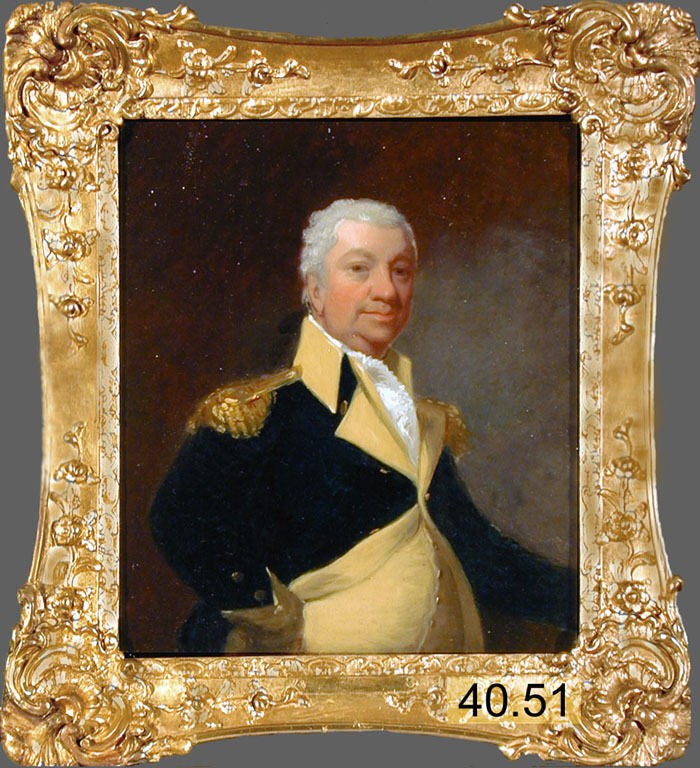
After Gilbert Stuart, 1805. Wikimedia Commons. Public domain.
1750–1806
General Henry Knox
0
recorded events
Connected towns:
Newburgh, NYBiography
General Henry Knox (1750–1806): From Bookseller to Guardian of the Republic
Born in Boston on July 25, 1750, Henry Knox grew up in circumstances that demanded early self-reliance. His father, William Knox, a shipbuilder who had fallen on hard times, abandoned the family when Henry was still a boy, forcing the young man to leave the Boston Latin School at age twelve to support his mother. He found employment in a bookshop, and the thousands of volumes that passed through his hands became his true education. Knox read voraciously on military history, engineering, fortification, and artillery science — subjects that would have seemed purely theoretical to a colonial shopkeeper but that would soon prove extraordinarily practical. By his early twenties, he had opened his own bookstore, the London Book-Store, which became a gathering place for Boston's intellectuals, British officers, and patriot sympathizers alike. His imposing physical frame — Knox was a large, gregarious man, eventually well over six feet and more than two hundred and fifty pounds — made him a memorable presence. But it was his mind, sharpened on the treatises of Vauban and Muller, that set him apart. He also joined a local artillery company, the Boston Grenadier Corps, gaining hands-on experience that complemented his bookish knowledge. This unusual combination of self-taught scholarship and practical ambition forged a character perfectly suited for the crisis that was coming.
The shots fired at Lexington and Concord on April 19, 1775, transformed Knox from a prosperous young bookseller into a revolutionary. He and his wife, Lucy Flucker — whose wealthy Loyalist family opposed the match and the cause — smuggled themselves out of British-occupied Boston, reportedly hiding Knox's sword in the lining of Lucy's cloak. Knox immediately offered his services to the patriot army besieging the city, and his deep knowledge of artillery and fortification quickly attracted the attention of General George Washington, who had just taken command of the Continental forces in Cambridge. Washington recognized in Knox something rare among his volunteer officers: genuine technical expertise grounded in years of disciplined study. By November 1775, Washington entrusted the twenty-five-year-old with what seemed an impossible mission — to retrieve the cannons captured at Fort Ticonderoga and bring them to the siege lines around Boston. This single assignment became Knox's entry into the inner circle of the Revolution's leadership. His willingness to abandon a comfortable livelihood, to defy his wife's prominent Tory family, and to risk everything on the uncertain fortunes of a rebel army marked the decisive turning point of his life. In choosing revolution, Knox did not merely join a cause; he reinvented himself entirely, staking his future on principles he had absorbed from the very books he once sold.
The expedition to Fort Ticonderoga in the winter of 1775–1776 stands as Knox's single most significant military achievement and one of the most audacious logistical feats of the entire Revolutionary War. Washington needed artillery desperately: without heavy guns, the Continental Army could not dislodge the British from Boston. Knox proposed hauling some sixty tons of cannons, mortars, and howitzers — captured from the British the previous spring — across three hundred miles of frozen wilderness, over mountains, across rivers, and through the brutal New England winter. Setting out in November 1775 with teams of oxen, horses, and specially constructed sledges, Knox supervised every grueling mile of the journey. The column crossed the icy Hudson River multiple times, losing at least one cannon through the ice before recovering it. Knox's journal from the expedition reveals a man of relentless energy and infectious optimism, coaxing exhausted men and animals forward through snowdrifts and freezing rain. By late January 1776, the impossible train of artillery arrived outside Boston. Washington placed the guns on Dorchester Heights overlooking the harbor, and on March 17, 1776, the British evacuated the city without a fight. The "noble train of artillery," as Knox himself called it, announced to both armies that the Continental forces possessed not only courage but also the organizational capacity to wage a serious war.
From that triumph at Boston, Knox became an indispensable presence in nearly every major engagement of the war. He commanded the artillery at the crossing of the Delaware on Christmas night, 1776, managing the transport of eighteen cannons across the ice-choked river — a feat of coordination that made the stunning victory at Trenton possible. At Princeton days later, his guns again proved decisive. Through the dark years of 1777 and 1778, Knox endured the defeats at Brandywine and Germantown, survived the misery of Valley Forge, and commanded artillery effectively at the Battle of Monmouth in June 1778. Washington's trust in him only deepened with each campaign. At the decisive Siege of Yorktown in October 1781, Knox directed the Continental and French artillery that pounded Cornwallis's fortifications into submission. His placement of guns in parallel siege lines reflected years of self-taught mastery now tested and confirmed on the battlefield. Throughout all these engagements, Knox demonstrated an ability to adapt European artillery doctrine to American conditions — improvising with inferior equipment, training raw recruits into competent gun crews, and maintaining morale among men who were often unpaid and poorly supplied. Each battle added to his reputation and cemented his role as one of Washington's most dependable commanders.
No relationship shaped Knox's wartime career more profoundly than his bond with George Washington. The two men formed a partnership built on mutual respect, shared hardship, and complementary temperaments. Washington, reserved and deliberate, found in Knox an officer who combined technical brilliance with warmth, humor, and an eagerness to execute orders with creative energy. Knox, in turn, revered Washington as the embodiment of republican virtue and military resolve. Their correspondence reveals genuine affection alongside professional respect — Washington sought Knox's counsel not only on artillery matters but also on questions of strategy, morale, and politics. Knox also maintained important relationships with other senior officers, including Nathanael Greene and the Marquis de Lafayette, and he cultivated connections with members of Congress who controlled the army's funding. His wife Lucy, despite her Loyalist family background, became a formidable social presence in camp, and the Knoxes' hospitality helped sustain the fragile network of friendships and alliances that held the officer corps together. These relationships were not merely personal; they were structural. In an army constantly threatened by desertion, mutiny, and political neglect, the web of loyalty that Knox helped weave around Washington was itself a strategic asset of the first order.
Knox's career was not without setbacks, controversies, and moral complexity. His massive physical appetites — for food, for land, for social prominence — sometimes drew criticism, and his post-war pursuit of wealth through vast land claims in Maine, totaling hundreds of thousands of acres acquired through his wife's family connections, generated lasting resentment among settlers who regarded him as a speculator and an aristocrat. During the war itself, Knox could be vain and sensitive about rank, engaging in disputes with fellow officers over seniority and credit. His relationship with the Society of the Cincinnati, the hereditary organization of Continental Army officers that he helped found in 1783, attracted accusations of elitism and anti-republican sentiment — charges that stung because they contradicted everything Knox claimed to stand for. There were also moments of genuine military failure: artillery shortages he could not overcome, battles where his guns arrived too late or were poorly positioned. And the fundamental tension of his position — a self-made man who craved the approval of established elites — gave his character a contradictory quality that contemporaries noticed. Knox believed passionately in the republic, yet he also yearned for the trappings of gentility that the republic was supposedly leaving behind. This tension made him deeply human, and it complicates any portrait that seeks to present him as a simple hero.
Eight years of war transformed Henry Knox from a young bookseller with theoretical knowledge into a seasoned military leader who had witnessed the full spectrum of human courage and frailty. The physical toll was significant: he had lost two fingers in a hunting accident before the war and carried the weight of constant campaigning on his already large frame. But the deeper transformation was psychological and moral. Knox had seen men freeze at Valley Forge, had watched soldiers mutiny over unpaid wages, had witnessed the fragile Continental Congress nearly collapse under the weight of its own dysfunction. These experiences burned into him a conviction that the new nation needed stronger institutions — a more powerful central government, a professional military establishment, a system capable of honoring its promises to the men who had fought for it. His wartime letters reveal an evolution from youthful enthusiasm to something more sober and resolute. He still possessed his famous geniality, but it was now tempered by an awareness of how easily the experiment in self-government could fail. The war had taught him that liberty required not only bravery but also organization, not only idealism but also the mundane machinery of governance. This understanding shaped everything he did after the guns fell silent.
As the war wound toward its uncertain conclusion in 1782 and 1783, Knox found himself at the center of the most dangerous internal crisis the Continental Army ever faced. Encamped at Newburgh, New York, the officer corps seethed with frustration. Congress had failed to pay them for months, and promises of half-pay pensions seemed likely to evaporate with demobilization. In March 1783, anonymous letters — later attributed to Major John Armstrong — circulated through the camp, urging officers to take collective action and hinting that the army might refuse to disband or even march against the civilian government. Knox, firmly aligned with Washington, helped assess the mood of the officer corps and identify the most volatile figures. He supported Washington's decision to call a meeting of officers on March 15, 1783, and was present in the Temple of Virtue when Washington delivered his extraordinary address. When Washington fumbled for his spectacles and remarked that he had "grown gray in your service, and now find myself growing blind," the emotional power of the moment dissolved the conspiracy's momentum. Knox's steadfast presence behind the scenes during those weeks exemplified the quiet loyalty that prevented the American Revolution from devouring itself.
Contemporaries recognized Knox as one of the indispensable men of the Revolution. Washington himself, in numerous letters and official communications, praised Knox's skill, loyalty, and tireless energy. After the war, Knox served as Secretary of War under the Articles of Confederation beginning in 1785 and continued in that role under President Washington when the new Constitution took effect in 1789. In this capacity, he worked to establish the foundations of American military policy, advocating for a system of citizen militias supplemented by a small professional force — a vision that reflected his own experience as a self-taught soldier who had risen through talent rather than birth. His contemporaries also noted his personal warmth: Knox was renowned as a generous host, a lively conversationalist, and a man who could lighten the mood of even the most desperate councils of war. Yet there were also those who viewed him with skepticism — critics who saw his land dealings, his appetite for rank and recognition, and his involvement with the Cincinnati as evidence that the Revolution's ideals were being compromised by the very men who had fought for them. His reputation in his own time was thus both luminous and contested, reflecting the larger tensions of a new nation struggling to define what its revolution had actually meant.
Students and visitors today should know Henry Knox because his story illuminates one of the Revolution's most important and least understood lessons: that winning independence was only half the battle, and that preserving self-government required a different kind of courage. Knox's journey from a Boston bookshop to the command of Continental artillery shows that the Revolution was made by ordinary people who educated and transformed themselves to meet extraordinary demands. His technical mastery reminds us that wars are won not only by heroism but by logistics, planning, and unglamorous competence. His loyalty during the Newburgh crisis demonstrates that the survival of American democracy depended on military leaders who chose to subordinate their power to civilian authority — a choice that was not inevitable and not easy. And his post-war career reveals the ongoing struggle to build institutions worthy of the ideals for which the war was fought. Knox was not a perfect man: he was vain, ambitious, and sometimes acquisitive. But his fundamental commitment to the principle that the army serves the republic, not the other way around, helped establish a tradition of civil-military relations that remains the foundation of American democracy. His story deserves to be remembered not as a simple tale of heroism but as a complicated, instructive portrait of revolutionary citizenship.
WHY GENERAL HENRY KNOX MATTERS TO NEWBURGH
Henry Knox's presence at Newburgh during the crisis of March 1783 places him at the exact moment when the American Revolution could have collapsed into military dictatorship. As Washington's artillery commander and one of his most trusted confidants, Knox helped hold the officer corps together when unpaid, angry men were tempted to turn against the civilian government they had fought to create. His story teaches students that the Revolution's success depended not only on battlefield victories but on the moral choices made in frustrating, unglamorous moments of waiting. Visitors to the Newburgh sites walk the same ground where Knox and his fellow officers faced that test — and chose republic over power.
TIMELINE
- 1750: Born in Boston, Massachusetts, on July 25
- 1771: Opens the London Book-Store in Boston, which becomes a gathering place for intellectuals and patriots
- 1774: Marries Lucy Flucker, daughter of a prominent Loyalist family
- 1775: Escapes British-occupied Boston; joins the Continental Army and proposes the Ticonderoga artillery expedition
- 1775–1776: Transports sixty tons of captured cannons from Fort Ticonderoga to Boston, forcing British evacuation on March 17, 1776
- 1776: Commands artillery at the crossing of the Delaware and the Battle of Trenton (December 25–26)
- 1781: Directs Continental and French artillery at the Siege of Yorktown (September–October), leading to British surrender
- 1783: Present at Newburgh during the conspiracy; supports Washington's address to officers on March 15; helps found the Society of the Cincinnati
- 1785–1794: Serves as Secretary of War under the Articles of Confederation and then under President Washington
- 1806: Dies at his estate in Thomaston, Maine, on October 25, at age fifty-six
SOURCES
- Puls, Mark. Henry Knox: Visionary General of the American Revolution. Palgrave Macmillan, 2008.
- Philbrick, Nathaniel. Valiant Ambition: George Washington, Benedict Arnold, and the Fate of the American Revolution. Viking, 2016.
- Knox, Henry. Henry Knox Papers. Massachusetts Historical Society. https://www.masshist.org/collection-guides/view/fa0191
- Head, David. A Crisis of Peace: George Washington, the Newburgh Conspiracy, and the Fate of the American Revolution. Pegasus Books, 2019.
- Brooks, Noah. Henry Knox: A Soldier of the Revolution. G.P. Putnam's Sons, 1900.