

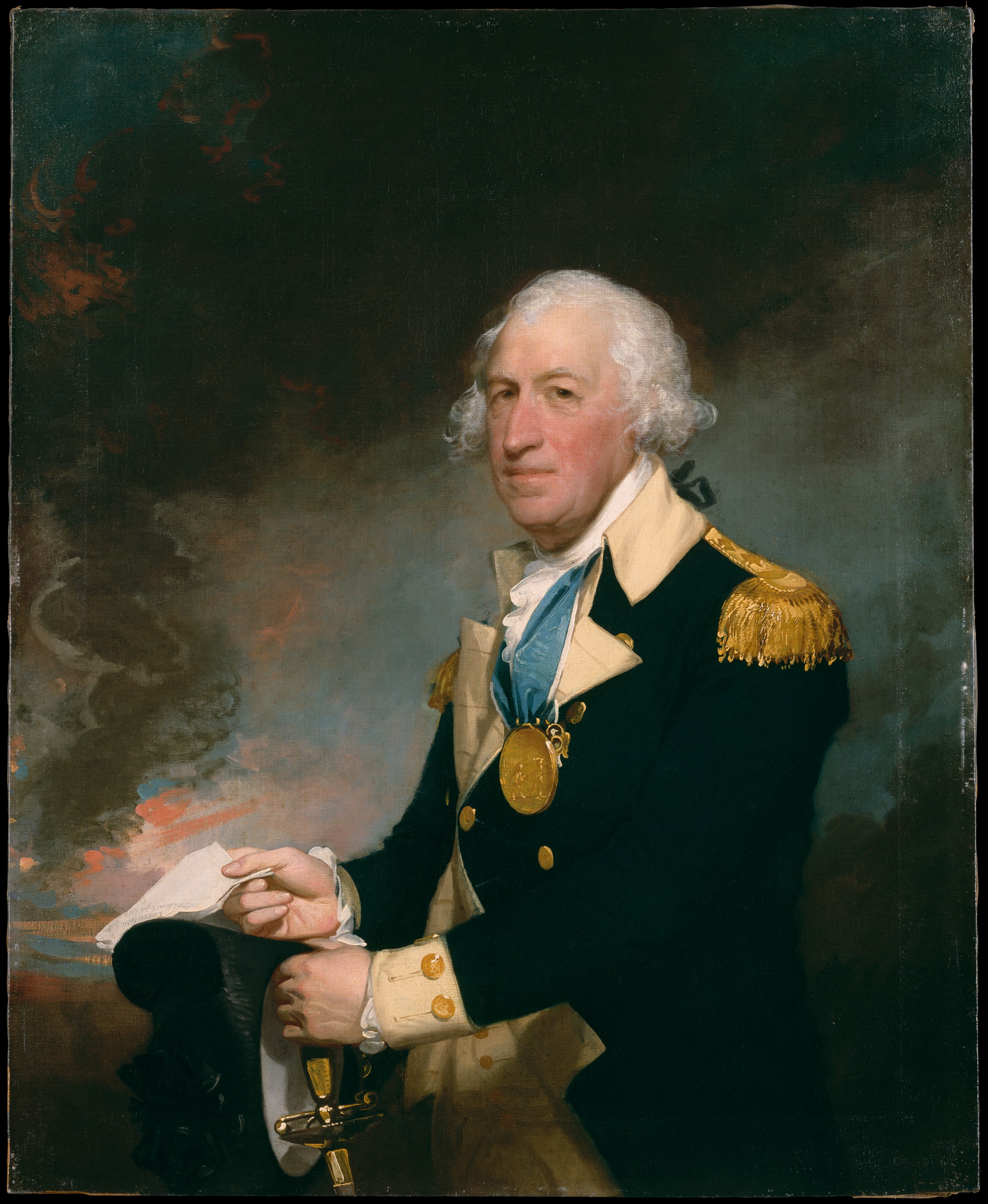
Gilbert Stuart, betw. Wikimedia Commons. CC0.
1727–1806
Horatio Gates
1
recorded events
Connected towns:
Crown Point, NYBiography
Horatio Gates (1727–1806)
Continental Army Major General and Commander of the Northern Department
Born in Maldon, Essex, England, in 1727, the man who would one day claim America's most celebrated early victory came from modest origins and built his career through persistence and military professionalism rather than wealth or social rank. Gates entered the British army as a young man and found his way to North America during the imperial wars that defined the mid-eighteenth century. He served under General Edward Braddock in the disastrous 1755 expedition against Fort Duquesne, surviving the ambush that killed Braddock and shattered British confidence in frontier warfare. That harrowing experience taught Gates lasting lessons about the limits of European tactics in American terrain, the fragility of supply lines in wilderness campaigns, and the devastating consequences of overconfidence. He continued in British service through the broader Seven Years' War, accumulating practical knowledge of logistics, garrison command, and the operational realities of campaigning in the colonies. When peacetime reductions left him on half-pay with limited prospects for advancement in an army that favored aristocratic connections, Gates looked westward. He emigrated to Virginia, purchased a plantation, and cultivated friendships with prominent colonists, including George Washington, positioning himself for a new chapter.
When the American colonies broke with Britain, Gates's professional military background made him an unusually valuable recruit for a rebel army desperately short of trained officers. Congress recognized his experience immediately, commissioning him as a brigadier general in June 1775 and appointing him adjutant general of the Continental Army, a staff position responsible for the organizational machinery that transformed raw militia into something resembling a functioning military force. In this role, Gates helped impose order on the chaotic encampments around Boston, drafting regulations, systematizing record-keeping, and establishing administrative procedures that the fledgling army badly needed. His talents were clearly administrative and organizational as much as tactical, and this bureaucratic competence — unglamorous but essential — distinguished him from many of his fellow generals who craved battlefield glory above all else. Gates understood that armies moved on paperwork as much as on courage, and he proved adept at the unglamorous work of making military institutions function. His ambition, however, extended well beyond staff work. He lobbied persistently for independent field command, and by the summer of 1776, Congress granted his wish by assigning him to the Northern Department, where a full-scale crisis was unfolding along the Lake Champlain corridor.
Gates assumed command of the Northern Department during one of the war's most perilous moments. The ambitious American invasion of Canada had collapsed catastrophically, and the survivors — sick, demoralized, and disorganized — were streaming southward along Lake Champlain in the summer of 1776. Smallpox ravaged the ranks, supplies were nearly nonexistent, and the British were preparing to exploit their advantage with a powerful southward thrust aimed at splitting the colonies along the Hudson River corridor. Gates threw himself into the enormous task of rebuilding this broken force, managing the logistics of feeding, sheltering, and re-equipping thousands of soldiers who had lost nearly everything. He oversaw the defensive preparations along Lake Champlain, understanding that every week of delay imposed on the British advance gave the American cause time it desperately needed. Crown Point, situated at a critical juncture on the lake, served as the northern anchor of this defensive line, and Gates recognized its strategic importance as a forward observation point and staging area. His decision-making during this period prioritized organizational discipline and careful resource management over dramatic offensive action, reflecting a sober assessment of what his battered department could realistically accomplish against superior British forces.
The culmination of Gates's northern command came in the autumn of 1777, when the Saratoga campaign produced the most consequential American victory of the entire war. British General John Burgoyne led a formidable army southward from Canada, expecting to slice through New York and sever New England from the rest of the rebellion. Gates, now firmly in command of the Northern Department, positioned his growing army on Bemis Heights near Saratoga, forcing Burgoyne into a series of increasingly desperate engagements. The Battles of Freeman's Farm on September 19 and Bemis Heights on October 7 bled the British army badly, and Gates's defensive strategy — allowing the enemy to exhaust itself against fortified American positions while militia swelled his ranks — proved devastatingly effective. On October 17, 1777, Burgoyne surrendered his entire army, a stunning event that reverberated across the Atlantic and directly persuaded France to enter the war as an American ally. This single outcome transformed the Revolution from a colonial rebellion into a global conflict, fundamentally altering the strategic calculus. Yet Gates's triumph contained seeds of controversy, as questions immediately arose about how much credit belonged to him and how much to subordinates like Benedict Arnold and Daniel Morgan, whose battlefield leadership had been more visibly dramatic.
Gates's relationships with fellow commanders shaped both his successes and his eventual downfall. His partnership with Philip Schuyler, whom he replaced as Northern Department commander, was poisoned by rivalry and mutual resentment; Schuyler's political allies never forgave Gates for supplanting their patron, and the resulting factional warfare consumed congressional energy at critical moments. Gates's association with the so-called Conway Cabal — a murky episode in late 1777 and early 1778 involving Brigadier General Thomas Conway and several congressional delegates who allegedly schemed to replace Washington as commander-in-chief — permanently damaged his standing with Washington and Washington's supporters. Whether Gates actively conspired or merely benefited passively from others' intrigues remains debated, but the political fallout was real and lasting. His relationship with Benedict Arnold during the Saratoga campaign was openly hostile; the two clashed bitterly over tactics and credit, with Gates eventually relieving Arnold of command just before the final battle. When Congress gave Gates command of the Southern Department in 1780, he marched confidently into South Carolina and suffered a catastrophic defeat at Camden on August 16, where his army disintegrated before Lord Cornwallis's regulars. Gates fled the field with conspicuous speed, and his military career effectively ended in disgrace.
The story of Horatio Gates challenges simple narratives about Revolutionary War heroism and compels a more nuanced understanding of how the war was actually won. His greatest contributions were organizational rather than tactical — the painstaking, unglamorous work of rebuilding shattered armies, managing supply chains across vast wilderness distances, and maintaining defensive positions that denied the enemy strategic momentum. Saratoga, the victory most associated with his name, was arguably the single most important military event of the Revolution, yet Gates's role in it has been endlessly debated and frequently minimized in favor of more charismatic figures. His catastrophe at Camden and his suspected involvement in the Conway Cabal ensured that posterity would treat him skeptically, and the contrast between his northern triumph and southern humiliation became a cautionary tale about the limits of reputation. Gates spent his final years in New York City, having freed his enslaved workers and retired from public life, dying in 1806 as the new nation he helped create was still defining itself. His career illustrates an essential truth about the Revolution: that victory depended not only on battlefield courage but on the administrative competence and logistical endurance that kept fragile armies in the field long enough to win.
WHY HORATIO GATES MATTERS TO CROWN POINT
Horatio Gates understood what many visitors to Crown Point come to appreciate firsthand: that geography shaped the American Revolution as powerfully as any general's decision. As commander of the Northern Department, Gates oversaw the defensive network along Lake Champlain in which Crown Point served as a vital forward position — a watchtower and staging point guarding the corridor that the British intended to use to split the colonies in two. His management of the 1776–1777 northern theater, including the retreat from Canada and the buildup that culminated at Saratoga, depended on places like Crown Point functioning as links in a chain of defense. Students visiting these sites can see the landscape through Gates's eyes and understand that the Revolution's greatest victory was built on months of quiet, determined preparation across dozens of miles of contested frontier.
TIMELINE
- 1727: Born in Maldon, Essex, England
- 1749: Receives first British army commission and begins military career
- 1755: Serves under General Edward Braddock in the disastrous expedition against Fort Duquesne; survives the ambush that kills Braddock
- 1772: Emigrates to Virginia and establishes himself as a planter
- 1775: Commissioned as brigadier general in the Continental Army and appointed adjutant general
- 1776: Assumes command of the Northern Department during the retreat from Canada; oversees defensive preparations along Lake Champlain, including Crown Point
- 1777: Commands the American forces at Saratoga; accepts the surrender of General Burgoyne's army on October 17
- 1778: Implicated in the Conway Cabal controversy, damaging his relationship with George Washington
- 1780: Suffers catastrophic defeat at the Battle of Camden, South Carolina, on August 16; relieved of command
- 1806: Dies in New York City on April 10
SOURCES
- Mintz, Max M. The Generals of Saratoga: John Burgoyne and Horatio Gates. Yale University Press, 1990.
- Nelson, Paul David. General Horatio Gates: A Biography. Louisiana State University Press, 1976.
- Ketchum, Richard M. Saratoga: Turning Point of America's Revolutionary War. Henry Holt and Company, 1997.
- National Archives. "Papers of the Continental Congress: Letters from Major General Horatio Gates." https://www.archives.gov/
- Ferling, John. Almost a Miracle: The American Victory in the War of Independence. Oxford University Press, 2007.
Events
Oct
1777
Saratoga Campaign Ends at British SurrenderCrown PointContinental Army Major General# The Saratoga Campaign and the British Surrender The British surrender at Saratoga on October 17, 1777, stands as one of the most consequential moments in the American Revolutionary War — a turning point that transformed a struggling colonial rebellion into an international conflict that Britain could not ultimately win. To understand why this single event carried such enormous weight, one must look back to the preceding year and trace the chain of decisions, battles, and delays that made the American victory at Saratoga possible. In 1776, the British devised an ambitious strategy to crush the rebellion by splitting the American colonies along the Hudson River Valley, effectively severing New England from the rest of the states. A critical part of this plan involved moving a large invasion force southward from Canada through the waterways of Lake Champlain and into New York. Standing in the way was a small and hastily assembled American fleet commanded by Benedict Arnold, then a Continental Army general whose courage and tactical instincts had already earned him a formidable reputation. At the Battle of Valcour Island in October 1776, Arnold's outgunned flotilla engaged a far superior British naval force. Though the Americans lost most of their ships and Arnold was forced to retreat, the engagement achieved something of immeasurable strategic value: it delayed the British advance long enough that the approaching winter made further southward movement impractical. The invasion was postponed until the following year, and that delay would prove fatal to British ambitions. The months gained by Arnold's stand at Valcour Island gave the Continental Army precious time to recruit, reorganize, and fortify positions throughout New York. When British General John Burgoyne finally launched his campaign in the summer of 1777, leading an army of roughly 8,000 troops southward from Canada, he encountered a far better prepared American resistance than he had anticipated. Burgoyne's force initially made progress, capturing Fort Ticonderoga in early July, but the deeper his army pushed into the wilderness of upstate New York, the more his supply lines stretched thin and his forces became vulnerable. The American forces opposing Burgoyne were under the overall command of Major General Horatio Gates, a cautious and politically adept officer who established strong defensive positions near Saratoga. The campaign culminated in two critical engagements known as the Battles of Saratoga. The first, the Battle of Freeman's Farm on September 19, 1777, saw fierce fighting that checked the British advance. The second, the Battle of Bemis Heights on October 7, proved decisive. During this engagement, Benedict Arnold — who had been effectively relieved of field command after clashing with Gates — rode into battle without authorization, rallying American troops in a series of aggressive assaults that broke the British lines. Arnold's leadership on the field that day was instrumental in the American victory, though it came at great personal cost: he was severely wounded in the leg, an injury that would trouble him for the rest of his life. With his army battered, surrounded, and cut off from reinforcement or retreat, General Burgoyne found himself in an impossible position. On October 17, 1777, he formally surrendered approximately 5,700 British and allied troops to General Gates — one of the largest capitulations of the entire war. The defeat shattered the British strategy of dividing the colonies and dealt a severe blow to British prestige on the world stage. The ramifications of Saratoga extended far beyond the battlefield. The American victory provided exactly the evidence that France had been waiting for — proof that the Continental Army could defeat a major British force in a set campaign. Within months, France entered the war as a formal ally of the United States, signing the Treaty of Alliance in February 1778. French military and naval support, along with financial assistance, fundamentally altered the balance of the conflict, stretching British resources across multiple theaters and ultimately making their hold on the American colonies unsustainable. The Saratoga campaign thus represents far more than a single battle or surrender. It was the culmination of a sequence that began with Arnold's desperate stand at Valcour Island, continued through months of rebuilding and preparation, and ended with a victory that reshaped the entire war. Without the delay won in 1776, without the reinforcements gathered through the winter, and without the fierce fighting at Freeman's Farm and Bemis Heights, the outcome might have been very different — and with it, the course of American independence itself.