

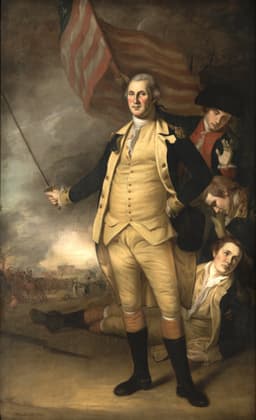
Charles Willson Peale, 1784. Wikimedia Commons. Public domain.
1726–1777
Hugh Mercer
3
recorded events
Connected towns:
Fredericksburg, VABiography
Hugh Mercer (1726–1777)
Scottish Physician, Fredericksburg Patriot, Continental Army Brigadier General
Born around 1726 in the parish of Pitsligo, Aberdeenshire, Scotland, the man who would become one of the American Revolution's most celebrated martyrs began his professional life in the world of medicine. Hugh Mercer studied at the University of Aberdeen and received training as a physician and surgeon, skills that would serve him across two continents and multiple wars. His first taste of combat came not in America but on the rain-soaked moor of Culloden in April 1746, where he served as a surgeon with the Jacobite army of Charles Edward Stuart in its doomed attempt to reclaim the British throne for the House of Stuart. The catastrophic defeat at Culloden and the savage reprisals that followed — summary executions, forced clearances, and the systematic destruction of Highland culture — made remaining in Scotland a death sentence for anyone who had supported the rising. Mercer fled, carrying little more than his medical knowledge and whatever instincts for survival a young man on the losing side of a civil war could muster. He crossed the Atlantic and landed in Pennsylvania, beginning the long process of reinventing himself in a country that rewarded exactly the kind of resourcefulness his circumstances demanded.
Mercer initially settled in the frontier regions of Pennsylvania, where he practiced medicine among scattered settlements and gained firsthand experience with the dangers of colonial life on the western edges of British America. During the French and Indian War, he served with colonial forces and distinguished himself in several engagements, including the ill-fated expedition against Fort Duquesne in 1758, where he was wounded in action. It was during this period of frontier warfare that Mercer formed a friendship with George Washington, then a young Virginia militia colonel whose ambitions and temperament complemented Mercer's own. After the war, Mercer relocated to Fredericksburg, Virginia, where he established an apothecary shop on Caroline Street and built a respected medical practice. The move to Fredericksburg placed him at the center of a thriving colonial town and deepened his bond with Washington, whose Mount Vernon estate lay within comfortable traveling distance. As tensions between the colonies and the British Crown escalated through the late 1760s and early 1770s, Mercer's dual experience as a physician and a veteran of two wars positioned him as exactly the kind of man Virginia's Patriot leaders would turn to when words gave way to arms.
When open conflict became inevitable in 1775, Mercer threw himself into organizing Virginia's military response. He helped raise and organize militia companies in the Fredericksburg area, applying the hard lessons he had learned at Culloden and on the Pennsylvania frontier to the urgent task of preparing civilian soldiers for a war against the most powerful military force on earth. His organizational abilities, his combat experience, and his close relationship with Washington — now commander-in-chief of the newly formed Continental Army — made him a natural candidate for senior command. Congress appointed him a Brigadier General in the Continental Army on June 5, 1776, a rank that reflected both his genuine military competence and the trust Washington placed in him. Mercer took command of a brigade and became one of Washington's most relied-upon subordinates during the darkest months of 1776, when the Continental Army suffered a string of devastating defeats in New York and New Jersey that threatened to extinguish the Revolution before it had truly begun. His steadiness during retreat and his willingness to share the miseries of his soldiers earned him deep respect throughout the army.
The closing days of December 1776 brought the desperate gamble that would define and end Mercer's military career. On Christmas night, Washington led his battered army across the ice-choked Delaware River in a surprise attack on the Hessian garrison at Trenton, New Jersey. Mercer was a key participant in this operation, and the stunning American victory on December 26 revived Patriot morale across the colonies. It was also at Trenton that a young Virginia lieutenant named James Monroe was severely wounded during the assault, one of many officers whose courage that night became legendary. But the campaign was not finished. On January 3, 1777, Washington struck again, this time at Princeton. Mercer's brigade advanced ahead of the main army and encountered British regulars near an orchard belonging to William Clark. A savage close-range engagement erupted. Mercer's horse was shot from beneath him, and when he struggled to his feet, British soldiers — who reportedly mistook him for Washington himself — surrounded him, demanded his surrender, and bayoneted him repeatedly when he refused to yield. He was left bleeding on the frozen ground.
American soldiers recovered Mercer from the battlefield and carried him to a nearby farmhouse, where he lingered for nine agonizing days before dying of his wounds on January 12, 1777. Washington, who had personally rallied Mercer's retreating brigade and turned the Battle of Princeton into an American victory, was reportedly devastated by the loss. The two men had shared a friendship forged in the French and Indian War and deepened through years of mutual respect in Fredericksburg's social and civic life. Their bond illustrated something essential about the Revolution's leadership: many of its most important relationships predated the war itself, rooted in the networks of trust that colonial Virginia's gentry and professional classes had cultivated over decades. Mercer's friendship with Washington was not merely personal — it was professional, strategic, and ultimately sacrificial. Washington trusted Mercer with the advance guard at Princeton precisely because he knew the Scottish physician would not flinch, and Mercer's willingness to fight to the death rather than surrender validated that trust in the most terrible way possible.
The death of Hugh Mercer became one of the Revolution's most powerful martyrdom stories, circulated widely in newspapers and sermons to rally public support for the Patriot cause. The Continental Congress ordered a monument erected in his honor at Fredericksburg, though it would take decades for the memorial to be completed. John Trumbull's celebrated painting The Death of General Mercer at the Battle of Princeton fixed the image of Mercer's fall in the visual memory of the new nation, portraying the bayoneted general as a classical hero sacrificing himself for liberty. For Fredericksburg, Mercer became the town's most cherished Revolutionary figure — the immigrant physician who had crossed an ocean to escape one tyranny only to die fighting another. His apothecary on Caroline Street survived as a tangible link to his life, and his name was given to counties, streets, and forts across the growing republic. Mercer's story reminds us that the Revolution was not only fought by native-born Americans but by men who had chosen this country and its principles deliberately, sometimes at the cost of everything they had built and everything they were.
WHY HUGH MERCER MATTERS TO FREDERICKSBURG
Hugh Mercer's story connects Fredericksburg directly to some of the Revolution's most dramatic and consequential moments. Students and visitors who walk Caroline Street in Fredericksburg today can visit the site of the apothecary where Mercer practiced medicine, a tangible link to a man who helped organize Virginia's militia response, served as one of Washington's most trusted generals, and gave his life at Princeton in the war's darkest winter. His journey — from defeated Jacobite surgeon to American Brigadier General — illustrates how the Revolution drew strength from people who had already risked everything once and were willing to do so again. Mercer's Fredericksburg is a place where the personal friendships, professional networks, and civic commitments that sustained the Revolution were built long before the first shot was fired.
TIMELINE
- 1726: Born in Pitsligo, Aberdeenshire, Scotland
- 1744–1746: Studies medicine at the University of Aberdeen and serves as a surgeon with Jacobite forces
- 1746: Present at the Battle of Culloden on April 16; flees Scotland after the Jacobite defeat
- c. 1747: Emigrates to Pennsylvania and begins practicing medicine on the frontier
- 1758: Serves in the Forbes Expedition against Fort Duquesne during the French and Indian War; wounded in action
- c. 1760: Relocates to Fredericksburg, Virginia, and opens an apothecary on Caroline Street
- 1775: Organizes Virginia militia companies in the Fredericksburg area as the Revolution begins
- 1776: Appointed Brigadier General in the Continental Army on June 5; participates in the Battle of Trenton on December 26
- 1777: Fatally wounded at the Battle of Princeton on January 3; dies of his wounds on January 12
SOURCES
- Philander D. Chase, ed. The Papers of George Washington, Revolutionary War Series. University of Virginia Press, 1985–present.
- Joseph M. Waterman. With Sword and Lancet: The Life of General Hugh Mercer. Kingsport Press, 1941.
- Fischer, David Hackett. Washington's Crossing. Oxford University Press, 2004.
- George Washington's Ferry Farm and Historic Kenmore. "Hugh Mercer Apothecary Shop." https://kenmore.org/historic-sites/hugh-mercer-apothecary-shop/
- Boatner, Mark M., III. Encyclopedia of the American Revolution. David McKay Company, 1966.
Events
Jun
1775
Hugh Mercer Organizes Virginia MilitiaFredericksburgContinental Army Brigadier General# Hugh Mercer Organizes Virginia Militia — Fredericksburg, Virginia, 1775 In the spring of 1775, news of the battles at Lexington and Concord on April 19 rippled through the American colonies like a shockwave, transforming simmering political discontent into urgent military preparation. Nowhere was this transformation more consequential than in Virginia, where communities that had long debated the limits of British authority now found themselves confronting the very real possibility of armed conflict. In Fredericksburg, a prosperous town along the Rappahannock River, a Scottish-born physician named Hugh Mercer stepped forward to answer the call, drawing on a lifetime of hard-won military experience to mold raw Virginia volunteers into a disciplined fighting force capable of standing against one of the most powerful armies in the world. Hugh Mercer's path to Fredericksburg had been shaped by war and exile. Born in Scotland around 1726, he had studied medicine at the University of Aberdeen before serving as an assistant surgeon in the army of Charles Edward Stuart, the "Young Pretender," during the Jacobite rising of 1745. Mercer fought at the Battle of Culloden in April 1746, where the Jacobite cause met its devastating end at the hands of British government forces under the Duke of Cumberland. Fleeing Scotland in the aftermath of that defeat, Mercer eventually settled in Pennsylvania, where he established a medical practice on the frontier. When the French and Indian War erupted in the 1750s, he once again took up arms, this time serving in General Edward Braddock's ill-fated campaign against Fort Duquesne in 1755. That campaign, which ended in a catastrophic ambush and Braddock's death, taught Mercer painful but invaluable lessons about frontier warfare, the limitations of conventional European tactics, and the importance of adaptability in combat. During the same conflict, Mercer formed a lasting friendship with a young Virginia officer named George Washington, a relationship that would prove deeply significant in the years ahead. After the French and Indian War, Mercer relocated to Fredericksburg, Virginia, where he built a successful apothecary and became a respected member of the community. When the crisis with Britain intensified following the Intolerable Acts of 1774 and the dissolution of the Virginia House of Burgesses by Royal Governor Lord Dunmore, Mercer was among those patriot leaders who recognized that political resistance alone would not suffice. The events at Lexington and Concord confirmed what many Virginians already suspected: armed confrontation was no longer a distant possibility but an imminent reality. In this charged atmosphere, Mercer took on the critical task of organizing and drilling militia forces in the Fredericksburg area. His experience at Culloden and under Braddock gave him a rare combination of skills — an understanding of formal European military drill, an appreciation for irregular tactics, and firsthand knowledge of the chaos and terror of actual battle. He worked to instill discipline, marching order, and basic combat readiness in men who were largely farmers, tradesmen, and frontiersmen with little or no formal military training. His efforts were part of a broader movement across Virginia, as local committees of safety and patriot leaders scrambled to prepare their communities for war. The militia forces Mercer helped shape in Fredericksburg would go on to form a vital part of Virginia's contribution to the Continental Army as the conflict escalated. Mercer's organizational work in 1775 did not go unnoticed. His military credentials and demonstrated leadership earned him a commission as a brigadier general in the Continental Army, where he served under his old friend George Washington. His contributions would culminate tragically but heroically at the Battle of Princeton on January 3, 1777, where Mercer was mortally wounded while rallying his troops during a critical engagement. His death made him one of the Revolution's most celebrated martyrs, but his legacy was rooted in the quieter, less dramatic work he had done in Fredericksburg nearly two years earlier — transforming willing but untrained citizens into soldiers prepared to fight for American independence. That foundational effort in 1775 represents one of the countless local acts of organization and courage that, taken together, made the Revolution possible.
Dec
1776
James Monroe Wounded at TrentonFredericksburgContinental Army Brigadier General# James Monroe Wounded at Trenton By the late autumn of 1776, the American cause seemed on the verge of collapse. The Continental Army had suffered a devastating string of defeats in New York, losing battle after battle as British forces under General William Howe drove Washington's battered troops across New Jersey. Morale plummeted, enlistments were expiring, and many soldiers simply walked away from the fight. The young nation's experiment in independence, declared with such bold optimism only months earlier, appeared to be dying in the frozen fields of the mid-Atlantic. It was in this desperate moment that General George Washington conceived a daring plan to cross the ice-choked Delaware River on Christmas night and strike the Hessian garrison at Trenton, New Jersey. Among the thousands of shivering soldiers who climbed into boats on that bitter December evening was an eighteen-year-old Virginia lieutenant named James Monroe, a young man whose roots in the Rappahannock Valley of Virginia had already woven him into a tight-knit network of Patriot leaders who would help shape the outcome of the Revolution. Monroe had grown up in the Virginia countryside not far from Fredericksburg, a bustling colonial town along the Rappahannock River that served as a crossroads for commerce, politics, and revolutionary fervor. Fredericksburg and the surrounding region produced an extraordinary concentration of Patriot figures. Among them was Hugh Mercer, a Scottish-born physician and experienced soldier who had settled in Fredericksburg and risen to the rank of brigadier general in the Continental Army. George Weedon, a prominent Fredericksburg tavern keeper whose establishment had long been a gathering place for local Patriots, also held the rank of brigadier general and served with distinction in Washington's forces. Even George Washington's mother, Mary Ball Washington, resided in Fredericksburg, her presence a living reminder of the personal ties that bound the commander-in-chief to this Virginia community. Monroe's upbringing in this environment steeped him in the ideals and relationships that fueled the Revolution, and by the time he marched north to join the war, he carried with him the influence of a deeply committed Patriot culture. On the morning of December 26, 1776, after a harrowing nighttime crossing of the Delaware through sleet and floating ice, Washington's forces descended on Trenton in a surprise attack that caught the Hessian defenders off guard. The battle was swift and fierce. During the assault, Monroe was part of an advance party tasked with seizing a key Hessian position. In the chaos of the fighting, a musket ball struck him in the shoulder, severing an artery and leaving him gravely wounded. Quick medical attention on the battlefield saved his life, but the injury was serious enough to require a lengthy recovery. His courage under fire at Trenton earned him a promotion and marked him as a young officer of exceptional promise. The Battle of Trenton itself proved to be one of the most consequential engagements of the entire war. Washington's bold gamble succeeded brilliantly, resulting in the capture of nearly a thousand Hessian soldiers and an incalculable boost to American morale. The victory, followed days later by another success at Princeton — where Hugh Mercer would fall mortally wounded — reversed the tide of despair that had threatened to extinguish the Revolution. Soldiers reenlisted, civilian confidence was restored, and the Continental Army demonstrated that it could stand against professional European troops and win. For James Monroe, the wound at Trenton was both a personal trial and a defining chapter in a life of public service that would eventually carry him to the presidency of the United States. His sacrifice on that frozen December morning connected him forever to the desperate courage of the Revolution's darkest hour, and his Fredericksburg roots linked him to a community of Virginians — Mercer, Weedon, and the Washington family itself — whose collective commitment to independence helped forge a new nation. The story of Monroe at Trenton reminds us that the Revolution was fought not by distant abstractions but by real individuals from real places, bound together by shared conviction and extraordinary bravery.
Jan
1777
Hugh Mercer Killed at Battle of PrincetonFredericksburgContinental Army Brigadier General# The Death of Hugh Mercer at the Battle of Princeton In the bleak winter of early 1777, the American Revolution hung by the thinnest of threads. The Continental Army, battered by a string of devastating losses throughout the previous year, had been driven from New York and chased across New Jersey in a humiliating retreat that sapped morale and thinned the ranks through desertion and expiring enlistments. It was against this desperate backdrop that General George Washington conceived a bold counterstroke — a surprise attack on the Hessian garrison at Trenton on December 26, 1776, followed days later by a daring march on the British outpost at Princeton. These twin engagements would prove to be turning points in the war, restoring flickering hope to the Patriot cause. But the victory at Princeton came at a grievous cost, one felt with particular anguish in the town of Fredericksburg, Virginia: the mortal wounding of Brigadier General Hugh Mercer, a beloved physician, community leader, and close friend of Washington himself. Hugh Mercer was a Scottish-born doctor who had emigrated to America after serving as a surgeon in the Jacobite uprising of 1745. He eventually settled in Fredericksburg, where he established a thriving apothecary and medical practice and became a respected figure in the community. His ties to George Washington were deep and personal; the two men had known each other since the French and Indian War, and Mercer had become a trusted member of Fredericksburg's patriot circle, which also included Mary Ball Washington, George Washington's mother, who resided in the town. When war broke out, Mercer answered the call without hesitation, and Congress appointed him a brigadier general in the Continental Army, recognizing both his military experience and his fierce commitment to the cause of independence. On the morning of January 3, 1777, as Washington's forces advanced on Princeton, Mercer led a detachment tasked with destroying a bridge over Stony Brook to prevent British reinforcements from arriving. His troops unexpectedly encountered a column of British regulars near an orchard belonging to William Clarke, and a sharp and chaotic engagement erupted. Mercer's horse was shot from beneath him, and as he rose to rally his men on foot, British soldiers surged forward with fixed bayonets. According to accounts from the battle, the British troops believed the officer before them was Washington himself, given his commanding presence and prominent position on the field. When Mercer refused to surrender and continued to resist, the soldiers attacked him savagely, bayoneting him repeatedly and striking him with the butts of their muskets. He suffered at least seven bayonet wounds and was left on the frozen ground, grievously injured and barely alive. Mercer was carried from the field to a nearby farmhouse, where doctors attended to his terrible wounds. Despite their efforts, infection and the severity of his injuries proved insurmountable. He lingered for nine agonizing days before succumbing on January 12, 1777. His death sent shockwaves through the Continental Army and the broader Patriot movement. In Fredericksburg, the loss was deeply personal. Mercer had been a neighbor, a healer, and a friend to many of the town's residents, including Mary Ball Washington, who would have understood all too well the sacrifices demanded by the war her own son was leading. The community mourned not just a general but a man who had been woven into the fabric of their daily lives. Mercer's death became a powerful symbol in the revolutionary struggle. His brutal killing at the hands of British bayonets was used in Patriot propaganda to illustrate the cruelty of the enemy and to galvanize support for the war effort. Artists later depicted the scene of his wounding in dramatic paintings that cemented his place in the popular imagination. More broadly, the Battle of Princeton, despite its relatively small scale, proved strategically significant. Together with the victory at Trenton, it revived the morale of the Continental Army, convinced wavering supporters that the war could be won, and forced the British to pull back from much of New Jersey. Hugh Mercer did not live to see the independence he fought for, but his sacrifice at Princeton helped ensure that the struggle for it would continue.
Stories