

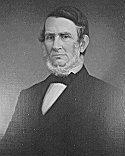
Portrait by U.D. Tenney, 1883. New Hampshire Division of Historical Resources, circ. Wikimedia Commons. Public domain.
1751–1814
Ira Allen
1
recorded events
Connected towns:
Brattleboro, VTBiography
Ira Allen (1751–1814): The Architect of Vermont
Born in 1751 in Cornwall, Connecticut, the youngest of the Allen brothers grew up in a family that combined frontier ambition with political cunning in equal measure. While Ethan Allen would become the Revolution's folk hero — capturing Fort Ticonderoga and embodying the defiant spirit of the Green Mountain Boys — Ira possessed a different and in some ways more consequential set of talents. He was a surveyor, a land speculator, a constitutional thinker, and a negotiator who understood that political power in the Revolutionary era flowed not just from military force but from legal maneuvering and strategic patience. The territory known as the New Hampshire Grants, claimed by both New York and New Hampshire, was a chaotic jurisdictional no-man's-land, and Ira Allen recognized earlier than most that this chaos represented opportunity. He moved through the Connecticut River valley and the wider Grants territory with a speculator's eye and a statesman's ambition, acquiring land, building political alliances, and positioning himself at the center of a movement that would transform a disputed frontier into an independent republic and, ultimately, a sovereign state.
Allen's most consequential acts unfolded between 1777 and 1791, a period during which he helped engineer Vermont's very existence as a political entity. He was instrumental in drafting Vermont's 1777 constitution, a remarkably progressive document that abolished adult male slavery and established universal male suffrage — provisions that placed Vermont ahead of every other American state in its commitment to democratic principles. But his most audacious maneuver was the Haldimand Affair, beginning in 1780. Allen and other Vermont leaders entered into secret negotiations with British General Frederick Haldimand, the commander of forces in Canada, ostensibly discussing Vermont's possible return to British allegiance. To Congress and the surrounding New England states, this looked like treason. Allen later maintained — and most historians have come to agree — that the negotiations were a calculated stratagem, designed to shield Vermont's northern settlements from British raids while the war wound down and Vermont consolidated its claims to independence. During the negotiation period, Vermont suffered no major British incursions, suggesting the gambit worked precisely as intended.
The personal risks Allen shouldered were enormous and rarely appreciated by those who benefited from his maneuvering. The Haldimand Affair could easily have resulted in his arrest and execution for treason had Congress or neighboring states decided to make an example of Vermont's leaders. His land speculation, which shaped the political economy of early Vermont and helped fund the independence movement, was a double-edged instrument — it gave him influence but also made him vulnerable to accusations of self-dealing and exposed him to devastating financial losses when markets shifted. Allen was fighting not for a single battlefield victory but for the survival of an idea: that the settlers of the Grants deserved self-governance independent of both New York's territorial claims and Britain's imperial ambitions. The communities of the Connecticut River valley, including those around Brattleboro, depended on leaders like Allen to navigate a political landscape where their legal standing was perpetually uncertain. His work was not glamorous — it involved constitutional drafts, backroom negotiations, and calculated deceptions — but it determined whether thousands of frontier families would have a government they could call their own.
Allen's later years were marked by the kind of ruin that often befell Revolutionary-era figures who operated in the gray zones between patriotism, diplomacy, and personal ambition. After securing Vermont's admission to the Union in 1791 as the fourteenth state, his financial empire collapsed, and an attempt to import arms from France for a Vermont militia led to his arrest and years of legal entanglement. He died in Philadelphia in 1814, largely forgotten beyond Vermont's borders. Yet his legacy is foundational. Vermont's 1777 constitution — which Allen helped create — stands as one of the most radical democratic documents of the eighteenth century. His willingness to pursue unconventional and even dangerous diplomatic strategies preserved Vermont's independence at a moment when it might have been absorbed by neighboring states or reconquered by Britain. Today, historians increasingly recognize Ira Allen not as a mere footnote to his brother Ethan's story but as the more deliberate and politically sophisticated architect of Vermont statehood, a figure whose career illuminates how the American Revolution was won not only on battlefields but in the messy, ambiguous work of political creation.
WHY IRA ALLEN MATTERS TO BRATTLEBORO
Ira Allen's story matters to Brattleboro because it reveals what the American Revolution actually looked like for communities in the Connecticut River valley — not a simple contest between patriots and redcoats, but a complicated struggle over land, legitimacy, and self-governance. Brattleboro sat within the disputed New Hampshire Grants, the very territory Allen fought to transform into an independent Vermont. His political maneuvering, from constitutional drafting to the dangerous gamble of the Haldimand Affair, directly determined whether towns like Brattleboro would be governed by New York, swallowed back into the British Empire, or allowed to chart their own course. For students and visitors, Allen's career is a powerful reminder that the Revolution was also a story of local people leveraging extraordinary circumstances to build new political communities from the ground up.
TIMELINE
- 1751: Born in Cornwall, Connecticut, the youngest of the Allen brothers
- 1770s: Moves into the New Hampshire Grants territory, begins surveying and acquiring land
- 1775: Participates in the early Green Mountain Boys' resistance to New York authority
- 1777: Helps draft the Vermont Constitution, which abolishes adult male slavery and establishes universal male suffrage
- 1777: Vermont declares independence as a sovereign republic
- 1780: Begins secret negotiations with British General Frederick Haldimand (the Haldimand Affair)
- 1783: Treaty of Paris ends the Revolutionary War; Vermont remains an independent republic
- 1791: Vermont admitted to the Union as the fourteenth state
- 1795–1803: Arrested and embroiled in legal proceedings after attempting to import arms from France
- 1814: Dies in Philadelphia in financial ruin and relative obscurity
SOURCES
- Bellesiles, Michael A. Revolutionary Outlaws: Ethan Allen and the Struggle for Independence on the Early American Frontier. University Press of Virginia, 1993.
- Duffy, John J., Samuel B. Hand, and Ralph H. Orth, eds. The Vermont Encyclopedia. University Press of New England, 2003.
- Allen, Ira. The Natural and Political History of the State of Vermont. J.W. Myers, 1798.
- Wardner, Henry Steele. The Birthplace of Vermont: A History of Windsor to 1781. Charles E. Tuttle Company, 1927.
- Vermont Historical Society. "Ira Allen Papers and Related Collections." https://vermonthistory.org
Events
Jul
1780
Haldimand Affair: Vermont's Secret Negotiations with BritainBrattleboroVermont Founder# The Haldimand Affair: Vermont's Secret Negotiations with Britain In the turbulent years of the American Revolution, few episodes were as audacious or as shrouded in mystery as the so-called Haldimand Affair, a series of secret negotiations between Vermont's leaders and the British military command in Quebec. Beginning around 1780 and continuing for roughly two years, this clandestine diplomatic gambit placed Vermont at the center of a high-stakes chess game between the fledgling American states, the Continental Congress, and the British Empire. At its heart were two of Vermont's most prominent founders, Ethan Allen and his brother Ira Allen, whose motivations have been debated by historians ever since. To understand why Vermont's leaders would even consider such negotiations, one must first appreciate the precarious position the young republic occupied during the Revolution. Vermont had declared itself an independent republic in 1777, separating from New York, but the Continental Congress repeatedly refused to recognize it as a fourteenth state. New York, New Hampshire, and Massachusetts all laid competing claims to Vermont's territory, and Congress, unwilling to alienate these larger and more powerful states, left Vermont in a kind of political limbo. Vermont contributed soldiers and resources to the patriot cause — Ethan Allen's capture of Fort Ticonderoga in 1775 was one of the war's earliest and most celebrated victories — yet the republic received no formal protection or recognition in return. This left Vermont vulnerable, particularly to British forces and their Native allies operating out of Canada under the command of General Frederick Haldimand, the governor of Quebec. It was in this atmosphere of isolation and strategic vulnerability that Ethan Allen and Ira Allen opened a back channel to General Haldimand. The negotiations explored the possibility of Vermont returning to the British fold, potentially as a separate province within the Empire. British agents traveled south, and correspondence passed between Quebec and Vermont under conditions of strict secrecy. Ira Allen, who was deeply involved in Vermont's governance and diplomacy, played a particularly active role in managing the discussions and controlling the flow of information. For the British, the prospect of peeling Vermont away from the American cause was enormously appealing. It would have created a loyalist wedge between New England and the rest of the rebelling colonies, potentially altering the strategic landscape of the entire war. Whether the Allen brothers ever genuinely intended to rejoin Britain, however, is the central question that has fascinated historians for over two centuries. Many scholars argue that the negotiations were a calculated bluff, a stratagem designed to achieve multiple objectives simultaneously. By engaging with Haldimand, the Allens secured an informal ceasefire that protected Vermont from British raids at a time when the republic lacked the military strength to defend itself. Equally important, word of the negotiations inevitably reached the Continental Congress, sending a clear and alarming message: if Congress continued to deny Vermont recognition and protection, Vermont had other options. In this reading, the Haldimand Affair was an extraordinary act of diplomatic leverage by leaders of a small, unrecognized republic playing far above their apparent weight. The affair ultimately ended without any formal agreement. The decisive American and French victory at Yorktown in October 1781 effectively sealed Britain's defeat and removed the strategic rationale for both sides. With British power collapsing, there was no longer a realistic British offer for Vermont to accept, nor any need for the Allens to maintain the pretense. Congress, though deeply alarmed by reports of the negotiations, never took punitive action against Vermont, and the episode faded into the background as the war wound down. Vermont would eventually join the Union as the fourteenth state in 1791. The Haldimand Affair matters because it reveals just how fragile and contested the American Revolution truly was. The war was not simply a unified colonial uprising against Britain; it was a period of competing loyalties, internal rivalries, and desperate improvisation. Vermont's secret negotiations remind us that statehood, allegiance, and national identity were still very much in flux during the founding era, and that small actors, operating in the spaces between great powers, could shape history through cunning as much as through force of arms.