

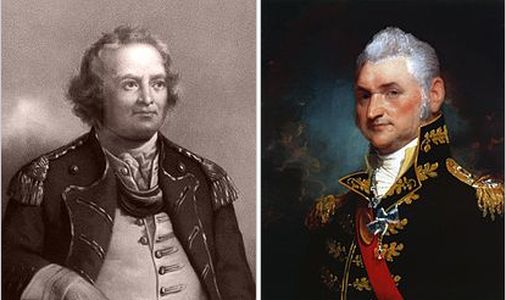
Gilbert Stewart, 2016. Wikimedia Commons. Public domain.
1718–1790
Israel Putnam
2
recorded events
Biography
Israel Putnam (1718–1790)
Continental Army General, Bunker Hill Veteran, and Division Commander
Few figures of the American Revolution arrived at the war's doorstep carrying a personal mythology as vivid and outsized as that of Israel Putnam. Born on January 7, 1718, in Salem Village (present-day Danvers), Massachusetts, Putnam grew up in the hardscrabble world of New England farming. As a young man he relocated to Pomfret, Connecticut, where he carved out a life as a farmer and tavern keeper. It was in Pomfret that the legend began: in 1743, according to widely repeated accounts, Putnam crawled into a narrow cave to kill a wolf that had been terrorizing local livestock, emerging triumphant with the animal's carcass. Whether embellished or not, the story cemented his reputation as a man of extraordinary physical courage and stubborn determination. These qualities would define his public persona for decades. Putnam was not a man of formal education or polished manners; he was rough-hewn, direct, and instinctively brave. His early years on the Connecticut frontier shaped a character built around action rather than reflection, a temperament that would serve him powerfully in some moments and betray him in others during the tumultuous years ahead.
The French and Indian War transformed Putnam from a local folk hero into a figure of colonial-wide renown. Serving as a ranger under Major Robert Rogers, he endured harrowing captivity at the hands of Native American allies of the French, reportedly coming within moments of being burned alive at the stake before a French officer intervened. He survived shipwrecks, brutal frontier campaigns, and the catastrophic British expedition against Havana in 1762, where disease killed far more soldiers than combat. By the time he returned to Connecticut, Putnam was one of the most celebrated military veterans in the colonies. When news of the Battles of Lexington and Concord reached Pomfret on April 20, 1775, the fifty-seven-year-old farmer reportedly left his plow in the field and rode the roughly one hundred miles to Cambridge without changing his clothes. The story, like so many Putnam tales, may be partly apocryphal, but its essential truth is undeniable: he answered the call to arms with an immediacy and fervor that few could match. His arrival in Cambridge electrified the gathering colonial forces, who saw in Old Put a living embodiment of American defiance.
Putnam's most significant single action came on June 17, 1775, at the Battle of Bunker Hill—more accurately fought on neighboring Breed's Hill on the Charlestown peninsula. Though the precise command structure of the American forces that day remains disputed among historians, Putnam played a prominent and visible role, rallying troops and directing the construction of fortifications. The famous exhortation "Don't fire until you see the whites of their eyes" has been attributed to Putnam more often than to any other commander present, though Colonel William Prescott and others have equal or stronger claims to the phrase. Regardless of who uttered those specific words, the battle itself became a defining moment of the early war. The Americans inflicted devastating casualties on the attacking British regulars before finally being driven from the hill when their ammunition ran out. Putnam's conspicuous presence on the battlefield, riding between positions and urging men to hold their ground, solidified his status as one of the rebellion's foremost military leaders. The Continental Congress subsequently appointed him a major general, one of the first four men to hold that rank, a reflection of both his popularity and the political need to reward Connecticut's substantial contributions.
During the siege of Boston that followed Bunker Hill, Putnam commanded Connecticut troops in the American lines ringing the city. He participated in the councils of war convened by General George Washington, who arrived in Cambridge in July 1775 to take command of the newly designated Continental Army. These councils debated critical questions, including whether to launch a direct assault on Boston—a proposal Putnam reportedly favored with characteristic aggressiveness. Washington ultimately chose a more cautious approach, fortifying Dorchester Heights with artillery hauled from Fort Ticonderoga, which forced the British evacuation in March 1776. When the war shifted to New York, Putnam was entrusted with command of forces in lower Manhattan, a responsibility that would test the limits of his abilities. At the Battle of Kip's Bay on September 15, 1776, British forces landed on the eastern shore of Manhattan, and the American militia defending the position broke and fled in panic. Putnam faced the urgent task of extracting thousands of Continental troops from lower Manhattan before they were cut off and captured, a crisis that demanded rapid decision-making under extreme pressure.
The relationships that shaped Putnam's wartime role were complex and often fraught with tension. His bond with George Washington was one of mutual respect tempered by growing concern. Washington valued Putnam's courage and his ability to inspire ordinary soldiers, qualities that were desperately needed in an army plagued by short enlistments and wavering morale. However, Washington increasingly recognized that Putnam's tactical judgment did not match his personal bravery. Among his fellow generals, Putnam occupied an awkward position: senior in rank but often outmatched in strategic thinking by younger, more professionally minded officers. His relationship with Generals Charles Lee and Horatio Gates—both former British officers with formal military training—highlighted the tensions within the Continental Army between experienced professionals and self-made warriors. Connecticut's political leaders, including Governor Jonathan Trumbull, remained staunch supporters, understanding that Putnam's fame was an invaluable recruiting tool. Common soldiers adored Old Put for his willingness to share their hardships and his plainspoken manner, a bond of affection that transcended his limitations as a battlefield tactician and sustained his influence even as questions about his competence mounted.
The Kip's Bay disaster of September 15, 1776, exposed the most painful dimensions of Putnam's generalship. When British warships bombarded the American positions and redcoats swarmed ashore, the raw Connecticut militia posted at the landing site dissolved in terror. Washington himself rode furiously among the fleeing men, reportedly striking soldiers with the flat of his sword in a rage of frustration. Putnam, commanding in lower Manhattan, now faced the harrowing challenge of organizing a retreat northward up the island to the relative safety of Harlem Heights. By most accounts, he performed this emergency withdrawal with considerable energy, personally leading troops along the western road while the British, inexplicably, paused rather than pressing their advantage to cut off the retreat. Roughly 3,500 American soldiers escaped what could have been a catastrophic encirclement. Yet the episode raised uncomfortable questions: had Putnam adequately prepared defenses? Had he responded quickly enough to the crisis? The controversy deepened during the subsequent Harlem Heights period, where Putnam served as a senior division commander under Washington. His role was increasingly supervisory rather than operational, a subtle demotion that reflected growing doubts at headquarters about his capacity for independent command.
The war changed Israel Putnam in ways both visible and deeply personal. The vigorous, seemingly indestructible frontiersman who had arrived in Cambridge in 1775 aged rapidly under the burdens of command. The physical toll of campaigning, combined with the emotional weight of watching men die—often due to circumstances beyond any general's control—wore on a man approaching sixty. After the New York campaign, Putnam was assigned to command in the Hudson Highlands, a strategically vital region guarding the river corridor between New England and the middle states. In 1777, while Putnam held this command, the British under Sir Henry Clinton captured Forts Clinton and Montgomery, a humiliating blow that led to a formal inquiry into Putnam's conduct. Though he was ultimately acquitted of negligence, the episode further eroded his reputation among the officer corps. The man who had once seemed invincible now appeared vulnerable, overtaken by a war that demanded organizational and strategic skills he had never fully possessed. His legendary courage remained unquestioned, but courage alone could not meet the complex demands of eighteenth-century generalship in an increasingly professionalized army.
A devastating stroke in December 1779 ended Putnam's active military career, removing him permanently from the field at age sixty-one. He retired to his farm in Brooklyn, Connecticut, where he lived out the remaining decade of his life as a celebrated but physically diminished figure. He did not participate in the war's climactic campaigns at Yorktown in 1781, nor did he play a role in the complex political negotiations that followed. In some respects, his forced retirement spared him the further controversies that consumed other generals, allowing his reputation to calcify around the heroic narrative of Bunker Hill rather than the more troubling questions raised by Kip's Bay and the Hudson Highlands. Putnam watched from afar as the nation he had helped to birth took its uncertain first steps. He did not attend the Constitutional Convention, nor did he seek political office. His contribution to the war's resolution was indirect but real: he had helped keep an army in the field during its most desperate early months, and the soldiers he had trained and inspired went on to fight under other commanders in the campaigns that ultimately secured American independence.
Contemporaries viewed Israel Putnam through sharply divided lenses. To the common people of New England, he was an authentic American hero—a farmer-soldier who had risen from humble origins to stand alongside Washington in the fight for liberty. His exploits, both real and embellished, were recounted in taverns, newspapers, and popular broadsides throughout the war and for decades afterward. David Humphreys, a former aide-de-camp to Washington, published a laudatory biography in 1788 that cemented the mythological version of Putnam's life. Among military professionals and some fellow officers, however, the assessment was more guarded. They acknowledged his courage and his ability to inspire, but they recognized that the Revolution had demanded more than personal bravery. Putnam's difficulty with complex tactical situations, his inconsistent command decisions, and his tendency to favor aggressive action regardless of circumstances marked him as a leader of a particular, limited type. When he died on May 29, 1790, in Brooklyn, Connecticut, at age seventy-two, he was mourned widely and sincerely. The new republic needed its heroes, and Putnam, with his wolf dens and cliffside rides and battlefield exhortations, fit the role as comfortably as anyone of his generation.
Students and visitors today should know Israel Putnam because his story illuminates one of the Revolution's most important and often overlooked truths: that personal courage, while necessary, was never sufficient to win a war. Putnam was arguably the bravest general in the Continental Army, a man whose physical daring was attested by friend and foe alike across decades of frontier warfare. Yet bravery alone could not compensate for the organizational, logistical, and tactical demands of commanding thousands of men in a modern military conflict. His story complicates the heroic narrative of the Revolution in productive ways, reminding us that the war was won not by a collection of fearless individuals but by an institution—the Continental Army—that slowly, painfully learned to function as a professional fighting force. Putnam's journey from the legendary charge at Bunker Hill to the chaotic retreat from Kip's Bay to the quiet of a Connecticut farm captures the full arc of revolutionary experience: the exhilaration, the failure, the endurance, and the cost. He deserves to be remembered not as a simple hero or a failed general, but as a complicated human being who gave everything he had to a cause larger than himself.
WHY ISRAEL PUTNAM MATTERS TO CAMBRIDGE
Israel Putnam's story matters to Cambridge because it was here, in the encampments surrounding Boston in 1775 and 1776, that the ragged promise of the American Revolution was first tested against the reality of building an army. Putnam arrived in Cambridge as perhaps the most famous soldier in the colonies, and his presence helped transform a disorganized collection of militia into something resembling a fighting force. He participated in the critical councils of war where Washington and his generals debated whether to storm Boston or wait—debates that shaped the entire trajectory of the war. For visitors walking the streets of Cambridge today, Putnam's story is a reminder that the Revolution was not won by legends alone, but by ordinary and extraordinary men grappling with impossible decisions in places exactly like this one.
TIMELINE
- 1718: Born January 7 in Salem Village (Danvers), Massachusetts
- 1743: Allegedly crawls into a wolf den in Pomfret, Connecticut, killing the animal and cementing his local fame
- 1755–1764: Serves in the French and Indian War as a ranger; captured and nearly executed by Native Americans; participates in the Havana expedition
- 1775: Rides to Cambridge upon news of Lexington and Concord; commands Connecticut forces during the siege of Boston
- 1775: Fights at the Battle of Bunker Hill (June 17); subsequently appointed major general by the Continental Congress
- 1775–1776: Participates in councils of war debating strategy against the British in Boston
- 1776: Commands Continental forces in lower Manhattan during the Kip's Bay disaster (September 15); organizes retreat to Harlem Heights
- 1777: Commands the Hudson Highlands; Forts Clinton and Montgomery fall to British forces; faces formal inquiry but is acquitted
- 1779: Suffers a debilitating stroke in December, ending his military career
- 1790: Dies May 29 in Brooklyn, Connecticut, at age seventy-two
SOURCES
- Humphreys, David. An Essay on the Life of the Honourable Major-General Israel Putnam. Hartford, 1788.
- Philbrick, Nathaniel. Bunker Hill: A City, a Siege, a Revolution. Viking, 2013.
- Schecter, Barnet. The Battle for New York: The City at the Heart of the American Revolution. Walker & Company, 2002.
- Livingston, William Farrand. Israel Putnam: Pioneer, Ranger, and Major-General, 1718–1790. G.P. Putnam's Sons, 1901.
- National Park Service. "Bunker Hill." National Historical Park resource pages. https://www.nps.gov/bost/learn/historyculture/bunker-hill.htm
Events
Oct
1775
Council of War Debates Attack on BostonCambridgeCouncil Member**The Council of War Debates an Attack on Boston, 1775** By the autumn of 1775, the Continental Army had been encamped around Boston for months, and the siege was beginning to wear on everyone involved—none more so than the man in command. General George Washington, who had arrived in Cambridge that July to take charge of the ragged forces besieging the British garrison, found himself presiding over an army that was enthusiastic but dangerously undisciplined, poorly supplied, and lacking in almost every resource that professional military operations demanded. The British, under General William Howe, held Boston itself along with commanding positions and, crucially, the support of the Royal Navy, whose warships patrolled the harbor and controlled the waterways surrounding the city. It was against this backdrop that Washington convened a council of war at his Cambridge headquarters to propose what he believed might break the stalemate: an amphibious assault directly across the Back Bay into Boston. Washington's instinct throughout the Revolution was almost always to attack. He understood that the longer an untrained army sat idle, the more it deteriorated through desertion, expired enlistments, disease, and flagging morale. He had watched his forces dwindle and knew that the Continental Congress and the American public expected action, not patience. An assault on Boston, he reasoned, could end the British occupation in a single decisive stroke and electrify the patriot cause at a moment when it desperately needed a victory. The proposal called for troops to cross the water in boats, storm British positions, and seize the city before the garrison could mount an effective defense. The generals gathered around Washington, however, saw the situation differently. Among the most prominent members of the council were Major General Nathanael Greene, the self-educated Quaker from Rhode Island who had already begun to distinguish himself as one of Washington's most capable and trusted officers, and Major General Israel Putnam, the rough-hewn Connecticut veteran whose personal bravery at Bunker Hill had made him a folk hero among the troops. Both men, along with the rest of the assembled officers, listened carefully to Washington's proposal—and unanimously rejected it. Their reasoning was sound and, in retrospect, almost certainly correct. The Continental Army lacked the training and coordination required to execute an amphibious operation, one of the most complex maneuvers in warfare. British naval superiority meant that any crossing could be disrupted or destroyed before the boats reached shore. The defenders held fortified positions and were professional soldiers seasoned by years of service. The risk of catastrophic failure was simply too great, and a devastating loss at Boston could have ended the Revolution before it truly began. Washington accepted the decision of his council, though not without frustration. Nearby, Martha Washington, who had traveled to Cambridge to join her husband during the winter encampment, witnessed firsthand the tension and strain that the siege placed on the commander and his officers. Her presence at camp provided personal comfort to Washington during one of the most trying periods of his early command. This pattern—Washington proposing bold offensive action and his more cautious officers pulling him back—would repeat itself throughout the siege of Boston and indeed throughout much of the war. It revealed something important about the emerging command structure of the Continental Army: Washington was not a dictator but a leader who consulted, listened, and ultimately deferred to collective military judgment even when it contradicted his own aggressive instincts. The decision to wait ultimately proved wise. In the months that followed, the arrival of artillery captured at Fort Ticonderoga by Henry Knox gave Washington the leverage he needed. In March 1776, Continental forces fortified Dorchester Heights overnight, placing cannons in a position that made the British hold on Boston untenable. Howe evacuated the city without a major battle, handing Washington and the patriot cause their first great strategic victory. Had the army launched a premature amphibious assault months earlier and suffered a bloody repulse, that triumphant outcome might never have come to pass. The council of war in Cambridge thus stands as a quiet but critical moment in the Revolution—a reminder that the war was won not only through boldness but also through the difficult, unglamorous discipline of knowing when not to fight.
Sep
1776
Kip's Bay DisasterHarlem HeightsContinental Army General# The Kip's Bay Disaster By the middle of September 1776, the American cause in New York was already unraveling. The Continental Army had suffered a bruising defeat at the Battle of Long Island on August 27, where British General William Howe's forces had outflanked and overwhelmed Washington's defenders in Brooklyn. Washington managed a miraculous nighttime evacuation across the East River on August 29, saving the bulk of his army, but the retreat left morale in tatters. His troops were exhausted, poorly supplied, and increasingly uncertain about whether they could stand against the disciplined professionals of the British army. Many enlistments were nearing their end, and desertion was becoming a serious problem. It was into this atmosphere of doubt and erosion that the events of September 15 delivered yet another devastating blow. On that morning, British warships positioned along the East River opened a thunderous preparatory bombardment against the shoreline at Kip's Bay, located on the eastern side of Manhattan roughly where modern-day midtown sits. The bombardment was ferocious, designed to soften the defenses and shatter the nerves of the soldiers waiting behind hastily constructed earthworks. The men assigned to hold this stretch of shoreline were Connecticut militia, many of them inexperienced and already demoralized by the string of recent setbacks. When the barrage lifted and British landing craft began rowing toward the beach carrying approximately four thousand troops, the militia did not wait to contest the landing. They broke and ran before the enemy even reached the shore. George Washington, serving as Commander-in-Chief, heard the guns and rode hard toward the fighting, hoping to take personal command of the defense. What he found instead was chaos. Soldiers were streaming northward in complete panic, abandoning their positions, their weapons, and any semblance of military order. By eyewitness accounts, Washington was overwhelmed with fury and despair. He struck fleeing officers with his riding crop, shouted himself hoarse trying to rally the men, and reportedly threw his hat to the ground in frustration, crying out in anguish at the spectacle of his army dissolving before his eyes. So consumed was he by the moment that he seemed almost indifferent to his own safety, remaining dangerously close to the advancing British lines until his aides physically led him away from the field to prevent his capture. It was one of the lowest moments of Washington's entire military career — a commander watching helplessly as the army he had spent over a year building simply refused to fight. The British landing at Kip's Bay created an immediate tactical crisis beyond the rout itself. By driving across the narrow width of Manhattan, Howe's forces threatened to cut the island in two, which would have trapped the substantial American garrison still stationed in lower Manhattan. Had that force been captured, the loss in manpower and material could have been catastrophic for the revolution. It fell to General Israel Putnam, a grizzled veteran known for his physical courage and forceful personality, to organize what amounted to a desperate rescue. Putnam led his division on a harrowing march up the western side of the island, hugging the Hudson River shore and moving with all possible speed while British patrols pushed inland to the east. According to tradition, the British advance was temporarily slowed when soldiers stopped to enjoy provisions found at a farmhouse along their route, buying Putnam precious minutes. Through a combination of urgency, luck, and Putnam's relentless drive, the division escaped northward and rejoined the main body of the army. It was survival by the thinnest of margins. Washington pulled his battered forces to the high ground of Harlem Heights in northern Manhattan, not because he had a grand plan but because he had no better option and desperately needed time to regroup and assess what remained of his army. The position offered defensible terrain and a momentary reprieve from the relentless British pressure. The very next morning, on September 16, a sharp engagement known as the Battle of Harlem Heights would unfold on this ground, and for the first time in weeks, American troops would stand, fight, and push British soldiers back. That small but symbolically important victory gave Washington's army something it badly needed — a reason to believe it could still function as a fighting force. The Kip's Bay disaster matters in the broader story of the Revolution because it laid bare just how fragile the Continental Army was in its early stages. This was not yet the force that would endure Valley Forge or triumph at Yorktown. It was an army learning, often through humiliation, what it would take to survive. Washington himself was learning too — about the limits of militia, the psychology of defeated troops, and the brutal arithmetic of a war in which simply keeping an army in the field was itself a form of victory. Kip's Bay was a failure, but the army lived to fight another day, and in the arithmetic of 1776, that was enough.