

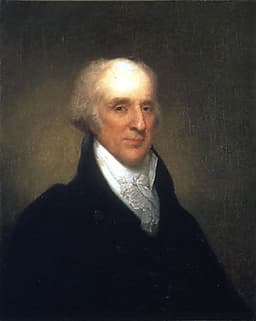
Rembrandt Peale, circ. Wikimedia Commons. Public domain.
1758–1843
John Armstrong Jr.
0
recorded events
Connected towns:
Newburgh, NYBiography
John Armstrong Jr. (1758–1843)
Continental Army Aide-de-Camp and Author of the Newburgh Addresses
Born in 1758 in Carlisle, Pennsylvania, the young Armstrong grew up in a household steeped in military service — his father, John Armstrong Sr., was a distinguished Continental general whose career offered his son both a model and an education in the realities of armed conflict. The younger Armstrong combined classical learning with the practical knowledge that came from proximity to war, and he entered the Continental Army while still a young man, serving in various capacities during the long years of the Revolution. His intelligence and literary skill marked him early, and by 1782 he had secured a position as aide-de-camp to Major General Horatio Gates, one of the most prominent — and most politically complicated — officers in the American command. That assignment brought Armstrong to Newburgh, New York, where Washington's main Continental Army was encamped during the war's frustrating final phase. There, amid rising anger over unpaid wages and unfulfilled pension promises, Armstrong found himself at the center of what would become one of the most dangerous internal crises the young republic ever faced, a moment when the relationship between military power and civilian authority hung in genuine doubt.
In March 1783, with peace negotiations between Britain and the United States nearing completion but Congress still failing to address the army's grievances, Armstrong took up his pen and produced the documents that history remembers as the Newburgh Addresses. These two anonymous letters, circulated rapidly through the officer corps at the Newburgh encampment, gave eloquent and deliberately threatening voice to years of accumulated frustration. Armstrong's prose was sophisticated and cutting: he mocked the idea that continued patience was a virtue, suggested that officers who meekly accepted Congress's broken promises were fools, and implied — without ever stating outright — that the army possessed the power to force the issue. The letters stopped short of calling explicitly for a coup or mutiny, but their meaning was unmistakable to anyone who read them. The addresses also called for an unauthorized meeting of officers to discuss collective action, a step that would have bypassed Washington's authority entirely. The effect was immediate and electric. In Philadelphia, members of Congress recognized that the republic's survival might depend on what happened next. At Newburgh, officers debated whether the moment for confrontation with civil government had finally arrived. The crisis Armstrong had precipitated was real.
What Armstrong risked by writing the Newburgh Addresses was considerable, though the full dimensions of that risk illuminate the ambiguity of his position. Had the crisis escalated into open defiance of Congress — or worse, into armed confrontation — Armstrong could have been remembered as the man who destroyed the American experiment before it truly began. Even as an anonymous author, he was gambling with his career, his reputation, and potentially his freedom. His authorship was suspected almost immediately, and suspicion alone was enough to mark a man in the tight circles of Revolutionary officers. Yet Armstrong was also giving voice to grievances that were entirely legitimate: the officers and soldiers of the Continental Army had sacrificed years of their lives, endured deprivation and danger, and received in return a string of broken promises from a Congress that lacked either the will or the constitutional power to pay them. Armstrong wrote not only for himself but for thousands of men who had fought the war and feared they would be discarded the moment peace arrived. Washington's dramatic personal intervention — the famous scene in which he donned spectacles before his officers, remarking that he had grown gray and nearly blind in their service — defused the immediate crisis, but it did not erase the underlying injustice that Armstrong had identified.
Armstrong's legacy is inseparable from the tension between his genuine talent and his persistently questionable judgment. The Newburgh Addresses revealed a writer of real power and a political mind willing to operate in the shadows, using language as a weapon in ways that flirted with catastrophe. His subsequent career confirmed both qualities. He served as a United States Senator from New York, as American minister to France during the Napoleonic era, and ultimately as Secretary of War under President James Madison during the War of 1812 — a position from which he was effectively forced to resign after the British captured and burned Washington, D.C., in August 1814, an event widely attributed in part to Armstrong's poor planning and organizational failures. Throughout his long public life, Armstrong inspired admiration for his intellect and deep suspicion regarding his motives and his capacity for reckless miscalculation. He died in 1843 at the age of eighty-four, a man whose most consequential act had occurred sixty years earlier, in an anonymous letter circulated among angry officers in a winter encampment along the Hudson River.
WHY JOHN ARMSTRONG JR. MATTERS TO NEWBURGH
Armstrong's story is essential to understanding what happened at Newburgh in the spring of 1783 — and why it matters. The Newburgh Addresses he authored were the catalyst for the most serious confrontation between military power and civilian government in the entire Revolutionary period. Without Armstrong's letters, there is no Newburgh Conspiracy; without the Newburgh Conspiracy, Washington never delivers the speech that has come to symbolize the principle of military subordination to democratic authority. Students and visitors who walk the grounds at Newburgh should understand that this crisis was not abstract — it was provoked by a specific young officer with a gift for rhetoric and a willingness to push events toward a precipice. Armstrong reminds us that the Revolution's outcome was shaped not only by battles but by dangerous arguments conducted on paper, in encampments where desperate men weighed loyalty against self-interest.
TIMELINE
- 1758: Born in Carlisle, Pennsylvania, son of Continental General John Armstrong Sr.
- 1775–1776: Enters the Continental Army as a young officer during the early years of the Revolution.
- 1782: Appointed aide-de-camp to Major General Horatio Gates at the Newburgh encampment.
- March 10, 1783: First Newburgh Address circulated anonymously among Continental officers at Newburgh, New York.
- March 12, 1783: Second Newburgh Address circulated; Armstrong's authorship suspected by contemporaries.
- March 15, 1783: Washington convenes officers and personally defuses the crisis with his famous spectacles speech.
- 1800–1802: Serves as United States Senator from New York.
- 1804–1810: Serves as American minister to France under Presidents Jefferson and Madison.
- 1813–1814: Serves as Secretary of War under President Madison; resigns after the British burning of Washington, D.C.
- 1843: Dies on April 1 at Red Hook, New York, at the age of eighty-four.
SOURCES
- Kohn, Richard H. Eagle and Sword: The Federalists and the Creation of the Military Establishment in America, 1783–1802. Free Press, 1975.
- Skeen, C. Edward. John Armstrong, Jr., 1758–1843: A Biography. Syracuse University Press, 1981.
- Kohn, Richard H. "The Inside History of the Newburgh Conspiracy: America and the Coup d'État." William and Mary Quarterly, Third Series, Vol. 27, No. 2 (April 1970), pp. 187–220.
- National Archives. "Newburgh Conspiracy." https://www.archives.gov
- Library of Congress. George Washington Papers, Series 4, General Correspondence. https://www.loc.gov/collections/george-washington-papers/