

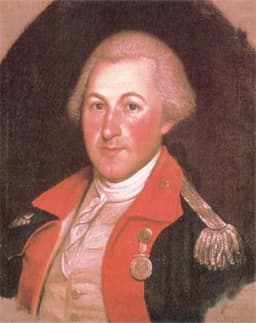
Charles Willson Peale, 1782. Wikimedia Commons. Public domain.
1752–1827
John Eager Howard
1
recorded events
Connected towns:
Baltimore, MDBiography
John Eager Howard (1752–1827)
Continental Army Colonel, Maryland Governor, United States Senator
Born in 1752 into one of Maryland's most established planting families, the young man who would become Baltimore's greatest Revolutionary War hero grew up steeped in the customs and expectations of the Chesapeake gentry. The Howard family occupied a prominent place in Maryland's colonial society, where wealth derived from tobacco cultivation, and social standing carried with it obligations of public service, military readiness, and gentlemanly conduct. In this world, a young man of means was expected not merely to prosper but to lead — in the courthouse, the assembly, and if necessary, on the battlefield. Howard received a thorough education befitting his station, one that cultivated both intellectual discipline and the physical confidence that would later serve him under fire. The rhythms of plantation life along the Chesapeake fostered a particular kind of self-assurance in young men of his class, a sense that they were born to command and duty-bound to answer when their community called. As political tensions between the American colonies and the British Crown intensified throughout the early 1770s, Howard's background positioned him precisely at the intersection of privilege and patriotic obligation that would propel many gentlemen of his generation into revolution.
When war erupted in 1775, Howard answered the call with the decisiveness that would characterize his entire military career, accepting a commission in the Continental Army and joining Maryland's contribution to the revolutionary cause. Maryland's regiments quickly earned a formidable reputation among Washington's forces, and Howard proved himself an officer of unusual competence and steadiness under pressure. He rose through the ranks not through political connections or social privilege alone but through repeated demonstrations of tactical skill and personal courage in the chaos of actual combat. His progression from junior officer to regimental commander reflected the Continental Army's desperate need for leaders who could maintain discipline and inspire confidence when the fighting turned desperate, as it so often did during the war's middle years. By the time the conflict's center of gravity shifted to the Southern Theater in 1780 and 1781, Howard had been tested in multiple engagements and hardened into one of the most reliable field officers in American service. He commanded a regiment of Maryland and Delaware Continentals — veterans who had survived years of brutal campaigning and who represented the professional backbone of an army that was otherwise heavily dependent on short-term militia. These were the men who would follow him into the most consequential moment of his life.
Howard's supreme moment came at the Battle of Cowpens on January 17, 1781, in the rolling grasslands of upcountry South Carolina, where General Daniel Morgan orchestrated one of the most brilliantly conceived tactical victories in American military history. Morgan arranged his outnumbered force in three successive lines, placing unreliable militia in the front ranks with instructions to fire two volleys and then retire, deliberately using their expected retreat to lure the overconfident British forward. Howard commanded the Continental regulars forming the critical third line — the anvil against which Morgan intended to hammer Banastre Tarleton's advancing force. When a confusing order caused a portion of Howard's line to begin pulling back, the situation teetered on the edge of disaster. Morgan rode urgently to Howard and demanded to know whether his men were broken. Howard's reply was coolly precise: they were not broken, they were merely moving to a new position. That calm assessment in the middle of battlefield confusion revealed an officer with extraordinary composure, a man who could distinguish between a rout and a maneuver when musket smoke clouded everything. Morgan trusted Howard's judgment and told him to halt his men, face them about, and deliver a volley at exactly the right instant.
What followed was one of the most devastating single tactical moments of the entire Southern Campaign. Howard executed the order with a precision that astonished both armies — his Continentals halted in mid-stride, wheeled as a body to face the onrushing British, presented their muskets, and unleashed a shattering volley at murderously close range. Before the stunned British infantry could recover, Howard ordered the bayonet charge. His men surged forward with fixed bayonets, crashing into Tarleton's already-staggered line with an aggression that broke their formation entirely. The British regulars — veterans of brutal southern campaigning who had grown accustomed to routing American forces — suddenly found themselves overwhelmed, surrounded, and forced to surrender in large numbers. Tarleton's cavalry fled the field, and the force that had terrorized the Carolina backcountry was effectively destroyed. The American victory at Cowpens was nearly total: over eight hundred British soldiers were killed, wounded, or captured, while American casualties remained remarkably light. Congress subsequently awarded Howard a silver medal for his conduct, one of only a handful of such honors bestowed during the entire war, recognizing that his split-second decisions had transformed a potential disaster into a masterpiece of battlefield execution.
The destruction of Tarleton's force at Cowpens sent shockwaves through the British command structure in the South and fundamentally altered the strategic calculus of Lord Cornwallis, who had been counting on Tarleton to protect his western flank and suppress patriot resistance in the backcountry. Cornwallis now found himself forced to pursue General Nathanael Greene's army through the wintry Carolina interior in a desperate attempt to bring the Americans to a decisive engagement before they could consolidate their gains. That grueling pursuit — the famous "Race to the Dan" — exhausted Cornwallis's army and stretched his supply lines to the breaking point, culminating in the pyrrhic British victory at Guilford Courthouse in March 1781 that so badly damaged his force he was compelled to abandon the Carolina interior and march to Virginia. Howard continued serving under Greene through the remaining southern engagements, contributing his steady battlefield leadership to the grinding campaign that gradually reclaimed the South for the American cause. His relationship with both Morgan and Greene reflected the collaborative command culture that characterized the best moments of the Continental Army, where mutual trust between generals and their subordinate officers could produce results far exceeding what their numbers and resources should have allowed. Howard emerged from the war as one of the most decorated and respected combat officers in American service.
The story of John Eager Howard's life after the Revolution demonstrates how the war created a generation of leaders whose battlefield credibility translated directly into political authority in the new republic. He returned to Maryland and entered public life with the same sense of duty that had carried him onto the field at Cowpens, serving as governor of Maryland from 1788 to 1791 during the critical years when the new federal Constitution was being ratified and implemented. He later represented Maryland in the United States Senate, bringing to legislative deliberations the practical judgment and decisiveness he had honed under fire. Howard's legacy in Baltimore is both monumental and deeply personal — his equestrian statue in Mount Vernon Place stands as the city's most prominent tribute to a Revolutionary War hero, a daily reminder that the liberties Americans enjoy were secured by men willing to make irrevocable decisions in moments of extreme crisis. His story teaches us something essential about the Revolution: that grand strategies and inspiring ideals ultimately depended on individual officers who could think clearly when everything around them was collapsing, who could turn confusion into opportunity, and whose courage in a single decisive moment could redirect the course of an entire war. Howard's bayonet charge at Cowpens remains one of those moments when the fate of a nation turned on one man's composure under fire.
WHY JOHN EAGER HOWARD MATTERS TO BALTIMORE
Baltimore claims John Eager Howard as its most celebrated Revolutionary War combat officer, and his story offers students and visitors a vivid lesson in how individual courage shaped the outcome of the American Revolution. His bayonet charge at Cowpens was not an act of reckless bravery but a display of disciplined tactical thinking under extreme pressure — exactly the kind of leadership that allowed an outmatched Continental Army to defeat professional British forces in the field. His statue in Mount Vernon Place connects the physical landscape of modern Baltimore to the sacrifices of the founding generation, reminding us that the Revolution was won not only in Philadelphia's meeting halls but on desperate battlefields across the Carolina backcountry. For anyone walking Baltimore's streets today, Howard's presence in bronze asks a powerful question: what does it mean to keep your composure when everything depends on the next decision you make?
TIMELINE
- 1752: Born into a prominent Maryland planting family near Baltimore
- 1775: Accepts a commission in the Continental Army at the outbreak of the Revolutionary War
- 1780: Commands Maryland Continentals deployed to the Southern Theater of operations
- 1781 (January 17): Leads the decisive bayonet charge at the Battle of Cowpens, South Carolina
- 1781 (March 15): Participates in the Battle of Guilford Courthouse, North Carolina
- 1781: Awarded a silver medal by the Continental Congress for gallantry at Cowpens
- 1783: War ends; Howard returns to Maryland and enters public life
- 1788–1791: Serves as Governor of Maryland during the early constitutional period
- 1796–1803: Represents Maryland in the United States Senate
- 1827: Dies in Baltimore; later honored with an equestrian statue in Mount Vernon Place
SOURCES
- Babits, Lawrence E. A Devil of a Whipping: The Battle of Cowpens. University of North Carolina Press, 1998.
- Buchanan, John. The Road to Guilford Courthouse: The American Revolution in the Carolinas. John Wiley & Sons, 1997.
- Papenfuse, Edward C., et al. A Biographical Dictionary of the Maryland Legislature, 1635–1789. Johns Hopkins University Press, 1985.
- National Park Service. "Battle of Cowpens." Cowpens National Battlefield. https://www.nps.gov/cowp/index.htm
Events
Jan
1781
Howard's Bayonet Charge at CowpensBaltimoreContinental Army Colonel**Howard's Bayonet Charge at Cowpens** By the winter of 1781, the American cause in the Southern states had reached a desperate hour. The fall of Charleston in May 1780 and the catastrophic defeat of General Horatio Gates at Camden that August had left the Continental Army's southern forces in tatters. British Lieutenant Colonel Banastre Tarleton, a young and aggressive cavalry commander, had earned a fearsome reputation for ruthlessness, and his combined force of British regulars and Loyalist militia seemed to move at will across the Carolina backcountry, terrorizing Patriot sympathizers and crushing resistance wherever it appeared. Into this dire situation stepped Brigadier General Daniel Morgan, a tough Virginia frontiersman and veteran of Saratoga, who was dispatched by the new Southern Department commander, Major General Nathanael Greene, to lead a flying force westward to threaten British supply lines and rally local militia. Greene's decision to divide his army in the face of a superior enemy was a calculated gamble, and it drew Tarleton in pursuit of Morgan like a hound after a fox. Morgan chose his ground carefully. On the morning of January 17, 1781, he positioned his men at a rolling pastureland known as the Cowpens, in present-day South Carolina, where local farmers grazed their cattle. Knowing that many of his troops were militia who might break under a direct assault, Morgan devised a layered defensive plan of extraordinary cunning. He placed sharpshooters and riflemen in a skirmish line at the front, with orders to fire two aimed volleys at the advancing British and then fall back. Behind them stood a line of militia under Colonel Andrew Pickens, instructed to deliver two volleys of their own before retiring around the American left flank. And behind them all, on a gentle rise, stood the backbone of the entire position: the Continental regulars of Maryland and Delaware, commanded by Colonel John Eager Howard of Baltimore. As Tarleton's forces advanced with characteristic confidence, the plan unfolded almost exactly as Morgan had designed it. The skirmishers and militia fired their volleys and withdrew in good order, and the British, seeing the Americans pulling back, surged forward with the conviction that they were witnessing another rout. Tarleton committed his reserves, certain that victory was at hand. But when the redcoats and Loyalist troops crashed against Howard's line of Continentals, they met disciplined, veteran soldiers who held firm. In the swirling confusion of battle, Howard ordered a repositioning of his line that momentarily resembled a retreat. Tarleton's men rushed forward in disorder, believing the Continentals were breaking. It was precisely the wrong assumption. At the critical moment, Howard gave the command. The Continentals wheeled around, leveled their bayonets, and charged directly into the disordered British ranks. The shock was devastating. Simultaneously, Pickens's militia, having completed their circuit around the flank, reappeared and poured fire into the British side, while Colonel William Washington's Continental cavalry swept into Tarleton's rear. Caught in what amounted to a double envelopment, the British force collapsed. In barely an hour, Tarleton lost more than eight hundred men killed, wounded, or captured, along with two artillery pieces, eight hundred muskets, and scores of horses. Tarleton himself barely escaped with a small detachment of cavalry. The Battle of Cowpens, and Howard's bayonet charge in particular, proved to be one of the most tactically brilliant small engagements of the entire Revolutionary War. It is widely considered the turning point of the Southern Campaign, shattering the aura of British invincibility in the region and depriving Lord Cornwallis of some of his best light troops. The victory breathed new life into the Patriot cause across the Carolinas and set in motion the chain of events that would eventually drive Cornwallis northward to Yorktown and ultimate surrender. In recognition of his valor and leadership, Colonel John Eager Howard was awarded a congressional gold medal, one of the rarest honors bestowed during the war. Howard returned to his native Baltimore after the conflict, where he served as governor of Maryland and remained one of the most respected figures of the Revolutionary generation, a living reminder that a single well-timed charge could alter the course of history.