

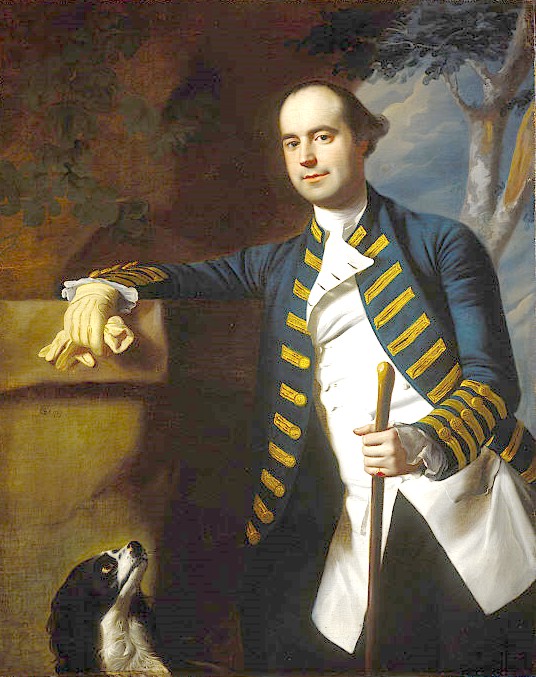
John Singleton Copley, Janu. Wikimedia Commons. Public domain.
1732–1797
John Glover
0
recorded events
Connected towns:
Cambridge, MABiography
John Glover: The Fisherman Who Saved the Revolution
Born in Salem, Massachusetts, in 1732 and raised in the hardscrabble coastal town of Marblehead, the man who would one day rescue George Washington's army from annihilation grew up on the unforgiving waters of the North Atlantic. Glover came from modest origins and made his living as a fisherman, merchant, and cordwainer, eventually rising to become one of Marblehead's leading citizens. The town itself was a place apart—a community of weathered mariners, many of mixed racial and ethnic backgrounds, who earned their bread hauling cod from treacherous seas. These men understood tides, currents, oars, and the deadly consequences of panic on open water. Glover's decades of experience managing crews and navigating commercial ventures gave him a natural authority that translated seamlessly into military leadership. By the time tensions between the colonies and Britain reached a breaking point in the mid-1770s, Glover was a prosperous man in his early forties with deep roots in a community that would follow him into war. His background was not that of a gentleman planter or educated lawyer; it was forged in salt spray and hard labor, and that made all the difference.
When fighting erupted at Lexington and Concord in April 1775, Glover was already deeply involved in the patriot cause, having organized and trained a company of Marblehead men as part of the local militia. His unit was formally mustered into Continental service as the 21st Massachusetts Regiment—later known simply as the Marblehead Regiment—and Glover received a colonel's commission. What made this regiment extraordinary was its composition: it was drawn almost entirely from Marblehead's seafaring community, including fishermen, sailors, and boat handlers who had spent their lives working in coordination on heaving decks and in small craft. The regiment was also notably diverse for its era, including Black, Native American, and mixed-race soldiers serving alongside white mariners. Glover marched his men to the siege lines around Boston, where they took up positions at Cambridge alongside thousands of other colonial troops hemming in the British garrison. During the long months of the siege through 1775 and into early 1776, the Marbleheaders manned fortifications, conducted coastal raids, and performed garrison duties. Their specialized maritime skills were not yet fully exploited, but their discipline and cohesion were already evident to officers who observed them in camp.
The Marblehead Regiment's most famous hour came not during a conventional battle but during one of the war's most daring retreats. After the Continental Army suffered a devastating defeat at the Battle of Brooklyn on August 27, 1776, Washington's forces found themselves trapped on the western tip of Long Island, their backs to the East River, with the full might of the British army preparing to deliver a finishing blow. On the night of August 29–30, Glover and his Marbleheaders undertook the nearly impossible task of ferrying approximately nine thousand soldiers, along with horses, artillery, and supplies, across the East River to Manhattan under cover of darkness and fog. Working in silence with muffled oars, the fishermen-turned-soldiers made trip after trip across the treacherous tidal strait, completing the evacuation by dawn without the loss of a single life. It was a masterpiece of seamanship, discipline, and nerve. Had the evacuation failed—had wind, tide, or British detection intervened—the Revolution might well have ended that night. Glover's men did not fire a shot, yet they arguably saved the American cause at its most vulnerable moment.
Glover's regiment performed a second iconic feat just four months later. On the freezing night of December 25–26, 1776, they once again manned the boats as Washington launched his surprise crossing of the ice-choked Delaware River, ferrying twenty-four hundred soldiers from Pennsylvania to New Jersey for the attack on the Hessian garrison at Trenton. The crossing was perilous—massive chunks of ice battered the Durham boats, temperatures plunged, and the operation ran hours behind schedule—but the Marbleheaders kept the boats moving. The resulting victory at Trenton on the morning of December 26 was a transformative moment for the Revolution, rescuing American morale from the brink of collapse and convincing wavering soldiers and citizens that the war could still be won. Beyond these celebrated crossings, Glover led his men in conventional combat as well, commanding troops at the Battle of Trenton and later seeing action at the Second Battle of Saratoga in October 1777, where his brigade helped secure the surrender of British General John Burgoyne—a turning point that brought France into the war as an American ally.
Glover's relationship with George Washington was complex and shaped by mutual respect forged under extreme pressure. Washington recognized Glover's unique capabilities and repeatedly turned to the Marblehead colonel when water operations demanded expertise no other commander possessed. Glover, for his part, was not an easy subordinate; he was proud, independent-minded, and protective of his men, qualities common among New England sea captains accustomed to absolute authority on their own vessels. His regiment's diversity also set it apart and occasionally created friction with soldiers from other colonies unaccustomed to integrated units. Despite these tensions, Glover's professionalism earned him a promotion to brigadier general in February 1777, a recognition of both his battlefield performance and his organizational abilities. He served alongside other notable figures of the war, including Horatio Gates at Saratoga, and his brigade played a role in guarding the Convention Army—the captured British troops from Burgoyne's surrender. By 1782, declining health forced Glover to retire from active service, and he returned to Marblehead, where he lived quietly until his death on January 30, 1797, largely overlooked by a nation focused on grander figures.
Glover's story illuminates a dimension of the American Revolution that is too often overshadowed by tales of generals and statesmen. The Revolution was won not only by brilliant strategy or political philosophy but by the practical skills of ordinary working people—fishermen who knew how to handle boats in the dark, sailors who understood currents and tides, and diverse communities that bound together across racial lines when the cause demanded it. Glover and his Marbleheaders remind us that the Continental Army was not a professional fighting force but a collection of civilians who brought their peacetime trades to the battlefield, and that sometimes those trades proved more decisive than musketry. His legacy also challenges us to consider who gets remembered and who gets forgotten: without Glover's regiment, the retreat from Brooklyn fails, the crossing of the Delaware never happens, and the Revolution likely collapses in its first full year. That a fisherman from a small Massachusetts port town held the fate of a nation in his calloused hands is among the most remarkable and instructive stories the Revolution has to offer.
WHY JOHN GLOVER MATTERS TO CAMBRIDGE
Students and visitors walking through Cambridge today stand on ground where John Glover and his Marblehead mariners camped during the Siege of Boston, training and waiting for the moment when their extraordinary skills would be called upon. Glover's story teaches us that the Revolution was not won solely by elite leaders deliberating in fine rooms—it was sustained by working people whose everyday expertise proved indispensable in moments of crisis. The Marblehead Regiment, encamped near Cambridge in 1775–1776, represented something radical: a diverse, skilled unit of fishermen and sailors who would go on to save an entire army. Their presence in the siege lines connects Cambridge directly to the most dramatic rescues of the war—Brooklyn and Trenton—and reminds us that the road to independence ran through this community before it ran across any river.
TIMELINE
- 1732: Born on November 5 in Salem, Massachusetts; raised in Marblehead
- 1775: Commissioned as colonel of the 21st Massachusetts Regiment (Marblehead Regiment) and joins the siege at Cambridge
- 1776 (August 29–30): Commands the overnight evacuation of Washington's army across the East River after the Battle of Brooklyn
- 1776 (December 25–26): Leads boat crews ferrying the Continental Army across the Delaware River for the surprise attack on Trenton
- 1777 (February): Promoted to brigadier general in the Continental Army
- 1777 (October): Commands a brigade at the Battles of Saratoga, contributing to Burgoyne's surrender
- 1782: Retires from military service due to declining health and returns to Marblehead
- 1797: Dies on January 30 in Marblehead, Massachusetts
SOURCES
- Billias, George Athan. General John Glover and His Marblehead Mariners. Henry Holt and Company, 1960.
- McCullough, David. 1776. Simon & Schuster, 2005.
- National Park Service. "Washington's Crossing: The Marblehead Mariners." https://www.nps.gov/wacr/
- Fischer, David Hackett. Washington's Crossing. Oxford University Press, 2004.
- Marblehead Museum. "John Glover and the Marblehead Regiment." https://www.marbleheadmuseum.org/