

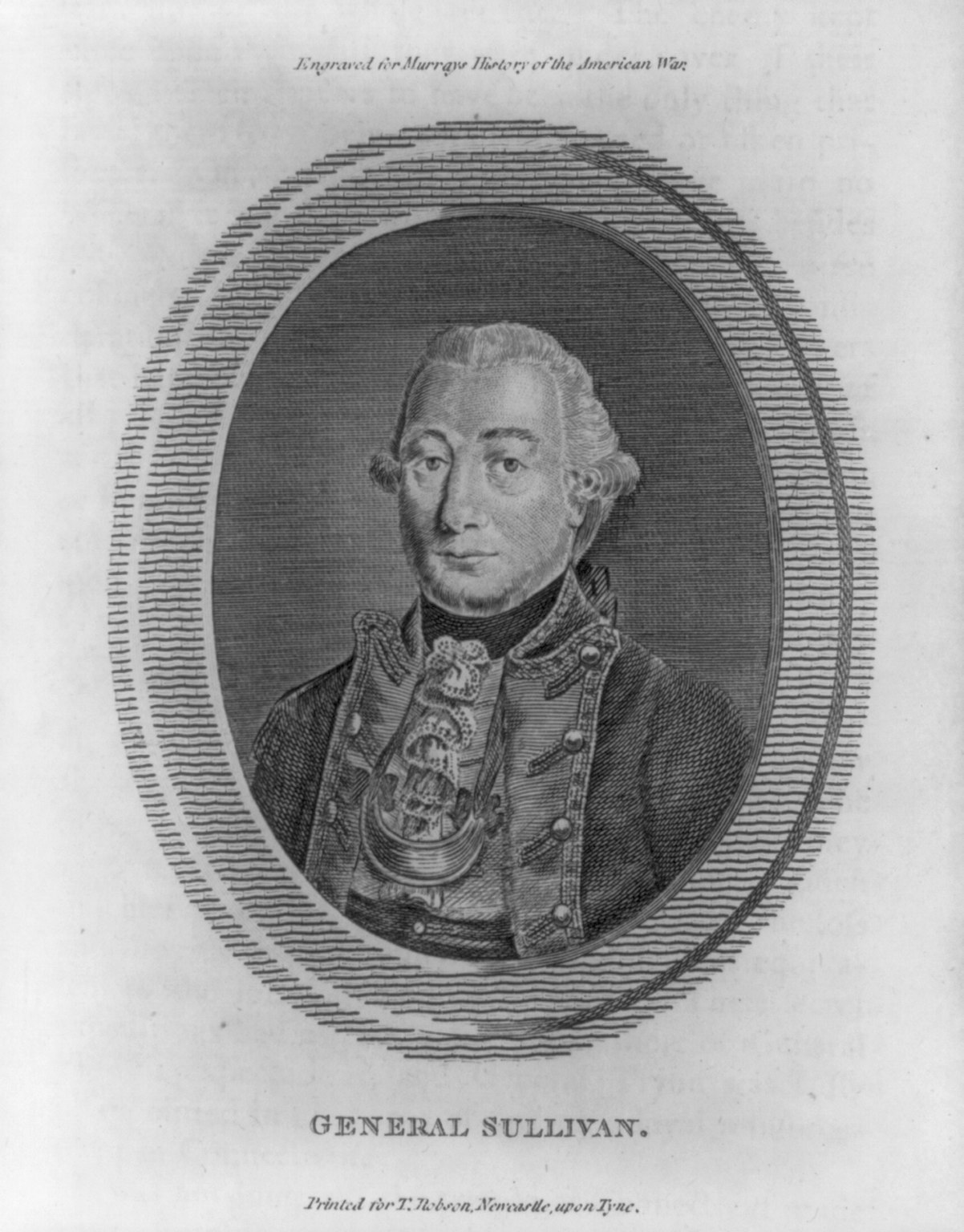
Miscellaneous Items in High Demand, PPOC, Library of Congress, 1778. Wikimedia Commons. Public domain.
1740–1795
General John Sullivan
2
recorded events
Connected towns:
Portsmouth, NHBiography
General John Sullivan: From Courtroom to Battlefield, New Hampshire's First Rebel
The son of Irish immigrants who settled in the hardscrabble town of Somersworth, New Hampshire, John Sullivan was born in 1740 into a family that understood what it meant to exist on the margins of the British Empire. His father, a schoolmaster who had come to the colonies seeking opportunity unavailable in Ireland, instilled in his children both an appreciation for education and a sharp awareness of how imperial power shaped ordinary lives. Sullivan pursued the law, studying under the prominent attorney Samuel Livermore before establishing his own thriving practice in Durham, a town situated along the Oyster River northwest of Portsmouth. His legal career brought him into contact with merchants, landowners, and political figures across southeastern New Hampshire, and he developed a reputation not only for sharp legal reasoning but for a combative temperament that could fill a courtroom with tension. He won election to New Hampshire's provincial assembly, where he aligned himself firmly with the Patriot faction challenging royal governance. By the early 1770s, Sullivan had become one of the colony's most outspoken critics of British policy, a man whose ambition and genuine ideological conviction fed each other in ways that made him impossible to ignore.
Sullivan's path from political agitation to armed confrontation began on December 14, 1774, when he led what historians recognize as the first organized seizure of British military property by American colonists. The catalyst was Paul Revere, who rode from Boston to Portsmouth bearing an urgent warning that the British ministry had ordered reinforcements to secure Fort William and Mary, the crumbling but strategically significant fortification guarding Portsmouth Harbor. Sullivan moved with remarkable speed, rallying several hundred men from the surrounding communities and marching them to the fort on a cold winter afternoon. The garrison — a skeleton force under Captain John Cochran — could offer only token resistance. Sullivan's raiders overwhelmed the defenders without significant bloodshed, hauled away approximately one hundred barrels of gunpowder, and distributed the military stores to Patriot communities across New Hampshire for safekeeping. The raid occurred a full four months before the shots fired at Lexington and Concord, and it demonstrated that at least some American colonists had already moved beyond petitions and protests to direct military confrontation with the Crown. For Sullivan personally, it was a transformative moment, marking his irrevocable crossing from legal advocacy into armed rebellion.
When the Continental Congress began commissioning officers in 1775, Sullivan's combination of political connections, legal prominence, and demonstrated willingness to act made him a natural choice for military command. He received a brigadier general's commission and was soon drawn into the war's major campaigns in the northern and middle theaters. Sullivan fought at the Battle of Long Island in August 1776, where the Continental Army suffered a devastating defeat at the hands of General William Howe's forces, and he was captured during the chaotic retreat. After his exchange, he returned to active command and participated in George Washington's celebrated crossing of the Delaware and the subsequent victory at Trenton in December 1776, a turning point that revived American morale during the war's darkest winter. He commanded a division at the Battle of Brandywine in September 1777, where British flanking maneuvers again produced an American defeat, with Sullivan's wing bearing much of the criticism for failing to detect the enemy's approach. Despite these setbacks, Sullivan repeatedly demonstrated physical courage and an unwillingness to surrender initiative, qualities that kept Washington's confidence even when congressional critics called for his removal.
The most consequential military operation bearing Sullivan's name was the Sullivan-Clinton Campaign of 1779, a large-scale punitive expedition directed against the Iroquois Confederacy nations — primarily the Seneca and Cayuga — who had allied with the British and conducted devastating raids on frontier settlements in New York and Pennsylvania. Washington personally chose Sullivan to lead approximately five thousand Continental troops on a systematic march through Iroquois territory, with orders to destroy villages, crops, and orchards so thoroughly that the region could no longer serve as a base for attacks on American settlements. Beginning in the summer of 1779, Sullivan's forces swept through the Finger Lakes region and beyond, burning at least forty Iroquois villages and destroying vast quantities of stored food. The campaign achieved its immediate military objective of neutralizing the Iroquois threat to the northern frontier, but its human cost was staggering — displacing thousands of Indigenous people and contributing to the long-term destruction of Iroquois political and territorial sovereignty. Sullivan himself regarded the campaign as his most significant military achievement, though modern historians view it with far greater moral complexity.
Sullivan's relationships with fellow officers and political leaders shaped both his opportunities and his frustrations throughout the war. George Washington maintained a complicated but ultimately supportive relationship with Sullivan, defending him against congressional critics after Long Island and Brandywine while privately acknowledging his tactical limitations. Sullivan clashed repeatedly with other generals, including the French admiral Comte d'Estaing during the failed 1778 siege of Newport, Rhode Island, where Sullivan's public criticism of French withdrawal strained the fragile Franco-American alliance and required diplomatic intervention to repair. His connections to New Hampshire's congressional delegates, including Josiah Bartlett, ensured that he retained political support even when his battlefield record invited scrutiny. Sullivan also served briefly as a Continental Congress delegate himself before accepting his military commission, giving him an understanding of the political dynamics governing military appointments that many of his fellow generals lacked. His ability to navigate between the worlds of politics and military command, however imperfectly, reflected the broader reality that the Revolution was as much a political struggle as a military one.
Sullivan's legacy resists easy summary, which is precisely what makes it valuable for understanding the Revolution as it actually unfolded rather than as later generations idealized it. His December 1774 raid on Fort William and Mary established a critical precedent — that Americans were willing to seize British military resources by force — and provided New Hampshire's Patriot communities with the gunpowder and weapons they would need in the months ahead. His battlefield career was marked by courage undermined by inconsistent tactical judgment, a pattern common among the amateur officers who built the Continental Army from nothing. The Sullivan-Clinton Campaign achieved its strategic goals but inaugurated a pattern of displacement and destruction that would define American policy toward Indigenous nations for the next century. After resigning his commission in 1779 due to failing health, Sullivan served New Hampshire as attorney general and later as governor, remaining a significant political figure until his death in 1795. His story reminds us that the Revolution was made by flawed, determined, sometimes reckless individuals whose willingness to act in uncertain moments created consequences — triumphant and tragic — that extended far beyond their own lifetimes.
WHY GENERAL JOHN SULLIVAN MATTERS TO PORTSMOUTH
John Sullivan's story matters to Portsmouth because it reframes the city's role in the American Revolution. Most Americans learn that the war began at Lexington and Concord in April 1775, but four months earlier, Sullivan led hundreds of men against Fort William and Mary in Portsmouth Harbor, seizing British gunpowder and cannons in what was the first direct military confrontation between colonists and Crown forces. That raid was triggered by Paul Revere's ride to Portsmouth — a journey far less famous than his later midnight ride but equally consequential. Students and visitors walking the streets of Portsmouth today are walking through the place where the Revolution's first act of armed defiance occurred, making this city not a footnote to the conflict but one of its genuine starting points.
TIMELINE
- 1740: Born in Somersworth, New Hampshire, to Irish immigrant parents
- 1760s: Establishes a successful law practice in Durham, New Hampshire
- 1774: Elected as a delegate to the First Continental Congress
- 1774 (December 14): Leads the raid on Fort William and Mary in Portsmouth, the first organized seizure of British military property
- 1775: Receives commission as brigadier general in the Continental Army
- 1776 (August): Fights at the Battle of Long Island; captured and later exchanged
- 1777 (September): Commands a division at the Battle of Brandywine
- 1778: Leads the siege of Newport, Rhode Island, in collaboration with French forces
- 1779: Commands the Sullivan-Clinton Campaign against the Iroquois Confederacy in New York
- 1779: Resigns military commission due to deteriorating health; returns to New Hampshire
- 1786–1790: Serves as President (Governor) of New Hampshire
- 1795: Dies in Durham, New Hampshire
SOURCES
- Whittemore, Charles P. A General of the Revolution: John Sullivan of New Hampshire. Columbia University Press, 1961.
- Fischer, David Hackett. Paul Revere's Ride. Oxford University Press, 1994.
- Williams, Glenn F. Year of the Hangman: George Washington's Campaign Against the Iroquois. Westholme Publishing, 2005.
- New Hampshire Historical Society. "John Sullivan Papers." https://www.nhhistory.org/
- Ammon, Charles H. "The Formation of the Republican Spirit in New Hampshire: John Sullivan and Revolutionary Politics." Historical New Hampshire, Vol. 25, 1970.
Events
Dec
1774
Paul Revere Rides to PortsmouthPortsmouthContinental Army General# Paul Revere's Ride to Portsmouth Most Americans know the story of Paul Revere's midnight ride in April 1775, immortalized by Longfellow's famous poem and etched into the national memory as a defining moment of the American Revolution. Far fewer know that Revere undertook an equally daring and arguably more consequential ride four months earlier, galloping north from Boston to Portsmouth, New Hampshire, in the cold of December 1774. This earlier mission was Revere's first significant intelligence ride, and it set in motion one of the earliest acts of armed colonial resistance against the British Crown — a raid that would supply the very gunpowder later used to fight for American independence. By the autumn of 1774, tensions between the American colonies and Great Britain had reached a breaking point. The passage of the Coercive Acts earlier that year, known to the colonists as the Intolerable Acts, had galvanized opposition throughout New England. In Massachusetts, the colonial government had been effectively dissolved, and General Thomas Gage commanded an increasingly aggressive British military presence in Boston. Patriots throughout the region organized networks of communication and intelligence, watching British troop movements and ship departures with anxious vigilance. Paul Revere, a skilled silversmith and engraver from Boston, had already established himself as a trusted courier for the patriot cause, carrying messages between committees of correspondence and revolutionary leaders. It was in this atmosphere of mounting crisis that Revere received intelligence that would send him racing northward. On December 13, 1774, Revere set out from Boston on horseback, riding roughly sixty miles through the winter landscape to reach Portsmouth, New Hampshire. He carried urgent news: the British were planning to reinforce Fort William and Mary, a lightly garrisoned royal fortification situated on New Castle Island in Portsmouth Harbor. The fort guarded a substantial store of gunpowder, cannons, and small arms — military supplies that the British intended to secure before colonial dissidents could seize them. Revere understood that time was critical. If the British reinforcements arrived first, the colonists would lose access to desperately needed munitions. Upon reaching Portsmouth, Revere delivered his intelligence to two prominent local patriots whose names would become deeply entwined with the revolutionary cause. John Langdon, who would later serve as an agent for the Continental Navy and play a vital role in outfitting American warships, received Revere's warning and immediately began rallying support. General John Sullivan, a lawyer and militia leader who would go on to become a major general in the Continental Army and one of George Washington's most relied-upon commanders, also learned of the British plans. Together, Langdon and Sullivan organized a swift and bold response. Woodbury Langdon, John's brother and a future delegate to the Continental Congress, was also connected to the patriot network in Portsmouth and the political infrastructure that made such rapid mobilization possible. On December 14, just one day after Revere's arrival, Sullivan led a force of approximately four hundred men in a raid on Fort William and Mary. The small British garrison, vastly outnumbered, was overwhelmed without significant bloodshed. The raiders seized roughly one hundred barrels of gunpowder, along with muskets and other military stores. A second raid the following day captured additional cannons and weapons. The gunpowder was hidden throughout the countryside, and some of it would later be transported to Cambridge, Massachusetts, where it reportedly supplied colonial forces at the Battle of Bunker Hill in June 1775. The significance of this event extends well beyond the immediate seizure of supplies. The raid on Fort William and Mary represented one of the first overt acts of armed defiance against British military authority, predating the battles of Lexington and Concord by more than four months. It demonstrated the effectiveness of the patriot intelligence and communication networks that Revere helped sustain, and it proved that colonists were willing to take up arms to protect their interests. For Revere himself, the ride to Portsmouth was a critical rehearsal for his more famous ride the following April, establishing his reputation as a reliable and courageous messenger in the revolutionary cause. The event also elevated the profiles of Sullivan and the Langdon brothers, all of whom would go on to serve the new nation in positions of significant military and political leadership. In the story of American independence, the ride to Portsmouth stands as a vital but often overlooked chapter — a reminder that the Revolution was not born in a single moment but built through countless acts of courage and coordination in the months before the first shots were fired.
Dec
1774
First Raid on Fort William and MaryPortsmouthContinental Army General# The First Raid on Fort William and Mary By the autumn of 1774, the relationship between Britain's American colonies and the Crown had deteriorated to a dangerous breaking point. The passage of the Coercive Acts — known to the colonists as the Intolerable Acts — earlier that year had inflamed tensions throughout New England. Boston's port had been forcibly closed, Massachusetts's charter had been effectively revoked, and British authorities were tightening their grip on colonial self-governance. In September, the First Continental Congress convened in Philadelphia to coordinate a unified response, and throughout the colonies, patriots began organizing committees of correspondence and militia companies. It was against this volatile backdrop that word reached New Hampshire of a royal order prohibiting the export of military stores to the colonies, a directive that many interpreted as a prelude to disarmament and, potentially, armed suppression. The news would ignite one of the most daring and consequential acts of colonial defiance — one that predated the famous battles of Lexington and Concord by four full months. Fort William and Mary sat on New Castle Island at the mouth of Portsmouth Harbor, guarding the approaches to one of New Hampshire's most important seaports. Despite its strategic position, the fort was woefully undermanned, garrisoned by a mere captain and five soldiers under British command. The fort's stores, however, were significant: approximately one hundred barrels of gunpowder along with other military supplies were housed within its walls. When Paul Revere rode north from Boston on December 13, 1774, carrying intelligence that British reinforcements might soon be dispatched to secure the fort and its contents, New Hampshire's patriot leaders recognized that they faced a narrow window of opportunity. John Sullivan, a prominent lawyer and militia leader from Durham who would later become one of the Continental Army's most important generals, quickly assumed a central role in organizing the response. On December 14, 1774, Sullivan helped rally approximately four hundred men from the surrounding communities and led them in a bold march on the fort. The sheer size of the force made the outcome almost inevitable. The small British garrison, vastly outnumbered and facing an overwhelming show of colonial resolve, offered only token resistance before surrendering. No lives were lost in the confrontation, but the symbolic and practical consequences were enormous. The raiders seized roughly one hundred barrels of gunpowder and carried them away from the fort, distributing the precious stores to communities throughout New Hampshire, where they would be hidden and safeguarded for future use. The significance of this event cannot be overstated. The raid on Fort William and Mary represented the first organized seizure of British military property by American colonists in the escalating crisis that would become the Revolutionary War. While acts of protest such as the Boston Tea Party had targeted commercial goods, this was a direct assault on a military installation — a clear act of rebellion against the authority of the Crown and an unmistakable signal that at least some colonists were prepared to use force to resist British power. The gunpowder seized that day did not sit idle; historians believe that some of it was later used by patriot forces at the Battle of Bunker Hill in June 1775, meaning the raid had tangible military consequences beyond its immediate symbolic impact. For John Sullivan, the raid marked the beginning of a distinguished revolutionary career. He would go on to serve as a delegate to the Continental Congress and was commissioned as a brigadier general in the Continental Army, participating in the Siege of Boston, the Battle of Trenton, and leading a major campaign against the Iroquois Confederacy in 1779. The raid on Fort William and Mary also demonstrated something that would prove essential to the revolutionary cause: the capacity of ordinary colonists to organize quickly, act decisively, and cooperate across community lines in pursuit of a shared political objective. Months before the first shots were fired at Lexington and Concord, the men who stormed that small fort on New Castle Island showed that the spirit of armed resistance was already alive in America — and that the revolution, when it came, would not be an impulsive reaction but the culmination of deliberate, courageous action.
Stories