

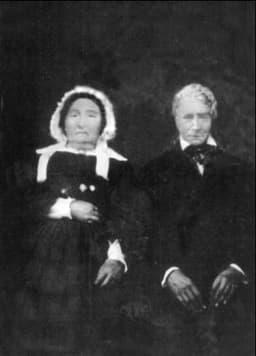
Unknown authorUnknown author, 19<s. Wikimedia Commons. Public domain.
1760–1850
Joseph Plumb Martin
6
recorded events
Connected towns:
Morristown, NJBiography
Joseph Plumb Martin (1760–1850)
Private Soldier, Diarist, and Memoirist of the American Revolution
Born in 1760 in western Connecticut, the boy who would become the Revolution's most eloquent common soldier grew up in circumstances that offered little promise of historical significance. Joseph Plumb Martin spent much of his childhood in the care of his grandparents in Milford, Connecticut, after being sent from his parents' home at a young age — a common enough arrangement in colonial New England, where families of modest means often distributed children among relatives who could better provide for them. His grandfather was a clergyman, and Martin received enough education to develop the sharp, literate mind that would eventually produce one of the war's great documents. But nothing in his upbringing marked him for distinction. He was an ordinary young man from an ordinary background, part of the vast class of Americans who owned little property and wielded no political influence. What set Martin apart was not privilege or ambition but rather an unusual gift for observation and language — a capacity to see clearly and remember precisely — that would lie dormant for decades before finding its purpose on the page. He was, in every sense, the kind of person the historical record was designed to overlook.
When the Revolutionary War erupted in 1775, Martin was just fifteen years old, yet the fervor sweeping through Connecticut proved irresistible. In 1776, he enlisted for a six-month stint in a Connecticut militia unit, getting his first raw taste of military life during the New York campaign, where Washington's army suffered a series of devastating defeats. The young soldier witnessed the chaos of battle at Brooklyn and the harrowing retreats that followed, experiences that might have permanently discouraged a less resilient spirit. Yet in 1777, Martin made a far more consequential decision: he reenlisted, this time in the Continental Army for the duration of the war. This was not a choice made lightly. Signing on "for the duration" meant surrendering one's freedom for an indefinite period to an army that was already notorious for failing to feed, clothe, or pay its soldiers. Martin understood what he was committing to, and he did it anyway — driven by a mixture of patriotic conviction, youthful restlessness, and the limited economic opportunities available to a young man without land or capital. That decision placed him at the center of the Revolution's grinding, unglamorous middle years, where the war was won not by brilliant strokes but by sheer endurance.
Martin's most important contribution to history was not any single act of battlefield heroism but rather his decision, decades after the war, to write down what he had lived through. His memoir, published in 1830 under the title A Narrative of Some of the Adventures, Dangers and Sufferings of a Revolutionary Soldier, stands as the single most important enlisted man's account of the American Revolution. Written with intelligence, irony, and a vein of dark humor that never quite conceals the underlying pain, the narrative captures what it actually felt like to serve as a private soldier in Washington's army. Martin recorded the tedium of camp life, the terror of combat, the humiliation of marching barefoot in rags, and the slow corrosion of morale that came from being systematically neglected by the government one was fighting to establish. He wrote not to glorify himself or the cause but to bear witness — to ensure that someone, somewhere, would know what the common soldiers had endured. His prose is vivid, specific, and unsentimental, offering correctives to the romanticized version of the Revolution that was already taking hold by the time he set pen to paper.
The winter of 1779–1780 at Morristown, New Jersey, forms one of the most harrowing sections of Martin's narrative. He marched with the Continental Army to its encampment at Jockey Hollow in December 1779, arriving to find inadequate shelter and virtually no provisions. His account of the months that followed is unflinching in its detail: he describes eating birch bark and boiling old shoe leather to extract whatever nourishment it might yield, going days at a stretch without any food whatsoever. When the great snowstorms of January 1780 struck — storms that buried the camp under feet of snow and drove temperatures to extremes not seen in living memory — Martin recorded the cold with the specificity of a man who had endured it in every fiber of his body. He wrote of fingers too numb to load a musket, of sentries discovered frozen at their posts, of the futile struggle to keep fires burning inside huts that leaked warmth as fast as it could be generated. He helped build those soldier huts at Jockey Hollow and occupied them through months of misery before finally departing Morristown with the army in the spring of 1780.
Martin served among thousands of anonymous soldiers, but his memoir occasionally illuminates his relationship to the army's command structure and the wider world of Revolutionary politics. He writes of General Washington with a mixture of respect and distance — the commander-in-chief was a figure glimpsed from afar, issuing orders whose logic was not always apparent to the men who carried them out. Martin's sharpest commentary is reserved not for individual officers but for the Continental Congress and the state governments, which he held responsible for the supply crisis that nearly destroyed the army at Morristown. He gives voice to the collective fury of enlisted men who watched their government debate and delay while soldiers starved. His account captures the dangerous erosion of discipline that resulted, including mutinous rumblings among troops who felt they had been betrayed by the very republic they were defending. Through Martin's eyes, we see the Revolution not as a unified national effort but as a fractured, contested enterprise in which the burdens of liberty fell disproportionately on those least equipped to bear them.
Martin survived the war, eventually settling in Prospect, Maine, where he lived as a farmer in modest circumstances — a fate shared by many veterans who never received the land grants and back pay they had been promised. He lived until 1850, reaching the age of eighty-nine, long enough to watch the Revolution he had fought in harden into national mythology. His memoir, largely ignored upon its initial publication, was rediscovered in the twentieth century and recognized as a document of extraordinary importance. It gave voice to the enlisted men whose endurance had sustained the Continental Army through its darkest hours — men who had no property, no political power, and no expectation that their country would remember them. Martin's legacy is the legacy of the common soldier, and his story serves as a permanent reminder that the American Revolution was won not only by generals and statesmen but by thousands of anonymous individuals who suffered beyond what should have been endurable and somehow chose to remain. His narrative insists that we reckon with the full cost of independence, paid in frozen flesh and empty stomachs by people history was content to forget.
WHY JOSEPH PLUMB MARTIN MATTERS TO MORRISTOWN
Joseph Plumb Martin's memoir is the closest thing we have to a time machine pointed at Jockey Hollow. When students and visitors walk the grounds of the Morristown encampment today, they see reconstructed huts and gentle wooded hills — a landscape that conceals its own history of suffering. Martin's words restore what the landscape cannot show: the gnawing hunger, the bone-deep cold, the rage of soldiers who felt abandoned by their own government. His account transforms Morristown from a historical site into a human experience. He reminds us that the Revolution was preserved not by grand strategy but by the stubborn endurance of ordinary men who had every reason to walk away and did not. His story is Morristown's story, told from the ground up.
TIMELINE
- 1760: Born in western Connecticut; later raised by grandparents in Milford, Connecticut
- 1776: Enlists in a Connecticut militia unit at age fifteen; serves during the New York campaign
- 1777: Reenlists in the Continental Army for the duration of the war
- 1778: Endures the winter at Valley Forge and participates in subsequent campaigns
- 1779: Marches with the Continental Army to Morristown; helps construct soldier huts at Jockey Hollow
- 1780: Survives the Hard Winter at Morristown, enduring starvation, record snowstorms, and the army's supply crisis; departs Morristown with the army in spring
- 1781: Present at the Siege of Yorktown, witnessing the war's decisive conclusion
- 1783: Discharged from the Continental Army at war's end
- 1830: Publishes A Narrative of Some of the Adventures, Dangers and Sufferings of a Revolutionary Soldier
- 1850: Dies in Prospect, Maine, at the age of eighty-nine
SOURCES
- Martin, Joseph Plumb. A Narrative of Some of the Adventures, Dangers and Sufferings of a Revolutionary Soldier. Glazier, Masters & Co., 1830. (Widely reprinted; modern editions often titled Private Yankee Doodle.)
- Kirschke, James J. Gouverneur Morris: Author, Statesman, and Man of the World. Thomas Dunne Books, 2005. (Provides broader context for the political failures Martin criticizes.)
- Fleming, Thomas. The Forgotten Victory: The Battle for New Jersey — 1780. Reader's Digest Press, 1973.
- National Park Service. "Joseph Plumb Martin." Morristown National Historical Park. https://www.nps.gov/morr/
- Lender, Mark Edward, and Garry Wheeler Stone. Fatal Sunday: George Washington, the Monmouth Campaign, and the Politics of Battle. University of Oklahoma Press, 2016.
Events
Dec
1779
Continental Army Returns to Morristown for Second EncampmentMorristownEnlisted soldier who marched to Morristown with the army**The Continental Army's Second Encampment at Morristown, 1779–1780** In the winter of 1779, General George Washington faced a decision that would test the endurance of his army and the resolve of the American cause. After a campaign season that had produced no decisive victory, Washington once again selected Morristown, New Jersey, as the site for his winter encampment. He had quartered a much smaller force there during the winter of 1777, and the location's strategic advantages remained compelling. Nestled among the Watchung Mountains, Morristown offered natural defensive terrain that would make a British surprise attack from New York City difficult. Its position in northern New Jersey also allowed the Continental Army to monitor British movements and protect vital supply lines running through the mid-Atlantic region. What Washington could not have fully anticipated, however, was that the winter of 1779–1780 would prove to be one of the most brutal of the eighteenth century—and that his soldiers would endure suffering that rivaled, and in many ways surpassed, the infamous trials at Valley Forge. Approximately 10,000 Continental troops marched into the Morristown area beginning in late November and early December of 1779. Among them was Private Joseph Plumb Martin, an enlisted soldier from Connecticut whose later memoirs would provide one of the most vivid firsthand accounts of life in the ranks. Martin and his fellow soldiers were directed to Jockey Hollow, a wooded tract of land south of the town center, where they were ordered to construct their own shelter. Under guidelines influenced by Baron Friedrich Wilhelm von Steuben, the Prussian-born inspector general who had transformed the army's discipline and organization at Valley Forge, the camp was laid out with military precision. Regiments were assigned specific areas, and soldiers set about felling trees and raising over 1,000 log huts arranged in orderly rows. Von Steuben's insistence on proper camp layout was not merely aesthetic; it promoted sanitation, facilitated rapid assembly, and reinforced the professional standards he had worked so hard to instill. Overseeing the monumental task of supplying this encampment was Major General Nathanael Greene, who served as quartermaster general. Greene faced nearly impossible logistical challenges. The Continental Congress was financially exhausted, the currency had depreciated to near worthlessness, and the supply system was plagued by inefficiency and corruption. Food, clothing, and firewood were all desperately scarce. Soldiers went days without adequate rations, and many lacked shoes and blankets as temperatures plunged and record snowfalls buried the camp. The suffering was so acute that some units teetered on the edge of mutiny, and desertions increased alarmingly. Washington himself established his headquarters at the Ford Mansion, a handsome home in the center of Morristown owned by the widow Theodosia Ford and her family. Martha Washington joined her husband there, as she did during several winter encampments throughout the war, helping to manage the headquarters household, hosting visiting dignitaries and officers, and lending a stabilizing presence during a period of profound uncertainty. Her role, though often overlooked, contributed meaningfully to maintaining morale and the social cohesion of the officer corps. The encampment's enormous size—far larger than the first Morristown winter quarters—placed extraordinary strain on the surrounding civilian population. Local farms were stripped of provisions, fences were torn down for firewood, and tensions between soldiers and residents simmered throughout the winter. These frictions highlighted one of the Revolution's enduring dilemmas: the difficulty of sustaining a citizens' army without alienating the very citizens it fought to protect. The second Morristown encampment matters in the broader story of the Revolution because it demonstrated that the Continental Army could survive conditions that would have destroyed a less committed force. Despite starvation, freezing cold, and the near-collapse of the supply system, the army held together and emerged in the spring of 1780 ready to continue the fight. The perseverance displayed at Jockey Hollow became a testament to the determination of ordinary soldiers whose willingness to endure extraordinary hardship ultimately made American independence possible.
Dec
1779
The Hard Winter: Second Encampment at MorristownMorristownPrivate Soldier# The Hard Winter: Second Encampment at Morristown By the winter of 1779, the American Revolution had entered a grueling phase of attrition. The initial fervor of independence had cooled, and the Continental Army found itself locked in a war that seemed to have no clear end. The British occupied New York City, the Continental Congress struggled to fund the war effort, and the French alliance forged in 1778 had yet to deliver decisive results on the battlefield. It was in this climate of exhaustion and uncertainty that General George Washington made the decision to encamp his army at Morristown, New Jersey, for the second time. He had wintered there in early 1777 and knew the location's strategic advantages — its proximity to the British in New York, the natural protection offered by the Watchung Mountains, and the network of roads that allowed for communication and movement. What Washington could not have anticipated was that the winter of 1779–80 would become the most punishing ordeal his army had ever faced, surpassing even the legendary suffering at Valley Forge. Washington established his headquarters at the Ford Mansion, the home of the widow Theodosia Ford, while approximately 10,000 soldiers set about constructing a vast encampment of over 1,000 log huts at Jockey Hollow, a few miles to the southwest. The encampment sprawled across farmland and forest, including property belonging to local families such as that of Temperance "Tempe" Wick, a young civilian woman whose family farm was directly affected by the military presence. The army's arrival transformed the rural landscape into a military city, straining relationships with the local population while also making the community an unwitting participant in the Revolution's survival. The weather that winter was unprecedented in its severity. Between November and April, twenty-eight blizzards lashed the region, burying the encampment under snowdrifts that reached six feet in places. New York Harbor froze solid, an event so rare that no one alive could recall it ever happening before. The extreme cold compounded an already dire supply crisis. Nathanael Greene, serving as Quartermaster General, bore the enormous responsibility of keeping the army fed, clothed, and equipped, but the supply system — undermined by inflation, congressional dysfunction, and logistical breakdown — collapsed entirely. Soldiers subsisted on half-rations, then quarter-rations, and then nothing at all. Private Joseph Plumb Martin, one of the war's most vivid chroniclers, later recorded eating birch bark and roasted shoe leather simply to survive. The physical suffering was matched by a crisis of morale. Soldiers had not been paid in months, and many were dressed in little more than rags. Discipline frayed as desperation set in. Baron Friedrich Wilhelm von Steuben, the Prussian-born Inspector General who had reshaped the army's training at Valley Forge, worked relentlessly to maintain order and military discipline within the camp, but even his efforts could not prevent the unrest from boiling over. On May 25, 1780, two Connecticut regiments paraded under arms and refused to obey orders, demanding food and back pay. Officers managed to suppress the mutiny before it spread, but the incident sent shockwaves through the army's leadership, including Washington's trusted aide-de-camp, Alexander Hamilton, who witnessed firsthand how close the army stood to complete dissolution. Despite everything, the vast majority of soldiers stayed. They endured the cold, the hunger, and the silence from a government that seemed to have forgotten them. They stayed without pay, without adequate clothing, and without any guarantee that the Revolution would succeed. This collective act of endurance is one of the most extraordinary and underappreciated episodes in American military history. While Valley Forge has claimed the greater share of public memory, Morristown was objectively worse — colder, longer, and more deprived. The encampment at Morristown also had lasting consequences for the war. The near-mutiny forced Congress and state governments to confront the army's desperate condition, prompting renewed, if still insufficient, efforts to reform supply and finance. The survival of the Continental Army through this winter preserved the Revolution at a moment when it could easily have collapsed from within. When the soldiers finally broke camp in the spring of 1780, they carried with them not only the scars of a brutal season but also a hardened resolve that would sustain the fight through its remaining years, all the way to the decisive victory at Yorktown in 1781. Morristown was not a battle, but it was a test of endurance that proved as consequential as any clash of arms in the struggle for American independence.
Dec
1779
Soldier Hut Construction at Jockey HollowMorristownEnlisted soldier who built and occupied the huts# Soldier Hut Construction at Jockey Hollow In the late autumn of 1779, the Continental Army faced a crisis that had nothing to do with British muskets or battlefield tactics. After years of grueling campaigns, depleted supplies, and a Congress that struggled to fund even the most basic necessities of war, General George Washington made the difficult decision to establish winter quarters near Morristown, New Jersey. The location, known as Jockey Hollow, offered strategic advantages — it was shielded by the Watchung Mountains, positioned close enough to monitor British movements in New York, and surrounded by wooded terrain that could provide building material and fuel. But the winter of 1779–1780 would prove to be the coldest of the eighteenth century, and the thousands of soldiers who arrived at Jockey Hollow were about to endure suffering that rivaled anything they had experienced on the battlefield. On December 14, 1779, Washington issued precise specifications for the construction of soldier huts, bringing his characteristic attention to order and discipline even to the act of building shelter. Each hut was to measure approximately fourteen by fifteen feet and house twelve enlisted men. The structures were to be built from logs, with walls notched at the corners for stability and gaps chinked with clay to block the wind. Fireplaces built into the back wall would provide heat, and roofing materials — often nothing more than split wood slabs and whatever canvas could be spared — would offer modest protection from the relentless snow. Washington understood that without adequate shelter, he would lose more soldiers to exposure and disease than he ever had to enemy fire, and so the construction effort became a military operation in its own right. The reality of building these huts, however, was far more punishing than any written specification could convey. Soldiers like Joseph Plumb Martin, an enlisted man from Connecticut who later recorded his wartime experiences in vivid detail, labored through deep snow and frozen ground with inadequate tools. Many men lacked proper axes, and those who had them found the work exhausting as they felled trees, dragged timber through snowdrifts, and shaped logs with numb, cracked hands. The construction consumed virtually all the standing timber in the Jockey Hollow area, stripping the landscape bare as thousands of men worked in organized brigades to raise roughly one thousand huts over the course of several weeks. During this time, many soldiers had no choice but to remain in thin canvas tents, exposed to temperatures that plunged well below freezing and storms that buried the encampment under feet of snow. While the enlisted men suffered in the hollow, Washington established his headquarters nearby, and Martha Washington joined him there, as she often did during winter encampments. Martha served as a vital presence at headquarters, managing the household, hosting officers, and helping to maintain morale during a period of extraordinary deprivation. Her willingness to endure the discomforts of camp life alongside the army lent a sense of shared sacrifice that was not lost on the soldiers. The hut construction at Jockey Hollow matters in the broader story of the American Revolution because it reveals the unglamorous endurance that ultimately sustained the patriot cause. The winter at Morristown is often overshadowed by the more famous suffering at Valley Forge two years earlier, but conditions in 1779–1780 were arguably worse. Soldiers went days without food, clothing was in tatters, and pay was months in arrears. Mutiny simmered beneath the surface, and desertions increased. Yet the army held together, in no small part because men like Joseph Plumb Martin continued to shoulder axes, stack logs, and build the crude shelters that kept them alive through the darkest months of the war. The huts they constructed were not monuments — they were desperate, functional acts of survival — but they represented something essential about the Continental Army's resilience. Washington did not win the Revolution solely through brilliant generalship or decisive battles. He won it by keeping an army in the field year after punishing year, and the soldier huts at Jockey Hollow stand as a testament to the ordinary men who made that possible.
Jan
1780
Supply Crisis and Starvation at Jockey HollowMorristownEnlisted soldier who experienced starvation firsthand# Supply Crisis and Starvation at Jockey Hollow In the winter of 1779–1780, the Continental Army marched into Jockey Hollow near Morristown, New Jersey, expecting the kind of difficult but manageable winter encampment they had endured before. What they encountered instead was a catastrophe that surpassed even the legendary suffering at Valley Forge two years earlier. While Valley Forge has long occupied the central place in America's memory of Revolutionary War hardship, the crisis at Morristown was, by nearly every measure, more severe, more prolonged, and more threatening to the survival of the American cause. It was here, in the frozen hills of northern New Jersey, that the Continental Army came closer to simply ceasing to exist than at perhaps any other moment in the war. The roots of the crisis lay in the near-total collapse of the Continental currency. By late 1779, the paper money issued by Congress had depreciated so drastically that it was virtually worthless. Merchants and farmers refused to accept it, and the army's purchasing agents found themselves unable to buy even the most basic provisions. Quartermaster General Nathanael Greene, one of Washington's most capable and trusted officers, bore the immense burden of managing the failing supply system. Greene worked tirelessly to coordinate the movement of food, clothing, and materiel to Jockey Hollow, but no amount of organizational skill could overcome the fundamental reality that the army had no credible money with which to pay for supplies. Compounding the problem was the failure of individual states to meet their requisition quotas. Congress, lacking the power to tax, depended on the states to contribute provisions and funds voluntarily, and state after state fell short of what was needed. The result was a supply pipeline that was not merely strained but functionally broken. For the soldiers enduring these conditions, the suffering was immediate and visceral. Private Joseph Plumb Martin, an enlisted man whose later memoir would become one of the most vivid firsthand accounts of the war, experienced the starvation at Jockey Hollow personally. Men went days at a time without receiving any food whatsoever. They boiled shoe leather, gnawed on bark, and scavenged the frozen countryside for anything remotely edible. The winter itself was punishing — one of the coldest on record — and soldiers huddled in hastily built log huts with inadequate clothing and blankets. Disease spread through the camp, and morale plummeted to dangerous lows. Desertions increased as men who had endured years of war simply could not endure another day of empty stomachs and frozen limbs. Commander-in-Chief George Washington watched the deterioration of his army with growing alarm. He wrote urgently to Congress, warning in stark and unambiguous language that the army stood on the verge of dissolution. These were not the words of a man prone to exaggeration; Washington understood that if the crisis was not addressed, there would be no army left to fight. At his headquarters, Martha Washington joined her husband as she had during previous winter encampments, helping to manage the household operations and maintain some semblance of order and morale among the officers and their families. Her presence was a steadying force, but it could not fill empty supply wagons. With no other recourse, officers began conducting forced requisitions from local farms, seizing livestock, grain, and other provisions and issuing promissory notes in return. These notes promised future payment, but many New Jersey farmers rightly suspected they would never be honored. The requisitions bred deep resentment among the civilian population and strained the already fragile relationship between the army and the communities it was supposedly defending. It was a bitter irony that an army fighting for liberty found itself confiscating the property of its own citizens. The supply crisis at Jockey Hollow did not resolve neatly with the arrival of spring. Its effects lingered and festered, contributing directly to one of the most dramatic episodes of the war: the Pennsylvania Line mutiny of January 1781, when roughly 1,500 soldiers marched out of their winter camp in armed protest against unpaid wages, expired enlistments, and the persistent deprivation they had endured. The mutiny was eventually resolved through negotiation rather than bloodshed, but it laid bare the fundamental fragility of the Continental Army and the failure of Congress and the states to adequately support the men who were fighting for independence. The crisis at Morristown thus matters not only as a story of suffering but as a turning point that exposed the deep structural weaknesses of the American war effort — weaknesses that would not be fully addressed until the nation itself was reimagined under a new Constitution years after the war's end.
Jan
1780
Great Snowstorms of January 1780MorristownEnlisted soldier who endured the storms and recorded conditions# The Great Snowstorms of January 1780 The winter encampment at Morristown, New Jersey, in 1779–1780 is often overshadowed in popular memory by the famous suffering at Valley Forge two years earlier, yet by nearly every measure it was the more brutal ordeal. The Continental Army arrived in the Morristown area in early December 1779, establishing its main camp at Jockey Hollow, a series of wooded slopes southwest of the town. General George Washington chose the site for its defensible terrain and its proximity to supply routes connecting the mid-Atlantic states. What neither he nor his officers could foresee was that the winter of 1779–1780 would prove to be the coldest of the entire eighteenth century, a season of relentless cold that tested the Revolution's survival as severely as any British offensive. The trouble began well before the great snowstorms struck. By late December the army was already on reduced rations, a consequence of the collapsing Continental currency, exhausted state treasuries, and a supply system that struggled to move food and forage even under favorable conditions. Nathanael Greene, who served as quartermaster general, faced the nearly impossible task of maintaining supply lines across a countryside drained by years of war. Farmers were reluctant to accept the depreciated paper money Congress printed, and many states were slow to fill their quotas of provisions. Greene wrote urgently to state officials and Continental delegates, warning that the army was on the verge of dissolution, yet the responses came haltingly if they came at all. Into this already desperate situation came the storms of early January 1780. A series of severe snowfalls buried the Morristown encampment under four to six feet of snow, blocking every road and rendering wagon transport impossible for days at a stretch. Temperatures plunged well below zero Fahrenheit, and the snow, driven by fierce winds, drifted into enormous banks that sealed the crude log huts the soldiers had only recently finished building. Firewood, which had to be cut from the surrounding forest and dragged back to camp, became almost impossible to gather in sufficient quantities. Men who lacked blankets, shoes, and warm clothing huddled together in their huts, burning whatever scraps they could find. Among the soldiers who endured these conditions was Joseph Plumb Martin, an enlisted man from Connecticut whose later memoir would become one of the most vivid firsthand accounts of ordinary soldiers' experiences during the Revolution. Martin described days without bread or meat, nights of shivering misery, and a pervasive sense of abandonment by the civilian population the army was fighting to protect. His writings capture not only the physical suffering but also the psychological toll of prolonged deprivation, the way hunger and cold eroded morale and bred resentment toward a Congress and a public that seemed indifferent to the army's plight. The consequences of the January storms rippled outward for weeks. Even after the worst snowfalls ended, the roads remained difficult and supply deliveries were sporadic. Greene continued his desperate appeals, and local committees were eventually organized to requisition food from nearby farms, a measure that angered civilians but kept the army from starving outright. Discipline frayed, and small mutinies broke out in some units, foreshadowing the larger mutinies that would erupt among Pennsylvania and New Jersey troops the following winter. Despite everything, the Continental Army held together. The fact that it did so speaks to the tenacity of ordinary soldiers like Martin and to the determined efforts of officers like Greene who refused to let the logistical system collapse entirely. The great snowstorms of January 1780 matter in the broader story of the Revolution because they reveal how close the American cause came to failure not on the battlefield but in the frozen misery of a winter camp. The war was not won only by victories at Saratoga or Yorktown; it was also won by the sheer endurance of men who chose to stay when every rational calculation told them to go home. Morristown in January 1780 stands as one of the starkest testaments to that endurance, a reminder that the survival of the Revolution often depended less on strategy or statesmanship than on the willingness of cold, hungry soldiers to hold on for one more day.
Jun
1780
Continental Army Departs Morristown (Second Encampment)MorristownEnlisted soldier departing after months of sufferingThe Continental Army broke camp at Jockey Hollow in June 1780, dispersing to various positions across New Jersey and New York. The departure was prompted by the approach of British forces and the need to defend the state against the raids that culminated in the Battle of Springfield. The second encampment had lasted approximately six months and had tested the army's survival more severely than any other period of the war. The army that left Morristown was diminished, hungry, and poorly equipped, but it had endured.
Stories
HISTORICAL VOICE · Morristown
A Private Soldier's Winter
Joseph Plumb Martin was nineteen years old during the Hard Winter at Morristown. He had already served three years in the Continental Army — long enough to lose any illusions about glory. What he had ...
HISTORICAL VOICE · Morristown
Starving at Jockey Hollow
We arrived in Morristown in December with the expectation that winter quarters would mean rest, shelter, and provisions. It meant none of those things. The march into Jockey Hollow was through snow th...