

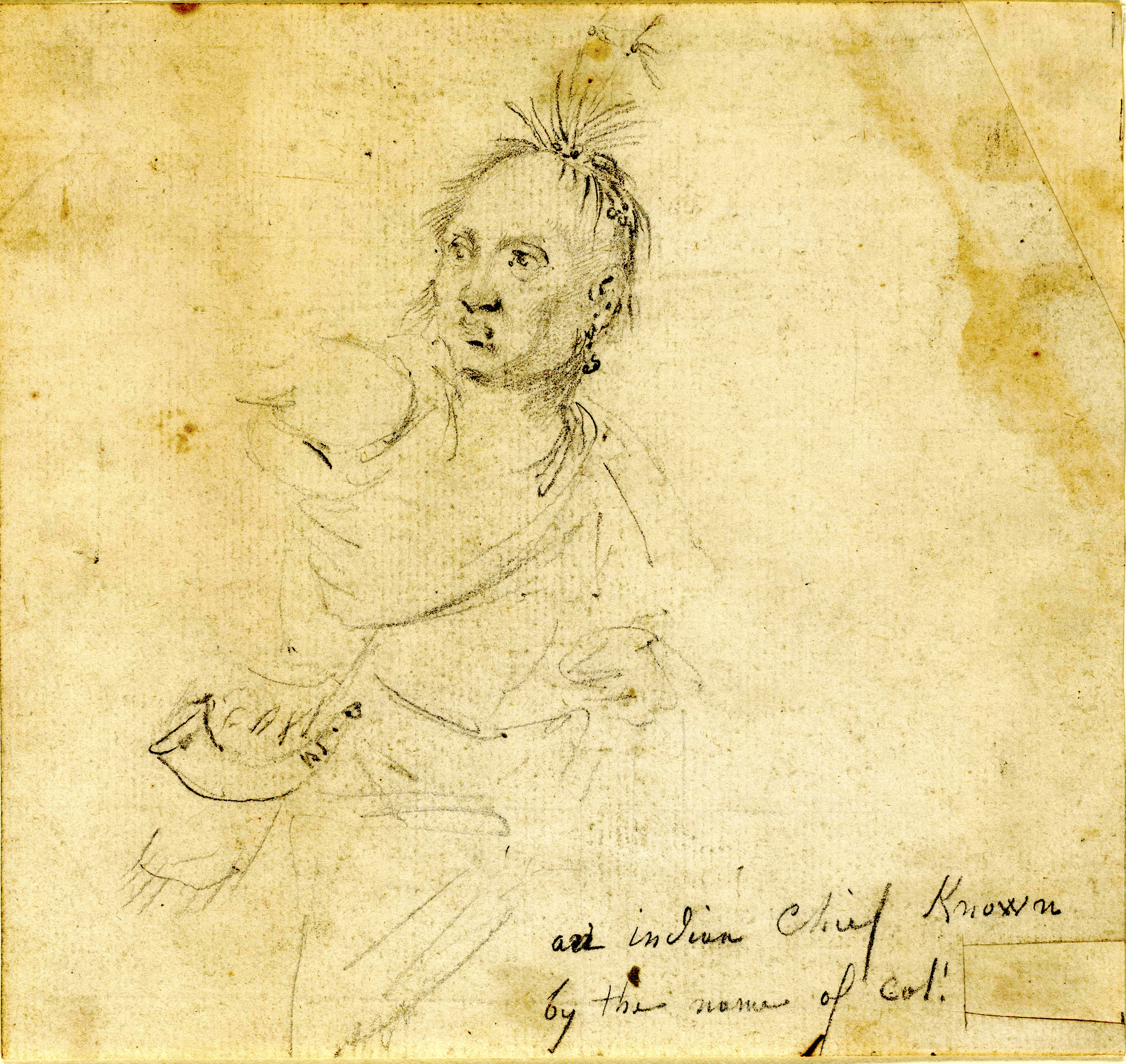
John Trumbull, betw. Wikimedia Commons. Public domain.
1748–1794
Captain John Montgomery
0
recorded events
Connected towns:
Kaskaskia, ILBiography
Captain John Montgomery (1748–1794)
Virginia Militia Officer and Frontier Courier in Clark's Illinois Campaign
Born in 1748, the man who would become one of George Rogers Clark's trusted officers grew up in a Virginia that was rapidly pushing its settlements westward across the Appalachian Mountains and into the contested interior of North America. Like so many of the men who would eventually follow Clark into the Illinois Country, John Montgomery was shaped by the rhythms and dangers of frontier life — a world where self-reliance was not a virtue but a survival requirement. The trans-Appalachian borderlands of the 1760s and 1770s were a volatile landscape where competing imperial claims, Indigenous sovereignty, and settler ambition collided constantly. Montgomery came of age in this environment, learning the skills of wilderness travel, frontier warfare, and community defense that Virginia's militia system demanded of its men. When the American Revolution erupted in 1775 and spread beyond the eastern seaboard into the western territories, Montgomery was among the frontiersmen whose experience made them natural candidates for service. He was not a gentleman officer trained in European military conventions but a practical man of the backcountry, exactly the type of soldier that an audacious campaign like Clark's would require.
Montgomery participated in one of the most improbable military operations of the entire Revolutionary War: George Rogers Clark's 1778 campaign to seize the British-allied posts of the Illinois Country. Holding a captain's commission in the Virginia militia, Montgomery was among the small force — fewer than two hundred men — that descended the Ohio River and marched overland to surprise the town of Kaskaskia on the night of July 4 to 5, 1778. The seizure was accomplished without significant bloodshed, a testament to Clark's combination of speed, secrecy, and psychological intimidation. In the days and weeks that followed, as Clark worked to win over the French Creole inhabitants and extend American authority to Cahokia and other nearby settlements, Montgomery served in the garrisons that held these captured posts. His role then shifted to one that was arguably even more critical: serving as a courier on the vast communication lines stretching from the Illinois Country back to Virginia. He carried dispatches, requests for reinforcements, and intelligence reports across hundreds of miles of wilderness, connecting Clark's isolated outposts to the government that had authorized the campaign. Without these tenuous lines of communication, the entire enterprise would have collapsed into irrelevance.
The risks Montgomery faced were not the concentrated dangers of a pitched battlefield but the slow, grinding peril of frontier service stretched across enormous distances. As a courier traveling between the Illinois posts and Virginia, he moved through territory where hostile forces, harsh weather, and simple misfortune could end a journey permanently. There were no supply depots along the way, no friendly garrisons to offer shelter between Kentucky and the Mississippi River settlements. A man carrying sensitive military dispatches through this landscape was utterly alone with his mission, responsible not only for his own survival but for the strategic lifeline that kept Clark's campaign connected to its political and logistical base. Montgomery was also fighting for something larger than personal glory: the American claim to the vast territory northwest of the Ohio River, a region whose fate would shape the future boundaries and character of the new nation. The French Creole families of Kaskaskia, the Kentucky settlers vulnerable to British-allied raids, and the broader American cause all depended on men like Montgomery performing unglamorous duties with reliability and courage. His willingness to accept these assignments reflected a type of patriotism rooted not in ideology alone but in the practical bonds of loyalty to a commanding officer and to the communities he sought to protect.
Captain John Montgomery died in 1794, leaving behind no memoir, no substantial pension record, and no monument. His later years are poorly documented, which was the common fate of frontier militia officers who returned to civilian life after the war without the political connections or Continental Army credentials that sometimes secured recognition for veterans of the Revolution. Yet Montgomery's relative obscurity should not be mistaken for insignificance. The western campaigns that secured the Illinois Country and ultimately strengthened the American negotiating position at the 1783 Treaty of Paris were made possible by men exactly like him — officers who garrisoned remote posts, carried critical messages through dangerous territory, and held together an improbable military operation through sheer endurance. Today, historians increasingly recognize that the Revolution was won not only at Yorktown and Saratoga but also in the small, scattered actions of the western frontier, where a handful of determined men extended American sovereignty across a landscape that dwarfed them. Montgomery's story reminds us that the infrastructure of revolution was human, built from individual acts of service that no one at the time thought to record in detail but without which the grand narrative would have unfolded very differently.
WHY CAPTAIN JOHN MONTGOMERY MATTERS TO KASKASKIA
Kaskaskia was the linchpin of George Rogers Clark's entire Illinois strategy, and Captain John Montgomery was one of the officers who made its capture and continued American occupation possible. Students and visitors standing in the Kaskaskia region today should understand that holding this town required more than one dramatic night of surprise — it demanded months and years of garrison duty, diplomatic engagement with French Creole residents, and relentless communication with distant Virginia authorities. Montgomery embodied all of these unglamorous necessities. His story teaches us that revolutions are sustained not only by bold commanders but by the reliable officers who carry out the daily work of maintaining control, ferrying intelligence, and keeping fragile operations alive across impossible distances. To know Montgomery is to understand what it truly cost to hold Kaskaskia for the American cause.
TIMELINE
- 1748: Born in Virginia, likely in the frontier regions of the colony's western settlements.
- 1778, early summer: Joins George Rogers Clark's expedition as a captain in the Virginia militia, descending the Ohio River toward the Illinois Country.
- 1778, July 4–5: Participates in the surprise capture of Kaskaskia, one of Clark's principal officers during the operation.
- 1778, summer–fall: Serves in the garrison at Kaskaskia and the surrounding Illinois posts as Clark consolidates American control over the region.
- 1778–1779: Acts as a courier between the Illinois Country and Virginia, carrying dispatches and reinforcement requests across hundreds of miles of frontier wilderness.
- 1779, February: Remains engaged in Illinois operations while Clark leads his famous march to recapture Vincennes from British forces under Henry Hamilton.
- 1779–1780s: Continues frontier service in various capacities; details of his later military and civilian career are not well documented.
- 1794: Dies at approximately forty-six years of age; circumstances and location of death are not clearly recorded in surviving sources.
SOURCES
- Barnhart, John D. Henry Hamilton and George Rogers Clark in the American Revolution. R. E. Banta, 1951.
- Seineke, Katherine Wagner. The George Rogers Clark Adventure in the Illinois and Selected Documents of the American Revolution at the Frontier Posts. Polyanthos, 1981.
- James, James Alton. The Life of George Rogers Clark. University of Chicago Press, 1928.
- Illinois State Archives. George Rogers Clark Collection: Virginia Military Records. https://www.ilsos.gov/departments/archives/
- Bodley, Temple. George Rogers Clark: His Life and Public Services. Houghton Mifflin, 1926.