

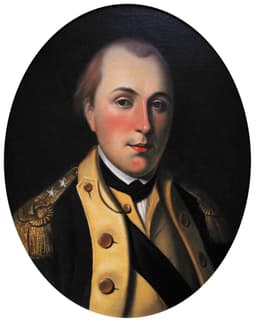
Charles Willson Peale, betw. Wikimedia Commons. Public domain.
1757–1834
Marquis de Lafayette
1
recorded events
Connected towns:
Wilmington, DEBiography
Marquis de Lafayette: The French Nobleman Who Bled for American Liberty
Born on September 6, 1757, in the Château de Chavaniac in the Auvergne region of south-central France, Marie-Joseph Paul Yves Roch Gilbert du Motier inherited one of the most illustrious names in the French aristocracy. His family's martial tradition ran deep — his father had been killed by a British cannonball at the Battle of Minden in 1759, when the boy was barely two years old. His mother and grandfather both died when he was thirteen, leaving him an orphan of staggering wealth and social position but without the parental guidance that might have channeled his restless ambitions along conventional paths. Instead, the young Marquis de Lafayette absorbed the Enlightenment philosophy that animated the French intellectual world, reading deeply about natural rights, liberty, and the social contract. He married at sixteen into the powerful Noailles family, which connected him to the highest circles of the French court. Yet privilege did not satisfy him. He trained as a military officer in the French army, earning a commission in the king's dragoons, but he craved something more than the ceremonial life of Versailles. He wanted a cause worthy of his ideals and his family's legacy of battlefield sacrifice.
The eruption of the American Revolution in 1775 provided exactly the spark Lafayette's restless spirit needed. News of the colonial rebellion against Britain electrified reform-minded aristocrats across France, but no one responded with the reckless determination of the nineteen-year-old marquis. Despite official French neutrality and the active opposition of King Louis XVI's court, Lafayette resolved to cross the Atlantic and join the fight. When the French government attempted to block his departure, he purchased his own ship — the Victoire — and defied the royal prohibition outright, sailing from the Spanish port of Los Pasajes in April 1777. It was an act of breathtaking audacity for a young nobleman with a pregnant wife and powerful in-laws who opposed his plan. He arrived in South Carolina after a grueling voyage and made his way to Philadelphia, where he presented himself to the Continental Congress. Unlike many European officers who arrived demanding high rank and generous pay, Lafayette asked only for the opportunity to serve, offering his services without compensation. Congress, impressed by his lineage and his willingness to volunteer, commissioned him a major general in July 1777 — initially an honorary distinction, though Lafayette would soon insist on earning it in blood.
The Battle of Brandywine on September 11, 1777, tested Lafayette's commitment in the most visceral way possible. It was his very first engagement, and it proved catastrophic for the Continental Army. British General William Howe executed a brilliant flanking maneuver that sent roughly seventeen thousand troops in a wide arc around the American right wing, crashing into the divisions of Generals Sullivan and Stirling near Birmingham Meeting House. The American right collapsed under the weight of the assault, and soldiers began streaming rearward in confusion and panic. Lafayette, attached to Sullivan's division, threw himself into the chaos. Rather than retreating to safety — the sensible course for a foreign volunteer with no obligation to die on American soil — he rode directly among the broken units, shouting orders, attempting to rally the men, and trying to organize some coherent line of resistance. In the midst of this desperate effort, a British musket ball tore through his left calf. He continued directing troops until blood loss forced him from the field. His conduct under fire transformed him overnight from a curiosity of foreign aristocracy into a proven soldier.
Lafayette's wound was serious enough that surgeons initially feared he might lose the leg. He was evacuated first to a field hospital and then transported to Bethlehem, Pennsylvania, where skilled Moravian physicians undertook his care in the weeks that followed. During his convalescence, he also spent time in the Wilmington, Delaware, area, where the retreating Continental Army had passed through after abandoning Philadelphia to British occupation. His recovery was neither swift nor painless, but Lafayette's determination to return to duty amazed those around him. By December 1777, still limping, he rejoined the army at Valley Forge, where he shared the infamous winter encampment with Washington's suffering troops. He went on to fight at the Battle of Monmouth in June 1778, where his command of the advance guard helped stabilize a confused tactical situation. His willingness to endure the same hardships as common soldiers — the cold, the hunger, the uncertainty — deepened the respect he commanded throughout the army and reinforced the authenticity of his commitment to the American cause.
The relationship between Lafayette and George Washington became one of the most celebrated bonds of the Revolutionary era, and it shaped the trajectory of Lafayette's entire American career. Washington, who had lost his own biological children in infancy and stepchildren to illness, treated the young Frenchman with an almost paternal warmth that went far beyond military courtesy. Lafayette, orphaned young and hungry for a father figure, reciprocated with fierce devotion and loyalty. This bond was not merely sentimental — it carried enormous strategic weight. Lafayette served as an informal ambassador between the American military command and the French court, and his letters home painted vivid pictures of American valor and determination that influenced both public opinion and political calculation in Paris. His presence in the Continental Army helped legitimize the American cause in European eyes, making it easier for French ministers to justify the military and financial commitment that would prove decisive. The formal Franco-American alliance, signed in February 1778, owed much to the diplomatic groundwork Lafayette helped prepare through his personal connections.
Lafayette's Revolutionary career was not without setbacks and moral complexity. His eagerness for command sometimes outpaced his tactical experience, and the abortive invasion of Canada that Congress proposed in early 1778 — with Lafayette as its designated leader — collapsed before it began due to inadequate resources and poor planning. Lafayette arrived at Albany to find a skeleton force incapable of the ambitious operation he had been promised, and he was forced to withdraw without ever crossing into British-held territory. The episode embarrassed him and exposed the tension between his political enthusiasm and military reality. Furthermore, Lafayette occupied an inherently contradictory position: a French aristocrat fighting for republican ideals, a man of enormous inherited wealth championing the rights of common citizens. He navigated these contradictions with remarkable grace, but they were real, and they would haunt him during the far more radical upheavals of the French Revolution, when his moderate constitutionalism pleased neither the monarchists nor the Jacobins. His American experience taught him the possibilities of revolutionary change, but not all of its dangers.
The war transformed Lafayette from a privileged young nobleman seeking glory into a mature political figure with a lifelong commitment to constitutional liberty. When he had sailed from France in 1777, he was driven partly by idealism and partly by the aristocratic pursuit of honor and military reputation. By the time he returned to France after Yorktown, he carried a fundamentally different understanding of what government could be. He had witnessed ordinary citizens take up arms to defend their rights, endured the brutal winter at Valley Forge alongside men who had nothing but their conviction, and watched a new nation struggle into existence through sheer collective willpower. These experiences rooted his political philosophy in something deeper than salon conversation. He became convinced that sovereignty belonged to the people, that written constitutions were essential safeguards against tyranny, and that the American experiment could inspire similar transformations across the Atlantic. The scars he carried — both the physical wound in his leg and the emotional memory of shared sacrifice — anchored his idealism in lived experience rather than abstract theory.
Lafayette's role in the war's final act was as important as his sacrifice at Brandywine. In 1781, Washington assigned him command of the Continental forces in Virginia, tasking him with the delicate mission of containing the British army under Lord Cornwallis. With a force far smaller than his opponent's, Lafayette conducted a brilliant campaign of strategic retreat and maneuver, refusing to be drawn into a decisive engagement he could not win while keeping Cornwallis pinned in the Virginia tidewater. His patience and discipline helped channel Cornwallis toward the Yorktown peninsula, where the convergence of Washington's army from the north and the French fleet under Admiral de Grasse from the Caribbean created the trap that ended the war. The siege of Yorktown in October 1781, with Lafayette commanding one of the assault columns that stormed the British redoubts, represented the culmination of everything he had worked toward since stepping off his ship in South Carolina four years earlier. The victory belonged to many, but Lafayette's Virginia campaign was indispensable to its achievement.
Contemporaries on both sides of the Atlantic recognized Lafayette as something extraordinary — a figure who embodied the transatlantic dimension of the American Revolution in his very person. Americans revered him as the foreign nobleman who had risked everything for their liberty, and his name was given to towns, counties, and streets across the new nation. The French regarded him with more complicated feelings: he was celebrated as a hero of two worlds but also suspected by radicals and reactionaries alike during France's own revolutionary turmoil. His 1824 to 1825 farewell tour of the United States, undertaken at the invitation of President James Monroe, became a national celebration of astonishing proportions. Enormous crowds greeted him in every city and town he visited, and Congress awarded him a grant of two hundred thousand dollars and a large tract of land in recognition of his service. He was the last surviving general officer of the Continental Army, a living link to the founding generation, and Americans treated him with a reverence usually reserved for the founders themselves.
Students and visitors today should know Lafayette because his story challenges comfortable assumptions about who fights for freedom and why. He was not oppressed, not taxed without representation, not denied his rights — he was one of the wealthiest and most privileged young men in Europe, and he chose to risk his life for principles that would ultimately threaten the very aristocratic order that had produced him. His wound at Brandywine, suffered in his very first battle while rallying soldiers who were not his countrymen, stands as one of the most vivid demonstrations of personal commitment in the entire Revolution. His story also illuminates the international dimension of American independence — the reality that the Revolution succeeded not as an isolated national uprising but as part of a broader Atlantic world of political ideas and strategic alliances. Lafayette reminds us that liberty is not the property of any single nation, and that the willingness to sacrifice for another people's freedom represents one of the highest expressions of the Enlightenment ideals that shaped the founding of the United States.
WHY MARQUIS DE LAFAYETTE MATTERS TO WILMINGTON
When Lafayette was carried from the battlefield at Brandywine with a musket ball wound in his left leg, the Wilmington area became part of his recovery and part of his story. That a nineteen-year-old French nobleman shed his blood in his very first battle — not retreating to safety but riding among broken American units trying to rally them — speaks to a kind of commitment that transcends nationality. Students and visitors in Wilmington walk ground that witnessed the aftermath of one of the war's most consequential defeats, a defeat that opened Philadelphia to British occupation. Lafayette's willingness to suffer alongside Americans in that dark hour helped convince France that the American cause was worth supporting, a decision that ultimately won the war. His story connects Wilmington to the broader transatlantic struggle for liberty.
TIMELINE
- 1757: Born September 6 at the Château de Chavaniac in Auvergne, France, into a distinguished noble family
- 1770: Orphaned at age thirteen following the deaths of his mother and grandfather; inherits vast fortune
- 1774: Commissioned as an officer in the French army; marries Adrienne de Noailles
- 1777: Defies royal prohibition and sails to America aboard the Victoire; commissioned major general by Congress in July
- 1777: Wounded in the leg at the Battle of Brandywine on September 11; treated in Bethlehem, Pennsylvania, and the Wilmington, Delaware, area
- 1777–1778: Shares the winter encampment at Valley Forge with Washington's army
- 1778: Leads advance guard at the Battle of Monmouth on June 28; Franco-American alliance formally signed in February
- 1781: Commands Continental forces in Virginia; participates in the siege of Yorktown in October
- 1824–1825: Returns to the United States for a triumphant farewell tour at the invitation of President Monroe
- 1834: Dies in Paris on May 20, mourned on both sides of the Atlantic as the last surviving Revolutionary War general
SOURCES
- Unger, Harlow Giles. Lafayette. John Wiley & Sons, 2002.
- Gaines, James R. For Liberty and Glory: Washington, Lafayette, and Their Revolutions. W.W. Norton & Company, 2007.
- Clary, David A. Adopted Son: Washington, Lafayette, and the Friendship That Saved the Revolution. Bantam Books, 2007.
- National Park Service. "Marquis de Lafayette." Brandywine Battlefield Park Historical Resources. https://www.nps.gov/subjects/americanrevolution/lafayette.htm
- Lafayette, Marquis de. Memoirs, Correspondence, and Manuscripts of General Lafayette. Saunders and Otley, 1837.
Events
Sep
1777
Lafayette Wounded at BrandywineWilmingtonFrench Volunteer Officer# Lafayette Wounded at Brandywine On September 11, 1777, along the banks of Brandywine Creek in southeastern Pennsylvania, one of the most consequential battles of the American Revolution unfolded, and with it, a moment that would help define the war's most celebrated foreign alliance. The Battle of Brandywine was a major engagement in which the British army, commanded by General Sir William Howe, sought to outmaneuver General George Washington's Continental Army and open the road to Philadelphia, the young nation's capital and the seat of the Continental Congress. Among the thousands of American soldiers who took the field that day was a nineteen-year-old French aristocrat named Marie-Joseph Paul Yves Roch Gilbert du Motier, better known to history as the Marquis de Lafayette, who had crossed the Atlantic at his own expense to volunteer his services to the American cause of liberty. Lafayette had arrived in America only months earlier, driven by youthful idealism, a thirst for military glory, and a genuine sympathy for the principles of republican self-governance. The Continental Congress, initially skeptical of yet another foreign officer seeking a commission, was nevertheless impressed enough by his willingness to serve without pay that they granted him the honorary rank of major general in July 1777. Washington, who met Lafayette shortly thereafter, took an almost immediate liking to the earnest young Frenchman, though he had not yet had the opportunity to observe him under fire. Brandywine would provide that test. The battle itself was a disaster for the American side. Howe executed a flanking maneuver reminiscent of his tactics at the Battle of Long Island the previous year, sending a large column under General Charles Cornwallis on a wide march to the north to cross the Brandywine at an unguarded ford and strike the American right wing. Washington, receiving conflicting intelligence reports throughout the day, was slow to recognize the threat. When Cornwallis's forces finally crashed into the American right, held by troops under General John Sullivan, the effect was devastating. Sullivan's division buckled under the assault, and soldiers began to retreat in growing disorder. It was in this moment of crisis that Lafayette distinguished himself. Riding into the chaos of the collapsing right wing, the young Frenchman attempted to rally the retreating troops, exposing himself to enemy fire with a disregard for personal safety that bordered on recklessness. During these efforts, a musket ball struck him in the left calf, and he bled considerably before the wound was even noticed. According to accounts that have become part of Revolutionary War lore, Lafayette was so absorbed in trying to restore order among the fleeing soldiers that he did not immediately realize the severity of his injury. Only when his boot filled with blood and his aides urged him to withdraw did he consent to leave the field. Lafayette was transported to a field hospital in the Wilmington, Delaware, area, where surgeons treated his wound. Washington himself reportedly instructed the physicians to care for Lafayette as though he were his own son, a sentiment that reflected the deep personal bond already forming between the two men. The injury, while painful and requiring weeks of recovery, was not life-threatening, and Lafayette would return to active duty before the end of the year. The significance of Lafayette's conduct at Brandywine extended far beyond the battlefield. His willingness to shed blood for the American cause at such a young age won him the admiration of Continental soldiers and officers alike and proved that his commission was no mere ceremonial gesture. More importantly, it cemented his relationship with Washington in a bond of mutual affection and respect that would endure for over two decades, until Washington's death in 1799. Their friendship became one of the most storied partnerships of the Revolution, and it bore strategic fruit as well, for Lafayette's continued advocacy in France helped secure the formal French alliance that would ultimately prove decisive in winning American independence. What began with a wound on a chaotic September afternoon near Brandywine Creek would ripple outward to shape the fate of nations.