

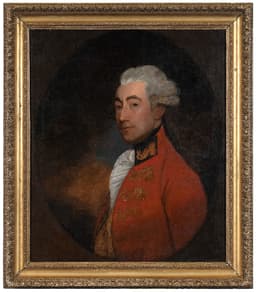
Gilbert Stuart, circ. Wikimedia Commons. Public domain.
1754–1826
Lord Francis Rawdon
3
recorded events
Connected towns:
Ninety Six, SCBiography
Lord Francis Rawdon (1754–1826)
British Commander in South Carolina
Born in 1754 into the privileged ranks of the Anglo-Irish aristocracy, Francis Rawdon entered the world with every advantage that birth and station could provide in eighteenth-century Ireland. His family, seated among the Protestant gentry who dominated Irish political and social life, ensured that young Francis received a rigorous classical education befitting his rank. That education cultivated intellectual discipline and a facility for strategic thinking that would serve him well on battlefields far from the drawing rooms of Dublin. Commissioned into the British army as a young man, Rawdon followed a path that was conventional for sons of his class — military service was both an expectation and a vehicle for advancement. Yet nothing in his genteel upbringing could have fully prepared him for what he would encounter across the Atlantic. The American colonies were descending into open rebellion, and the British Crown needed officers willing to cross an ocean to suppress it. Rawdon was among those who answered that call, carrying with him the confidence of a young aristocrat who had been taught that British arms were irresistible and that colonial resistance would crumble before professional soldiers in disciplined ranks.
Rawdon's introduction to the realities of the American war came with shocking violence at Bunker Hill on June 17, 1775, one of the earliest and bloodiest engagements of the Revolution. The battle shattered any illusions he may have harbored about the nature of the conflict. Colonial defenders, entrenched on the heights above Charlestown, Massachusetts, poured devastating fire into advancing British regulars and inflicted staggering casualties before finally being driven from their positions. For a young officer expecting irregulars to scatter at the sight of bayonets, the ferocity of American resistance was a revelation. Bunker Hill taught Rawdon a lesson that many British commanders were slower to absorb: that this war would not be won easily, and that the Americans were willing to fight with a tenacity that demanded respect. The experience hardened him and shaped his approach to command. Rather than dismissing his opponents, Rawdon developed a pragmatic understanding of their capabilities. He emerged from the battle's carnage as an officer marked for rapid advancement, one who combined personal courage with an increasingly sophisticated grasp of how this unconventional war would need to be fought across a vast and hostile continent.
Over the years that followed, Rawdon proved himself one of the more energetic and capable British officers serving in North America, rising steadily through the ranks as the war shifted southward after 1778. By 1781, with Lord Cornwallis marching the main British army into Virginia in pursuit of a decisive campaign, Rawdon was left in command of British forces based at Charleston, South Carolina — a position that placed enormous responsibility on his shoulders. The southern interior was disintegrating for the British. A network of fortified posts, many garrisoned by Loyalist militia, was under relentless pressure from Nathanael Greene's Continental army and a formidable array of partisan leaders who struck at supply lines and isolated garrisons with devastating effectiveness. Rawdon faced an impossible calculus: too many posts to defend, too few troops to reinforce them all, and supply lines that stretched across hundreds of miles of territory increasingly controlled by hostile forces. His most consequential decision — the one that would define his role in the southern campaign — was his determination to march from Charleston with a relief column to save the besieged garrison at Ninety Six, a Loyalist stronghold deep in the South Carolina backcountry that Greene had placed under siege.
The relief of Ninety Six in June 1781 stands as the defining episode of Rawdon's American war. Greene had invested the fortified post, anchored by the formidable Star Fort, and was pressing his siege with increasing urgency as weeks passed. On June 18, 1781, Greene launched a final desperate assault on the Star Fort, hoping to take the position before Rawdon's relief column could arrive. The attack was beaten back with heavy casualties on both sides, and within days Rawdon's force — which had covered the distance from Charleston with remarkable speed — appeared on the horizon. Greene, recognizing that he could not simultaneously continue the siege and face a fresh relief force, withdrew his army. It was a genuine tactical triumph for Rawdon. Yet what followed revealed the depth of his strategic judgment. Rather than celebrating his success and reinforcing the garrison, Rawdon surveyed the situation and ordered Ninety Six evacuated. The post was simply too isolated, its supply lines too vulnerable, its position too exposed to the relentless partisan warfare that characterized the South Carolina backcountry. He withdrew the garrison toward Charleston, effectively conceding the interior.
Rawdon's decisions at Ninety Six cannot be understood in isolation from the broader web of relationships and rivalries that shaped the British southern campaign. His superior, Lord Cornwallis, had departed for Virginia, leaving Rawdon to manage a deteriorating situation with inadequate resources. On the American side, Nathanael Greene — arguably the most strategically gifted general of the Revolution — was orchestrating a campaign designed precisely to force the kind of impossible choices Rawdon faced. Greene understood that he did not need to win battles outright; he needed only to make British posts untenable. Meanwhile, partisan commanders Francis Marion, Thomas Sumter, and Andrew Pickens operated as a constellation of threats across the lowcountry and backcountry, severing communications, ambushing supply convoys, and ensuring that no British garrison could feel secure. Rawdon's decision to abandon Ninety Six was, in part, an acknowledgment that these partisan forces had fundamentally altered the strategic landscape. No relief column, however swift, could permanently secure a post whose supply lines ran through territory controlled by Marion's raiders or Pickens's frontier fighters. Rawdon's clear-eyed realism stood in contrast to the optimism that often characterized British planning in the southern theater.
Rawdon departed South Carolina later in 1781, his health broken by the punishing conditions of campaigning in the southern interior, and he took no further part in the American war. His subsequent career, however, was far from over. He went on to serve as governor-general of India from 1813 to 1823, earning a reputation as one of the more capable British imperial administrators of his era and eventually receiving the title Marquis of Hastings. He died in 1826. Yet it is his brief, intense tenure commanding British forces in South Carolina that holds the greatest significance for understanding the American Revolution. Rawdon's story illuminates the central paradox of the British war effort in the South: talented commanders could win tactical victories, relieve besieged garrisons, and outmaneuver their opponents on the battlefield, yet none of it mattered if the larger strategic situation was irretrievable. The British could not hold an interior populated by people who largely refused to submit, supplied by lines that could be cut at will, and contested by an enemy who understood that patience and persistence mattered more than any single engagement. Rawdon saw this truth clearly, perhaps more clearly than most of his peers, and acted on it — even when acting on it meant admitting defeat.
WHY LORD FRANCIS RAWDON MATTERS TO NINETY SIX
Lord Rawdon's story is essential for anyone visiting Ninety Six because it reveals the painful arithmetic of the British southern strategy in its most vivid form. He marched over two hundred miles from Charleston to save the garrison, arrived in time to force Greene's withdrawal after the bloody final assault on the Star Fort, and then — in a decision that speaks volumes about the reality of the war — ordered the very post he had just rescued to be abandoned. For students and visitors standing at Ninety Six today, Rawdon's choice makes the site's meaning unmistakable: this was a place the British could reach but could not hold. His story teaches us that winning a battle and winning a war are very different things, and that the Revolution was decided not only by dramatic assaults but by the slow, grinding logic of supply lines, partisan warfare, and a population's refusal to be pacified.
TIMELINE
- 1754: Born in Ireland into the Anglo-Irish aristocracy
- 1775: Fights at the Battle of Bunker Hill on June 17, experiencing his first major combat in the American war
- 1778–1780: Serves in the southern theater as the British shift their strategic focus to the Carolinas and Georgia
- 1781: Commands British forces in South Carolina from Charleston after Cornwallis moves the main army into Virginia
- June 1781: Marches a relief column from Charleston to Ninety Six with notable speed
- June 18, 1781: His approaching relief force contributes to the urgency of Greene's final assault on the Star Fort
- June 1781: Arrives at Ninety Six, forcing Greene to withdraw, then orders the post evacuated and the garrison pulled back toward Charleston
- Late 1781: Departs South Carolina for Britain in poor health, ending his active role in the American war
- 1813–1823: Serves as governor-general of India, earning distinction as a British imperial administrator
- 1826: Dies, having been created Marquis of Hastings in recognition of his service
SOURCES
- Buchanan, John. The Road to Guilford Courthouse: The American Revolution in the Carolinas. John Wiley & Sons, 1997.
- Pancake, John S. This Destructive War: The British Campaign in the Carolinas, 1780–1782. University of Alabama Press, 1985.
- Wickwire, Franklin and Mary. Cornwallis: The American Adventure. Houghton Mifflin, 1970.
- Lumpkin, Henry. From Savannah to Yorktown: The American Revolution in the South. University of South Carolina Press, 1981.
Events
Jun
1781
Final American Assault on Star FortNinety SixBritish General# The Final Assault on Star Fort at Ninety Six By the spring of 1781, the American war for independence in the Southern states had become a grueling contest of attrition, strategy, and will. Major General Nathanael Greene, the Continental Army commander in the South, had undertaken a bold campaign to reclaim British-held outposts scattered across South Carolina. Though Greene had lost several pitched battles, his strategic brilliance lay in wearing down the British by forcing them to defend far-flung positions they could scarcely afford to garrison. One of the most important of these positions was the fortified Loyalist stronghold at Ninety Six, a remote settlement in the South Carolina backcountry that had served as a center of British and Loyalist influence for years. Commanding the garrison there was Lieutenant Colonel John Harris Cruger, a capable and determined New York Loyalist officer who led a force composed primarily of Provincial troops fiercely loyal to the Crown. Greene arrived at Ninety Six in late May 1781 and laid siege to the fortification, hoping to starve or batter the garrison into submission before British reinforcements could arrive. The centerpiece of Cruger's defenses was the Star Fort, an earthen fortification whose pointed, star-shaped walls were designed to eliminate blind spots and allow defenders to pour crossfire on any attackers. Greene's engineers, led by the Polish volunteer Colonel Thaddeus Kosciuszko, directed the construction of approach trenches and a siege tower, slowly tightening the noose around the garrison. Cruger, however, proved a resourceful adversary. He ordered his men to raise the walls of the Star Fort with sandbags, conducted daring nighttime sorties to disrupt American siege works, and kept the morale of his defenders remarkably high despite dwindling supplies and the constant pressure of Greene's lines drawing ever closer. As the siege dragged into June, Greene received alarming intelligence that Lord Francis Rawdon, the aggressive young British general commanding Crown forces in the South Carolina interior, had assembled a relief column and was marching rapidly toward Ninety Six. Rawdon's force, bolstered by fresh reinforcements recently arrived from the British Isles, threatened to trap Greene between the garrison and a formidable field army. With time running out and the relief column only days away, Greene made the difficult decision to launch a direct assault on the Star Fort on June 18, 1781, gambling that a bold stroke could capture the position before Rawdon arrived. The attack was entrusted to two columns of handpicked soldiers, led by Lieutenants Samuel Duval and Isaac Hatton. These men advanced under heavy fire toward the steep earthen walls of the Star Fort, carrying long poles fitted with iron hooks designed to pull down the sandbag parapets that Cruger's men had built. The fighting that erupted was among the most savage of the entire siege. As the Americans reached the ditch surrounding the fort, Cruger's Loyalists met them with bayonets, musket fire, and sheer ferocity. Hand-to-hand combat raged in the narrow confines of the ditch and along the parapet. A few American soldiers managed to breach the walls and momentarily enter the fort itself, but they were overwhelmed and driven back. Lieutenant Hatton was among those killed in the desperate struggle, and casualties on the American side were significant. The assault had failed, and Greene was forced to accept the bitter reality. When Rawdon's relief column drew near only days later, Greene lifted the siege and withdrew his army, having spent nearly a month in the effort. Though the outcome was a tactical defeat for the Americans, the siege of Ninety Six fit into Greene's larger strategy of exhausting British resources and forcing them to consolidate their positions. Rawdon, recognizing that Ninety Six was too isolated to defend indefinitely, ultimately evacuated the post and pulled his forces back toward the coast. In this sense, Greene's campaign achieved its broader objective even in defeat. The struggle at the Star Fort stands as a testament to the tenacity of both sides and to the often-overlooked ferocity of the Revolutionary War in the Southern backcountry, where neighbor fought neighbor and the line between victory and defeat was measured in blood and perseverance.
Jun
1781
Rawdon Relieves Ninety SixNinety SixBritish General# Rawdon Relieves Ninety Six By the spring of 1781, the American Revolution in the Southern states had entered a desperate and fluid phase. Major General Nathanael Greene, appointed by George Washington to command the Continental Army's Southern Department, had embarked on a bold campaign to reclaim the interior of South Carolina from British control. Although Greene had suffered a tactical defeat at the Battle of Guilford Courthouse in North Carolina in March of that year, his strategy was far more ambitious than any single engagement. He intended to stretch British supply lines and isolate their network of outposts scattered across the South Carolina backcountry. One by one, forts and stockades began to fall or come under pressure from Continental forces and their militia allies. By late May, Greene turned his attention to one of the most important British positions still standing: the fortified village of Ninety Six, located in the western reaches of South Carolina. Ninety Six was no ordinary outpost. It served as the most significant British interior stronghold in the colony, a vital link in the chain of control that connected Charleston to the backcountry. The garrison there was composed largely of Loyalist militia, men deeply committed to the Crown's cause and determined to hold their ground. Greene arrived before the fortifications in late May 1781 and commenced a formal siege, employing engineering approaches that included the digging of trenches and parallels designed to bring his forces close enough to breach the defenses. His army, though battle-hardened, was undersupplied and lacked heavy artillery, which made the prospect of a prolonged siege both necessary and precarious. The defenders, for their part, resisted tenaciously, launching sorties to disrupt the American siege works and refusing to capitulate despite mounting pressure. Day after day, the siege ground forward in the Carolina heat, with neither side able to force a decisive conclusion. Meanwhile, Lord Francis Rawdon, the young and aggressive British commander who had assumed a leading role in defending South Carolina's interior following Lord Cornwallis's march into Virginia, recognized the danger facing Ninety Six. Rawdon had already demonstrated his tactical ability at the Battle of Hobkirk's Hill in April, where he repulsed Greene's attack near Camden. Now, despite exhaustion and illness among his own troops, Rawdon gathered reinforcements freshly arrived from Charleston, including several regiments of regular soldiers, and set out on a grueling march westward to relieve the besieged garrison. Greene, aware that Rawdon was approaching but uncertain of the exact timing, launched a desperate assault on the fortifications on June 18, 1781, hoping to take Ninety Six before relief could arrive. The attack was fiercely contested and ultimately repulsed, with significant casualties on both sides. When Lord Rawdon and his column of fresh troops reached Ninety Six on June 21, Greene had no choice but to lift the siege and withdraw. The garrison had held out for twenty-eight grueling days. Greene pulled his weary and diminished army northward into the hills of South Carolina, seeking rest, provisions, and an opportunity to regroup. The relief of Ninety Six represented a genuine British success, yet it was a success tinged with strategic futility. Although Rawdon had saved the garrison, the British soon concluded that Ninety Six was too isolated and too costly to maintain. Within weeks, they abandoned the post and consolidated their forces closer to Charleston, effectively ceding the very territory they had fought so hard to defend. Greene's campaign, despite this setback and others, was achieving its larger purpose. By keeping the British reacting to threats across a vast landscape, he was slowly but systematically dismantling their hold on the Southern interior. The siege of Ninety Six and Rawdon's relief march illustrated a recurring pattern of the war in the South: the British could win battles and relieve garrisons, but they could not hold the countryside. Greene's willingness to endure short-term defeats in pursuit of long-term strategic gains would prove instrumental in liberating the Carolinas and setting the stage for the war's conclusion at Yorktown later that same year.
Jul
1781
British Abandon Ninety SixNinety SixBritish General# The British Abandon Ninety Six In the summer of 1781, the small frontier outpost of Ninety Six in the South Carolina backcountry became the stage for one of the most consequential strategic retreats of the Revolutionary War's Southern Campaign. For years, Ninety Six had served as a critical British stronghold in the interior of South Carolina, a fortified position that anchored royal authority across a vast stretch of disputed territory. Its abandonment marked a turning point in the struggle for control of the Southern colonies and signaled the accelerating collapse of British power beyond the coastal cities. To understand why the British gave up Ninety Six, one must look at the broader military situation unfolding across the Carolinas in 1781. After the British had captured Charleston in 1780 and scored a devastating victory at Camden, it seemed as though the Southern colonies might be firmly secured for the Crown. But the tide began to shift. American forces under General Nathanael Greene, appointed by George Washington to command the Southern Department, launched a brilliant campaign of strategic maneuvering designed not necessarily to win pitched battles but to stretch British supply lines and force them to abandon their inland posts one by one. Greene fought engagements at Guilford Courthouse in North Carolina and Hobkirk's Hill near Camden, South Carolina. Though he technically lost both battles on the field, the cumulative toll on British resources was severe. The British found themselves winning fights but losing the war for the interior. It was within this context that Greene turned his attention to Ninety Six in the late spring of 1781, laying siege to the fortified post in May and June. The garrison, defended by a determined Loyalist force, held out stubbornly for nearly a month. Greene's assault on the Star Fort, an impressive earthen fortification at the site, was repulsed in fierce fighting. When Lord Francis Rawdon, the young and capable British general who commanded forces in South Carolina following Lord Cornwallis's march northward into Virginia, arrived with reinforcements after a grueling march from the lowcountry, Greene was compelled to lift the siege and withdraw. The defense of Ninety Six appeared, on the surface, to be a British success. Yet Rawdon understood that appearances were deceiving. His relief column had been assembled only with great difficulty, and the effort of marching troops through hostile territory in the brutal summer heat had left his forces weakened and overextended. The surrounding countryside was increasingly dominated by Patriot militias and sympathizers, making supply lines dangerously vulnerable. Holding Ninety Six would require a commitment of men and resources that the British simply could no longer afford in a theater where their strategic position was deteriorating by the week. Approximately six weeks after the siege was lifted, Rawdon made the painful but pragmatic decision to order the evacuation of the post entirely. The consequences of this decision rippled through the lives of hundreds of Loyalist families who had sheltered under the fort's protection. These civilians, many of whom had staked everything on British victory, were forced to abandon their homes, their farms, and their livelihoods to follow the retreating British column on the long march toward Charleston. For them, the evacuation was not merely a military maneuver but a devastating personal upheaval, a forced exile from the only home many had known. Their plight illustrates the deeply personal and often tragic dimensions of the Revolutionary War, which was as much a civil conflict among neighbors as it was a war between nations. Once the British departed, Patriot forces moved in to reoccupy the town and the surrounding area. The British never returned to Ninety Six. The abandonment of this post, combined with the earlier evacuations of Camden and other interior positions, effectively confined British military power in South Carolina to Charleston and its immediate environs. Greene's strategy of exhausting the British across the Southern interior had succeeded. Within months, Lord Cornwallis would surrender at Yorktown, Virginia, and the broader war would move inexorably toward its conclusion. The quiet withdrawal from Ninety Six, though lacking the drama of a great battle, proved to be one of the moments that sealed the fate of British ambitions in America.