

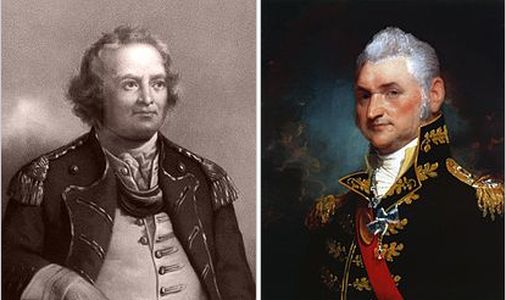
Gilbert Stewart, 2016. Wikimedia Commons. Public domain.
1766–1831
Israel Putnam
4
recorded events
Connected towns:
Marietta, OHBiography
Israel Putnam the Younger: A Revolutionary Name on the Ohio Frontier
Born in 1766, the younger Israel Putnam entered the world already carrying the weight of a name that would soon become legendary across the American colonies. He was the nephew of Israel "Old Put" Putnam, the Connecticut farmer-turned-warrior whose exploits against the French and Indians had already made him a figure of local renown before the Revolution even began. Growing up in New England during the tumultuous years of colonial resistance, the younger Israel was shaped by a household and a community where duty to the common cause was not an abstraction but a lived expectation. The Putnam family of Connecticut embodied the Yankee virtues of self-reliance, physical courage, and civic obligation that would fuel the rebellion against British authority. Though still a child when the Revolution began, Israel absorbed its lessons through the stories that surrounded him, through the comings and goings of soldiers, through the anxiety and pride that filled New England homes during those uncertain years. His uncle's fame at Bunker Hill and elsewhere cast a particular glow over the family, creating an inheritance that was not measured in money or land but in reputation and expectation. The boy who bore the general's name understood early that he would be called upon to honor it.
The Revolutionary Cause and a Family Legacy
The Revolution was not something the younger Israel Putnam chose in the way that his uncle had chosen it; rather, it was the atmosphere he breathed from his earliest years. By the time the war's great battles were being fought, he was still too young to shoulder a musket in the Continental line, but the conflict defined his world completely. His uncle, General Israel Putnam, was among the most prominent American commanders in the war's early years, famous for his supposed command at Bunker Hill to hold fire until seeing the whites of the enemy's eyes, and celebrated for a fearlessness that bordered on recklessness. The younger Israel watched from the home front as his uncle's reputation grew and as the war extracted its terrible costs from New England families. The Revolution's ideals of republican self-governance, resistance to tyranny, and the obligation of citizens to defend their own liberty became the foundational principles of his education. When the war ended in 1783, Israel was seventeen years old, a young man formed entirely by the revolutionary generation's values but denied by his youth the chance to prove himself on its battlefields. That denial would shape his subsequent choices profoundly, driving him toward the frontier, where a new kind of proving ground awaited men who had inherited the Revolution's commitments without having yet earned their own scars.
Joining the Ohio Company and the March Westward
The most significant action of Israel Putnam's life was not a single battle but a decisive migration. When the Ohio Company of Associates organized its ambitious plan to settle the Northwest Territory in the late 1780s, the younger Putnam recognized the venture as the continuation of the Revolutionary cause by other means. The Ohio Company was overwhelmingly composed of former Continental Army officers and soldiers, men who had been promised western lands in exchange for their service and who now intended to collect on that promise by building a new society in the wilderness. Putnam joined this movement, departing the familiar landscapes of New England for the unknown country beyond the Appalachian Mountains. His arrival at the confluence of the Muskingum and Ohio Rivers in 1788, alongside the original party of Ohio Company settlers, marked the beginning of Marietta, the first organized American settlement in the Northwest Territory. This was no mere land speculation; it was an act of nation-building, extending the principles of the Northwest Ordinance, with its prohibitions on slavery and its guarantees of civil liberties, into territory that remained contested and dangerous. For Putnam, the journey west represented his generation's answer to the question of what the Revolution's sacrifices had been for. The republic would not simply be defended; it would be expanded.
Ranging and Scouting During the Frontier Wars
The years between 1790 and 1794 were the crucible in which Israel Putnam's personal courage was tested most severely. The Native confederacy, composed of Shawnee, Miami, Delaware, and other nations determined to resist American expansion north of the Ohio River, launched sustained raids against the scattered settlements around Marietta. Putnam took up the role of ranger and scout, a form of military service that demanded constant vigilance, independent judgment, and a willingness to operate alone or in small parties in dense forests where ambush was an ever-present threat. He moved between Campus Martius, the fortified compound that served as Marietta's defensive center, and the outer settlements where isolated families worked their claims in daily peril. His duties included gathering intelligence on Native movements, escorting settlers between fortified positions, and providing early warning of approaching raiding parties. This was warfare stripped of the pageantry that characterized the Revolution's famous engagements, a grinding contest of endurance and nerve in which survival depended on reading the forest correctly. The frontier war reached its climax at the Battle of Fallen Timbers in 1794, when General Anthony Wayne's decisive victory broke the confederacy's military power and opened the Northwest Territory to safer settlement.
Relationships and Alliances That Defined His Role
Israel Putnam's place within the Marietta community was defined by a web of relationships that connected him to the most important figures in the Ohio Company's enterprise. The company's leaders, including Rufus Putnam, another member of the extended Putnam family and a Revolutionary War veteran who served as the settlement's chief organizer, provided the institutional framework within which the younger Israel operated. His family connection to General Israel Putnam gave him a standing among the settlers that transcended his youth and his relatively modest rank, linking him symbolically to the highest levels of Revolutionary leadership. He worked alongside other rangers and scouts, men whose names are largely forgotten but whose collective labor kept the Marietta settlements viable during the most dangerous years. His relationships with the military officers at nearby Fort Harmar and later with the forces operating under General Anthony Wayne's command connected him to the broader federal effort to pacify the frontier. These alliances were practical rather than political; they were forged in shared danger and sustained by mutual dependence. The community of Marietta in its early years was small enough that every individual's contribution was visible and valued, and Putnam's willingness to undertake the most dangerous work earned him respect that rested on his own merits rather than solely on his family name.
Setbacks, Moral Complexity, and the Cost of Settlement
The story of Israel Putnam the younger, like the story of Marietta itself, cannot be told honestly without acknowledging the profound moral complexity of the frontier project he served. The Ohio Company settlers believed sincerely that they were extending republican civilization into a wilderness, fulfilling the promise of the Revolution by building free communities governed by law. But the land they settled was not empty; it was the homeland of Native peoples who had lived there for generations and who resisted dispossession with a determination that was entirely justified from their perspective. The raids that Putnam defended against were not random acts of savagery, as frontier mythology often portrayed them, but strategic military operations by confederated nations fighting for their survival. Putnam's service as a scout and ranger placed him at the sharp edge of this conflict, making him a participant in a process of displacement whose consequences were catastrophic for Native communities. The personal setbacks he faced, including the constant danger of death, the isolation of frontier life, and the grinding uncertainty of years spent in fortified compounds, were real but were experienced in the context of a larger injustice that the settlers themselves rarely questioned. This moral complexity does not erase Putnam's courage, but it demands that we understand his story within its full human context.
How the Frontier Changed Israel Putnam
The years of frontier warfare transformed Israel Putnam from a young man living in the reflected glory of his uncle's fame into a seasoned frontiersman whose identity was forged by his own experiences. The New England he had left behind was a settled, structured society where the Revolution had become a memory enshrined in toasts and commemorations. The Ohio frontier was something entirely different, a place where the Revolution's unfinished business played out in daily acts of survival and where abstract principles about republican governance had to be defended with rifle and vigilance. The experience of scouting through forests where hostile forces operated, of spending nights in the fortified confines of Campus Martius while families huddled against the threat of attack, and of witnessing the casualties that frontier violence inflicted on both sides stripped away whatever romantic notions Putnam may have carried west. In their place grew a practical toughness and a deep attachment to the community he had helped defend. The frontier did not make him famous in the way his uncle had been famous; it made him something arguably more valuable, a reliable and tested citizen whose commitment to his community had been proved under the most demanding circumstances. By the time peace came to the Ohio country, Putnam was no longer a nephew living in a legend's shadow.
The War's Resolution and Putnam's Continuing Role
The Treaty of Greenville in 1795, which followed the decisive American victory at the Battle of Fallen Timbers, brought a measure of peace to the Ohio frontier that the Marietta settlers had not known since their arrival. For Israel Putnam, this resolution meant the end of active ranging and the beginning of a new phase of life focused on the quieter but equally important work of building a permanent community. The danger of organized raids diminished, and the settlers who had crowded into Campus Martius and other fortified positions gradually returned to their outlying farms and homesteads. Putnam participated in this transition, helping to establish the civic and agricultural foundations of the Marietta area as it evolved from a military outpost into a functioning town. The passage of the Northwest Territory through its various stages of governance, culminating in Ohio statehood in 1803, represented the fulfillment of the vision that had brought the Ohio Company settlers west. Putnam witnessed this transformation, seeing the dangerous frontier of his youth become a state within the union his uncle's generation had created. His continued presence in Marietta through these years of growth and consolidation made him a living link between the settlement's perilous founding and its emergence as a stable community within the expanding American republic. He remained in Ohio for the rest of his life.
Immediate Legacy and How Contemporaries Saw Him
Among the settlers of early Marietta, Israel Putnam was recognized not primarily as a hero in the dramatic mold of his uncle but as a dependable and courageous participant in the collective enterprise of frontier settlement. His contemporaries valued him for what he had done rather than for what his name represented, though the two were never entirely separable. The Putnam name carried enormous symbolic weight in a community founded by Revolutionary War veterans who understood their settlement as an extension of the war's purposes, and Israel's presence reinforced the connection between Marietta and the revolutionary generation in a way that the settlers found meaningful. He was one of many men and women who contributed to the survival and growth of Marietta without achieving individual fame, and his story was remembered within the community even as it faded from the broader national narrative. The founding generation of Marietta understood that their achievement was collective, that the settlement had survived not because of any single hero but because of the sustained effort of ordinary people who had chosen to risk their lives for a shared vision. Putnam embodied that understanding, his life a testament to the proposition that courage and service did not require fame to be genuine and consequential in the long work of building a nation.
Why Students and Visitors Should Know Israel Putnam
The story of Israel Putnam the younger matters today because it reveals something essential about how the American Revolution actually worked, not as a discrete event that ended at Yorktown but as an ongoing process that extended across decades and across the continent. Students who visit Marietta and stand at the site of Campus Martius, or who walk along the confluence where the first Ohio Company settlers landed, are standing in places where the Revolution's promises were tested against the brutal realities of frontier life. Putnam's story teaches us that the generation that followed the Revolution's heroes bore responsibilities every bit as demanding as those faced by the heroes themselves. His service as a ranger and scout, unglamorous and largely unrecorded, was the kind of work that made the difference between a settlement that survived and one that did not. His family connection to General Israel Putnam reminds us that the Revolution was a family affair, its consequences inherited by sons and nephews who had to find their own ways to honor what their elders had begun. His story also compels us to reckon with the costs of westward expansion, recognizing that the courage of the settlers and the suffering of the displaced Native peoples are both part of the same history. Understanding Putnam means understanding the Revolution in its fullest and most complicated dimensions.
WHY ISRAEL PUTNAM MATTERS TO MARIETTA
Israel Putnam the younger embodies the living connection between the Revolutionary War and the founding of Marietta, Ohio. As the nephew of one of the Revolution's most famous generals, his presence among the original Ohio Company settlers in 1788 symbolized the direct link between the struggle for independence and the dangerous work of building a republic in the Northwest Territory. His service as a ranger and scout during the frontier wars of 1790–1794 demonstrated that the Revolution's values — courage, civic duty, self-sacrifice — had to be defended anew in each generation. Students and visitors who walk the grounds of Campus Martius or stand at the Muskingum's confluence with the Ohio River can find in Putnam's story a reminder that the Revolution was not merely won on famous battlefields but sustained by ordinary people on dangerous frontiers.
TIMELINE
- 1766: Israel Putnam the younger is born in New England, nephew of General Israel "Old Put" Putnam
- 1775–1783: Grows up during the American Revolution, shaped by his uncle's fame and the war's impact on New England
- 1788: Arrives at the confluence of the Muskingum and Ohio Rivers with the original Ohio Company settlers; Marietta is founded as the first organized American settlement in the Northwest Territory
- 1788: Campus Martius fortification is constructed to defend the Marietta settlement against frontier threats
- 1790–1794: Serves as a ranger and scout during the frontier wars, operating between Campus Martius and the outer settlements
- 1794: The Battle of Fallen Timbers ends the frontier war, bringing security to the Ohio Company settlements
- 1795: The Treaty of Greenville formalizes peace on the frontier, allowing Marietta to grow beyond its fortified core
- 1803: Ohio achieves statehood, fulfilling the vision of the Northwest Ordinance and the Ohio Company founders
- 1831: Israel Putnam the younger dies, having spent more than four decades in the Ohio community he helped establish
SOURCES
- Hildreth, Samuel P. Pioneer History: Being an Account of the First Examinations of the Ohio Valley and the Early Settlement of the Northwest Territory. H.W. Derby and Co., 1848.
- Cutler, William Parker, and Julia Perkins Cutler. Life, Journals, and Correspondence of Rev. Manasseh Cutler, LL.D. Robert Clarke & Co., 1888.
- Ohio History Connection. "Ohio Company of Associates and the Settling of Marietta." ohiohistory.org.
- Sword, Wiley. President Washington's Indian War: The Struggle for the Old Northwest, 1790–1795. University of Oklahoma Press, 1985.
- Buell, Rowena. The Memoirs of Rufus Putnam and Certain Official Papers and Correspondence. Houghton, Mifflin and Company, 1903.
Events
Apr
1788
First Ohio Company Settlers Arrive at the ConfluenceMariettaOhio Company Settler# First Ohio Company Settlers Arrive at the Confluence The American Revolution was fought not only for independence from Britain but also for the promise of what lay beyond the Appalachian Mountains. For the soldiers who endured years of hardship in the Continental Army, often receiving little or no pay for their service, the vast lands of the Ohio Country represented both compensation owed and a future earned. It was this promise that drove Brigadier General Rufus Putnam, a skilled military engineer who had served under George Washington, to organize one of the most ambitious settlement ventures in American history through the Ohio Company of Associates. Founded in 1786 by Putnam and other New England veterans, the company negotiated the purchase of approximately 1.5 million acres along the Ohio River from the federal government, which had gained control of the territory through the Treaty of Paris in 1783. The Northwest Ordinance of 1787, which established a framework for governing these western lands and eventually admitting new states to the union, provided the legal architecture that made organized settlement possible. With land secured and a government structure in place, Putnam assembled a party of pioneers to make the dangerous journey westward. On April 7, 1788, the first group of Ohio Company settlers — forty-eight men, most of them veterans of the Revolutionary War — arrived at the confluence of the Ohio and Muskingum Rivers in what is now southeastern Ohio. They had departed from Pittsburgh aboard a large flatboat they christened the *Mayflower*, a deliberate and symbolic reference to the Pilgrim vessel that had carried English settlers to Plymouth in 1620. By choosing this name, Putnam and his companions cast themselves as founders of a new civilization, extending the arc of American settlement from the Atlantic coast into the heart of the continent. Among the settlers was Israel Putnam, who shared in the company's vision of building a structured and orderly community in the wilderness. Awaiting their arrival was Brigadier General Josiah Harmar, whose federal troops had been stationed at the confluence to provide military protection and to receive the incoming pioneers. The settlers wasted no time in establishing their community. They named their settlement Marietta in honor of Marie Antoinette, the Queen of France, a gesture of profound gratitude for the French alliance that had proven decisive in securing American independence. Without French military support, financial aid, and naval power — most critically at the Battle of Yorktown in 1781 — the outcome of the Revolution might have been very different, and the naming of Marietta stood as a lasting acknowledgment of that debt. Later that year, General Arthur St. Clair, a Continental Army veteran who had fought at Trenton, Princeton, and Brandywine, arrived at Marietta to assume his role as the first governor of the Northwest Territory. His presence transformed the settlement from a frontier outpost into the official seat of government for a territory that encompassed the future states of Ohio, Indiana, Illinois, Michigan, and Wisconsin. Marietta thus held the distinction of being both the first permanent American settlement in the Northwest Territory and its political capital. The founding of Marietta was not merely a footnote to the Revolution; it was among its most consequential outcomes. The war had been fought to secure self-governance and opportunity, and the settlement at the confluence represented the physical realization of those ideals. Pioneers like Persis Rice Putnam, who would later join the community as one of its early female settlers, helped transform a military encampment into a lasting home, enduring the considerable dangers of frontier life, including conflict with Indigenous nations who had their own deep claims to the land. The arrival of those forty-eight men on the *Mayflower* in April 1788 set in motion the westward expansion of the young republic, proving that the Revolution's consequences would extend far beyond the battlefields of the East. Marietta became a model for ordered settlement under federal law, a place where the sacrifices of war were converted into the foundations of a new American society.
Jul
1788
Campus Martius Fortification ConstructedMariettaOhio Company Settler# Campus Martius Fortification Constructed In the years immediately following the American Revolution, the newly independent United States faced a pressing question that had, in many ways, helped spark the conflict itself: what would become of the vast western territories? For the veterans of the Continental Army, many of whom had been promised land bounties in exchange for their military service, the answer lay beyond the Ohio River. It was in this spirit that the Ohio Company of Associates was formed in 1786, organized largely by former Revolutionary War officers who pooled their land warrants and petitioned Congress for a massive tract in the Northwest Territory. Among the most prominent of these founders was Brigadier General Rufus Putnam, a man whose wartime service as George Washington's chief military engineer would soon prove invaluable in an entirely different theater of operations — the deep and uncertain wilderness of the Ohio Country. In April 1788, the first wave of Ohio Company settlers arrived at the confluence of the Muskingum and Ohio Rivers, founding what would become Marietta, Ohio — the first permanent organized American settlement in the Northwest Territory. Among those settlers was Israel Putnam, who shared the pioneering ambitions of the company's founders, and Persis Rice Putnam, one of the pioneer women whose presence signaled that this venture was not merely an exploratory expedition or a speculative land grab but the deliberate planting of a new community. The settlers understood from the outset that the land they intended to occupy was not empty. Indigenous nations, many of whom had allied with the British during the Revolution and remained wary of American expansion, viewed the encroachment with justified alarm. The threat of armed conflict was real and immediate, and the settlers knew they would need protection. Through the summer and fall of 1788, Rufus Putnam directed the construction of Campus Martius, a name borrowed from the ancient Roman training ground and meaning "Field of Mars." Drawing on the engineering expertise he had honed building fortifications for Washington's army during the Revolution, Putnam designed a stockade that was far more than a simple frontier fort. The fortification covered approximately four acres and was enclosed by a high picket wall reinforced with blockhouses positioned at each corner, providing overlapping fields of fire and the ability to shelter the entire settlement population during attacks. Yet what made Campus Martius truly remarkable was what it contained within those walls. Putnam laid out interior streets, reserved lots for schools and churches, and incorporated the settlers' own houses directly into the walls of the fortification itself. The design fused military pragmatism with civic vision, reflecting the founders' conviction that they were establishing a permanent, self-governing community rooted in the democratic ideals for which they had fought during the Revolution. This dual purpose distinguished Campus Martius from the rough stockades that dotted much of the American frontier. The men and women who built it — people like Israel Putnam and Persis Rice Putnam — were not merely surviving; they were enacting the promises of the new republic. The Northwest Ordinance of 1787 had already guaranteed that the territory would eventually be organized into states with full rights, prohibited slavery within its boundaries, and mandated public education. Campus Martius was the physical embodiment of those principles, a place where the rule of law, community planning, and democratic institutions were embedded into the very architecture of settlement. In the years that followed, Campus Martius proved its military worth. As tensions with Indigenous nations escalated into open warfare during the Northwest Indian War of the early 1790s, the fortification provided critical refuge for settlers throughout the region. It remained a center of community life until the threat of attack subsided following the Treaty of Greenville in 1795. Over time, the settlement expanded well beyond the stockade walls, and most of the original structures were dismantled or fell into disrepair. The notable exception is the Rufus Putnam house, built into the northwest corner of the fortification, which survives today as the only remaining structure from the original Campus Martius and stands as a tangible connection to the Revolutionary generation that carried the ideals of independence westward into an uncertain frontier.
Aug
1794
Battle of Fallen Timbers Ends the Frontier WarMariettaOhio Company Settler# Battle of Fallen Timbers Ends the Frontier War For six long years, the settlers of Marietta, Ohio, lived under siege. What had begun in 1788 as a bold experiment in democratic settlement — the first organized American community in the Northwest Territory — had become a desperate struggle for survival. The men, women, and children who had journeyed to the confluence of the Muskingum and Ohio Rivers carried with them the promises of the American Revolution: that the vast lands beyond the Appalachian Mountains would be opened to free citizens of the new republic. But the Revolutionary War, though formally ended by the Treaty of Paris in 1783, had left deep unfinished business on the frontier. British forces continued to occupy forts in the Northwest Territory, and a powerful confederacy of Native nations — including the Shawnee, Miami, and Delaware — resisted American expansion into lands they had inhabited for generations. For the pioneers of Marietta, the revolution was not yet over. Brigadier General Rufus Putnam, a Continental Army engineer who had served with distinction during the war, was the driving force behind the settlement. As a leader of the Ohio Company of Associates, Putnam envisioned Marietta as the foundation of an orderly, civilized society in the western wilderness. He oversaw the construction of Campus Martius, a fortified compound whose very name — "Field of Mars" — spoke to the military realities of frontier life. Settlers like Israel Putnam, who came west with the Ohio Company, and Persis Rice Putnam, a pioneer settler who endured the daily hardships and dangers of life on the edge of American civilization, found themselves confined within those walls for extended periods as raids and violence intensified throughout the early 1790s. The promise of open farmland and new beginnings gave way to a grim routine of armed vigilance. The young United States government struggled to address the crisis. Two major military expeditions into the Ohio country ended in humiliation. In 1790, General Josiah Harmar's campaign was repulsed by the Native confederacy, and in 1791, General Arthur St. Clair suffered one of the worst defeats in American military history when his forces were routed along the Wabash River. These disasters underscored how fragile American control of the Northwest Territory truly was and how boldly the British-supported confederacy could challenge the new nation's sovereignty. President George Washington turned to General Anthony Wayne, a disciplined and methodical commander known as "Mad Anthony" for his battlefield daring during the Revolutionary War. Wayne spent two years carefully training a new professional fighting force called the Legion of the United States. On August 20, 1794, Wayne's legion met the Native confederacy at a place called Fallen Timbers, near present-day Toledo, Ohio, where a storm had toppled trees across the landscape, creating a natural defensive position. The engagement lasted less than an hour. Wayne's well-drilled troops broke through the confederacy's lines and drove the warriors from the field. In a moment of profound significance, the retreating fighters fled toward Fort Miami, a British post nearby, expecting their allies to shelter them. The British commander refused to open the gates. That single act of abandonment revealed a critical truth: Britain would not risk open war with the United States to defend its Native allies or maintain its grip on the Northwest Territory. The consequences of Fallen Timbers rippled across the frontier. In August 1795, the Treaty of Greenville was signed, in which the Native nations who had resisted American settlement agreed to cede most of present-day Ohio to the United States. For Marietta, the treaty marked the end of an era of fear and confinement. Settlers who had sheltered behind the walls of Campus Martius could finally step out and begin building the town that Rufus Putnam had long envisioned — laying out farms, establishing institutions, and creating a community rooted in the ideals of the Revolution. The Battle of Fallen Timbers matters in the broader story of the American Revolution because it represents the moment when the revolution's territorial promises were finally secured. Independence had been declared in 1776 and won on the battlefield by 1783, but the Northwest Territory remained contested ground for another decade. Only with Wayne's victory and the Treaty of Greenville did the United States truly consolidate its hold on the lands that would become the heart of the nation, fulfilling the vision that had drawn pioneers like Rufus Putnam, Israel Putnam, and Persis Rice Putnam into the wilderness in the first place.
Mar
1803
Ohio Statehood — Northwest Ordinance FulfilledMariettaOhio Company Settler# Ohio Statehood — Northwest Ordinance Fulfilled On March 1, 1803, Ohio entered the Union as the seventeenth state, a moment that represented far more than the addition of another star to the American flag. For the men and women who had fought for independence and then staked their futures on the vast wilderness beyond the Appalachian Mountains, Ohio's statehood was the final vindication of a revolutionary promise — that the lands won through blood and sacrifice would not become colonial possessions of the existing states but would instead grow into free, self-governing commonwealths equal in every respect to the original thirteen. The story of how that promise was kept begins not on the Ohio frontier but in the corridors of the old Confederation Congress, where two remarkable men — one a soldier, the other a minister — conceived a plan that would shape the destiny of the American West. Brigadier General Rufus Putnam had served the Continental Army as a military engineer, building the fortifications that helped win American independence. When the war ended, Putnam turned his attention to the uncharted territory northwest of the Ohio River, recognizing that the new nation's future depended on orderly, principled settlement of its western lands. He became a driving force behind the Ohio Company of Associates, a venture organized to purchase and settle land in what is now southeastern Ohio. Working alongside him was Reverend Manasseh Cutler, a Congregationalist minister from Massachusetts whose intellectual breadth and political skill proved indispensable. Cutler lobbied Congress directly, helping to secure both the land sale and, crucially, the passage of the Northwest Ordinance of 1787. That landmark legislation established the framework by which territories would be governed and eventually admitted as new states. Among its most consequential provisions was the prohibition of slavery throughout the Northwest Territory, a moral line drawn in law before the Constitution itself was ratified. In April 1788, Putnam led the first organized group of settlers to the confluence of the Muskingum and Ohio Rivers, where they founded Marietta — the first permanent American settlement in the Northwest Territory. Among those who followed were Israel Putnam, a settler connected to the Ohio Company's broader community, and Persis Rice Putnam, a pioneer woman whose presence reflected the families and domestic foundations without which no frontier settlement could endure. These were not mere fortune seekers. They were Revolutionary War veterans, ministers, teachers, and their families, intent on building a society rooted in education, religious observance, and republican self-government. For fifteen years, the settlers of Marietta and the surrounding territory endured the grinding hardships of frontier life — conflict with Native nations, isolation, disease, and the slow labor of turning forest into farmland. Through it all, they maintained the civil institutions that Putnam and Cutler had insisted upon from the beginning. When the time came to draft a state constitution in 1802, the revolutionary principles embedded in the Northwest Ordinance faced a critical test. Powerful voices at the constitutional convention pushed to permit slavery in the new state, arguing that it would attract settlers and accelerate economic growth. It was Ephraim Cutler, the son of Manasseh Cutler and an Ohio legislator, whose decisive vote preserved the antislavery provision. His stand ensured that Ohio's founding document explicitly prohibited human bondage, carrying forward the moral commitment his father had helped write into federal law fifteen years earlier. Ohio's statehood completed the arc that Rufus Putnam and Manasseh Cutler had envisioned when they first imagined a model settlement in the western wilderness. Marietta had demonstrated that republican governance could take root on the frontier, that liberty and order could coexist far from the established centers of American life. The precedent Ohio set proved durable and far-reaching. Indiana followed into the Union in 1816, Illinois in 1818, Michigan in 1837, and Wisconsin in 1848 — each state carved from the same Northwest Territory, each admitted under the same framework, each bound by the same prohibition against slavery. In the broader story of the American Revolution, Ohio's admission reminds us that the war's meaning was not sealed at Yorktown. The Revolution was also a set of promises about what kind of nation would follow independence — promises about self-governance, territorial expansion without empire, and the limits of human exploitation. The men and women who settled Marietta and built Ohio into a state spent their lives ensuring that those promises were kept, transforming revolutionary ideals into enduring political reality on the American frontier.