

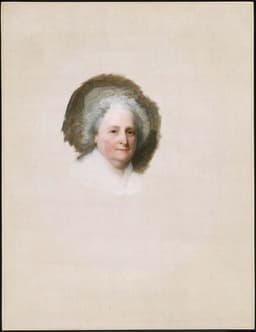
Gilbert Stuart, 1796. Wikimedia Commons. Public domain.
1731–1802
Martha Washington
16
recorded events
Connected towns:
Morristown, NJBiography
Martha Washington: The Revolution's Indispensable Partner
Few figures in the American Revolution embodied quiet, resolute sacrifice quite like Martha Dandridge, born on June 2, 1731, in New Kent County, Virginia. Raised among the planter gentry of the Tidewater region, she received the education typical of elite colonial women — instruction in domestic management, social graces, needlework, and basic literacy rather than the classical training afforded to men. At eighteen, she married Daniel Parke Custis, a wealthy planter, and quickly proved herself a capable manager of a large and complex household. When Custis died in 1757, Martha became one of the wealthiest widows in Virginia, overseeing vast landholdings and hundreds of enslaved people. Her marriage to George Washington in January 1759 merged two great Virginia estates and created a partnership that would endure for four decades. At Mount Vernon, Martha refined the skills she would later bring to the revolutionary cause: managing a sprawling household, hosting political visitors and neighbors with warmth and efficiency, and navigating the intricate social networks of colonial Virginia's elite. These were not trivial accomplishments. In an era when political alliances were forged across dinner tables, Martha's social acumen was a genuine asset to her husband's rising ambitions.
The coming of the Revolution transformed Martha Washington from a Virginia plantation mistress into a figure of national significance, though the transformation was neither sudden nor simple. When George Washington accepted command of the Continental Army in June 1775, Martha faced a stark choice. She could remain in the comfort and safety of Mount Vernon, managing the estate as she had done during her husband's absences in the House of Burgesses, or she could join him at the front, sharing the deprivations and dangers of war. She chose the latter, traveling to the army's winter encampments every year of the conflict. This decision represented a genuine turning point — not only for Martha personally, but for the public image of the revolutionary cause. Her willingness to leave behind the considerable luxuries of Mount Vernon sent a powerful message to officers, soldiers, and the watching public: the Washington family had staked everything on American independence. She first joined George at the siege of Boston in late 1775, establishing the pattern she would follow for the rest of the war. Each autumn, as armies settled into winter quarters, Martha would make the long journey from Virginia to wherever the army was encamped, returning home only when spring campaigns resumed.
Martha Washington's most significant contribution to the Revolution was her management of military headquarters as a functioning social, domestic, and political institution — a role she performed with particular distinction during the two winter encampments at Morristown, New Jersey. When the Continental Army arrived in Morristown in January 1777, Washington established his headquarters at Arnold's Tavern, and Martha joined him to manage the household and serve as the social center of camp life. She returned for the second encampment during the brutal Hard Winter of 1779–1780, when Washington established headquarters at the Ford Mansion. In both instances, Martha presided over a household that served simultaneously as a private residence, a military command center, and a diplomatic venue where officers gathered, intelligence was discussed, and the fragile morale of the army's leadership was carefully tended. She organized dinners, receptions, and social gatherings that brought together officers who might otherwise have succumbed to the isolation, frustration, and factional disputes that plagued winter quarters. This was not merely entertaining — it was a form of institutional management critical to the army's survival. Martha understood that an army held together by personal loyalty to its commander required a human center, and she provided one with skill and grace.
During the Hard Winter of 1779–1780, conditions at the Morristown encampment deteriorated to a degree that surpassed even the legendary suffering at Valley Forge. Soldiers at Jockey Hollow endured record snowfall, sub-zero temperatures, and a supply crisis that left men without adequate food, clothing, or shelter. Martha Washington responded to this crisis with characteristic practicality. She organized sewing circles among officers' wives and local women, gathering them at the Ford Mansion to produce shirts, stockings, and other desperately needed garments for the freezing troops. She visited sick and wounded soldiers, offering comfort and demonstrating that the leadership of the army had not abandoned its men. When the supply crisis deepened into outright starvation, Martha's presence at headquarters helped maintain a veneer of order and normalcy that prevented complete collapse of morale among the officer corps. Her efforts during the Continental Army's smallpox inoculation program in 1777 further demonstrated her willingness to confront the practical realities of military life. She supported the controversial mass inoculation effort that George Washington ordered, understanding that disease posed as great a threat to the army as British muskets. Martha herself had been inoculated, lending personal credibility to the program.
Martha Washington's effectiveness at headquarters depended upon a web of relationships that she cultivated with deliberate care. She formed close bonds with the wives of senior officers, including Lucy Knox, wife of artillery commander Henry Knox, and Catharine Greene, wife of General Nathanael Greene. These women joined Martha at various winter encampments, creating a community of officers' wives who supported one another and contributed to the functioning of camp life. Martha also developed warm relationships with Washington's military aides, including Alexander Hamilton and the Marquis de Lafayette, who frequently dined at the headquarters table and came to regard her with genuine affection. Her interactions with local women in Morristown and the surrounding New Jersey countryside expanded the headquarters' social network and helped secure cooperation from civilian communities that were often exhausted by the demands of hosting an army. Martha navigated these relationships with the diplomatic skill of a seasoned political figure, smoothing tensions between officers, mediating social disputes, and ensuring that the headquarters household projected an image of unity and resolve. Her alliance with her husband was, of course, the most important relationship of all — a partnership of extraordinary depth and mutual dependence that sustained both of them through the darkest years of the war.
Martha Washington's story is not without moral complexity and genuine hardship. She was a slaveholder throughout her life, and the labor of enslaved people sustained the wealth and comfort that made her public role possible. When she traveled to winter encampments, enslaved servants accompanied her to manage the domestic work of headquarters. This fundamental contradiction — fighting for liberty while holding human beings in bondage — shadows her legacy as it shadows the legacy of her husband and many other founders. Martha also faced personal setbacks during the war years. She endured prolonged separations from her family and the constant anxiety of knowing her husband was a target for capture or assassination. The discovery of Benedict Arnold's treason in September 1780, while the Washingtons were still connected to the Morristown network of operations, shook the entire command structure and reminded Martha how fragile the revolutionary cause truly was. The New Jersey Line Mutiny of January 1781, when soldiers stationed near Morristown rose up against their officers over unpaid wages and expired enlistments, further underscored the precariousness of the army's situation and the limits of morale-building in the face of genuine material deprivation.
The war changed Martha Washington in ways both visible and profound. The young Virginia widow who had married George Washington in 1759 had been primarily concerned with managing her estate, raising her children, and fulfilling her social obligations within a relatively narrow world. By war's end, she had spent years living in makeshift military households, enduring harsh winters far from home, and performing a public role that had no precedent in American life. She had witnessed suffering on a scale that would have been unimaginable in her prewar existence — starving soldiers, smallpox victims, the psychological toll of years of uncertain warfare. She had also experienced the intoxicating energy of a revolutionary movement and the deep satisfaction of contributing to a cause larger than herself. Those who knew her noted that the war years had made her both tougher and more compassionate, more attuned to the suffering of ordinary people and more impatient with the petty social distinctions that had once defined her world. Martha emerged from the Revolution as a figure of national stature, recognized and admired far beyond the borders of Virginia, yet she remained fundamentally private, preferring the rhythms of domestic life to the spotlight of public adulation.
When the war ended and George Washington was inaugurated as the first President of the United States in 1789, Martha assumed yet another unprecedented role: that of the president's wife. She brought to this position the same skills she had honed at Morristown and other winter encampments — managing a complex household, hosting social events that served political purposes, and projecting an image of republican dignity that balanced accessibility with authority. As the nation's first "Lady Washington," she established traditions that would shape the role of First Lady for generations. She held weekly Friday evening receptions, known as "drawing rooms," that were open to a relatively broad public and helped define the social culture of the new republic. After Washington's retirement in 1797, Martha returned to Mount Vernon, where she lived quietly until her death on May 22, 1802. In her final years, she destroyed nearly all of her correspondence with George, an act that has deprived historians of invaluable insight into their partnership but that reflected her deep commitment to privacy. She had given decades of her life to public service and wished to reclaim what remained for herself.
Contemporaries recognized Martha Washington's contributions in terms that went beyond conventional praise for a dutiful wife. Officers who served at Morristown and other encampments consistently noted her warmth, her practical generosity, and her steadying influence on headquarters life. Soldiers who glimpsed her visiting the sick or distributing clothing understood that her presence was a statement of solidarity. Abigail Adams, who met Martha during the presidential years, described her as possessing "great ease and politeness" combined with genuine modesty. The Marquis de Lafayette, who had dined at her table many times, spoke of her with deep respect and affection. Even British observers grudgingly acknowledged that Martha Washington's willingness to share the hardships of war had enhanced her husband's reputation and strengthened the revolutionary cause. In an era when women were largely excluded from public life, Martha had carved out a role of genuine influence — not through political maneuvering or public oratory, but through the patient, unglamorous work of managing a household that happened to be the nerve center of a revolution. Her legacy among contemporaries was that of a woman who had chosen sacrifice when comfort was readily available.
Students and visitors today should know Martha Washington not as a cardboard figure of domestic virtue, but as a woman who made consequential choices under extraordinary pressure. Her decision to join the army at winter quarters — year after year, through some of the worst conditions soldiers and civilians endured during the Revolution — was an act of courage and commitment that shaped the course of the war. At Morristown, she managed a household that doubled as a military headquarters during two of the army's most desperate winters. She organized practical relief efforts, maintained the social fabric of the officer corps, and demonstrated through her presence that the revolutionary cause demanded sacrifice from everyone, not just the men who carried muskets. Her story challenges us to think more broadly about who fights a revolution and what forms of service matter. It also compels us to grapple with the contradictions of the founding era — the gap between the rhetoric of liberty and the reality of slavery, the tension between public duty and private desire. Martha Washington's life was not simple, and we do her no honor by pretending otherwise. She deserves to be remembered as she was: complicated, capable, and essential.
WHY MARTHA WASHINGTON MATTERS TO MORRISTOWN
Martha Washington's story transforms our understanding of what happened at Morristown during the Revolution's darkest hours. The Ford Mansion was not merely a military headquarters — it was a household, and Martha was the person who made it function. During both the 1777 and 1779–1780 encampments, she managed the domestic operations that kept the command center running, organized relief efforts for suffering soldiers, and maintained the social gatherings that held the officer corps together. When visitors walk through the Ford Mansion today, they are walking through Martha's workspace. Her sewing circles, her dinners, her visits to the sick — these were acts of leadership that sustained an army on the brink of collapse. Her story reminds us that the Revolution was won not only on battlefields but in the daily, unglamorous work of keeping people fed, clothed, and united in a common cause.
TIMELINE
- 1731: Born Martha Dandridge on June 2 in New Kent County, Virginia
- 1750: Marries Daniel Parke Custis, becoming one of Virginia's wealthiest women
- 1757: Daniel Parke Custis dies; Martha becomes a wealthy widow managing extensive estates
- 1759: Marries George Washington on January 6; settles at Mount Vernon
- 1775: Joins George Washington at the Continental Army's winter camp near Boston, beginning her wartime tradition
- 1777: Travels to Morristown during the first winter encampment, managing headquarters operations at Arnold's Tavern
- 1779–1780: Returns to Morristown for the Hard Winter encampment at the Ford Mansion, organizing sewing circles and visiting sick soldiers
- 1780: Present in the orbit of headquarters operations when Benedict Arnold's treason is discovered in September
- 1789: Becomes the nation's first presidential consort, establishing the role's social traditions
- 1802: Dies at Mount Vernon on May 22 at the age of seventy
SOURCES
- Brady, Patricia. Martha Washington: An American Life. Viking, 2005.
- Bryan, Helen. Martha Washington: First Lady of Liberty. John Wiley & Sons, 2002.
- Mount Vernon Ladies' Association. "Martha Washington." George Washington's Mount Vernon. https://www.mountvernon.org/library/digitalhistory/digital-encyclopedia/article/martha-washington/
- National Park Service. "Morristown National Historical Park." https://www.nps.gov/morr/index.htm
- Fields, Joseph E., ed. "Worthy Partner": The Papers of Martha Washington. Greenwood Press, 1994.
Events
Jan
1777
First Winter Encampment at MorristownMorristownHeadquarters Manager# The First Winter Encampment at Morristown, 1777 In the closing days of 1776, the American cause had seemed all but lost. The Continental Army had suffered a devastating string of defeats in New York, losing Long Island, Manhattan, and Fort Washington in rapid succession before retreating across New Jersey with a dwindling force that barely resembled an army at all. Yet in a stunning reversal, General George Washington led his troops across the ice-choked Delaware River on Christmas night and struck the Hessian garrison at Trenton, following that triumph days later with a bold victory at Princeton. These engagements electrified a weary nation and breathed life back into the revolutionary movement, but they did not change the fundamental reality confronting Washington: his army was exhausted, undersupplied, and shrinking by the day. He needed a place to rest, rebuild, and prepare for the campaigns ahead. In early January 1777, he marched the Continental Army to Morristown, New Jersey, and established winter quarters there — a decision that would prove as consequential as any battlefield maneuver of the war. The choice of Morristown was deliberate and strategically shrewd. The town sat nestled behind the Watchung Mountains, a rugged ridgeline that formed a natural defensive barrier against any British advance westward from their stronghold in New York City. The surrounding countryside was home to a thriving iron industry capable of producing weapons, tools, and other materiel the army desperately needed. Local sympathies ran largely toward the patriot cause, meaning Washington could expect cooperation rather than hostility from the civilian population. Upon arrival, Washington initially established his headquarters at Jacob Arnold's Tavern on the town green, positioning himself at the center of the small community. Colonel Jacob Ford Jr., a prominent local militia officer, had offered his family's handsome mansion as a resource for the army, but Ford died of illness on January 11, 1777, shortly after the encampment began. His widow, Theodosia Ford, graciously shared the Ford Mansion with Washington's military household during portions of the encampment, a sacrifice of privacy and comfort that typified the burdens the war placed on ordinary civilians. The army that straggled into Morristown was in wretched condition. Many soldiers had marched through snow and ice without shoes, leaving bloody footprints on frozen roads. Clothing was threadbare, rations were scarce, and morale — despite the recent victories — was fragile. Compounding these miseries, enlistment terms were expiring for large numbers of troops, threatening to dissolve the army entirely. Perhaps most alarming of all, smallpox was tearing through the ranks with terrifying speed, incapacitating soldiers more efficiently than British muskets ever had. Washington recognized that disease posed an existential threat to his force and made the bold and controversial decision to inoculate the entire army against smallpox through variolation, a procedure that involved deliberately introducing a mild form of the virus to build immunity. The practice was medically risky — some soldiers would sicken and a few would die from the inoculation itself — and it temporarily weakened the army at a moment when it could scarcely afford further losses. Yet Washington understood that the alternative, allowing the disease to rage unchecked, was far worse. The mass inoculation campaign was carried out with as much secrecy as possible to prevent the British from learning how vulnerable the army was during the process. Throughout the winter and into the spring, Washington and his senior officers worked tirelessly to reorganize and rebuild. Nathanael Greene, one of Washington's most trusted generals, oversaw critical logistics and camp organization, ensuring that supplies flowed and order was maintained among troops scattered across local homes and farms. Alexander Hamilton, the brilliant young officer who had distinguished himself at Trenton and Princeton, served as one of Washington's aides-de-camp during this period, helping manage the enormous volume of correspondence and administrative work required to hold the army together. By the time the Continental Army broke camp in May 1777 and marched toward the campaigning season ahead, it was a fundamentally different force than the one that had limped into Morristown four months earlier. The inoculation program had produced a healthier army largely immune to the scourge that had decimated its ranks. New recruits had been enlisted, units reorganized, and supply lines strengthened. The first winter encampment at Morristown is often overshadowed in popular memory by the later, more famous suffering at Valley Forge, but its importance to the survival of the Revolution can hardly be overstated. It was here that Washington demonstrated the organizational leadership and willingness to make difficult decisions that would define his command throughout the war, transforming a battered collection of survivors into an army capable of continuing the fight for American independence.
Jan
1777
Continental Army Arrives in MorristownMorristownHeadquarters Manager# Continental Army Arrives in Morristown, 1777 In the early days of January 1777, the Continental Army marched into the small village of Morristown, New Jersey, weary but buoyed by a remarkable turn of fortune. Just days earlier, General George Washington had orchestrated two of the most consequential victories of the American Revolution — the surprise attack on Hessian forces at Trenton on December 26, 1776, and the sharp engagement with British troops at Princeton on January 3, 1777. These triumphs had rescued the patriot cause from the brink of collapse. Throughout the autumn of 1776, the Continental Army had suffered a devastating string of defeats in New York, losing control of Manhattan and retreating across New Jersey in disarray. Enlistments were expiring, morale was crumbling, and many observers believed the Revolution was effectively over. The crossing of the Delaware River and the victories that followed changed everything, injecting new life into the struggle for independence and proving that Washington's battered army could stand against professional European soldiers. Now, however, Washington faced a pressing strategic question: where to shelter his exhausted troops for the long winter months ahead. He chose Morristown with characteristic deliberation. The town sat nestled behind the natural barrier of the Watchung Mountains, a rugged ridgeline that would make any British advance from their stronghold in New York City both difficult and easily detected. Morristown also offered access to vital supply routes that connected the army to resources in New England and Pennsylvania, ensuring that provisions and reinforcements could reach the troops. Its position allowed Washington to monitor British movements while keeping his forces safely out of reach — close enough to threaten the enemy, but far enough to avoid a devastating surprise attack. Approximately three thousand soldiers accompanied Washington into Morristown, a fraction of the force that would be needed to continue the war. Among the senior officers was Nathanael Greene, one of Washington's most trusted and capable generals, who would play an essential role in managing the army's logistics and readiness during the encampment. Greene's organizational skills proved invaluable as the army struggled with shortages of food, clothing, and shelter throughout the winter. The troops were billeted in local homes, barns, and hastily constructed huts scattered in and around the town, turning the quiet community into the de facto military capital of the American Revolution. Morristown's residents bore the burden of this transformation with varying degrees of willingness. Among the most prominent local figures was Colonel Jacob Ford Jr., a militia officer and ironworks owner who had contributed significantly to the patriot cause. Tragically, Ford died shortly after the army's arrival, likely from illness, leaving behind his family and a handsome home that would later serve as Washington's headquarters during the army's second encampment in Morristown in 1779–1780. Martha Washington also joined her husband during the winter months, as she did throughout much of the war, managing the headquarters household and providing a stabilizing presence during an uncertain time. Her role extended beyond domestic duties; she helped maintain morale and facilitated the social interactions between military leaders and local civilians that were essential to sustaining community support for the war effort. The months spent at Morristown in early 1777 proved critical to the survival of the Continental Army. Washington used the time to reorganize his forces, recruit new soldiers, inoculate troops against smallpox — a disease that threatened to do more damage than British muskets — and plan for the campaigns ahead. The encampment demonstrated that the Revolution would not be won through battlefield heroics alone but through endurance, logistics, and the careful management of limited resources. In the broader arc of the Revolutionary War, the arrival at Morristown marked a turning point. It signaled that the Continental Army had not only survived its darkest hours but was prepared to persist. Morristown became a symbol of resilience, a place where the fragile machinery of revolution was quietly rebuilt during the cold and uncertain months of early 1777, setting the stage for the prolonged struggle that would ultimately lead to American independence.
Jan
1777
Washington Establishes Headquarters at Ford MansionMorristownHeadquarters Manager# Washington Establishes Headquarters at Ford Mansion By the winter of 1777, the American Revolution had entered a grueling phase that tested the resolve of every patriot who believed in the cause of independence. The Continental Army, though buoyed by surprising victories at Trenton and Princeton earlier that year, remained an exhausted, undersupplied force struggling to hold together against the most powerful military in the world. General George Washington, the Commander-in-chief of the Continental forces, faced the monumental challenge of keeping his army intact through the brutal winter months while simultaneously planning the strategic moves that would sustain the war effort into the following year. It was under these pressing circumstances that Washington chose Morristown, New Jersey, as the site for his first winter encampment and requisitioned the stately home of the recently deceased Colonel Jacob Ford Jr. as his military headquarters. The Ford Mansion was one of the finest homes in Morristown, a Georgian-style residence that reflected the prominence of the Ford family in the community. Colonel Jacob Ford Jr. had been a committed patriot who served the Revolutionary cause with distinction, but he had died of pneumonia earlier in 1777, leaving behind his widow, Theodosia Ford, and their children. When Washington arrived and requisitioned the home for military use, Theodosia found herself confined to just two rooms of her own residence while the commanding general and his extensive military staff occupied the remainder of the house. Her sacrifice, though rarely celebrated in the grand narratives of the Revolution, was emblematic of the countless personal costs borne by civilians whose lives were upended by the demands of war. Theodosia endured the loss of her privacy and domestic autonomy without formal compensation, a quiet testament to the burdens that fell disproportionately on women and families during the conflict. Inside the Ford Mansion, Washington transformed a family home into a nerve center of military operations. From its rooms, he directed intelligence-gathering efforts, coordinated correspondence with the Continental Congress, and began laying the groundwork for the spring campaign that would carry the war forward. The headquarters buzzed with the activity of aides, officers, and couriers. Among those stationed at the mansion was Alexander Hamilton, who served as one of Washington's most trusted aides-de-camp. Hamilton, still in his early twenties, had already distinguished himself through his sharp intellect and tireless work ethic, and his time at the Ford Mansion deepened the professional relationship with Washington that would shape both of their legacies. Hamilton drafted letters, managed communications, and helped translate Washington's strategic vision into actionable orders, honing the administrative and political skills that would later make him one of the young nation's most influential founders. Martha Washington also played a vital role at the headquarters, as she did during several winter encampments throughout the war. Far from serving merely as a domestic companion, Martha functioned as a headquarters manager, overseeing the daily operations of the household, managing supplies, and helping to maintain the morale of both the staff and the soldiers who visited. Her presence lent a sense of stability and normalcy to what was otherwise a tense and uncertain environment, and her tireless efforts behind the scenes contributed meaningfully to the functioning of Washington's command. The choice of Morristown itself was strategic. Nestled among the Watchung Mountains, the town offered natural defensive advantages that made it difficult for the British to launch a surprise attack. Its location also allowed Washington to monitor British movements in and around New York City while maintaining lines of communication with Congress and other Continental forces. The winter encampment at Morristown gave the army a critical period of rest and reorganization, even as soldiers continued to suffer from shortages of food, clothing, and essential supplies. The establishment of Washington's headquarters at the Ford Mansion matters in the broader story of the Revolution because it illustrates how the war was sustained not only on battlefields but also in the administrative and strategic work conducted during the difficult months between campaigns. It reveals the human dimensions of the conflict, from the personal sacrifices of a widow like Theodosia Ford to the tireless labors of young officers like Hamilton. Morristown became a proving ground for leadership, endurance, and the unglamorous but essential work of holding a revolution together when its survival was far from certain.
Jan
1777
Morristown Intelligence Network OperationsMorristownHeadquarters Manager# Morristown Intelligence Network Operations In the winter of 1777, the American Revolution hung in a precarious balance. George Washington's Continental Army, buoyed by its stunning surprise victories at Trenton and Princeton in the closing days of 1776, had proven that it could strike decisively against professional British and Hessian forces. Yet those triumphs, while invaluable to American morale, did not change the fundamental reality that the British still controlled New York City and much of New Jersey, possessed a far superior navy, and commanded troops whose training and equipment outstripped anything the Continental Army could yet muster. Washington understood that the survival of the patriot cause depended not only on the strength of arms but on the strength of information. When he chose Morristown, New Jersey, as the site of his first major winter encampment, he was making a decision that was as much about intelligence as it was about rest and resupply. Morristown offered a combination of geographic advantages that made it an ideal base for espionage operations. The town sat behind the natural defensive barrier of the Watchung Mountains, a chain of ridgelines that shielded the Continental Army from sudden British assault while also providing elevated observation points from which American scouts could monitor enemy movements across the plains below. The roads leading into and out of Morristown connected to a web of smaller routes through the New Jersey countryside, allowing agents and messengers to travel discreetly between patriot headquarters and the British-held territories around New York and along the Jersey coast. Washington, who had long recognized the critical importance of timely and accurate intelligence, seized upon these advantages to establish and expand a network of spies, scouts, and informants whose work would profoundly shape the course of the war. From his headquarters in Morristown, Washington personally directed much of this intelligence activity, demonstrating a hands-on approach to espionage that distinguished him from many commanders of his era. He recruited agents, devised cover stories, evaluated the reliability of reports, and issued detailed instructions about what kinds of information he most urgently needed — troop strengths, supply shipments, fortification construction, and any signs of impending British offensives. Working closely alongside him was Alexander Hamilton, the young and brilliant aide-de-camp whose role extended well beyond clerical duties. Hamilton helped process and analyze the intelligence reports that flowed into headquarters, distilling raw information into actionable assessments that informed Washington's strategic planning. Meanwhile, Martha Washington, who joined her husband at Morristown during the encampment, played an important role as headquarters manager, helping to maintain the social and organizational fabric of the command post from which these sensitive operations were coordinated. Her presence also helped project an image of stability and normalcy that belied the covert activities unfolding behind closed doors. The intelligence gathered through the Morristown networks provided Washington with a clearer picture of British intentions and capabilities than his adversaries likely suspected. Spies moved between American and British lines at considerable personal risk, gathering details about enemy troop movements and defensive preparations that allowed Washington to make informed decisions about when to engage and when to avoid confrontation. This flow of information shaped the Continental Army's strategic choices throughout 1777, a year that would see both devastating setbacks, including the loss of Philadelphia, and the momentous American victory at Saratoga — a triumph that ultimately brought France into the war as an ally. The Morristown intelligence operations matter in the broader story of the Revolution because they reveal a dimension of Washington's leadership that is often overshadowed by battlefield narratives. Washington was not merely a general who commanded troops in the field; he was a sophisticated spymaster who understood that wars are won as much through knowledge as through firepower. The networks he built and refined during the winter of 1777 laid the groundwork for even more elaborate espionage efforts later in the war, including the famous Culper Ring that would operate out of New York. In this sense, Morristown was not just a place where a weary army rested — it was the birthplace of American military intelligence, a tradition whose origins in that small New Jersey town continue to resonate through the centuries.
Feb
1777
Continental Army Smallpox Inoculation ProgramMorristownHeadquarters Manager# Continental Army Smallpox Inoculation Program In the winter of 1777, as the Continental Army settled into its encampment at Morristown, New Jersey, General George Washington faced an enemy far more lethal than the British redcoats arrayed against him. Smallpox, the dreaded variola virus, had been ravaging his forces since the earliest days of the Revolution, killing soldiers by the thousands and rendering entire regiments unfit for duty. The disease had already played a devastating role in the failed American invasion of Canada in 1775 and 1776, where it swept through the ranks with such ferocity that the campaign essentially collapsed. Continental soldiers retreating from Quebec carried the virus back with them, spreading it to new units and civilian populations alike. By the time Washington brought his weary army to Morristown after his celebrated victories at Trenton and Princeton, he understood with painful clarity that smallpox posed a greater strategic threat to American independence than any military force King George III could send across the Atlantic. It was against this grim backdrop that Washington made one of the most consequential and courageous medical decisions in American military history: he ordered the mass inoculation of the entire Continental Army. The decision was anything but simple. Inoculation in the eighteenth century bore no resemblance to the relatively safe vaccinations that would come later, after Edward Jenner's breakthrough with cowpox in 1796. The procedure, known as variolation, involved deliberately introducing live smallpox material — typically pus or scabs taken from an infected person — into a small incision in a healthy patient's skin. The goal was to induce a milder case of the disease that would, if all went well, confer lifelong immunity. But the risks were enormous. Inoculated patients contracted genuine smallpox. They suffered through weeks of fever, painful pustules, and profound weakness. Some died. And during their illness, they were fully contagious, capable of sparking new outbreaks among the uninoculated. To inoculate an army in the middle of a war meant deliberately sickening a substantial portion of the fighting force at a time when every able-bodied soldier was desperately needed. Many colonial legislatures had actually banned the practice in their communities for fear of triggering epidemics, which made Washington's order all the more radical. Washington entrusted the enormous logistical and medical undertaking to Dr. John Cochran, a skilled physician who would later serve as Surgeon General of the Continental Army. Cochran organized the program with remarkable efficiency under extraordinarily difficult conditions. Makeshift hospitals were established in and around Morristown, and soldiers were inoculated in carefully staggered groups so that a significant portion of the army remained healthy and combat-ready at any given time. This rotation system was essential, because Washington knew that if the British learned the army was partially incapacitated, they might launch a devastating attack. Secrecy was paramount. Washington issued strict orders to prevent word of the inoculation campaign from reaching enemy intelligence, and the program was managed with a level of operational security that reflected just how vulnerable the army was during this period. Martha Washington, who had joined her husband at his Morristown headquarters as she did during many winter encampments, played a vital role in managing the affairs of the household and headquarters, helping to maintain the sense of order and normalcy that sustained morale during the difficult weeks of the program. The results were nothing short of transformative. Before the inoculation campaign, smallpox had been a constant and catastrophic presence in the Continental Army, killing more soldiers than British muskets and cannons combined. After the Morristown program and subsequent inoculation efforts that extended to new recruits throughout the war, smallpox infection rates among American troops plummeted. The disease, which had once threatened to dissolve entire brigades, ceased to function as a strategic weapon against the American cause. Historians have recognized Washington's inoculation order as the first large-scale military public health campaign in American history, a pioneering act that predated modern military medicine by generations. The significance of this decision extends far beyond its immediate medical impact. Washington's willingness to accept enormous short-term risk for long-term strategic advantage revealed the same boldness and foresight that characterized his crossing of the Delaware just weeks earlier. By neutralizing smallpox as a factor in the war, he preserved the fighting strength of an army that could not afford to lose a single regiment to disease. In the broader narrative of the American Revolution, the Morristown inoculation program stands as a reminder that the war for independence was won not only on battlefields but also in hospital tents, through decisions that demanded as much courage as any cavalry charge.
May
1777
Construction of Fort NonsenseMorristownHeadquarters ManagerWashington ordered the construction of an earthwork fortification on a hilltop overlooking Morristown during the first encampment. The fort commanded views of the surrounding countryside and would have served as a rallying point in case of British attack. Local tradition holds that the soldiers nicknamed it "Fort Nonsense" because they considered the construction unnecessary — a name that stuck despite the sound military reasoning behind the position. The fort was never tested in combat.
May
1777
Continental Army Departs Morristown (First Encampment)MorristownHeadquarters ManagerWashington led the Continental Army out of Morristown at the end of May 1777, moving to Middlebrook, New Jersey, to observe British movements and prepare for the summer campaign. The first encampment had lasted approximately five months, during which the army had recovered from the winter, received new recruits, and conducted the smallpox inoculation program. The departure marked the end of Morristown's first period as a military capital, though the army would return two and a half years later.
Dec
1779
The Hard Winter: Second Encampment at MorristownMorristownHeadquarters Manager# The Hard Winter: Second Encampment at Morristown By the winter of 1779, the American Revolution had entered a grueling phase of attrition. The initial fervor of independence had cooled, and the Continental Army found itself locked in a war that seemed to have no clear end. The British occupied New York City, the Continental Congress struggled to fund the war effort, and the French alliance forged in 1778 had yet to deliver decisive results on the battlefield. It was in this climate of exhaustion and uncertainty that General George Washington made the decision to encamp his army at Morristown, New Jersey, for the second time. He had wintered there in early 1777 and knew the location's strategic advantages — its proximity to the British in New York, the natural protection offered by the Watchung Mountains, and the network of roads that allowed for communication and movement. What Washington could not have anticipated was that the winter of 1779–80 would become the most punishing ordeal his army had ever faced, surpassing even the legendary suffering at Valley Forge. Washington established his headquarters at the Ford Mansion, the home of the widow Theodosia Ford, while approximately 10,000 soldiers set about constructing a vast encampment of over 1,000 log huts at Jockey Hollow, a few miles to the southwest. The encampment sprawled across farmland and forest, including property belonging to local families such as that of Temperance "Tempe" Wick, a young civilian woman whose family farm was directly affected by the military presence. The army's arrival transformed the rural landscape into a military city, straining relationships with the local population while also making the community an unwitting participant in the Revolution's survival. The weather that winter was unprecedented in its severity. Between November and April, twenty-eight blizzards lashed the region, burying the encampment under snowdrifts that reached six feet in places. New York Harbor froze solid, an event so rare that no one alive could recall it ever happening before. The extreme cold compounded an already dire supply crisis. Nathanael Greene, serving as Quartermaster General, bore the enormous responsibility of keeping the army fed, clothed, and equipped, but the supply system — undermined by inflation, congressional dysfunction, and logistical breakdown — collapsed entirely. Soldiers subsisted on half-rations, then quarter-rations, and then nothing at all. Private Joseph Plumb Martin, one of the war's most vivid chroniclers, later recorded eating birch bark and roasted shoe leather simply to survive. The physical suffering was matched by a crisis of morale. Soldiers had not been paid in months, and many were dressed in little more than rags. Discipline frayed as desperation set in. Baron Friedrich Wilhelm von Steuben, the Prussian-born Inspector General who had reshaped the army's training at Valley Forge, worked relentlessly to maintain order and military discipline within the camp, but even his efforts could not prevent the unrest from boiling over. On May 25, 1780, two Connecticut regiments paraded under arms and refused to obey orders, demanding food and back pay. Officers managed to suppress the mutiny before it spread, but the incident sent shockwaves through the army's leadership, including Washington's trusted aide-de-camp, Alexander Hamilton, who witnessed firsthand how close the army stood to complete dissolution. Despite everything, the vast majority of soldiers stayed. They endured the cold, the hunger, and the silence from a government that seemed to have forgotten them. They stayed without pay, without adequate clothing, and without any guarantee that the Revolution would succeed. This collective act of endurance is one of the most extraordinary and underappreciated episodes in American military history. While Valley Forge has claimed the greater share of public memory, Morristown was objectively worse — colder, longer, and more deprived. The encampment at Morristown also had lasting consequences for the war. The near-mutiny forced Congress and state governments to confront the army's desperate condition, prompting renewed, if still insufficient, efforts to reform supply and finance. The survival of the Continental Army through this winter preserved the Revolution at a moment when it could easily have collapsed from within. When the soldiers finally broke camp in the spring of 1780, they carried with them not only the scars of a brutal season but also a hardened resolve that would sustain the fight through its remaining years, all the way to the decisive victory at Yorktown in 1781. Morristown was not a battle, but it was a test of endurance that proved as consequential as any clash of arms in the struggle for American independence.
Dec
1779
Continental Army Returns to Morristown for Second EncampmentMorristownHeadquarters Manager**The Continental Army's Second Encampment at Morristown, 1779–1780** In the winter of 1779, General George Washington faced a decision that would test the endurance of his army and the resolve of the American cause. After a campaign season that had produced no decisive victory, Washington once again selected Morristown, New Jersey, as the site for his winter encampment. He had quartered a much smaller force there during the winter of 1777, and the location's strategic advantages remained compelling. Nestled among the Watchung Mountains, Morristown offered natural defensive terrain that would make a British surprise attack from New York City difficult. Its position in northern New Jersey also allowed the Continental Army to monitor British movements and protect vital supply lines running through the mid-Atlantic region. What Washington could not have fully anticipated, however, was that the winter of 1779–1780 would prove to be one of the most brutal of the eighteenth century—and that his soldiers would endure suffering that rivaled, and in many ways surpassed, the infamous trials at Valley Forge. Approximately 10,000 Continental troops marched into the Morristown area beginning in late November and early December of 1779. Among them was Private Joseph Plumb Martin, an enlisted soldier from Connecticut whose later memoirs would provide one of the most vivid firsthand accounts of life in the ranks. Martin and his fellow soldiers were directed to Jockey Hollow, a wooded tract of land south of the town center, where they were ordered to construct their own shelter. Under guidelines influenced by Baron Friedrich Wilhelm von Steuben, the Prussian-born inspector general who had transformed the army's discipline and organization at Valley Forge, the camp was laid out with military precision. Regiments were assigned specific areas, and soldiers set about felling trees and raising over 1,000 log huts arranged in orderly rows. Von Steuben's insistence on proper camp layout was not merely aesthetic; it promoted sanitation, facilitated rapid assembly, and reinforced the professional standards he had worked so hard to instill. Overseeing the monumental task of supplying this encampment was Major General Nathanael Greene, who served as quartermaster general. Greene faced nearly impossible logistical challenges. The Continental Congress was financially exhausted, the currency had depreciated to near worthlessness, and the supply system was plagued by inefficiency and corruption. Food, clothing, and firewood were all desperately scarce. Soldiers went days without adequate rations, and many lacked shoes and blankets as temperatures plunged and record snowfalls buried the camp. The suffering was so acute that some units teetered on the edge of mutiny, and desertions increased alarmingly. Washington himself established his headquarters at the Ford Mansion, a handsome home in the center of Morristown owned by the widow Theodosia Ford and her family. Martha Washington joined her husband there, as she did during several winter encampments throughout the war, helping to manage the headquarters household, hosting visiting dignitaries and officers, and lending a stabilizing presence during a period of profound uncertainty. Her role, though often overlooked, contributed meaningfully to maintaining morale and the social cohesion of the officer corps. The encampment's enormous size—far larger than the first Morristown winter quarters—placed extraordinary strain on the surrounding civilian population. Local farms were stripped of provisions, fences were torn down for firewood, and tensions between soldiers and residents simmered throughout the winter. These frictions highlighted one of the Revolution's enduring dilemmas: the difficulty of sustaining a citizens' army without alienating the very citizens it fought to protect. The second Morristown encampment matters in the broader story of the Revolution because it demonstrated that the Continental Army could survive conditions that would have destroyed a less committed force. Despite starvation, freezing cold, and the near-collapse of the supply system, the army held together and emerged in the spring of 1780 ready to continue the fight. The perseverance displayed at Jockey Hollow became a testament to the determination of ordinary soldiers whose willingness to endure extraordinary hardship ultimately made American independence possible.
Dec
1779
Soldier Hut Construction at Jockey HollowMorristownHeadquarters Manager# Soldier Hut Construction at Jockey Hollow In the late autumn of 1779, the Continental Army faced a crisis that had nothing to do with British muskets or battlefield tactics. After years of grueling campaigns, depleted supplies, and a Congress that struggled to fund even the most basic necessities of war, General George Washington made the difficult decision to establish winter quarters near Morristown, New Jersey. The location, known as Jockey Hollow, offered strategic advantages — it was shielded by the Watchung Mountains, positioned close enough to monitor British movements in New York, and surrounded by wooded terrain that could provide building material and fuel. But the winter of 1779–1780 would prove to be the coldest of the eighteenth century, and the thousands of soldiers who arrived at Jockey Hollow were about to endure suffering that rivaled anything they had experienced on the battlefield. On December 14, 1779, Washington issued precise specifications for the construction of soldier huts, bringing his characteristic attention to order and discipline even to the act of building shelter. Each hut was to measure approximately fourteen by fifteen feet and house twelve enlisted men. The structures were to be built from logs, with walls notched at the corners for stability and gaps chinked with clay to block the wind. Fireplaces built into the back wall would provide heat, and roofing materials — often nothing more than split wood slabs and whatever canvas could be spared — would offer modest protection from the relentless snow. Washington understood that without adequate shelter, he would lose more soldiers to exposure and disease than he ever had to enemy fire, and so the construction effort became a military operation in its own right. The reality of building these huts, however, was far more punishing than any written specification could convey. Soldiers like Joseph Plumb Martin, an enlisted man from Connecticut who later recorded his wartime experiences in vivid detail, labored through deep snow and frozen ground with inadequate tools. Many men lacked proper axes, and those who had them found the work exhausting as they felled trees, dragged timber through snowdrifts, and shaped logs with numb, cracked hands. The construction consumed virtually all the standing timber in the Jockey Hollow area, stripping the landscape bare as thousands of men worked in organized brigades to raise roughly one thousand huts over the course of several weeks. During this time, many soldiers had no choice but to remain in thin canvas tents, exposed to temperatures that plunged well below freezing and storms that buried the encampment under feet of snow. While the enlisted men suffered in the hollow, Washington established his headquarters nearby, and Martha Washington joined him there, as she often did during winter encampments. Martha served as a vital presence at headquarters, managing the household, hosting officers, and helping to maintain morale during a period of extraordinary deprivation. Her willingness to endure the discomforts of camp life alongside the army lent a sense of shared sacrifice that was not lost on the soldiers. The hut construction at Jockey Hollow matters in the broader story of the American Revolution because it reveals the unglamorous endurance that ultimately sustained the patriot cause. The winter at Morristown is often overshadowed by the more famous suffering at Valley Forge two years earlier, but conditions in 1779–1780 were arguably worse. Soldiers went days without food, clothing was in tatters, and pay was months in arrears. Mutiny simmered beneath the surface, and desertions increased. Yet the army held together, in no small part because men like Joseph Plumb Martin continued to shoulder axes, stack logs, and build the crude shelters that kept them alive through the darkest months of the war. The huts they constructed were not monuments — they were desperate, functional acts of survival — but they represented something essential about the Continental Army's resilience. Washington did not win the Revolution solely through brilliant generalship or decisive battles. He won it by keeping an army in the field year after punishing year, and the soldier huts at Jockey Hollow stand as a testament to the ordinary men who made that possible.
Dec
1779
Martha Washington Arrives at MorristownMorristownArrived to join her husband at winter quartersMartha Washington traveled from Virginia to join her husband at Morristown during the second winter encampment, as she did during most winter quarters throughout the war. Her presence at the Ford Mansion served both personal and political purposes: she provided companionship and domestic stability for Washington, and she organized social events that maintained morale among the officer corps. Martha Washington also visited sick soldiers and coordinated sewing circles among officers' wives that produced shirts and other clothing for the troops.
Jan
1780
Supply Crisis and Starvation at Jockey HollowMorristownHeadquarters Manager# Supply Crisis and Starvation at Jockey Hollow In the winter of 1779–1780, the Continental Army marched into Jockey Hollow near Morristown, New Jersey, expecting the kind of difficult but manageable winter encampment they had endured before. What they encountered instead was a catastrophe that surpassed even the legendary suffering at Valley Forge two years earlier. While Valley Forge has long occupied the central place in America's memory of Revolutionary War hardship, the crisis at Morristown was, by nearly every measure, more severe, more prolonged, and more threatening to the survival of the American cause. It was here, in the frozen hills of northern New Jersey, that the Continental Army came closer to simply ceasing to exist than at perhaps any other moment in the war. The roots of the crisis lay in the near-total collapse of the Continental currency. By late 1779, the paper money issued by Congress had depreciated so drastically that it was virtually worthless. Merchants and farmers refused to accept it, and the army's purchasing agents found themselves unable to buy even the most basic provisions. Quartermaster General Nathanael Greene, one of Washington's most capable and trusted officers, bore the immense burden of managing the failing supply system. Greene worked tirelessly to coordinate the movement of food, clothing, and materiel to Jockey Hollow, but no amount of organizational skill could overcome the fundamental reality that the army had no credible money with which to pay for supplies. Compounding the problem was the failure of individual states to meet their requisition quotas. Congress, lacking the power to tax, depended on the states to contribute provisions and funds voluntarily, and state after state fell short of what was needed. The result was a supply pipeline that was not merely strained but functionally broken. For the soldiers enduring these conditions, the suffering was immediate and visceral. Private Joseph Plumb Martin, an enlisted man whose later memoir would become one of the most vivid firsthand accounts of the war, experienced the starvation at Jockey Hollow personally. Men went days at a time without receiving any food whatsoever. They boiled shoe leather, gnawed on bark, and scavenged the frozen countryside for anything remotely edible. The winter itself was punishing — one of the coldest on record — and soldiers huddled in hastily built log huts with inadequate clothing and blankets. Disease spread through the camp, and morale plummeted to dangerous lows. Desertions increased as men who had endured years of war simply could not endure another day of empty stomachs and frozen limbs. Commander-in-Chief George Washington watched the deterioration of his army with growing alarm. He wrote urgently to Congress, warning in stark and unambiguous language that the army stood on the verge of dissolution. These were not the words of a man prone to exaggeration; Washington understood that if the crisis was not addressed, there would be no army left to fight. At his headquarters, Martha Washington joined her husband as she had during previous winter encampments, helping to manage the household operations and maintain some semblance of order and morale among the officers and their families. Her presence was a steadying force, but it could not fill empty supply wagons. With no other recourse, officers began conducting forced requisitions from local farms, seizing livestock, grain, and other provisions and issuing promissory notes in return. These notes promised future payment, but many New Jersey farmers rightly suspected they would never be honored. The requisitions bred deep resentment among the civilian population and strained the already fragile relationship between the army and the communities it was supposedly defending. It was a bitter irony that an army fighting for liberty found itself confiscating the property of its own citizens. The supply crisis at Jockey Hollow did not resolve neatly with the arrival of spring. Its effects lingered and festered, contributing directly to one of the most dramatic episodes of the war: the Pennsylvania Line mutiny of January 1781, when roughly 1,500 soldiers marched out of their winter camp in armed protest against unpaid wages, expired enlistments, and the persistent deprivation they had endured. The mutiny was eventually resolved through negotiation rather than bloodshed, but it laid bare the fundamental fragility of the Continental Army and the failure of Congress and the states to adequately support the men who were fighting for independence. The crisis at Morristown thus matters not only as a story of suffering but as a turning point that exposed the deep structural weaknesses of the American war effort — weaknesses that would not be fully addressed until the nation itself was reimagined under a new Constitution years after the war's end.
Feb
1780
Alexander Hamilton Courts Elizabeth SchuylerMorristownHosted social gatherings where the courtship developed# Alexander Hamilton Courts Elizabeth Schuyler at Morristown The winter of 1779–1780 was one of the most brutal the Continental Army ever endured, and yet it was against this backdrop of extraordinary suffering that one of the most consequential romances in American history unfolded. Alexander Hamilton, the brilliant and ambitious young aide-de-camp to General George Washington, met and courted Elizabeth Schuyler during the army's second winter encampment at Morristown, New Jersey. Their courtship, which blossomed amid dances, social gatherings, and the grinding misery of a starving army, would bind Hamilton to one of the most powerful families in New York and help shape the political trajectory of the young republic. By the time the Continental Army settled into its winter quarters at Morristown in December 1779, Hamilton had already distinguished himself as one of Washington's most trusted and capable staff officers. Still in his early twenties, the West Indian-born Hamilton had served at Washington's side for nearly three years, drafting correspondence, managing logistics, and acting as an essential liaison between the Commander-in-Chief and Congress. He was restless, intellectually voracious, and keenly aware that his lack of family wealth and social standing in America placed him at a disadvantage. A strategic marriage could change that, and Hamilton made no secret in letters to friends that he was looking for a wife who combined beauty, sense, and good family connections. Elizabeth Schuyler — called Eliza or Betsey by those close to her — arrived in Morristown as part of the social circle that gathered around the army's winter headquarters. She and her sisters had traveled from Albany, New York, drawn by the lively society that formed each winter when officers, their wives, and prominent civilians congregated near the encampment. Eliza was the daughter of Major General Philip Schuyler, one of the wealthiest and most influential men in New York, and her presence in Morristown immediately placed her at the center of the small but vibrant social world that revolved around Washington's headquarters. Martha Washington, who had joined her husband for the winter as she customarily did, hosted gatherings and informal entertainments that brought officers and young women of good families together. It was in this environment — at the home of Dr. Jabez Campfield, where Eliza was lodging, and at the various dances and dinners that punctuated the long winter months — that Hamilton pressed his suit. The contrast between the elegance of these social occasions and the desperate conditions endured by the rank and file could hardly have been starker. The winter of 1779–1780 proved even more severe than the legendary winter at Valley Forge two years earlier. Record snowfall buried the crude log huts at Jockey Hollow, where thousands of enlisted soldiers huddled with inadequate clothing, dwindling food supplies, and little firewood. Men starved, deserted, and in some cases mutinied. Officers, meanwhile, attended balls and evening gatherings just miles away, a disparity that underscored the rigid class divisions within the Continental Army and the broader society it fought to create. Despite the hardship surrounding them, Hamilton's courtship of Eliza moved swiftly. His letters from this period reveal a man deeply smitten, blending romantic ardor with his characteristic wit and intellectual energy. Eliza, for her part, was drawn to Hamilton's charm, intelligence, and evident ambition. By the spring of 1780, the couple was engaged, and they married on December 14, 1780, at the Schuyler family estate in Albany. The marriage mattered far beyond the personal happiness of the two individuals. By joining the Schuyler family, Hamilton gained access to a network of political influence, wealth, and social respectability that would prove indispensable in the years ahead. Philip Schuyler became a powerful ally, and the Schuyler connections helped Hamilton build the political base from which he would later serve as the nation's first Secretary of the Treasury and architect of its financial system. Eliza herself would become a fierce protector of Hamilton's legacy, spending the fifty years she survived him preserving his papers and championing his contributions to the founding of the United States. What began as a wartime romance in a freezing New Jersey encampment ultimately helped shape the political and financial foundations of the new nation.
Mar
1780
Continental Currency CollapseMorristownHeadquarters Manager**The Continental Currency Collapse at Morristown, 1780** The winter encampment at Morristown, New Jersey, in early 1780 is often overshadowed in popular memory by the more famous suffering at Valley Forge two years earlier, yet in many ways the crisis that gripped the Continental Army at Morristown was more dangerous and more revealing of the structural weaknesses that threatened the American cause. At the heart of that crisis was the catastrophic depreciation of Continental currency, the paper money that Congress had been printing since 1775 to finance the war. By the opening months of 1780, it took roughly forty dollars in Continental paper to purchase what a single dollar in hard coin could buy — and by the close of that year, the ratio would plunge to a staggering one hundred to one. The phrase "not worth a Continental" became a bitter joke among soldiers and civilians alike, and it captured a truth that endangered the entire Revolution. The roots of the collapse stretched back to the earliest days of the war. When the Continental Congress declared independence, it possessed no power to levy taxes on the states, and so it resorted to the printing press. Between 1775 and 1779, Congress authorized more than two hundred million dollars in paper currency, flooding the economy with money that was backed by little more than the promise of future redemption. At first the notes circulated with reasonable confidence, but as the war dragged on, as military setbacks shook public faith, and as British counterfeiting operations pumped additional fake bills into circulation, trust in the currency eroded steadily. Inflation accelerated, and by 1779 the spiral had become uncontrollable. Nowhere was the human cost of this fiscal disaster more acutely felt than at Morristown during the brutal winter of 1779–1780. Nathanael Greene, serving as Quartermaster General, bore the impossible responsibility of feeding, clothing, and equipping an army of roughly ten thousand men. Greene found that local farmers and merchants in New Jersey simply refused to accept Continental paper in exchange for grain, meat, or forage. They had learned through painful experience that bills accepted one week might lose half their value the next. Greene's supply wagons returned empty, and soldiers went days without adequate food, huddling in makeshift huts through what was recorded as one of the coldest winters of the eighteenth century. Commander-in-Chief George Washington, headquartered at the Ford Mansion in Morristown, watched the crisis with growing alarm. Martha Washington, who had joined her husband at the winter encampment as she did during several winters of the war, helped manage the household operations at headquarters and witnessed firsthand the desperation that pervaded the camp. Washington wrote urgent letters to Congress and to state governors, warning that the army was on the verge of dissolution — not from enemy action, but from neglect and insolvency. When voluntary commerce failed entirely, Washington was forced to resort to a measure he despised: the compulsory requisitioning of supplies from the surrounding countryside, issuing certificates of future payment to farmers whose goods were effectively seized. It was a practice that strained the relationship between the army and the civilian population it claimed to protect. Meanwhile, Alexander Hamilton, serving as Washington's aide-de-camp, turned his formidable intellect toward diagnosing the crisis. Hamilton drafted detailed analyses of the fiscal collapse, arguing that the Continental government's inability to tax, borrow reliably, or maintain a sound currency represented a fatal flaw in the existing political structure. His writings during this period planted the intellectual seeds for ideas he would champion for the rest of his career — a national bank, federal taxation, and a consolidated fiscal system — concepts that would eventually find expression in the Constitution of 1787 and in Hamilton's later tenure as the first Secretary of the Treasury. The currency collapse of 1780 matters because it revealed that winning battles was not enough to win a war. Without a functioning economy and a credible government capable of financing its obligations, the Revolution could starve in the field. The crisis ultimately prompted Congress to begin reforming its financial practices, appointing Robert Morris as Superintendent of Finance in 1781 and seeking critical foreign loans from France and the Netherlands. In this sense, the suffering at Morristown was not merely a footnote to military history; it was a turning point in American political thought, demonstrating the necessity of a stronger central government and a sound fiscal foundation — lessons that would shape the nation long after the last shots of the Revolution had been fired.
Sep
1780
Benedict Arnold's Treason DiscoveredMorristownHeadquarters Manager# Benedict Arnold's Treason Discovered By the autumn of 1780, the American Revolution had entered one of its darkest chapters, and the Continental Army knew darkness intimately. The soldiers encamped at Morristown, New Jersey, had barely survived what history would remember as the Hard Winter — a season of brutal cold, starvation, inadequate shelter, and dwindling supplies that tested the resolve of every man who shivered through it. Desertion had thinned the ranks. The Pennsylvania Line seethed with grievances over unpaid wages and broken enlistment promises. Morale was a fragile, threadbare thing. It was into this atmosphere of exhaustion and fragility that the most devastating betrayal of the entire Revolutionary War landed like a thunderclap. Benedict Arnold had once been among the most celebrated officers in the Continental Army. His extraordinary courage at the Battles of Saratoga in 1777, where his aggressive leadership on the field proved instrumental in securing the decisive American victory that brought France into the war as an ally, had made him a genuine hero of the Revolution. George Washington himself had championed Arnold repeatedly, defending him against political enemies in Congress and entrusting him with significant commands. Yet Arnold harbored deep resentments. He felt overlooked for promotion, believed Congress had failed to adequately recognize his sacrifices, and chafed under accusations of financial impropriety during his tenure as military governor of Philadelphia. These personal grievances, combined with mounting debts and the influence of his loyalist-sympathizing wife, Peggy Shippen Arnold, gradually corroded his allegiance to the American cause. By 1779, Arnold had secretly opened communications with the British through Major John André, the charming and capable head of British intelligence in New York. The negotiations escalated through coded letters and intermediaries until Arnold secured command of West Point, the strategically vital fortress perched above the Hudson River in New York. Control of the Hudson was essential to the American war effort — it connected New England to the rest of the states, and its loss could effectively sever the rebellion in two. Arnold offered to surrender West Point, along with its garrison, to the British in exchange for twenty thousand pounds and a commission as a British officer. The conspiracy unraveled in September 1780 through a combination of chance and vigilance. Major André, returning to British lines after a clandestine meeting with Arnold, was stopped near Tarrytown, New York, by American militiamen. Concealed in his stockings were documents in Arnold's handwriting detailing West Point's defenses, troop dispositions, and vulnerabilities. André was detained, and word of the capture traveled swiftly up the chain of command. When Arnold learned that André had been taken, he fled immediately, escaping down the Hudson River to the British warship HMS Vulture before he could be arrested. At the Ford Mansion in Morristown, which served as Continental Army headquarters, George Washington absorbed the news with visible anguish. Alexander Hamilton, serving as Washington's trusted aide-de-camp, helped manage the immediate crisis — dispatching urgent orders to secure West Point, coordinating communications, and working to assess the full scope of the conspiracy. Martha Washington, who had been managing the domestic operations of the headquarters and sustaining the social fabric that held the officer corps together through that punishing winter, witnessed firsthand the shock that rippled through the command. Washington reportedly said little at first, the weight of personal betrayal compounding the strategic emergency. Major André was tried by a military tribunal, convicted of espionage, and hanged on October 2, 1780, despite widespread sympathy for his bearing and dignity. Arnold, safely behind British lines, received his commission and his money, though neither the sum nor the respect he had imagined. He would lead British raids against American positions for the remainder of the war, despised by both sides — a traitor to one, never fully trusted by the other. The discovery of Arnold's treason cut deeper than any battlefield defeat could have. If a hero of Saratoga, a man Washington had personally elevated and defended, could sell the cause for British gold, then what held the Continental Army together at all? The question echoed through the camps and headquarters with terrible force. Yet the answer had already been written — not in proclamations or treaties, but in the frozen footprints at Morristown, in the soldiers who had starved and stayed, in the officers who had endured insult and neglect without turning their coats. What held the army together was a commitment that transcended personal grievance, a stubborn belief in something larger than any single man's ambition or resentment. Arnold's treason, paradoxically, clarified that conviction. The Revolution would survive not because its leaders were flawless, but because enough ordinary people refused to abandon it.
Jan
1781
New Jersey Line MutinyMorristownHeadquarters Manager# The New Jersey Line Mutiny By the bitter winter of 1781, the American Revolution was entering its sixth grueling year, and the Continental Army was fraying at the seams. The soldiers who had pledged their lives to the cause of independence were suffering from chronic shortages of food, clothing, and pay. Many had enlisted under terms they believed had expired, yet they remained bound to service with little hope of relief. Nowhere was this desperation more acutely felt than in the winter encampments of New Jersey, where freezing temperatures and broken promises pushed men to the breaking point. It was against this backdrop of misery and disillusionment that the New Jersey Line Mutiny erupted — a crisis that would test General George Washington's leadership and reveal the fragile foundations upon which the patriot cause rested. The spark for the New Jersey mutiny was lit not in Morristown but in Pennsylvania. On January 1, 1781, approximately 1,500 soldiers of the Pennsylvania Line stationed at Jericho Hill near Morristown mutinied, marching toward Philadelphia to present their grievances directly to the Continental Congress. Their complaints were substantial and legitimate: many had not been paid in over a year, enlistment terms were being disputed, and promises of bounties and provisions had gone unfulfilled. Rather than respond with force, Washington and congressional leaders chose negotiation. A committee investigated the soldiers' claims, and many Pennsylvanians were granted discharges or received back pay. The mutiny ended without widespread bloodshed, and while the outcome addressed genuine injustices, it also set a dangerous precedent — one that soldiers in neighboring units quickly noticed. Inspired by the partial success of the Pennsylvania Line mutiny, soldiers of the New Jersey Line stationed at Pompton mutinied on January 20, 1781. They too had endured months of deprivation and broken promises, and they believed that the path forged by their Pennsylvania counterparts offered a viable means of securing what they were owed. The mutineers refused orders, demanded redress for their grievances, and threatened to march in pursuit of relief from civil authorities. The situation was immediately perilous. If mutiny became an accepted method of seeking redress within the Continental Army, the entire military structure — already dangerously fragile — could collapse. Washington recognized this threat with cold clarity. While he had shown restraint with the Pennsylvanians because their complaints were legitimate and their numbers overwhelming, he could not afford to let a second mutiny succeed through the same means. To do so would signal to every disgruntled regiment in the Continental Army that insubordination was a viable tool for negotiation. Washington ordered a forceful suppression of the New Jersey mutiny and dispatched Major General Robert Howe with a detachment of approximately 500 loyal New England troops to confront the mutineers. Howe moved swiftly and decisively. His forces surrounded the New Jersey soldiers, compelled them to parade without their arms, and placed the most prominent agitators under arrest. Three ringleaders were identified and sentenced to death by firing squad. In a grim and deliberate act of military discipline, two of the three men were executed on the spot. The third was pardoned, a calculated gesture that tempered justice with a measure of mercy. The contrasting responses to the Pennsylvania and New Jersey mutinies revealed the difficult calculations Washington faced as commander-in-chief. He was not indifferent to the suffering of his troops — indeed, he had repeatedly pleaded with Congress and state governments for better provisions and timely pay. But he understood that an army that could extract concessions through mutiny was no army at all. Throughout the crisis, Washington managed operations from his headquarters in the Morristown area, where Martha Washington also played a role in maintaining the daily functions of the headquarters, providing a measure of stability during an extraordinarily tense period. The New Jersey Line Mutiny matters in the broader story of the Revolution because it exposed the war's internal contradictions. Men fighting for liberty and self-governance were themselves denied basic dignity and fair treatment by the government they served. The mutinies of January 1781 forced Congress to confront the reality that the Continental Army could not survive on patriotism alone. While the immediate crisis was resolved through a combination of negotiation and force, the underlying problems of pay, supply, and enlistment persisted throughout the war. The episode remains a powerful reminder that the American Revolution was won not only on battlefields but through the desperate endurance of ordinary soldiers whose sacrifices were too often met with indifference.