
1737–1832
Charles Carroll of Carrollton
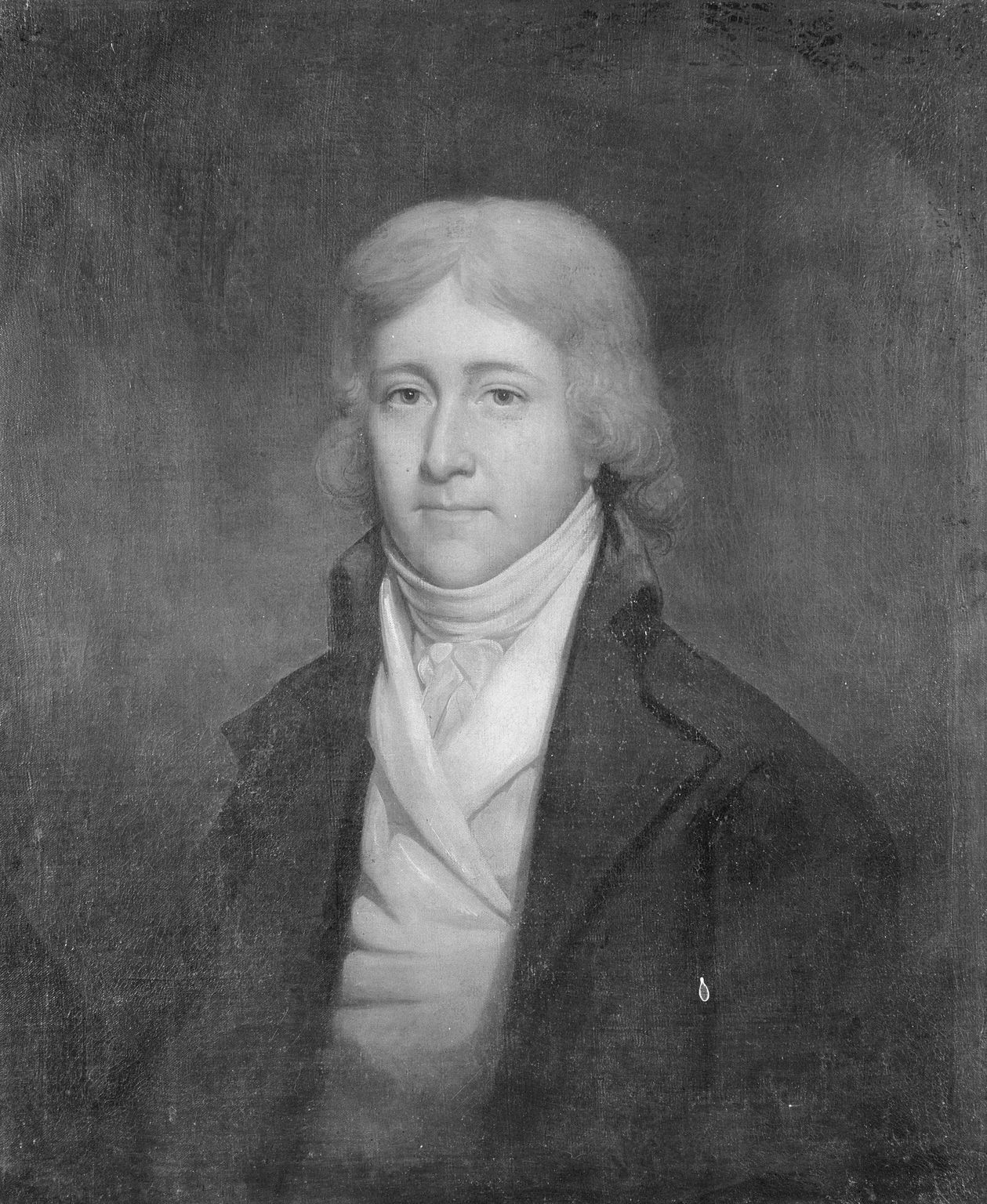
Rembrandt Peale, 1797
Biography
Charles Carroll of Carrollton (1737–1832)
Born in 1737 into one of the wealthiest Catholic families in British North America, Charles Carroll of Carrollton grew up in Annapolis, Maryland, surrounded by privilege and paradox. His family's fortune — built on vast tobacco plantations and tens of thousands of acres of land — made him arguably the richest man in the colonies, yet Maryland's colonial laws barred him, as a Catholic, from voting, holding office, or even practicing law. Sent abroad for his education at the age of ten, Carroll spent nearly two decades studying at Jesuit colleges in France and reading law at the Inns of Court in London before returning to Maryland in 1765. He came home to a colony seething with resentment over British taxation and imperial overreach. Though legally excluded from formal political life, Carroll wielded enormous influence through his wealth, intellect, and social connections. In the early 1770s, writing under the pen name "First Citizen," he engaged in a celebrated newspaper debate defending colonial rights against the royal governor's allies. The exchange electrified Maryland and transformed Carroll from a wealthy planter operating in the shadows of public life into one of the colony's most visible and articulate champions of resistance against the Crown.
Carroll's formal political career began in earnest in 1776, when Maryland appointed him to the Continental Congress. That same year, the Continental Congress sent him on a diplomatic mission to Canada alongside Benjamin Franklin and Samuel Chase, hoping to persuade French Canadians to join the American cause — a mission that ultimately failed but demonstrated the trust Congress placed in Carroll's judgment and his Catholic faith as a potential bridge to Quebec. In August 1776, Carroll signed the Declaration of Independence, adding his full name — "Charles Carroll of Carrollton" — in a deliberate act of self-identification that distinguished him from relatives of the same name and made unmistakably clear who was staking his life on this document. He subsequently helped draft Maryland's first state constitution and served in the Maryland Senate, where he became one of the most influential voices in shaping the new state's government. When the federal Constitution was ratified, Carroll was elected as one of Maryland's first two United States Senators, serving from 1789 to 1792. Throughout the war years, he also played a critical behind-the-scenes role in organizing financing for the Continental Army, leveraging his personal wealth and connections at moments when the revolution's survival hung in the balance.
What made Carroll's signature on the Declaration so extraordinary was the depth of what he personally risked. As the wealthiest signer, he had more material fortune to lose than anyone else who put pen to that parchment. Had the Revolution failed, the British Crown would almost certainly have seized his estates, and his status as a Catholic — already a legal liability — would have compounded his vulnerability to prosecution for treason. Carroll understood persecution intimately. He had spent his entire life under laws that treated his faith as a civic disqualification, denying him rights that his Protestant neighbors took for granted. When he signed the Declaration, he was not merely endorsing an abstract philosophy of liberty; he was wagering everything — his family, his fortune, his life — on the proposition that a new nation might extend rights to those whom the old order had systematically excluded. He fought not only for independence from Britain but for the principle that religious identity should not determine a citizen's standing. His willingness to bear these risks, when he could easily have protected his wealth by remaining neutral, lent his commitment a moral gravity that his contemporaries recognized and celebrated even during his own lifetime.
Charles Carroll of Carrollton outlived every other signer of the Declaration of Independence, dying on November 14, 1832, at the age of ninety-five. In his final decades, he became a living monument — the last breathing connection to the summer of 1776 — and Americans traveled to meet him as though visiting a sacred relic of the founding. Yet his legacy resists simple celebration. Carroll enslaved hundreds of people on his Maryland plantations throughout his life, and despite his eloquent defenses of liberty and natural rights, he never freed them — a moral contradiction he shared with much of the founding generation but never resolved. His story teaches us that the American Revolution was made by complicated human beings whose principles often collided with their practices. Still, Carroll's arc remains extraordinary: a man barred by law from full citizenship because of his Catholic faith who helped create a nation founded on the idea that such barriers should not exist. His life challenges us to measure the founders not only by their ideals but by the distance between those ideals and their actions, and to recognize that the work of closing that gap continues.
WHY CHARLES CARROLL OF CARROLLTON MATTERS TO ANNAPOLIS
Charles Carroll of Carrollton is arguably the most prominent founding figure associated with Annapolis, the city where he was born, raised, and lived for much of his life. His story is inseparable from the streets, legislative chambers, and social world of colonial and early republican Annapolis — then the capital of Maryland and a hub of political activity during the Revolution. Students and visitors walking through Annapolis today are walking through the same city where Carroll debated independence, helped organize a new state government, and watched the young republic take shape. His life illuminates some of the Revolution's deepest tensions: between wealth and principle, between declarations of liberty and the reality of enslavement, and between religious exclusion and the founding promise of equal rights. Carroll's story reminds us that the Revolution was not only fought on battlefields but in the minds and moral struggles of individuals who risked everything for an uncertain future.
TIMELINE
- 1737: Born in Annapolis, Maryland, into one of the wealthiest Catholic families in British North America
- 1748: Sent abroad for education at Jesuit colleges in France; later studies law at the Inns of Court in London
- 1765: Returns to Maryland to manage the family's extensive landholdings and tobacco plantations
- 1773: Publishes essays as "First Citizen" in a celebrated newspaper debate defending colonial rights
- 1776: Appointed to the Continental Congress; travels on diplomatic mission to Canada with Benjamin Franklin and Samuel Chase
- 1776: Signs the Declaration of Independence in August, adding "of Carrollton" to his signature
- 1776–1800: Serves in the Maryland Senate and helps draft the Maryland state constitution
- 1789–1792: Serves as one of Maryland's first two United States Senators under the new federal Constitution
- 1832: Dies on November 14 in Baltimore at age ninety-five, the last surviving signer of the Declaration of Independence
SOURCES
- Hoffman, Ronald. Princes of Ireland, Planters of Maryland: A Carroll Saga, 1500–1782. University of North Carolina Press, 2000.
- Smith, Ellen Hart. Charles Carroll of Carrollton. Harvard University Press, 1942.
- Birzer, Bradley J. American Cicero: The Life of Charles Carroll. ISI Books, 2010.
- National Archives. "The Signers of the Declaration of Independence." https://www.archives.gov/founding-docs/declaration/signers
- Maryland State Archives. "Charles Carroll of Carrollton." https://msa.maryland.gov/megafile/msa/speccol/sc3500/sc3520/002100/002177/html/2177bio.html
In Annapolis
Aug
1776
Maryland Delegates Sign the Declaration of IndependenceRole: Maryland Senator
# Maryland Delegates Sign the Declaration of Independence In the summer of 1776, as the American colonies moved toward a dramatic and irreversible break with Great Britain, the question of independence was far from settled in every colonial delegation. Maryland, a prosperous colony with deep economic ties to the British Empire and a complex social hierarchy shaped by its origins as a proprietary colony, faced its own internal debates about whether to support the radical step of declaring independence. Yet when the moment came, Maryland stood firmly with the other colonies, and its four delegates — Samuel Chase, William Paca, Thomas Stone, and Charles Carroll of Carrollton — affixed their names to the Declaration of Independence on August 2, 1776, a date that would mark one of the most consequential acts of collective courage in American history. The road to that moment had been fraught with uncertainty. The Continental Congress had been deliberating for months over the question of independence, and individual colonies wrestled with whether to authorize their delegates to vote in favor of such a drastic measure. Samuel Chase, a fiery and passionate advocate for the patriot cause who served as a Continental Congressman, played a particularly active role in pushing Maryland toward supporting independence. Chase had traveled back to Maryland in the weeks before the July vote to rally support among the colony's convention members, working tirelessly to persuade hesitant leaders that reconciliation with Britain was no longer possible. His efforts proved successful, and the Maryland Convention ultimately gave its delegates the authority to join the other colonies in voting for independence. William Paca, who would later serve as Governor of Maryland, brought a distinguished legal mind and a deep commitment to the principles of self-governance to the cause. A wealthy planter and trained lawyer, Paca had long been involved in resisting British overreach, and his willingness to sign the Declaration reflected both personal conviction and a recognition that the colonies had exhausted all peaceful avenues for redress. Thomas Stone, the quietest of the four delegates, was a more cautious figure who had initially hoped for reconciliation but ultimately recognized that independence had become a necessity. Perhaps no signature among the Maryland delegation carried as much personal weight as that of Charles Carroll of Carrollton. Carroll was the only Catholic to sign the Declaration of Independence, a fact that made his participation extraordinary in ways that extended far beyond the immediate political crisis. Under British law, Catholics in Maryland faced significant legal disabilities — they could not vote, hold public office, or practice their faith openly. Carroll, one of the wealthiest men in the colonies, had every material reason to remain silent and protect his vast fortune. Instead, he chose to place his name on a document that, had the Revolution failed, would almost certainly have led to his execution for treason. When asked upon signing whether the British could identify him specifically among the many Charles Carrolls in Maryland, he reportedly added "of Carrollton" to remove any ambiguity, a gesture of defiance that became legendary. Carroll went on to serve as one of Maryland's first United States Senators after the war and lived longer than any other signer of the Declaration, passing away in 1832 at the remarkable age of ninety-five. He was the last surviving signer, a living bridge between the founding generation and the rapidly expanding young republic. The signing by Maryland's delegates mattered enormously in the broader story of the Revolution because it demonstrated that independence was not merely the project of a radical few in Massachusetts or Virginia. Maryland's participation signaled that colonies across the geographic and cultural spectrum of British America were united in their determination to govern themselves. The personal risks these men accepted — the threat of hanging, the potential seizure of their properties, the destruction of their families' futures — underscored the gravity of what they were undertaking. Their signatures transformed the Declaration from an abstract philosophical statement into a binding personal commitment, backed by their lives, their fortunes, and their sacred honor.