
1742–1817
Hugh Percy, 2nd Duke of Northumberland
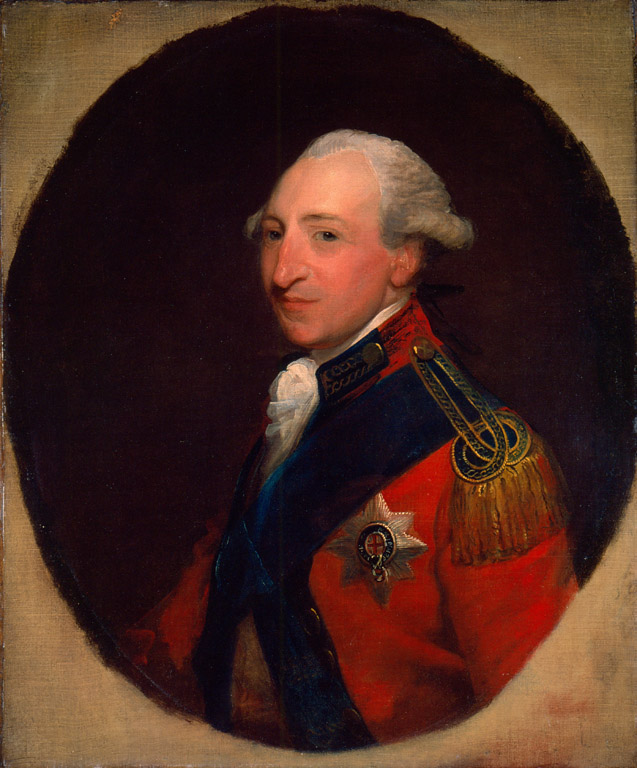
Gilbert Stuart, circ
Biography
Hugh Percy, 2nd Duke of Northumberland (1742–1817)
British General and Relief Column Commander
Born into one of England's most illustrious aristocratic families on August 25, 1742, Hugh Percy grew up surrounded by privilege, political influence, and a deeply ingrained sense of military obligation. As the eldest son of the 1st Duke of Northumberland, he bore the courtesy title Earl Percy for much of his early life and was educated with the expectation that he would serve both crown and country. He entered the British Army at the age of fourteen, purchasing a commission as was customary for young men of his rank. His rise through the officer corps was swift, aided by both family connections and a genuine aptitude for military command. He served with distinction during the Seven Years' War in continental Europe, gaining battlefield experience that would later prove invaluable. By the early 1770s, Percy held the rank of brigadier general and had been elected to Parliament, where he initially expressed sympathy for American colonial grievances. His dual identity — as both a professional soldier and a politically aware nobleman — set him apart from many of his peers. When orders came to reinforce the Boston garrison, Percy sailed for North America carrying complex and sometimes contradictory feelings about the looming conflict.
Percy arrived in Boston during a period of escalating tension between British authorities and Massachusetts colonists. Stationed under General Thomas Gage, he initially struggled to take the American resistance seriously, reportedly dismissing the colonial militias as disorganized and unthreatening. However, his professional instincts soon led him to reassess. He observed the discipline with which local communities organized their defenses and the depth of popular resentment toward British policies. As months passed, Percy grew increasingly critical of the way Gage and the Crown were managing the crisis, though he kept his reservations largely private. His first significant role in the Revolutionary conflict came on April 19, 1775, when Gage ordered Lieutenant Colonel Francis Smith to lead a force of roughly seven hundred regulars to seize colonial military supplies stored at Concord. When reports reached Boston that Smith's column had encountered fierce resistance and was in danger of being overwhelmed, Gage turned to Percy to lead a relief brigade. Percy assembled approximately one thousand troops — including marines and a pair of artillery pieces — and marched them out of Boston with urgency. This mission would become the defining episode of his American service and one of the most consequential tactical decisions of the war's opening day.
Percy's relief column reached Lexington in the early afternoon of April 19, arriving just as Smith's battered and demoralized force staggered back from Concord. The sight that greeted Percy was sobering: British regulars, many of them wounded and nearly out of ammunition, were on the verge of complete disintegration. Percy immediately deployed his fresh troops in a defensive formation, positioned his two six-pound cannon to sweep the surrounding terrain, and gave Smith's men time to rest and regroup. His use of artillery was particularly effective, momentarily scattering the pursuing militia and creating a window for the combined British force to begin an organized retreat toward Boston. Percy made the critical decision to alter the return route, choosing to march through Menotomy (present-day Arlington) and on to Charlestown rather than retracing the original path through Cambridge, where he suspected the rebels had fortified a key bridge. This decision likely saved the column from catastrophic ambush. Throughout the retreat, Percy attempted to maintain strict discipline, ordering flanking parties to clear buildings along the road where militia fighters had taken up positions. His leadership transformed what could have been a complete rout into a fighting withdrawal — costly, but not annihilating.
The passage through Menotomy proved to be the bloodiest segment of the entire day's fighting. As Percy's combined column moved along the road through the town, American militia and minutemen from dozens of surrounding communities poured fire from behind stone walls, barns, and houses. The fighting became intensely personal and savage, with hand-to-hand combat erupting in homes and yards. Percy's flanking parties, tasked with clearing these positions, grew increasingly aggressive as casualties mounted and the pressure of ambush eroded restraint. Several Menotomy homes became sites of brutal close-quarters engagements where both sides suffered grievous losses. Jason Russell's house, in particular, became a scene of extraordinary violence. Percy later acknowledged that controlling his troops under such conditions was nearly impossible, and he was candid in his assessment that the day had fundamentally changed his understanding of the conflict. In letters written shortly after the battle, he admitted that the Americans had displayed a fighting spirit and tactical resourcefulness he had not anticipated. "Whoever looks upon them as an irregular mob will find himself much mistaken," he reportedly wrote, a remarkable concession from a veteran British officer who had initially underestimated his opponents.
Percy's relationships with his fellow British commanders shaped both his effectiveness and his frustrations during the American campaign. He maintained a professional but sometimes strained rapport with General Gage, whose strategic decisions Percy increasingly questioned. His rescue of Lieutenant Colonel Smith's force on April 19 demonstrated a capacity for decisive independent action that Gage's cautious planning often lacked. Percy also developed a grudging but genuine respect for the American commanders and militia leaders he faced, a sentiment that set him apart from officers who dismissed colonial fighters as mere rabble. His willingness to acknowledge American competence, while diplomatically delicate, reflected an intellectual honesty that informed his tactical decisions. When General William Howe replaced Gage later in 1775, Percy continued to serve in senior command positions, including during operations around New York in 1776. However, his relationship with Howe deteriorated, and Percy grew disillusioned with what he perceived as a lack of coherent strategy. Personal disagreements and professional frustrations ultimately led him to request a return to England in 1777. He never returned to American shores, and upon inheriting the dukedom in 1786, he devoted his remaining years to managing his vast estates and political interests.
Percy's legacy in the story of the American Revolution is both military and attitudinal. As a commander, he demonstrated tactical competence at a critical moment, preventing the likely destruction of an entire British expeditionary force on the war's first day. His decision to reroute through Menotomy and Charlestown, his effective use of artillery, and his efforts to impose order during a chaotic running battle all reflected the skills of a seasoned professional officer. But perhaps more enduringly, his honest appraisal of American fighting capability served as an early warning — largely unheeded by his superiors — that Britain faced a far more formidable adversary than London's political leaders imagined. His candid writings about April 19 provide historians with an invaluable British perspective on the day that launched a revolution. Percy's story illustrates how the Revolution confounded expectations on both sides, forcing even accomplished military professionals to revise their assumptions. He died on July 10, 1817, at his estate in England, remembered in British history as a capable nobleman-soldier and in American history as the officer who marched through Menotomy on one of the most consequential days in the nation's founding.
WHY HUGH PERCY, 2ND DUKE OF NORTHUMBERLAND MATTERS TO ARLINGTON
Hugh Percy's march through Menotomy on April 19, 1775, made Arlington the site of the bloodiest fighting of the entire opening day of the American Revolution. Students and visitors walking Arlington's streets today are tracing the same route where Percy's flanking parties battered down doors and militiamen fired from behind stone walls. His story matters because it reveals the war from the other side — a skilled British officer who arrived expecting to rescue a routine expedition and instead encountered a community willing to fight with extraordinary ferocity. Percy's honest admission that Americans were capable soldiers, not a disorganized mob, teaches us that the Revolution's outcome was never predetermined. His experience in Arlington shattered British assumptions and foreshadowed the long, difficult war ahead.
TIMELINE
- 1742: Born August 25 at Alnwick Castle, Northumberland, eldest son of the 1st Duke of Northumberland
- 1759: Commissioned in the British Army; serves during the Seven Years' War in Europe
- 1763: Elected to Parliament as member for Westminster
- 1774: Arrives in Boston as brigadier general under General Thomas Gage
- 1775: Leads relief column of approximately 1,000 troops to rescue Smith's force at Lexington on April 19
- 1775: Commands British forces during the bloody retreat through Menotomy (Arlington), the fiercest fighting of the day
- 1776: Participates in British operations around New York, including engagements on Long Island
- 1777: Returns to England after disputes with General Howe, ending his American service
- 1786: Inherits the title 2nd Duke of Northumberland upon his father's death
- 1817: Dies July 10 at Alnwick Castle, Northumberland, England
SOURCES
- Fischer, David Hackett. Paul Revere's Ride. Oxford University Press, 1994.
- Bolton, Charles Knowles. Letters of Hugh Earl Percy from Boston and New York, 1774–1776. Charles E. Goodspeed, 1902.
- Kehoe, Vincent J.-R. We Were There! April 19th, 1775. Minuteman Press, 1975.
- Coburn, Frank Warren. The Battle of April 19, 1775, in Lexington, Concord, Lincoln, Arlington, Cambridge, Somerville, and Charlestown, Massachusetts. Lexington Historical Society, 1912.
In Arlington
Apr
1775
Battle of Menotomy - Main EngagementRole: British Commander
# The Battle of Menotomy: The Bloodiest Fight of April 19, 1775 By the time the British column reached the village of Menotomy — known today as Arlington, Massachusetts — on the late afternoon of April 19, 1775, the day had already been one of extraordinary violence and confusion. What had begun before dawn with the skirmishes at Lexington and Concord had evolved into a running battle stretching miles along the road back to Boston. British regulars, who had marched out the previous night under orders to seize colonial military supplies stored in Concord, were now in full retreat, harassed at every turn by growing numbers of Massachusetts militia. Yet nothing they had experienced that day prepared them for what awaited in Menotomy. The engagement that unfolded there would prove to be the single bloodiest confrontation of the entire day, a brutal and intimate clash that revealed just how quickly the tensions between crown and colony had spiraled into open war. Throughout the morning and early afternoon, as word of the fighting spread across eastern Massachusetts, militia companies from dozens of towns had mobilized and converged on the route the British would have to take back to Boston. By the time the column neared Menotomy, fresh companies of armed colonists lined the road, positioned behind stone walls, inside homes, and among the apple orchards that flanked the village. Among the local militia leaders organizing resistance were Captain Samuel Cook and Captain Benjamin Locke, both of whom commanded companies of Menotomy men determined to exact a toll on the retreating regulars. These were not the same scattered, loosely organized fighters who had harassed the British earlier in the march. Many of these men were fresh, well-supplied with powder and shot, and intimately familiar with every wall, lane, and building in the area. They held every advantage that the exhausted, ammunition-depleted British soldiers lacked. Commanding the British forces was Brigadier General Hugh Percy, 2nd Duke of Northumberland, who had been dispatched from Boston with a relief brigade of roughly a thousand men to rescue the original expedition force under Colonel Francis Smith. Percy's reinforcements had met the battered column earlier in the afternoon near Lexington, and his leadership and fresh troops had likely saved the expedition from complete destruction. But even Percy's disciplined soldiers could not prevent the carnage that erupted in Menotomy. The fighting there was not the long-range sniping that had characterized much of the day's earlier engagements. Instead, the close terrain forced encounters at pointblank range. Militiamen fired from windows and doorways, and British soldiers, increasingly desperate to neutralize the threat, began kicking in doors and searching homes for hidden shooters. The result was savage, close-quarters combat — men fighting with bayonets, musket butts, and bare hands in kitchens and hallways. Casualties on both sides mounted rapidly, and the violence took on a personal ferocity that shocked participants and observers alike. The toll in Menotomy was staggering relative to the rest of the day. Approximately forty British soldiers were killed or wounded in the village, along with roughly twenty-five militiamen — figures that made Menotomy the deadliest single engagement of April 19. The fighting there demonstrated something that many on both sides had not yet fully grasped: that the colonial resistance was not a disorganized mob that would scatter at the sight of professional soldiers, but a determined and capable fighting force willing to kill and die for its cause. After passing through Menotomy, Percy's column continued its harrowing retreat toward Charlestown, where the protection of naval guns finally ended the day's fighting. But the events in Menotomy reverberated far beyond that single afternoon. The ferocity of the engagement helped shatter any remaining illusion that the dispute between Britain and her American colonies could be resolved without sustained bloodshed. Within weeks, thousands of militia from across New England would converge on Boston, beginning the siege that would last nearly a year. The Battle of Menotomy, fought in orchards and farmhouses by men like Cook and Locke, stands as a stark reminder that the American Revolution was not born in grand declarations alone, but in moments of desperate, close-range violence where ordinary people made extraordinary and irreversible choices.
Apr
1775
Percy's Relief Column Reaches MenotomyRole: Commander
# Percy's Relief Column Reaches Menotomy By the afternoon of April 19, 1775, the road between Boston and Concord had become the most dangerous stretch of ground in British North America. What had begun at dawn as a mission to seize colonial military stores had spiraled into a running catastrophe for the Crown's forces. Lieutenant Colonel Francis Smith had led roughly seven hundred regulars to Concord, only to encounter armed resistance at Lexington Green and then a sharp, costly engagement at Concord's North Bridge. As Smith's column began its long retreat eastward toward Boston, hundreds and then thousands of Massachusetts militia converged on the route, firing from behind stone walls, trees, barns, and houses. By the time Smith's battered regulars staggered into Lexington around midday, many were out of ammunition, scores were wounded, and unit cohesion was dissolving. Without intervention, the entire force risked annihilation or capture. That intervention came in the form of Brigadier General Hugh Percy, 2nd Duke of Northumberland, a thirty-two-year-old aristocrat and professional soldier who commanded a relief column of approximately one thousand troops drawn from several regiments, accompanied by two six-pound field cannons and a supply of ammunition. General Thomas Gage, the military governor of Massachusetts, had dispatched Percy from Boston that morning after receiving reports that the countryside was rising against Smith's expedition. Percy reached Lexington in time to deploy his fresh troops and cannon in a defensive formation that gave Smith's exhausted men a chance to rest, reorganize, and replenish their cartridge boxes. It was a moment of genuine salvation for the British force, and Percy understood that lingering would only allow more militia to gather. He ordered the combined column to resume the march toward Boston without unnecessary delay. The route took them through Menotomy, the village known today as Arlington, and it was here that some of the bloodiest fighting of the entire day occurred. Unlike the open fields and scattered farmsteads along other stretches of the road, Menotomy was a relatively dense settlement where houses and buildings crowded close to the line of march. Militia from surrounding towns had raced ahead to take up positions inside these structures, and they poured devastating close-range fire into the passing column. Percy responded by deploying flanking parties, small detachments of soldiers ordered to sweep the buildings on either side of the road before the main body advanced through. These flanking actions produced savage encounters. Soldiers broke down doors and fought hand to hand with armed colonists who refused to withdraw. According to multiple accounts, the troops sometimes killed occupants they discovered inside, whether those individuals were combatants or not. The line between military engagement and something more indiscriminate blurred in the chaos of house-to-house fighting. Percy's two field cannons proved valuable in keeping larger bodies of militia from massing for a decisive ambush, as the boom and scatter of grapeshot forced colonial fighters to stay dispersed. Yet the artillery could not silence the relentless harassment from small groups and individual marksmen who fired, fell back, and fired again. Casualties mounted steadily on both sides. Menotomy claimed more lives than any other single point along the day's retreat, with estimates suggesting that roughly forty colonists and forty British soldiers were killed or wounded in the village alone. Among the American dead were Jason Russell, an elderly resident who was bayoneted in his own home, and Samuel Whittemore, an eighty-year-old man who engaged the flankers with a musket and pistols before being shot, bayoneted, and left for dead, though he remarkably survived. Percy later wrote with a degree of professional admiration about the militia's tenacity, and he praised his own soldiers for maintaining what he described as commendable restraint under extreme provocation. The evidence, however, suggests that restraint was in short supply on either side by the time the column cleared Menotomy. The fighting had acquired a ferocity born of exhaustion, fear, and close-quarters desperation. The events at Menotomy matter because they reveal how quickly the conflict escalated beyond the symbolic first shots at Lexington and the stand at Concord's bridge. By the time Percy's column pushed through this village, the American Revolution was no longer an idea debated in meeting houses. It was a war, measured in shattered doors, bloodied bayonets, and neighbors burying their dead.