
28
Jun
1776
Battle of Sullivan's Island (Fort Moultrie)
Charleston, SC· day date
The Story
# The Battle of Sullivan's Island (Fort Moultrie), 1776
In the early summer of 1776, as the Continental Congress in Philadelphia moved closer to declaring independence from Great Britain, a dramatic military confrontation was unfolding along the coast of South Carolina that would prove to be one of the most consequential engagements of the Revolutionary War's opening chapter. The Battle of Sullivan's Island, fought on June 28, 1776, demonstrated that the American colonists could stand toe to toe with the might of the Royal Navy and emerge victorious — a revelation that electrified the patriot cause and secured the vital port city of Charleston for years to come.
The British had set their sights on Charleston as part of a broader southern strategy. Crown officials believed that strong loyalist sentiment in the southern colonies could be rallied to suppress the rebellion if British forces established a foothold in the region. To that end, a powerful naval squadron under the command of Commodore Peter Parker, accompanied by land forces led by General Henry Clinton, sailed south with the objective of capturing Charleston Harbor. The key to the harbor's defense was Sullivan's Island, a sandy barrier island at the mouth of the channel. There, colonial forces under the command of Colonel William Moultrie had been laboring for months to construct a fort from palmetto logs and sand. By the time the British arrived, the fort remained unfinished — its walls incomplete, its garrison modestly supplied — and many observers, including the commander of the Continental Army's southern forces, General Charles Lee, doubted whether it could withstand a serious naval assault. Lee reportedly urged abandonment of the position, but Moultrie and South Carolina's political leaders insisted on holding the fort.
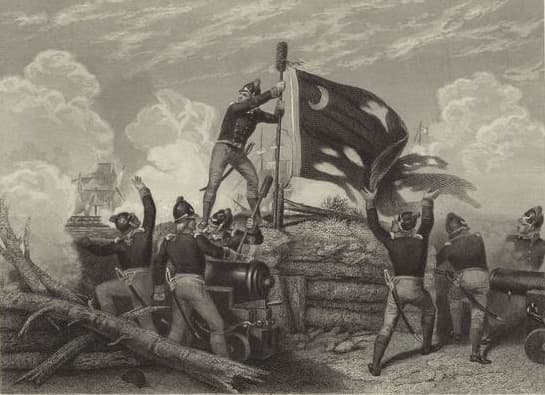
On the morning of June 28, Commodore Parker ordered his fleet of nine warships into position and opened a thunderous bombardment that would last nearly ten hours. The British expected their concentrated cannon fire to shatter the fort's walls and force a quick surrender. Instead, something remarkable happened. The palmetto logs, cut from the native cabbage palm trees of the Carolina lowcountry, proved to be extraordinarily resilient. Their soft, spongy wood absorbed cannonballs rather than splintering, and the sand packed between the fort's double walls further cushioned the impact. While the British poured round after round into the fort, Moultrie's garrison — working with a limited supply of gunpowder — returned fire with disciplined and devastating accuracy. Their shots tore into Parker's flagship, the fifty-gun Bristol, and inflicted severe damage on several other vessels in the squadron. Parker himself was wounded during the engagement, and casualties aboard the British ships mounted steadily throughout the day.
Meanwhile, General Clinton attempted to execute his part of the plan by landing troops on nearby Long Island, now known as the Isle of Palms, with the intention of wading across a narrow inlet known as Breach Inlet to attack the fort from its vulnerable rear. However, the waters between the two islands proved far deeper and more treacherous than British intelligence had suggested, with depths reaching seven feet in places and strong currents making the crossing impossible under fire. American forces positioned near the inlet kept Clinton's troops pinned down, and the planned land assault never materialized. By nightfall, with his ships battered and his land forces stymied, Parker ordered the fleet to withdraw. The British had suffered over two hundred casualties, while American losses were comparatively light, with roughly a dozen killed and several dozen wounded.
The victory at Sullivan's Island resonated far beyond Charleston. It was the first major American military triumph in the southern colonies and one of the earliest significant defeats inflicted on the Royal Navy during the Revolution. Colonel William Moultrie became a celebrated hero, and the fort was subsequently named Fort Moultrie in his honor. The palmetto log that had saved the garrison became an enduring symbol of South Carolina, eventually finding its place on the state flag. More strategically, the failed assault discouraged the British from attempting another major campaign against Charleston for nearly four years, keeping the South's largest and wealthiest port city in patriot hands during a critical period of the war. The battle proved that American resolve, resourcefulness, and even the raw materials of the southern landscape could overcome the formidable power of the British Empire.
People Involved
General Henry Clinton
British General
British general who commanded the land force intended to attack Fort Sullivan from Long Island. His troops discovered the crossing channel was impassable at the planned depth and could not support the naval bombardment. Clinton returned in 1780 with a completely different approach and captured Charleston.
Colonel William Moultrie
Continental Army Colonel
South Carolina colonel who commanded the garrison at Fort Sullivan on June 28, 1776. His calm conduct during the British bombardment and his effective direction of the fort's artillery made the victory possible. The fort was renamed Fort Moultrie in his honor.
Sources for Charleston