
1743–1826
Thomas Jefferson
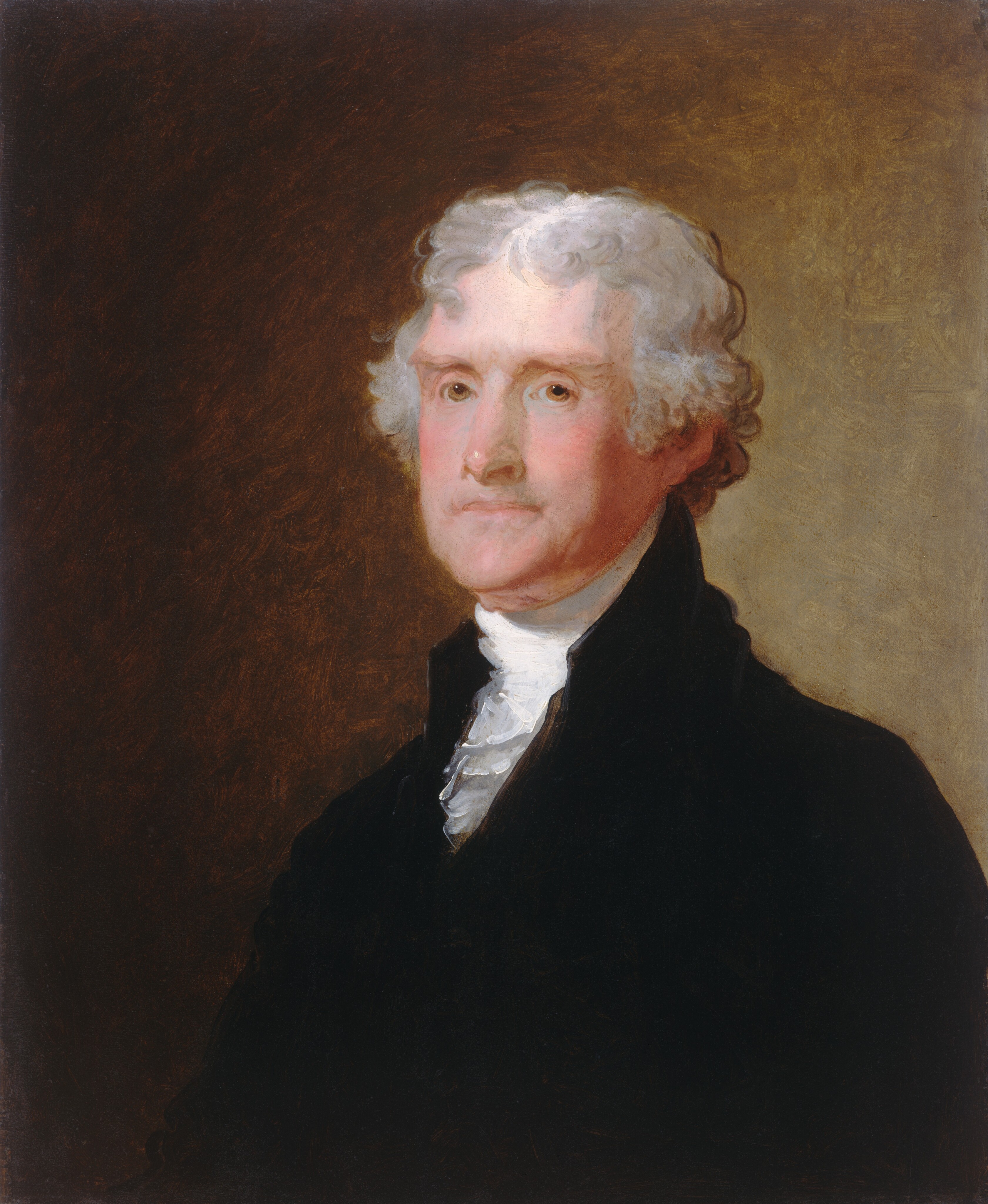
Gilbert Stuart, circ
Biography
Thomas Jefferson (1743–1826)
Governor of Virginia, Statesman, Author of the Declaration of Independence
Born in 1743 at Shadwell, in the rolling piedmont country of central Virginia, Thomas Jefferson grew up in a world shaped by land, learning, and the labor of enslaved people. His father, Peter Jefferson, was a prosperous planter and surveyor who mapped Virginia's frontier; his mother, Jane Randolph Jefferson, connected him to one of the colony's most prominent families. The elder Jefferson died when Thomas was fourteen, leaving him a substantial estate and the expectation of a gentleman's education. At the College of William and Mary in Williamsburg, the young Virginian fell under the influence of Professor William Small, who introduced him to the empirical sciences and the moral philosophy of the Scottish Enlightenment. After completing his studies, Jefferson read law under George Wythe, the most distinguished legal mind in Virginia and a man who would become a lifelong mentor. These years of rigorous intellectual formation gave Jefferson a capacious, restless mind and a deep conviction that reason and natural law could reshape human society. He began building Monticello, his beloved mountaintop home near Charlottesville, in 1768, and entered the Virginia House of Burgesses the following year — already a man of considerable ambition and formidable learning.
The path from Virginia planter to revolutionary statesman was neither sudden nor accidental. Jefferson's early years in the House of Burgesses exposed him to the deepening constitutional crisis between the colonies and Parliament, and he quickly aligned himself with the more radical faction that challenged British authority. His pen proved sharper than his voice; he was never a commanding orator, but his written arguments cut with surgical precision. In 1774, illness prevented him from attending the Virginia Convention in person, but he sent along a pamphlet titled A Summary View of the Rights of British America, which argued boldly that Parliament had no authority over the colonies and that the king himself was merely a servant of the people. The pamphlet was published and widely read, establishing Jefferson's reputation as one of the most articulate defenders of colonial rights in America. It also brought his name to the attention of delegates gathering for the Continental Congress. When he arrived in Philadelphia in June 1775 as a Virginia delegate, he was known as a man whose ideas could be trusted to paper with uncommon force. That reputation would prove decisive the following summer, when the Congress needed someone to draft the document that would sever the colonies from the British Crown forever.
In June 1776, a committee of five — including Benjamin Franklin and John Adams — selected Jefferson to draft the Declaration of Independence, a decision that would define his life and shape the course of American history. Working in a rented room on Market Street in Philadelphia, Jefferson composed the document in roughly seventeen days, drawing on Enlightenment philosophy, English constitutional tradition, and his own deeply held convictions about natural rights. The Declaration's opening lines — "We hold these truths to be self-evident, that all men are created equal" — gave the Revolution a moral vocabulary that transcended the immediate political crisis. Congress debated and revised the text, removing a passage that condemned the slave trade (a deletion that foreshadowed the contradictions that would haunt both Jefferson and the republic), and adopted the final version on July 4, 1776. Jefferson later insisted that the Declaration was not meant to be original but to express the common sense of the subject, yet its language achieved something no committee report could: it turned a colonial rebellion into a universal argument about human freedom. This was Jefferson's most significant contribution to the Revolution, and arguably to world history — a political act accomplished entirely through the power of ideas set down in ink.
Jefferson returned to Virginia in September 1776, where he threw himself into the work of remaking the state's laws and institutions. He served in the Virginia legislature and undertook a sweeping revision of the legal code, proposing bills that would abolish primogeniture and entail, establish public education, and — most controversially — guarantee religious freedom. His Virginia Statute for Religious Freedom, drafted in 1777 and finally passed in 1786, became one of the foundational documents of American liberty, separating church from state with language as luminous as anything in the Declaration. In June 1779, the Virginia legislature elected Jefferson governor, a post that would test him in ways his pen never could. Virginia was a sprawling, poorly defended state, and the war was moving south. British forces under Benedict Arnold invaded in January 1781, burning Richmond and scattering the government. Jefferson struggled to mobilize the state's militia, secure supplies, and coordinate with Continental forces, all while lacking the executive authority that a wartime crisis demanded. These years revealed a man far more comfortable with ideas than with the gritty, improvised business of military command, and the consequences of that mismatch would soon arrive at his own doorstep.
Jefferson's political life was shaped by a web of relationships — alliances, rivalries, and intellectual partnerships — that both sustained and complicated his role in the Revolution. His bond with George Wythe gave him a legal foundation; his friendship with James Madison, which deepened during the 1780s, became one of the most consequential political partnerships in American history. His relationship with John Adams was intense, competitive, and ultimately moving — the two men collaborated on independence, quarreled bitterly over the direction of the republic, and reconciled in old age through a remarkable exchange of letters. In Virginia, Jefferson worked closely with George Mason, whose Virginia Declaration of Rights influenced the language of the Declaration of Independence, and with Patrick Henry, whose fiery oratory complemented Jefferson's literary brilliance even as the two men clashed over questions of governance. Jefferson also relied on the counsel of the Marquis de Lafayette, who admired his idealism, and on the practical legislative skills of Edmund Pendleton. Yet these relationships existed within a society built on slavery, and Jefferson's dependence on enslaved labor at Monticello — including the Hemings family, with whom his personal history was deeply entangled — shaped every aspect of his public and private life in ways his contemporaries understood but often declined to confront directly.
The events of June 1781 brought Jefferson's most painful public controversy into sharp focus. On the night of June 3, Captain Jack Jouett spotted Banastre Tarleton's cavalry moving toward Charlottesville, where the Virginia legislature had relocated after fleeing Richmond. Jouett rode through the night to warn the legislators and the governor. On the morning of June 4, Tarleton's dragoons descended on Charlottesville, capturing several legislators, while a detachment under Captain Kenneth McLeod rode up the mountain to Monticello. Jefferson, who had received Jouett's warning only hours earlier, sent his family away and lingered to secure papers before departing himself — minutes, perhaps only moments, before British soldiers entered his home. The soldiers treated the house with relative restraint, but the image of a fleeing governor was devastating. Jefferson's political enemies, including Patrick Henry, pushed the Virginia legislature to investigate his conduct as governor. Though the inquiry ultimately cleared him of wrongdoing, the episode haunted Jefferson for decades. His critics called him a coward; his defenders argued he had acted prudently in an impossible situation. The moral complexity of the moment is inescapable: Jefferson was a civilian governor, not a military officer, and yet the expectation of personal bravery in the face of the enemy was a powerful force in eighteenth-century Virginia culture.
The war changed Jefferson profoundly. The governorship left him exhausted, humiliated, and briefly determined to withdraw from public life altogether. He retreated to Monticello, where he devoted himself to writing Notes on the State of Virginia, a work of natural history, geography, and social commentary that revealed both the range of his intellect and the depth of his contradictions — he condemned slavery as a moral evil while simultaneously expressing pseudo-scientific theories about racial inferiority that would be used to justify the institution for generations. The death of his wife, Martha, in September 1782 plunged him into a grief so consuming that his daughter later recalled him pacing his room for weeks, unable to function. It was this private devastation, more than any political calculation, that finally drove him back into public service; he needed work to survive his sorrow. The man who returned to politics in 1783 was harder, more guarded, and more determined than the idealistic young author of the Declaration. The Revolution had cost him something personal — not merely reputation or comfort, but the naive confidence that the world could be remade by the force of good ideas alone. He had learned that governance required compromise, endurance, and the willingness to absorb public scorn.
Jefferson's contributions to the war's resolution were primarily intellectual and diplomatic rather than military. After the British surrender at Yorktown in October 1781 — a victory won in his own state — Jefferson served in the Confederation Congress, where he drafted an ordinance for the governance of western territories that prefigured the Northwest Ordinance and proposed, unsuccessfully, that slavery be banned from all new territories after 1800. In 1784, Congress sent him to France, first as a trade commissioner and then as minister, replacing Benjamin Franklin. In Paris, Jefferson witnessed the early stirrings of the French Revolution and offered advice to Lafayette and other reformers who drew inspiration from the American experiment. He observed the fall of the Bastille from a distance and believed, with characteristic optimism, that France could achieve the same transformation that America had undergone. His years in France also exposed him to European art, architecture, and wine, influences that would shape Monticello's ongoing renovation and, eventually, the design of the University of Virginia. He returned to America in 1789 to serve as Secretary of State under George Washington, carrying with him a vision of republican government that would soon collide with Alexander Hamilton's competing vision of centralized financial power.
Jefferson's contemporaries viewed him through sharply divided lenses. To his admirers, he was the philosopher of the Revolution, the man who had given voice to the principles that justified American independence and who continued to champion individual liberty, limited government, and the agrarian republic. To his critics — Federalists, political rivals, and those who had witnessed the chaos of his governorship — he was an impractical dreamer, a man whose lofty rhetoric masked a dangerous radicalism and a personal hypocrisy made manifest by the hundreds of enslaved people who worked his fields and built his home. The controversy over his flight from Monticello followed him into the presidential campaigns of 1796 and 1800, when Federalist newspapers gleefully revived the story to question his fitness for leadership. Even his admirers acknowledged that his record as governor had been, at best, uneven. Yet his influence on the shape of American government was undeniable: the Declaration of Independence, the Virginia Statute for Religious Freedom, the Louisiana Purchase, the Lewis and Clark Expedition — these were the achievements of a man whose vision of what America could become was as expansive as the continent itself. His death on July 4, 1826, exactly fifty years after the adoption of the Declaration, seemed to his contemporaries an almost providential symmetry.
Students and visitors today should know Jefferson not as a marble monument but as a deeply human figure whose brilliance and contradictions illuminate the Revolution's unfinished promise. He wrote that all men are created equal while enslaving more than six hundred people over the course of his lifetime, including members of the Hemings family with whom he had children. He championed religious freedom while struggling to extend that same spirit of liberty to those he held in bondage. He fled Monticello ahead of British cavalry and spent the rest of his life defending that decision. These contradictions are not incidental to his story; they are the story, and they mirror the contradictions of the nation he helped create. To visit Charlottesville, to walk the grounds of Monticello or the Lawn of the University of Virginia — which he founded in 1819 and considered one of his three greatest achievements — is to confront the full complexity of the American experiment. Jefferson challenges us to take the Revolution's ideals seriously precisely because he failed to live up to them himself. His legacy demands not reverence but reckoning, and that reckoning is among the most important tasks that history can offer.
WHY THOMAS JEFFERSON MATTERS TO CHARLOTTESVILLE
Thomas Jefferson's life is inseparable from Charlottesville and the landscape of central Virginia. Monticello, visible from nearly everywhere in the town, was the home he designed, rebuilt, and loved — and the place from which he fled on the morning of June 4, 1781, when British cavalry under Banastre Tarleton descended on Charlottesville to capture the Virginia legislature and its governor. That dramatic morning connects Jefferson to Jack Jouett's midnight ride, to the legislators who scattered into the Blue Ridge, and to the Convention Army prisoners who had been held nearby since 1779. His later founding of the University of Virginia in 1819 transformed Charlottesville from a small courthouse town into a center of learning. To walk these streets is to encounter the full arc of Jefferson's story — the idealism, the crisis, and the profound contradictions that make his legacy a continuing conversation rather than a settled verdict.
TIMELINE
- 1743: Born on April 13 at Shadwell, Goochland (now Albemarle) County, Virginia
- 1762: Graduates from the College of William and Mary; begins studying law under George Wythe
- 1769: Elected to the Virginia House of Burgesses; begins construction of Monticello
- 1774: Publishes A Summary View of the Rights of British America
- 1776: Drafts the Declaration of Independence, adopted by Congress on July 4
- 1779: Elected Governor of Virginia by the state legislature
- 1781: Narrowly escapes capture at Monticello on June 4 during Tarleton's raid on Charlottesville; term as governor ends in June; legislature investigates and clears his conduct
- 1785: Appointed U.S. Minister to France, succeeding Benjamin Franklin
- 1801: Inaugurated as the third President of the United States
- 1819: Secures a charter for the University of Virginia in Charlottesville
- 1826: Dies at Monticello on July 4, the fiftieth anniversary of the Declaration of Independence
SOURCES
- Meacham, Jon. Thomas Jefferson: The Art of Power. Random House, 2012.
- Kranish, Michael. Flight from Monticello: Thomas Jefferson at War. Oxford University Press, 2010.
- Gordon-Reed, Annette. The Hemingses of Monticello: An American Family. W.W. Norton, 2008.
- Thomas Jefferson Foundation. "Thomas Jefferson Encyclopedia." https://www.monticello.org/research-education/thomas-jefferson-encyclopedia/
- Jefferson, Thomas. Notes on the State of Virginia. 1785. Available via the University of Virginia Library: https://www.encyclopediavirginia.org/
In Charlottesville
Jan
1779
Convention Army Prisoners at CharlottesvilleRole: Governor of Virginia
# The Convention Army Prisoners at Charlottesville In the autumn of 1777, one of the most consequential battles of the American Revolution unfolded near Saratoga, New York, when British General John Burgoyne surrendered his entire army to American forces. The terms of that surrender, known as the Convention of Saratoga, originally stipulated that Burgoyne's roughly 4,000 British and Hessian soldiers would be allowed to return to Europe on the condition that they would not take up arms again in the conflict. However, the Continental Congress, suspicious that Britain would simply reassign these troops to garrison duty and free other soldiers to fight in America, refused to ratify the agreement. The captured soldiers thus became prisoners of war in a kind of diplomatic limbo, collectively referred to as the "Convention Army." Initially held in Massachusetts, the prisoners placed enormous strain on resources in the Boston area, and by late 1778, Congress ordered them marched hundreds of miles south to a newly established prison camp near Charlottesville, Virginia, where it was hoped the milder climate and more abundant farmland would ease the burden of sustaining them. The prisoners arrived in early 1779, and their presence immediately transformed the small, relatively quiet community nestled in the foothills of the Blue Ridge Mountains. Charlottesville at the time was a modest county seat with limited infrastructure, and the sudden addition of approximately 4,000 foreign soldiers — along with the camp followers, wives, and support personnel who accompanied them — created both significant challenges and unexpected opportunities. Local farmers and merchants found a new market for their goods, as officers with personal funds purchased provisions, supplies, and small luxuries. At the same time, the sheer demand for food, firewood, and shelter strained resources that were already stretched thin by the broader war effort. The local economy experienced a complicated boom, one that brought welcome currency into the region even as it placed pressure on the community's capacity to provide for both its own residents and the captive army. Perhaps the most remarkable aspect of the Convention Army's stay near Charlottesville was the social and intellectual exchange that developed between the prisoners and the local gentry. Thomas Jefferson, then serving as Governor of Virginia and residing at his nearby Monticello estate, took a particular interest in the captured officers, especially the Hessian commanders who had been hired from German principalities to fight for the British Crown. Jefferson, a man of insatiable intellectual curiosity, found in these European officers kindred spirits who shared his interests in music, philosophy, natural science, and architecture. He visited the encampment and entertained officers at Monticello, forging relationships that blurred the expected lines between captor and captive. His wife, Martha Wayles Skelton Jefferson, also participated in this social world, hosting gatherings that reflected the refined cultural life the Jeffersons cultivated even during wartime. Meanwhile, the enslaved people who made such hospitality possible — including Isaac Jefferson, who lived and labored at Monticello — witnessed these interactions from an entirely different vantage point, serving the very ideals of liberty and refinement from which they were excluded. The German and British soldiers, for their part, left a tangible mark on the landscape. They cultivated elaborate gardens, constructed barracks and other structures, and introduced horticultural and building techniques that lingered in the area long after their departure. The Convention Army remained near Charlottesville for over a year before being relocated to other prison camps in Maryland and Pennsylvania as the war's shifting circumstances demanded. By the time they left, the prisoners had woven themselves into the fabric of local life in ways that no one had anticipated when the weary columns first marched into the Virginia Piedmont. The story of the Convention Army at Charlottesville matters because it reveals dimensions of the Revolutionary War that extend far beyond battlefields. It illustrates how the war disrupted and reshaped civilian communities, how the movement of thousands of prisoners created logistical and economic ripple effects across vast distances, and how even enemies could find common ground through shared intellectual and cultural traditions. It also underscores the contradictions at the heart of the American Revolution — a war fought in the name of liberty sustained in no small part by the labor of enslaved people who could only observe freedom's promise from the outside.
May
1781
Virginia Legislature Meets in Charlottesville (May 1781)Role: Governor of Virginia
# Virginia Legislature Meets in Charlottesville (May 1781) By the spring of 1781, Virginia's revolutionary government was a government on the run. The preceding months had delivered a series of devastating blows to the Commonwealth, each one pushing its leaders further from the seat of power in Richmond and deeper into the interior of the state. What unfolded in Charlottesville during the final days of May and the first days of June would become one of the most harrowing episodes in Virginia's experience of the American Revolution—a moment when the entire apparatus of state government nearly collapsed under the pressure of British military aggression. The crisis had been building since January, when the turncoat general Benedict Arnold led a British raiding force up the James River and burned much of Richmond, scattering the legislature and exposing the vulnerability of Virginia's capital. Governor Thomas Jefferson, already struggling with the immense logistical challenges of supporting the war effort in the South, found himself presiding over a government that could barely protect itself. Arnold's raid was humiliating, but it was only the beginning. In April and May, British General William Phillips launched another campaign against Richmond and its surroundings, further destabilizing the region and making it clear that the Tidewater and the fall line were no longer safe for the conduct of government business. Phillips died of illness during the campaign, but the British military presence in eastern Virginia only intensified as General Charles Cornwallis moved his army northward from the Carolinas, consolidating British strength in the state. Faced with these mounting threats, the Virginia General Assembly made the decision in late May 1781 to relocate to Charlottesville, a small town nestled in the Piedmont foothills at the foot of the Blue Ridge Mountains. The choice reflected a calculated judgment that distance from the coast and the navigable rivers would provide the breathing room the legislature needed to continue its work. Governor Jefferson, whose term was nearing its end, accompanied the government to Charlottesville, where he could retreat to his nearby estate at Monticello. His wife, Martha Wayles Skelton Jefferson, was at Monticello as well, in fragile health, adding a personal dimension of anxiety to an already desperate political situation. Among the enslaved community at Monticello was Isaac Jefferson, whose later recollections would provide a rare firsthand account of the chaos that descended on the mountain when the British arrived. For a brief period, the legislature attempted to conduct business in Charlottesville, but the sense of security proved illusory. British commanders recognized the opportunity to strike a decisive blow against Virginia's leadership. Lieutenant Colonel Banastre Tarleton, a young and aggressive cavalry officer already infamous for his ruthlessness in the Southern campaigns, was dispatched with a fast-moving force of mounted troops to ride across the Virginia countryside and surprise the legislature. On June 4, 1781, Tarleton's raiders descended on Charlottesville with stunning speed. Legislators scrambled to escape, many fleeing westward over the Blue Ridge toward the Shenandoah Valley. Several members of the Assembly were captured. Jefferson himself narrowly avoided capture at Monticello, departing only shortly before Tarleton's men arrived at the estate. The enslaved people at Monticello, including Isaac Jefferson, experienced the terrifying arrival of British soldiers firsthand, a reminder that the disruptions of war rippled through every layer of Virginia society, touching the lives of the free and the unfree alike. The scattering of the legislature and the near-capture of the governor represented the lowest point of Virginia's Revolutionary War experience. It exposed the fragility of the revolutionary government and raised painful questions about leadership and preparedness. Jefferson's reputation suffered considerably; critics accused him of failing to organize an adequate defense, and he chose not to seek another term as governor. The Assembly eventually reconvened further west in Staunton, determined to keep the machinery of self-governance alive even in the face of near-total disruption. Yet the Charlottesville episode, for all its embarrassment, also demonstrated something essential about the revolutionary cause: the refusal of Virginia's leaders to surrender the principle of self-government. The legislature kept meeting. The government kept functioning. Within months, the strategic situation in Virginia would shift dramatically, culminating in the siege of Yorktown in October 1781 and the effective end of major combat in the war. The desperate days in Charlottesville were not the final chapter but rather the darkest hour before a remarkable reversal of fortune.
Jun
1781
Jack Jouett's Midnight RideRole: Governor of Virginia
**Jack Jouett's Midnight Ride: The Race to Save Virginia's Government** By the spring of 1781, the Revolutionary War had shifted decisively southward, and Virginia found itself at the center of British military operations. British forces under generals like Cornwallis and Phillips had been ravaging the state for months, targeting supply lines, plantations, and seats of government. The Virginia legislature, driven from Richmond by earlier threats, had relocated to the small town of Charlottesville, nestled in the foothills of the Blue Ridge Mountains. Governor Thomas Jefferson, whose second term was nearing its troubled end, remained at his nearby mountaintop estate, Monticello, with his wife, Martha Wayles Skelton Jefferson, and the enslaved people who maintained the household, among them a man named Isaac Jefferson, who would later provide one of the few firsthand enslaved-person accounts of life at Monticello. It was into this precarious situation that British Lieutenant Colonel Banastre Tarleton launched a bold and secretive raid designed to capture the governor and scatter the rebel legislature in a single devastating stroke. Tarleton, notorious for his ruthlessness and speed, was one of the most feared British cavalry commanders of the war. On June 3, 1781, he led a detachment of roughly 250 mounted dragoons on a swift march westward from the Virginia lowlands toward Charlottesville. The column moved quickly and quietly, hoping to cover the distance before word of their approach could reach the American leadership. They paused to rest briefly at Cuckoo Tavern in Louisa County, approximately forty miles east of their target. It was there, by chance or sharp observation, that Captain Jack Jouett of the Virginia militia spotted the British cavalry and recognized their likely destination. Jouett, a tall and powerfully built man who knew the Virginia countryside intimately, made a fateful decision: he would ride through the night to sound the alarm. What followed was one of the most harrowing and consequential rides of the entire Revolutionary War. Rather than risk capture on the main roads, where British patrols might intercept him, Jouett chose to navigate by back roads, forest trails, and mountain paths through the darkness. The terrain was punishing—densely wooded, uneven, and barely passable even in daylight. By the time he arrived at Monticello around 4:30 in the morning on June 4, his face was reportedly scratched and scarred from low-hanging branches. He delivered his urgent warning to Jefferson, then pressed on to Charlottesville to alert the assembled legislators. Jefferson, roused from sleep, initially took time to organize his papers and prepare for departure, perhaps underestimating the immediacy of the threat. Martha Wayles Skelton Jefferson, who was in fragile health, had to be readied for travel as well. The enslaved members of the household, including Isaac Jefferson, played essential roles in the frantic preparations, hiding silver and other valuables before Tarleton's men arrived. Jefferson eventually departed Monticello only shortly before British dragoons rode up the mountain. In Charlottesville, most of the legislators managed to flee as well, though a handful were captured. The Virginia government reassembled days later in Staunton, farther west across the Blue Ridge, battered but intact. Tarleton's raid was a tactical embarrassment for Virginia's leadership but ultimately a strategic failure. The British colonel captured neither Jefferson nor the legislature in any meaningful sense, and the disruption proved temporary. Jefferson's narrow escape, however, became a source of political controversy; critics accused him of cowardice, a charge that shadowed his reputation for years. His term as governor ended just days later, and the experience left deep marks on his political consciousness. Jack Jouett's ride, covering roughly forty miles of difficult terrain in darkness, was by any measure as daring and consequential as Paul Revere's more celebrated midnight ride six years earlier in Massachusetts. Yet history treated the two men very differently. Revere was immortalized in Longfellow's famous 1861 poem, while Jouett faded into relative obscurity. The Virginia legislature acknowledged his bravery by awarding him an ornate sword and a pair of pistols, but no poet took up his cause. Today, historians recognize that Jouett's warning preserved the continuity of Virginia's revolutionary government at a moment when its capture could have dealt a serious blow to American morale and political organization. In the broader arc of the war, the failed British raid at Charlottesville was one in a series of overextensions that would culminate just months later in Cornwallis's fateful retreat to Yorktown, where the war effectively ended. Jouett's ride, then, was not merely an act of individual courage but a small, vital thread in the fabric of American independence.
Jun
1781
Tarleton's Raid on CharlottesvilleRole: Governor of Virginia
**Tarleton's Raid on Charlottesville: The Night Ride That Saved a Revolution** By the spring of 1781, Virginia had become a central theater of the Revolutionary War. British forces under General Charles Cornwallis had pushed northward from the Carolinas, and raiding parties roamed the Virginia countryside with increasing boldness. The state government, led by Governor Thomas Jefferson, had already been forced to flee the capital at Richmond earlier that year when the turncoat Benedict Arnold led a devastating British raid up the James River. Seeking safety farther inland, Jefferson and the Virginia legislature reconvened in the small town of Charlottesville, nestled against the Blue Ridge Mountains. They believed the distance from the coast and the main British forces would afford them protection. They were wrong. Lieutenant Colonel Banastre Tarleton, one of the most feared and aggressive British cavalry commanders of the war, was given a daring assignment: ride swiftly with a force of approximately 250 dragoons from the east, descend upon Charlottesville, and capture the governor and the assembled legislature in a single stroke. Tarleton, who had already earned a fierce reputation at battles like Waxhaws in South Carolina — where his troops were accused of cutting down surrendering Continental soldiers — was ideally suited for the mission. A successful capture of Jefferson and the legislature would have dealt a devastating blow to Virginia's ability to govern itself and support the broader American war effort. Tarleton's force moved with remarkable speed, covering roughly seventy miles in a punishing overnight march. But fortune intervened in the form of Captain Jack Jouett of the Virginia militia. On the night of June 3, 1781, Jouett spotted Tarleton's column resting at Cuckoo Tavern in Louisa County. Recognizing immediately what such a large body of British cavalry moving westward must intend, Jouett mounted his horse and embarked on a grueling overnight ride along back roads and forest paths to reach Charlottesville before the British did. Riding through dense woodland that left his face scarred by tree branches, Jouett arrived at Monticello, Jefferson's mountaintop estate, in the early morning hours of June 4. He warned the governor of the approaching danger before riding on into Charlottesville to alert the legislators. Jouett's warning gave Jefferson and the assembly precious hours to act, though not all responded with equal urgency. Jefferson, whose term as governor was expiring in mere days, saw to the safety of his wife, Martha Wayles Skelton Jefferson, and his family before preparing to leave Monticello himself. Among those who witnessed the frantic preparations that morning was Isaac Jefferson, an enslaved man at Monticello, whose later recollections would provide one of the few firsthand accounts of the chaos at the estate as the British approached. Jefferson lingered at Monticello longer than was prudent, reportedly pausing to gather important papers and to survey the approaching cavalry through a telescope before finally departing on horseback, narrowly avoiding capture. In Charlottesville, the legislature scattered in haste. Most members escaped, but seven who delayed too long were seized by Tarleton's dragoons. A detachment of British soldiers rode up the winding road to Monticello, only to find the governor gone. Tarleton's troops occupied Charlottesville for approximately eighteen hours, during which they destroyed supplies and arms but largely refrained from widespread destruction of private property. At Monticello, the British soldiers reportedly treated the estate and its enslaved residents without significant violence before withdrawing. The raid was, in narrow military terms, a tactical success for the British. They had demonstrated that no corner of Virginia was beyond their reach and had humiliated the state government by sending it fleeing yet again. However, the failure to capture Jefferson or a significant number of legislators stripped the operation of any lasting strategic value. The legislature simply reconvened in Staunton, farther west across the Blue Ridge, and continued its work. Jefferson, though politically embarrassed by the episode — his critics later questioned his conduct during the flight — went on to even greater prominence in American public life. In the broader arc of the Revolutionary War, Tarleton's raid on Charlottesville underscored both the vulnerability and the resilience of the American cause. Virginia's government bent but did not break. Jack Jouett's midnight ride, though far less celebrated than Paul Revere's, was equally consequential — a single act of initiative that preserved the leadership of a state essential to the revolution's success. Within months, Cornwallis would march to Yorktown, where the war's decisive siege would bring the struggle for independence to its climax.
Jun
1781
Jefferson Flees MonticelloRole: Governor of Virginia
**Jefferson Flees Monticello: A Governor's Narrow Escape and Its Lasting Consequences** By the spring of 1781, the American Revolution had shifted decisively southward, and Virginia found itself at the center of a devastating British campaign. British forces under generals like Benedict Arnold and Lord Cornwallis had been ravaging the state for months, burning supply depots, disrupting governance, and chasing the Virginia legislature from one temporary capital to the next. Thomas Jefferson, then serving his second term as Governor of Virginia, was struggling to mount an effective defense. The state militia was poorly supplied, Virginia's vast geography made coordinated defense nearly impossible, and Jefferson—a man of ideas and letters far more than of military command—found himself overwhelmed by the demands of wartime leadership. It was against this desperate backdrop that the British launched a bold strike aimed at capturing the governor himself and the members of the Virginia legislature, who had recently relocated to Charlottesville. British Lieutenant Colonel Banastre Tarleton, a young and aggressive cavalry officer already infamous for his ruthlessness at the Battle of Waxhaws, was tasked with leading a fast-moving force of approximately 250 mounted soldiers on a surprise raid toward Charlottesville. Tarleton's mission was to seize Jefferson at his mountaintop estate, Monticello, and capture as many legislators as possible, effectively decapitating Virginia's civilian government. The raid was designed for speed and shock, and Tarleton pushed his men through the night of June 3, 1781, covering roughly seventy miles in a rapid march that he hoped would outpace any warning. He nearly succeeded. What saved Jefferson was the keen observation and extraordinary ride of Captain Jack Jouett of the Virginia militia. Jouett, resting at a tavern along the road, spotted Tarleton's column moving through the darkness and immediately deduced their target. Mounting his horse, Jouett rode through the night along back roads and rough trails, arriving at Monticello in the early hours of June 4 to warn Jefferson of the approaching danger. His ride, often compared to Paul Revere's more famous journey, covered approximately forty miles of difficult terrain and proved decisive. Yet Jefferson did not flee immediately upon receiving Jouett's warning. According to historical accounts, he remained at Monticello to gather and secure important state papers and personal documents, apparently unwilling to leave critical records to fall into British hands. His wife, Martha Wayles Skelton Jefferson, who was in fragile health, also had to be seen to safety along with the household. Among those present during these tense hours was Isaac Jefferson, an enslaved man at Monticello whose later recollections would provide one of the few firsthand accounts of the events that morning. It was only when a second warning arrived—from a scout who could physically see British cavalry ascending the mountain toward the estate—that Jefferson finally mounted his horse and departed through wooded back paths. He escaped mere minutes before Tarleton's advance guard reached Monticello. The British soldiers occupied the house but, finding the governor gone, caused relatively little damage before moving on toward Charlottesville, where they captured several legislators and destroyed military supplies. The near-capture proved far more damaging to Jefferson politically than any physical harm could have been. His tenure as governor had already drawn sharp criticism from political rivals who viewed his leadership during the British invasion as indecisive and ineffective. The Virginia legislature had called for a formal investigation into his conduct as governor even before the flight from Monticello, and the dramatic image of the state's chief executive fleeing his home just ahead of enemy soldiers gave his critics potent ammunition. Although the legislative inquiry ultimately cleared Jefferson of wrongdoing, the episode left deep scars on his pride. Jefferson, a man acutely sensitive to his public reputation, was profoundly wounded by the accusations of cowardice and incompetence. He withdrew from public life for several years, retreating to Monticello to tend to his plantation, pursue his intellectual interests, and care for Martha, whose health continued to decline until her death in 1782. The flight from Monticello matters in the broader story of the Revolution because it reveals the vulnerability of American civil government during the war and the personal costs borne by those who served in it. It also shaped the trajectory of one of the nation's most consequential figures. Jefferson's years of withdrawal gave him time for reflection that would ultimately fuel his later return to politics, his service as Secretary of State, Vice President, and President, and his enduring contributions to American democratic thought. The humiliation of June 1781 did not end Jefferson's career—but it profoundly changed the man who would help define the new nation.
Jun
1781
British Troops at MonticelloRole: Governor of Virginia
**The British Raid on Monticello: June 4, 1781** By the spring of 1781, the American Revolution in Virginia had reached a critical and desperate phase. The war's center of gravity had shifted southward, and British forces under General Charles Cornwallis were pressing aggressively into the heart of the state. Virginia's defenses were stretched thin, its militia scattered and poorly supplied, and its government in disarray. Thomas Jefferson, serving his second term as Governor of Virginia, had already relocated the state capital from Richmond to Charlottesville after British forces under the turncoat Benedict Arnold raided Richmond earlier that year. Charlottesville, nestled in the foothills of the Blue Ridge Mountains, seemed safely removed from the main theaters of conflict. That sense of security proved dangerously false. In late May 1781, Cornwallis dispatched Lieutenant Colonel Banastre Tarleton, one of the most feared and aggressive British cavalry commanders, on a bold mission to strike at the Virginia government directly. Tarleton, already notorious for his ruthlessness at the Battle of Waxhaws in South Carolina, led a fast-moving force of approximately 250 dragoons on a rapid march toward Charlottesville. His objectives were ambitious: to capture Governor Jefferson, seize members of the Virginia legislature who had gathered there, and disrupt the rebel government's ability to function. The mission was designed not merely as a military strike but as a political blow intended to demoralize the American cause in Virginia. Word of Tarleton's approach nearly came too late. On the night of June 3, a young Virginia militia captain named Jack Jouett spotted Tarleton's column moving through Louisa County and undertook a legendary overnight ride through rough backcountry terrain to warn Jefferson and the legislators. Jouett arrived at Monticello in the early hours of June 4, giving Jefferson precious time to prepare. Jefferson initially lingered, gathering important papers and making arrangements, but ultimately departed on horseback just ahead of the British arrival, narrowly avoiding capture. His wife, Martha Wayles Skelton Jefferson, who was in frail health during this period, had already left with their children. A detachment of Tarleton's cavalry, led by Captain Kenneth McLeod, reached Monticello shortly after Jefferson's departure. The British troops spent approximately eighteen hours at the estate, consuming food and wine from Jefferson's considerable stores but causing relatively little physical damage to the property itself. Tarleton had reportedly ordered that Monticello be treated with respect, a decision that may have reflected both strategic calculation and an awareness of Jefferson's prominence. The restraint was notable, given that British forces elsewhere in Virginia destroyed plantations and seized property with far less hesitation. Yet for the enslaved community at Monticello, the British occupation carried an entirely different meaning. Left to manage the presence of enemy soldiers on their own, the enslaved people navigated a moment of extraordinary uncertainty. Isaac Jefferson, then a young boy enslaved at Monticello, later recalled the soldiers' arrival in his memoirs, providing one of the few firsthand accounts of the event from the perspective of an enslaved person. His recollections offer an invaluable glimpse into how the war was experienced not by generals and governors but by those whose freedom was denied even as others fought for liberty. Some enslaved individuals at Monticello used the confusion of the British raid as an opportunity to escape, joining British forces who frequently promised freedom to enslaved people willing to leave their enslavers. This pattern repeated itself across Virginia throughout 1781, revealing how military events disrupted the plantation system and created moments of both profound danger and unexpected possibility for enslaved communities. The raid on Monticello, while brief, carried significant consequences. Jefferson faced sharp political criticism for his departure, with some accusing him of cowardice and mismanagement of Virginia's defenses. An official inquiry by the Virginia legislature ultimately cleared him, but the episode left lasting marks on his reputation and contributed to his decision not to seek a third term as governor. In the broader arc of the Revolution, Tarleton's raid demonstrated the vulnerability of the American cause in the South even as the war moved toward its climax. Just months later, Cornwallis would find himself trapped at Yorktown, where a combined American and French force compelled his surrender in October 1781, effectively ending the war. The events at Monticello remind us that the Revolution was not only fought on battlefields but also unfolded in homes, on plantations, and in the lives of people whose stories are often overlooked.
Jun
1781
Virginia Legislature Flees to StauntonRole: Governor of Virginia
**The Virginia Legislature Flees to Staunton, 1781** By the spring of 1781, Virginia found itself in a state of mounting crisis. The war that had once seemed distant — fought primarily in the northern colonies and along the coastal lowlands — had shifted decisively southward. British forces under Lord Cornwallis were pressing through the Carolinas and into Virginia, and the state's defenses were dangerously thin. Governor Thomas Jefferson, the celebrated author of the Declaration of Independence, was nearing the end of his second one-year term as the state's chief executive, and his tenure had been marked by repeated emergencies that stretched Virginia's meager military resources to the breaking point. The state capital had already been moved once, from Richmond to Charlottesville, in an effort to place the government beyond the reach of British raiding parties. It would not be enough. In early June 1781, the British commander in Virginia, General Cornwallis, dispatched a fast-moving cavalry force under Lieutenant Colonel Banastre Tarleton with a daring objective: to ride swiftly into Charlottesville, capture the Virginia legislature, and seize Governor Jefferson himself. Such a blow would effectively decapitate the state's government and deal a devastating psychological strike against the patriot cause. Tarleton's dragoons moved quickly and quietly through the Virginia countryside, and the plan very nearly succeeded. What prevented a complete disaster was the sharp eyes and hard riding of Captain Jack Jouett of the Virginia militia. On the night of June 3, Jouett spotted Tarleton's column moving through Louisa County and immediately recognized the threat. He mounted his horse and rode through the night along back trails and rough terrain, covering roughly forty miles in the darkness to reach Charlottesville and Monticello, Jefferson's mountaintop home, ahead of the British. His ride, though far less celebrated than Paul Revere's, was every bit as consequential. Jouett's warning gave the legislature and the governor precious hours to escape. At Monticello, the scene was one of urgent but imperfect haste. Jefferson gathered what papers and belongings he could, and Martha Wayles Skelton Jefferson, the governor's wife, who was frequently in fragile health, was among those who had to be moved to safety. The household's enslaved workers, including Isaac Jefferson, a young enslaved man who would later dictate a remarkable memoir of life at Monticello, witnessed the chaos of the British approach firsthand. Isaac Jefferson's later recollections provide one of the few surviving accounts of the raid from the perspective of an enslaved person, offering a reminder that the Revolutionary War was experienced not only by generals and legislators but by the thousands of Black men and women whose labor sustained Virginia's planter elite even as that elite fought for its own liberty. Most of the legislators managed to flee Charlottesville before Tarleton's cavalry arrived, though a handful were captured. The body reconvened in Staunton, a small town on the far side of the Blue Ridge Mountains, where the natural barrier of the mountains offered some measure of protection against further British raids. This was the third relocation of the Virginia government in just six months — from Richmond to Charlottesville to Staunton — and it laid bare how close Virginia's civil government had come to total collapse. Once assembled in Staunton, the legislature took a decisive step. Jefferson's term as governor had expired, and he declined to seek reelection, a decision shaped in part by exhaustion, criticism of his leadership, and the harrowing experience of narrowly escaping capture. In his place, the legislators elected Thomas Nelson Jr., a wealthy planter and military officer who represented a sharp turn toward more aggressive wartime leadership. Nelson would prove willing to exercise powers that Jefferson had hesitated to claim, including the authority to impress supplies and command troops directly. Within months, Nelson would personally lead Virginia militia forces at the siege of Yorktown, where Cornwallis's surrender in October 1781 effectively ended major combat operations in the Revolutionary War. The flight to Staunton matters because it reveals how fragile the American cause remained even in its final year. Virginia, the largest and most populous state in the new nation, came perilously close to losing its functioning government. The episode also illuminates the sharp debate over executive power in wartime — a debate that shaped American political thought for generations — and it reminds us that the Revolution's outcome was never inevitable. It was secured not only through battlefield victories but through the desperate improvisations of legislators fleeing on horseback, enslaved people navigating chaos not of their making, and a young militia captain riding through the dark to sound the alarm.
Jun
1781
Thomas Nelson Jr. Elected GovernorRole: Governor of Virginia
# Thomas Nelson Jr. Elected Governor of Virginia In the spring of 1781, Virginia found itself in a state of crisis unlike anything it had experienced since the Revolutionary War began. British forces under the command of the traitor Benedict Arnold, and later the more formidable General Charles Cornwallis, had invaded the state, burning towns, seizing supplies, and throwing the government into disarray. Governor Thomas Jefferson, the brilliant author of the Declaration of Independence, had struggled to mount an effective defense. His philosophical commitment to limited executive power, while admirable in peacetime, left Virginia dangerously exposed in a moment that demanded swift and decisive action. Jefferson's term as governor was expiring, and the chaos of the British invasion had made governance nearly impossible. When a British raiding party under Lieutenant Colonel Banastre Tarleton swept toward Charlottesville in early June 1781, aiming to capture Jefferson and the Virginia legislature, the state's leaders were forced to flee into the Blue Ridge Mountains. Jefferson himself narrowly escaped Monticello, his mountaintop home, just ahead of the British cavalry. His wife, Martha Wayles Skelton Jefferson, already in fragile health, endured the terror and upheaval of the flight. Enslaved people at Monticello, including a young man named Isaac Jefferson, witnessed the British arrival firsthand and later recalled the chaos of those days, offering one of the few surviving accounts of the invasion from the perspective of those held in bondage. The legislature reconvened in Staunton, a small town on the far side of the Blue Ridge, on June 12, 1781. There, still shaken by their narrow escape and deeply aware that Virginia needed a different kind of leadership, the delegates elected Thomas Nelson Jr. as the new governor. Nelson was no stranger to the revolutionary cause. A signer of the Declaration of Independence, he was one of Virginia's wealthiest planters, based in Yorktown, and had long served as commander of the Virginia militia. Where Jefferson had been cautious and deliberate, Nelson was bold and willing to exercise the kind of emergency authority that wartime demanded. He did not hesitate to impress supplies, horses, and provisions for the Continental Army and Virginia's militia forces, using his personal credit and his own considerable fortune to sustain the war effort when state coffers ran dry. Nelson's election represented a profound shift in Virginia's wartime leadership, one that reflected the desperate circumstances of 1781. The legislature effectively acknowledged that survival required a governor willing to concentrate power in ways that might have seemed dangerous in quieter times. Nelson embraced this role without reservation. Just four months after taking office, he personally led the Virginia militia at the Siege of Yorktown, the climactic battle of the Revolutionary War. In one of the most dramatic episodes of the siege, Nelson reportedly ordered American artillery to direct cannon fire at his own elegant Yorktown home, which General Cornwallis had commandeered as his headquarters. Whether or not the story is perfectly literal, it became a powerful symbol of Nelson's willingness to sacrifice everything for the cause of independence. The British surrender at Yorktown in October 1781 effectively ended the war, and Nelson's aggressive leadership in Virginia's darkest months played a meaningful role in making that victory possible. Yet the cost to Nelson himself was devastating. His health, already strained by years of military service, collapsed under the pressures of the governorship and the Yorktown campaign. His personal fortune, which he had freely spent to supply troops and keep the state functioning, was never repaid. He resigned the governorship in November 1781, broken in body and finances. Thomas Nelson Jr. died in 1789 at the age of fifty-one, largely impoverished, a fate that stood in stark contrast to the wealth and prominence he had once enjoyed. Nelson's story is a reminder that the American Revolution was won not only by famous generals and celebrated statesmen but also by leaders who gave everything they had, including their health, their wealth, and their futures, to secure independence. His election in Staunton marked a turning point for Virginia and, ultimately, for the outcome of the war itself.
Aug
1818
Jefferson Proposes the University of Virginia (1818–1819)Role: Governor of Virginia
# Jefferson Proposes the University of Virginia (1818–1819) By the summer of 1818, Thomas Jefferson had been retired from public life for nearly a decade. The former president, former governor of Virginia, and principal author of the Declaration of Independence was seventy-five years old and living at Monticello, his mountaintop estate outside Charlottesville. Yet Jefferson's mind remained restless and ambitious, turning over an idea he had carried since the earliest days of the American Revolution: that a free republic could not survive without an educated citizenry. The war for independence had been won on battlefields more than forty years earlier, but Jefferson believed the deeper revolution — the one that would determine whether self-governance actually worked — still depended on building institutions worthy of the democratic experiment. It was this conviction that drove him, in his final years, to pour his remaining energy into founding a new kind of university. In August 1818, a body known as the Rockfish Gap Commission gathered at an inn near the Blue Ridge pass west of Charlottesville to decide where Virginia should establish its first state-supported university. Jefferson chaired the commission, and his influence over its deliberations was decisive. After reviewing several proposed locations, the commission recommended Charlottesville, conveniently close to Monticello, as the ideal site. The recommendation carried weight in Richmond, and in January 1819 Virginia's General Assembly formally chartered the University of Virginia. With the charter secured, Jefferson threw himself into every dimension of the project. He personally designed the buildings, envisioning an "academical village" organized around a central lawn rather than a single dominant structure. He drew on classical architectural forms — colonnades, pavilions, and a domed rotunda inspired by the Pantheon in Rome — to create a physical environment that reflected Enlightenment ideals of reason, order, and openness. Jefferson's ambitions extended well beyond architecture. He recruited faculty members from Europe, seeking scholars who could bring the most advanced scientific and philosophical thinking to Virginia's students. He developed the curriculum himself, insisting that it be secular and empirical. In a striking departure from the traditions of older American colleges such as Harvard, Yale, and William and Mary, Jefferson's university would have no theology department and no chapel at its center. The rotunda that anchored the campus housed a library, not a church — a deliberate statement that knowledge, not religious orthodoxy, would be the institution's foundation. Students would study law, medicine, mathematics, natural philosophy, and modern languages, equipping themselves for the practical work of democratic citizenship rather than for clerical careers. The university was, in Jefferson's own understanding, inseparable from the Revolution itself. He regarded it as one of his three greatest achievements, ranking it alongside the Declaration of Independence and the Virginia Statute for Religious Freedom. All three, in his mind, addressed the same fundamental question: how could human beings govern themselves freely and justly? The Declaration had asserted the political right to self-governance. The Statute for Religious Freedom had protected the liberty of conscience necessary for genuine self-governance. The university would cultivate the intellectual capacity that self-governance demanded. Without educated citizens who could think critically, debate openly, and understand the principles underlying their own republic, Jefferson feared that the Revolution's promises would eventually collapse into ignorance and tyranny. Yet even as Jefferson designed his university as a monument to human liberty, the contradictions of his life and his society persisted. The construction of the university's elegant pavilions and colonnades depended on enslaved labor. At Monticello itself, enslaved individuals such as Isaac Jefferson — a skilled tinsmith and nailer who spent decades in bondage on the estate — sustained the daily operations of Jefferson's household and made possible the leisure in which he pursued his intellectual projects. Martha Wayles Skelton Jefferson, Jefferson's wife, had died decades earlier in 1782, but her family's deep entanglement with slavery had shaped the very world in which Jefferson lived and thought. These realities remind us that the university's founding, like the Revolution itself, was marked by profound tensions between its ideals and the lived experiences of those excluded from its promises. Jefferson devoted his final years to overseeing the university's construction and early operations, calling it his "hobby" with characteristic understatement. He died on July 4, 1826 — the fiftieth anniversary of the Declaration of Independence — having lived long enough to see his university open its doors. The University of Virginia endures as Jefferson's last and most tangible argument that the American Revolution was not merely a military victory but an ongoing project, one that required each generation to educate itself in the habits of freedom.