
1747–1792
John Paul Jones
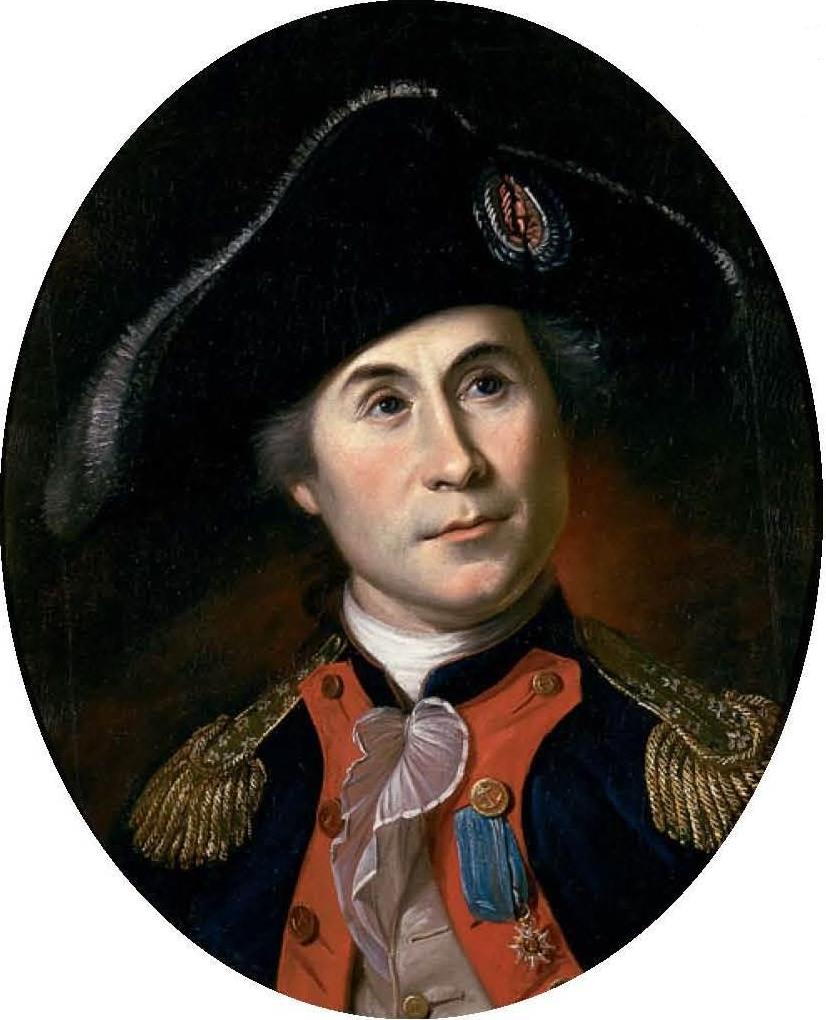
Charles Willson Peale, betw
Biography
John Paul Jones: The Scottish Sailor Who Struck Fear into Britain's Own Shores
Born in 1747 in the gardener's cottage of Arbigland estate in Kirkcudbrightshire, Scotland, the man who would become America's most celebrated naval hero entered the world with no wealth, no title, and no prospects beyond what the sea could offer. Christened simply John Paul, he went to sea at the age of thirteen, apprenticing aboard merchant vessels that sailed between Britain and the colonies. Over the following decade he rose through the ranks of the Atlantic maritime world, serving on merchant ships and, for a time, vessels engaged in the slave trade — an experience he later claimed to have abandoned out of moral disgust. His career took a dark turn in the Caribbean when he killed a mutinous sailor during a confrontation, an incident that forced him to flee to the American colonies around 1772. Settling in the Fredericksburg, Virginia, area, he adopted the surname Jones to conceal his identity and reinvent himself. His years in Virginia connected him to the Patriot networks that were beginning to coalesce in towns like Fredericksburg, and the coming Revolution would offer this restless, ambitious, supremely skilled mariner an opportunity that peacetime commerce never could have provided.
When the Continental Congress established a navy in 1775, John Paul Jones was among the first officers to seek a commission, and his proven seamanship made him a compelling candidate despite his obscure origins. He received a lieutenant's commission in December 1775 and quickly demonstrated the aggressive temperament that would define his career, participating in early naval operations in the Bahamas under Commodore Esek Hopkins. Yet Jones chafed under cautious commanders and the Continental Navy's chaotic system of seniority, which repeatedly placed less experienced officers above him. He lobbied relentlessly — writing to members of Congress, to Robert Morris, to anyone who might advance his cause — for an independent command that would allow him to wage the kind of offensive war he believed essential to American victory. His persistence paid off when Congress assigned him command of the sloop Ranger, then under construction in the shipyards of Portsmouth, New Hampshire. Jones arrived in Portsmouth and oversaw the final outfitting of the vessel, a sleek eighteen-gun warship that represented the best of New England naval craftsmanship. In November 1777, the Ranger was launched from Portsmouth's Langdon Island, and Jones set sail for France, carrying news of the American victory at Saratoga and carrying with him plans for a campaign that no American officer had yet dared to attempt.
Jones's most audacious decision was to carry the war to British home waters — a strategic gamble that no Continental Navy captain had attempted and that many considered suicidal. On the night of April 22–23, 1778, he led a raiding party from the Ranger into the harbor of Whitehaven, England, a port town he knew intimately from his years as a young merchant sailor. His men spiked the guns of the harbor fort and attempted to set fire to the shipping in the harbor. Though the material damage proved limited — only one vessel was burned — the psychological impact was enormous. For the first time since 1667, an enemy force had attacked English soil, and the shock reverberated through British newspapers and Parliament alike. Jones had demonstrated a principle that would define asymmetric naval warfare for centuries: a weaker navy could inflict disproportionate harm by striking where the enemy felt safest. He followed the Whitehaven raid with an attempt to kidnap the Earl of Selkirk from his estate on St. Mary's Isle in Scotland, a scheme that failed when the Earl was absent but that further rattled British confidence. These raids, conceived and executed through Jones's personal initiative, transformed him from an obscure colonial officer into an international figure overnight.
The capture of HMS Drake on April 24, 1778, just one day after the Whitehaven raid, marked a decisive turning point in Jones's career and in the wider perception of American naval capability. The Drake, a twenty-gun Royal Navy sloop stationed at Carrickfergus in Belfast Lough, sailed out to engage the Ranger, and Jones fought a disciplined ship-to-ship action lasting approximately one hour. The Drake's captain was killed and her first lieutenant mortally wounded before the battered British vessel struck her colors. Jones sailed his prize back to the French port of Brest, parading the captured warship before admiring French audiences and proving that the Continental Navy could defeat the Royal Navy in direct combat. Earlier that same year, on February 14, 1778, the Ranger had received the first foreign salute to the American flag when French warships in Quiberon Bay fired nine guns in recognition of the new nation's sovereignty — a diplomatic milestone that Jones took immense personal pride in securing. These events of early 1778, radiating outward from the Portsmouth-built Ranger, elevated Jones to the status of hero on both sides of the Atlantic and set the stage for his legendary command of the Bonhomme Richard.
Jones's rise depended not only on his own daring but on a web of relationships with powerful figures in both America and France. Benjamin Franklin, then serving as American minister in Paris, became Jones's most important patron, securing him the command of the Bonhomme Richard — a converted French merchant vessel — and supporting his plans for further raids on British waters. Jones cultivated French aristocrats, naval officials, and even King Louis XVI himself, understanding that American naval operations in European waters required French logistical and diplomatic support. Back in America, his connections to Virginia's Patriot community and his correspondence with congressional delegates like Robert Morris kept his name before the men who controlled naval appointments. Yet Jones was also a deeply difficult personality — vain, quarrelsome, and contemptuous of officers he considered his inferiors. His relationship with his own crew aboard the Ranger was strained; his officers formally protested his leadership style, and his disputes with Lieutenant Thomas Simpson over prize money and credit nearly derailed his career. These personal conflicts reflected a broader tension within the Continental Navy between individual ambition and collective discipline, a tension that Jones embodied more vividly than any other American officer of the Revolution.
The legacy of John Paul Jones extends far beyond the specific engagements he fought, touching the very identity of the United States Navy and the nation's understanding of what the Revolution required at sea. His willingness to carry offensive warfare to the enemy's homeland — at a time when the Continental Navy possessed barely a handful of serviceable ships — established a tradition of aggressive naval initiative that the American military would claim as foundational for centuries. His famous declaration during the battle with HMS Serapis in September 1779 — "I have not yet begun to fight" — spoken as his own ship was sinking beneath him, became the defining expression of American naval resolve. Yet his later years reveal the Revolution's darker costs: after the war, he served briefly and unhappily in the Russian Imperial Navy at Catherine the Great's invitation, then died in Paris in 1792 at the age of forty-five, largely forgotten by the nation he had helped create. It was not until 1905 that President Theodore Roosevelt arranged for his remains to be returned from a Paris cemetery and interred with full honors at the United States Naval Academy in Annapolis, Maryland, finally cementing his status as the founding hero of American naval tradition.
WHY JOHN PAUL JONES MATTERS TO FREDERICKSBURG
John Paul Jones's story connects two towns in this network — Fredericksburg, Virginia, and Portsmouth, New Hampshire — through the unlikely journey of a Scottish immigrant who reinvented himself in the colonial South and then sailed a New England–built warship into the heart of British power. His years in the Fredericksburg area in the early 1770s placed him within the Patriot networks that would fuel Virginia's commitment to independence, while his command of the Ranger, constructed in Portsmouth's shipyards, demonstrated how the Revolution depended on collaboration across colonial boundaries. For students and visitors, Jones embodies the Revolution's power to transform outsiders into founders. His story teaches that the war was won not only on battlefields but on the open ocean, by individuals willing to take extraordinary risks against a vastly superior naval force.
TIMELINE
- 1747: Born John Paul in Kirkcudbrightshire, Scotland
- 1761: Goes to sea as an apprentice aboard merchant vessels
- 1772: Flees the Caribbean after killing a mutinous sailor; settles in the Fredericksburg, Virginia, area under the adopted name John Paul Jones
- 1775: Receives a lieutenant's commission in the newly formed Continental Navy
- 1777: Takes command of the sloop Ranger, launched from the shipyards of Portsmouth, New Hampshire
- 1778 (February 14): Receives the first foreign salute to the American flag at Quiberon Bay, France
- 1778 (April 22–23): Leads the Ranger raid on Whitehaven, England — the first American naval attack on British soil
- 1778 (April 24): Captures HMS Drake in ship-to-ship combat off Carrickfergus, Ireland
- 1779 (September 23): Defeats HMS Serapis aboard the Bonhomme Richard, reportedly declaring "I have not yet begun to fight"
- 1792: Dies in Paris, France, at the age of forty-five
SOURCES
- Morison, Samuel Eliot. John Paul Jones: A Sailor's Biography. Little, Brown and Company, 1959.
- Thomas, Evan. John Paul Jones: Sailor, Hero, Father of the American Navy. Simon & Schuster, 2003.
- Naval History and Heritage Command. "John Paul Jones." https://www.history.navy.mil/browse-by-topic/people/john-paul-jones.html
- Papers of the Continental Congress, National Archives. Letters and reports from John Paul Jones, 1776–1780. https://www.archives.gov/research/military/american-revolution
- Boudriot, Jean. John Paul Jones and the Bonhomme Richard: A Reconstruction of the Ship and an Account of the Battle with HMS Serapis. Naval Institute Press, 1987.
In Fredericksburg
Jan
1773
John Paul Jones Resident in Fredericksburg AreaRole: Continental Navy Captain
# John Paul Jones: The Fredericksburg Years Long before he stood on the burning deck of the *Bonhomme Richard* and reportedly declared "I have not yet begun to fight," John Paul Jones was a young Scottish sailor trying to remake his life in the Virginia countryside. His residence in the Fredericksburg area beginning around 1772 represents a pivotal but often overlooked chapter in the biography of the man who would become the Continental Navy's most famous commander. It was during these relatively quiet years in Virginia that Jones forged the personal connections and developed the American identity that would ultimately lead him to offer his sword — and his extraordinary seamanship — to the revolutionary cause. Born John Paul in Kirkbean, Scotland, in 1747, the future naval hero had gone to sea as a boy and risen through the ranks of the British merchant marine with remarkable speed. By his early twenties he was captaining vessels in the West Indies trade. However, his career in the Caribbean ended under a cloud of controversy. After a series of incidents aboard ships under his command — including the death of a sailor, which Jones maintained was an act of self-defense — he found it prudent to leave the West Indies and seek a fresh start. He arrived in Virginia around 1772, apparently adding "Jones" to his birth name of John Paul, and settled in the Fredericksburg area to manage the estate and affairs of his older brother, William Paul, who had previously established himself as a tailor in the region. William's death left property that needed tending, and the younger Paul — now Jones — took on the responsibility of overseeing these holdings. The Fredericksburg area in the early 1770s was a thriving commercial and social hub along the Rappahannock River, home to a growing class of Virginia gentry who were increasingly restive under British imperial policies. The Stamp Act crisis of 1765, the Townshend Acts, and the Boston Massacre of 1770 had already inflamed colonial opinion, and Virginia's planter elite were among the most vocal critics of parliamentary overreach. By settling in this community, Jones found himself surrounded by men who were moving steadily toward revolutionary sentiment. The connections he cultivated during his years in the Fredericksburg area gave him entry into Virginia society and, crucially, provided him with the network of relationships he would later rely upon when seeking a commission in the fledgling Continental Navy. When armed conflict erupted at Lexington and Concord in April 1775 and the Continental Congress began assembling a naval force to challenge British supremacy at sea, Jones was among the first to volunteer his services. His Virginia connections proved instrumental. He received a lieutenant's commission in the Continental Navy in December 1775, and his experience as a seasoned merchant captain set him apart from many of his fellow officers. Over the following years, Jones conducted daring raids against British shipping and coastal towns, culminating in his legendary engagement between the *Bonhomme Richard* and HMS *Serapis* off Flamborough Head, England, in September 1779. That battle, in which Jones refused to surrender even as his own ship sank beneath him, made him an international symbol of American defiance and naval courage. The significance of Jones's Fredericksburg years extends beyond mere biography. His story illustrates how the American Revolution drew talent and ambition from across the Atlantic world, transforming immigrants and transplants into passionate advocates for a new nation. Jones arrived in Virginia as a man without a country, burdened by a troubled past and an uncertain future. The community he found along the Rappahannock gave him not only a home but a cause worth fighting for. Without those formative years in the Fredericksburg area — without the relationships he built, the American identity he adopted, and the sense of belonging he discovered — the Continental Navy might never have gained the commander whose audacity and skill did so much to prove that the young republic could challenge the greatest naval power on earth.