
1745–1829
John Jay
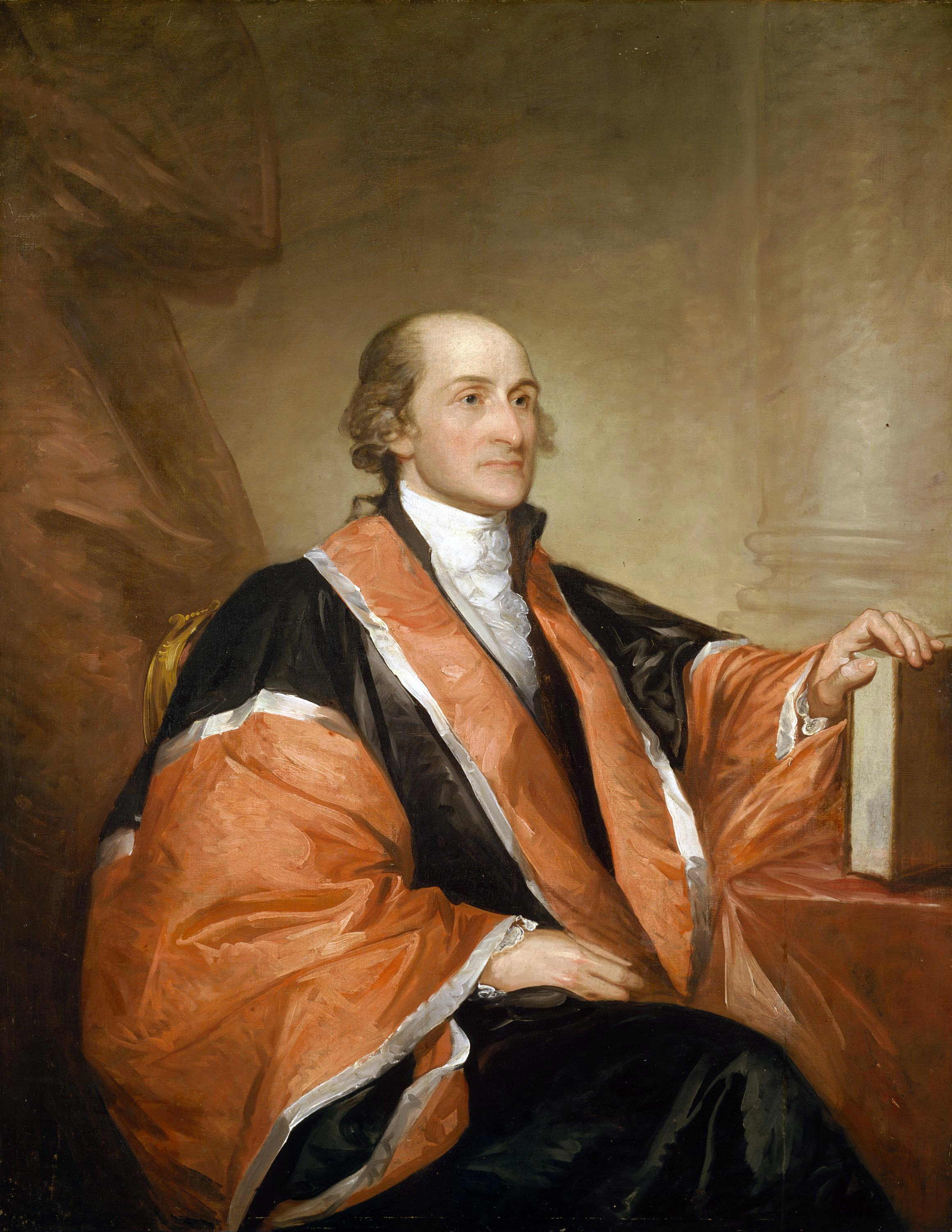
Gilbert Stuart, 1794
Biography
John Jay (1745–1829)
Born into a prosperous New York merchant family of Huguenot descent, Jay grew up in a world shaped by commerce, Protestantism, and the peculiar anxieties of a religious minority that had learned, across generations, to value legal protections and institutional stability. Educated at King's College — later Columbia University — he entered one of the most intellectually demanding legal professions in the colonies and rose with striking speed through New York's political ranks. Yet Jay was no firebrand. His temperament ran toward procedural rigor, careful reasoning, and a suspicion of unchecked enthusiasm that set him apart from many of his revolutionary contemporaries. He became a trusted figure among New York's Patriot leadership precisely because he was not easily swept up in passion. Where others reached for bold rhetoric, Jay reached for durable structures. This instinct — that revolution without institutional design was merely organized destruction — would define his entire career and make him indispensable at moments when the new nation needed not inspiration but architecture. His path into the conflict was not driven by radical ideology but by a conviction that British governance had become incompatible with the legal rights and self-governing traditions that colonists like himself considered foundational.
When New York moved to establish a formal state government amid the chaos of war, Jay became the principal architect of its constitutional framework. Working through the winter and spring of 1776–1777, he drafted a document that balanced popular sovereignty against safeguards for property, executive stability, and the rule of law — principles he considered essential to any government that hoped to outlast its founding crisis. The New York State Constitution was adopted at Kingston in April 1777, and the Senate House there became the venue for the inaugural session of the legislature that Jay's design had created. His constitutional work proved remarkably durable, governing New York for decades and influencing subsequent constitutional thinking at both the state and federal levels. But Jay's contributions extended far beyond Kingston. He served as president of the Continental Congress, represented the United States as minister to Spain during the war, and was one of three American commissioners who negotiated the Treaty of Paris in 1783 — where he pressed, against French expectations, for terms that secured vast western territories and full British recognition of American sovereignty. Each of these roles demanded the same quality: the ability to design agreements and institutions that could hold under pressure.
The risks Jay assumed were real and deeply personal. As a member of one of New York's prominent families, he had wealth, standing, and professional prospects that independence placed in direct jeopardy. British victory would have meant not merely political defeat but the likely confiscation of his property and the ruin of his family's position. When Kingston was burned by British forces in October 1777 — just months after the constitution he had drafted was adopted there — the destruction underscored how fragile the new government truly was. Jay was fighting not only for abstract principles of self-governance but for a specific vision of ordered liberty in which legal institutions protected individuals from both tyranny and mob rule. His insistence on constitutional safeguards reflected a clear-eyed understanding that the people most vulnerable in revolutionary upheaval were often those the revolution claimed to serve. He worked to build a republic that could protect minority rights, sustain commercial life, and resist the gravitational pull toward either anarchy or authoritarianism — dangers he believed were equally lethal to the experiment in self-government that the war had set in motion.
In 1789, George Washington appointed Jay the first Chief Justice of the United States, placing at the head of the new federal judiciary the man who had spent more than a decade thinking about what stable republican institutions required. It was a fitting culmination: the drafter of one of America's earliest and most influential state constitutions now presided over the federal court system that the national Constitution had established. Jay's significance today lies not in dramatic battlefield heroism but in the quieter, more demanding work of building governments that function. His constitutional design at Kingston in 1777 represented one of the first serious American attempts to translate revolutionary ideals into workable law — to answer the question that every revolution must eventually face: what comes after the fighting? Jay's career reminds us that the American founding was as much an act of institutional craftsmanship as it was an act of armed resistance, and that the men and women who built the frameworks of governance deserve the same attention we give to those who carried muskets. His legacy is the architecture itself.
WHY JOHN JAY MATTERS TO KINGSTON
Jay's story teaches us that revolutions are won not only on battlefields but in rooms where people sit down to write constitutions. Kingston was that room. In the spring of 1777, while British forces threatened New York from multiple directions, Jay drafted the state constitution that was adopted there — a document that created a functioning government out of wartime uncertainty. When the British burned Kingston that October, they destroyed buildings but not the institutions Jay had helped design. Students and visitors standing at the Senate House today are standing where American self-governance moved from theory to practice. Jay's work at Kingston reminds us that the most lasting acts of the Revolution were often acts of construction, not destruction — and that the willingness to build durable institutions in the middle of a war is its own form of courage.
TIMELINE
- 1745: Born December 12 in New York City to a prosperous merchant family of Huguenot descent
- 1764: Graduated from King's College (later Columbia University)
- 1774: Elected as a delegate to the First Continental Congress
- 1777: Served as principal drafter of the New York State Constitution, adopted at Kingston in April
- 1778–1779: Served as president of the Continental Congress
- 1779–1782: Served as minister to Spain, seeking diplomatic recognition and financial support
- 1783: Negotiated the Treaty of Paris as one of three American peace commissioners, securing favorable terms for the United States
- 1789: Appointed by President Washington as the first Chief Justice of the United States
- 1794: Negotiated Jay's Treaty with Great Britain, a controversial but consequential diplomatic agreement
- 1795–1801: Served as Governor of New York
- 1829: Died May 17 at his estate in Bedford, New York
SOURCES
- Stahr, Walter. John Jay: Founding Father. Hambledon and London, 2005.
- Pellew, George. John Jay. Houghton Mifflin, 1890.
- Columbia University Libraries. The Papers of John Jay. https://dlc.library.columbia.edu/jay
- New York State Office of Parks, Recreation and Historic Preservation. Senate House State Historic Site. https://parks.ny.gov/historic-sites/senatehouse
- Morris, Richard B. Witnesses at the Creation: Hamilton, Madison, Jay, and the Constitution. Holt, Rinehart and Winston, 1985.