
1747–1792
John Paul Jones
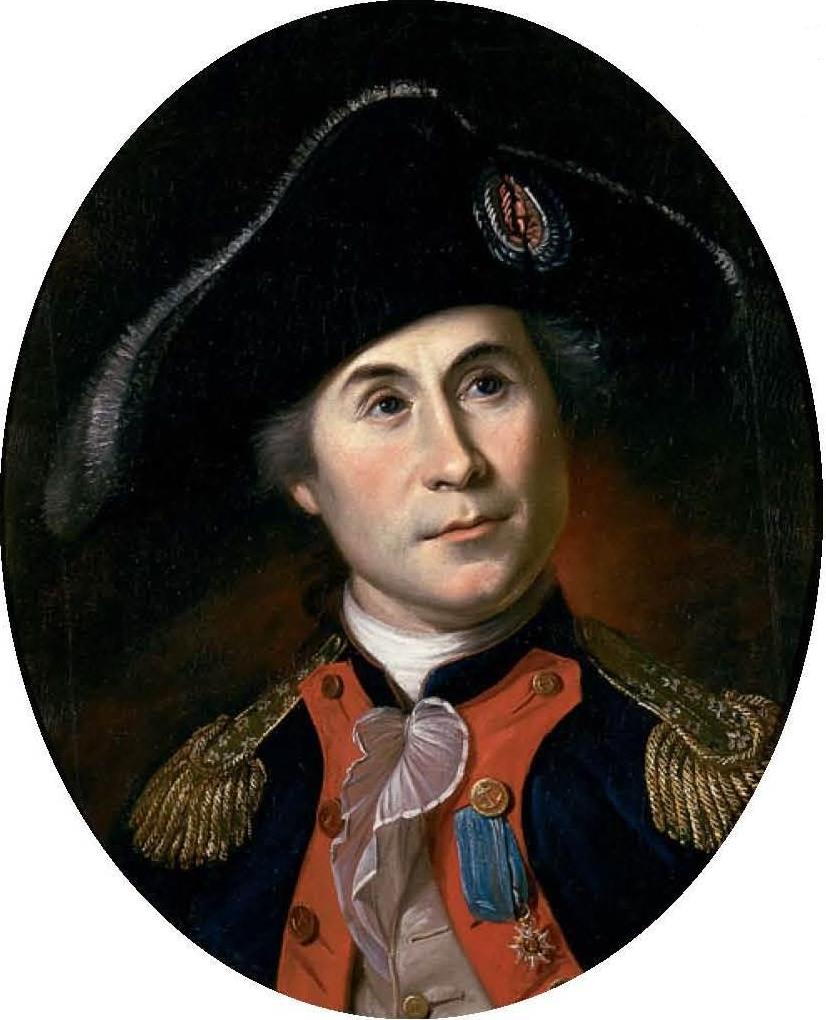
Charles Willson Peale, betw
Biography
John Paul Jones: The Scottish Sailor Who Struck Fear into Britain's Own Shores
Born in 1747 in the gardener's cottage of Arbigland estate in Kirkcudbrightshire, Scotland, the man who would become America's most celebrated naval hero entered the world with no wealth, no title, and no prospects beyond what the sea could offer. Christened simply John Paul, he went to sea at the age of thirteen, apprenticing aboard merchant vessels that sailed between Britain and the colonies. Over the following decade he rose through the ranks of the Atlantic maritime world, serving on merchant ships and, for a time, vessels engaged in the slave trade — an experience he later claimed to have abandoned out of moral disgust. His career took a dark turn in the Caribbean when he killed a mutinous sailor during a confrontation, an incident that forced him to flee to the American colonies around 1772. Settling in the Fredericksburg, Virginia, area, he adopted the surname Jones to conceal his identity and reinvent himself. His years in Virginia connected him to the Patriot networks that were beginning to coalesce in towns like Fredericksburg, and the coming Revolution would offer this restless, ambitious, supremely skilled mariner an opportunity that peacetime commerce never could have provided.
When the Continental Congress established a navy in 1775, John Paul Jones was among the first officers to seek a commission, and his proven seamanship made him a compelling candidate despite his obscure origins. He received a lieutenant's commission in December 1775 and quickly demonstrated the aggressive temperament that would define his career, participating in early naval operations in the Bahamas under Commodore Esek Hopkins. Yet Jones chafed under cautious commanders and the Continental Navy's chaotic system of seniority, which repeatedly placed less experienced officers above him. He lobbied relentlessly — writing to members of Congress, to Robert Morris, to anyone who might advance his cause — for an independent command that would allow him to wage the kind of offensive war he believed essential to American victory. His persistence paid off when Congress assigned him command of the sloop Ranger, then under construction in the shipyards of Portsmouth, New Hampshire. Jones arrived in Portsmouth and oversaw the final outfitting of the vessel, a sleek eighteen-gun warship that represented the best of New England naval craftsmanship. In November 1777, the Ranger was launched from Portsmouth's Langdon Island, and Jones set sail for France, carrying news of the American victory at Saratoga and carrying with him plans for a campaign that no American officer had yet dared to attempt.
Jones's most audacious decision was to carry the war to British home waters — a strategic gamble that no Continental Navy captain had attempted and that many considered suicidal. On the night of April 22–23, 1778, he led a raiding party from the Ranger into the harbor of Whitehaven, England, a port town he knew intimately from his years as a young merchant sailor. His men spiked the guns of the harbor fort and attempted to set fire to the shipping in the harbor. Though the material damage proved limited — only one vessel was burned — the psychological impact was enormous. For the first time since 1667, an enemy force had attacked English soil, and the shock reverberated through British newspapers and Parliament alike. Jones had demonstrated a principle that would define asymmetric naval warfare for centuries: a weaker navy could inflict disproportionate harm by striking where the enemy felt safest. He followed the Whitehaven raid with an attempt to kidnap the Earl of Selkirk from his estate on St. Mary's Isle in Scotland, a scheme that failed when the Earl was absent but that further rattled British confidence. These raids, conceived and executed through Jones's personal initiative, transformed him from an obscure colonial officer into an international figure overnight.
The capture of HMS Drake on April 24, 1778, just one day after the Whitehaven raid, marked a decisive turning point in Jones's career and in the wider perception of American naval capability. The Drake, a twenty-gun Royal Navy sloop stationed at Carrickfergus in Belfast Lough, sailed out to engage the Ranger, and Jones fought a disciplined ship-to-ship action lasting approximately one hour. The Drake's captain was killed and her first lieutenant mortally wounded before the battered British vessel struck her colors. Jones sailed his prize back to the French port of Brest, parading the captured warship before admiring French audiences and proving that the Continental Navy could defeat the Royal Navy in direct combat. Earlier that same year, on February 14, 1778, the Ranger had received the first foreign salute to the American flag when French warships in Quiberon Bay fired nine guns in recognition of the new nation's sovereignty — a diplomatic milestone that Jones took immense personal pride in securing. These events of early 1778, radiating outward from the Portsmouth-built Ranger, elevated Jones to the status of hero on both sides of the Atlantic and set the stage for his legendary command of the Bonhomme Richard.
Jones's rise depended not only on his own daring but on a web of relationships with powerful figures in both America and France. Benjamin Franklin, then serving as American minister in Paris, became Jones's most important patron, securing him the command of the Bonhomme Richard — a converted French merchant vessel — and supporting his plans for further raids on British waters. Jones cultivated French aristocrats, naval officials, and even King Louis XVI himself, understanding that American naval operations in European waters required French logistical and diplomatic support. Back in America, his connections to Virginia's Patriot community and his correspondence with congressional delegates like Robert Morris kept his name before the men who controlled naval appointments. Yet Jones was also a deeply difficult personality — vain, quarrelsome, and contemptuous of officers he considered his inferiors. His relationship with his own crew aboard the Ranger was strained; his officers formally protested his leadership style, and his disputes with Lieutenant Thomas Simpson over prize money and credit nearly derailed his career. These personal conflicts reflected a broader tension within the Continental Navy between individual ambition and collective discipline, a tension that Jones embodied more vividly than any other American officer of the Revolution.
The legacy of John Paul Jones extends far beyond the specific engagements he fought, touching the very identity of the United States Navy and the nation's understanding of what the Revolution required at sea. His willingness to carry offensive warfare to the enemy's homeland — at a time when the Continental Navy possessed barely a handful of serviceable ships — established a tradition of aggressive naval initiative that the American military would claim as foundational for centuries. His famous declaration during the battle with HMS Serapis in September 1779 — "I have not yet begun to fight" — spoken as his own ship was sinking beneath him, became the defining expression of American naval resolve. Yet his later years reveal the Revolution's darker costs: after the war, he served briefly and unhappily in the Russian Imperial Navy at Catherine the Great's invitation, then died in Paris in 1792 at the age of forty-five, largely forgotten by the nation he had helped create. It was not until 1905 that President Theodore Roosevelt arranged for his remains to be returned from a Paris cemetery and interred with full honors at the United States Naval Academy in Annapolis, Maryland, finally cementing his status as the founding hero of American naval tradition.
WHY JOHN PAUL JONES MATTERS TO FREDERICKSBURG
John Paul Jones's story connects two towns in this network — Fredericksburg, Virginia, and Portsmouth, New Hampshire — through the unlikely journey of a Scottish immigrant who reinvented himself in the colonial South and then sailed a New England–built warship into the heart of British power. His years in the Fredericksburg area in the early 1770s placed him within the Patriot networks that would fuel Virginia's commitment to independence, while his command of the Ranger, constructed in Portsmouth's shipyards, demonstrated how the Revolution depended on collaboration across colonial boundaries. For students and visitors, Jones embodies the Revolution's power to transform outsiders into founders. His story teaches that the war was won not only on battlefields but on the open ocean, by individuals willing to take extraordinary risks against a vastly superior naval force.
TIMELINE
- 1747: Born John Paul in Kirkcudbrightshire, Scotland
- 1761: Goes to sea as an apprentice aboard merchant vessels
- 1772: Flees the Caribbean after killing a mutinous sailor; settles in the Fredericksburg, Virginia, area under the adopted name John Paul Jones
- 1775: Receives a lieutenant's commission in the newly formed Continental Navy
- 1777: Takes command of the sloop Ranger, launched from the shipyards of Portsmouth, New Hampshire
- 1778 (February 14): Receives the first foreign salute to the American flag at Quiberon Bay, France
- 1778 (April 22–23): Leads the Ranger raid on Whitehaven, England — the first American naval attack on British soil
- 1778 (April 24): Captures HMS Drake in ship-to-ship combat off Carrickfergus, Ireland
- 1779 (September 23): Defeats HMS Serapis aboard the Bonhomme Richard, reportedly declaring "I have not yet begun to fight"
- 1792: Dies in Paris, France, at the age of forty-five
SOURCES
- Morison, Samuel Eliot. John Paul Jones: A Sailor's Biography. Little, Brown and Company, 1959.
- Thomas, Evan. John Paul Jones: Sailor, Hero, Father of the American Navy. Simon & Schuster, 2003.
- Naval History and Heritage Command. "John Paul Jones." https://www.history.navy.mil/browse-by-topic/people/john-paul-jones.html
- Papers of the Continental Congress, National Archives. Letters and reports from John Paul Jones, 1776–1780. https://www.archives.gov/research/military/american-revolution
- Boudriot, Jean. John Paul Jones and the Bonhomme Richard: A Reconstruction of the Ship and an Account of the Battle with HMS Serapis. Naval Institute Press, 1987.
In Portsmouth
May
1777
Continental Sloop Ranger LaunchedRole: Continental Navy Captain
# The Launch of the Continental Sloop Ranger, 1777 By the spring of 1777, the American struggle for independence was entering a critical phase. The Continental Army had survived the harrowing winter of 1776–1777 and scored morale-boosting victories at Trenton and Princeton, yet the broader military picture remained precarious. At sea, the situation was even more daunting. The Continental Navy, formally established only in October 1775, was a fledgling force vastly outnumbered by the Royal Navy, the most powerful maritime force on earth. American warships were few, often converted merchantmen, and struggled to challenge British dominance of the Atlantic. Against this backdrop, the construction and launch of the Continental sloop Ranger at Portsmouth, New Hampshire, represented both a bold investment in American naval capability and an act of defiance against an empire that considered the seas its unchallenged domain. The Ranger was built at Langdon's Island shipyard in Portsmouth, one of the most active shipbuilding centers in New England. The man overseeing her construction was John Langdon, who served as Continental Navy agent for New Hampshire. Langdon was a prominent merchant, shipbuilder, and patriot whose wealth and organizational energy made him indispensable to the Revolutionary cause in his home state. He used his resources, connections, and knowledge of maritime enterprise to push the Ranger's construction forward at a time when materials and skilled labor were scarce. His brother, Woodbury Langdon, served as a delegate to the Continental Congress and helped ensure that New Hampshire's contributions to the naval war effort received political support in Philadelphia. Together, the Langdon brothers exemplified the blend of local initiative and national commitment that kept the Revolution alive during its most uncertain years. The Ranger was an 18-gun ocean sloop, a relatively small but fast and maneuverable warship well suited to the kind of raiding and commerce disruption that the Continental Navy relied upon in lieu of pitched fleet battles it could not hope to win. Her design reflected the practical realities of American naval strategy: she needed to be swift enough to outrun larger British warships, sturdy enough to cross the Atlantic, and sufficiently well-armed to threaten enemy merchant vessels and smaller warships. When she slid into the waters of the Piscataqua River in the spring of 1777, she embodied the skill of Portsmouth's shipwrights and the determination of a young nation to contest British power wherever it could. In June 1777, Captain John Paul Jones was appointed to command the Ranger. Jones, a Scottish-born mariner who had committed himself to the American cause, was already gaining a reputation as one of the Continental Navy's most aggressive and capable officers. His appointment to the Ranger would prove to be one of the most consequential personnel decisions of the naval war. Under Jones's command, the Ranger sailed for France in November 1777, and within a year of her launch she carried out a series of daring raids in British home waters — an almost unthinkable feat for a navy that barely existed on paper. Jones struck at the English coast, raided the port of Whitehaven, and captured the British warship HMS Drake in April 1778, sending shockwaves through Britain and demonstrating that the Royal Navy could not guarantee the safety of its own shores. The launch of the Ranger matters in the broader story of the American Revolution because it illustrates how the patriots waged war at sea not through overwhelming force but through audacity, resourcefulness, and strategic daring. Portsmouth's shipyards, John Langdon's tireless efforts as navy agent, the political support of figures like Woodbury Langdon, and the fearless seamanship of John Paul Jones all converged in this single vessel. The Ranger proved that a small, well-commanded ship could project American power across an ocean, challenge British confidence, and rally international support for the cause of independence. Her story is a testament to the idea that in revolution, determination and ingenuity can overcome even the most formidable odds.
Feb
1778
First Foreign Salute to the American FlagRole: Continental Navy Captain
# The First Foreign Salute to the American Flag On a cold February afternoon in 1778, something remarkable happened in the harbor of Brest, France — something that carried no sound of musket fire or clash of bayonets, yet resonated as powerfully as any battlefield victory in the American struggle for independence. When French Admiral Toussaint-Guillaume Picquet de la Motte, commonly known as La Motte-Picquet, ordered his flagship to fire a nine-gun salute in honor of the Continental ship Ranger and the flag she flew, he set in motion a moment of profound diplomatic symbolism. It was the first time any foreign naval power had officially recognized the flag of the United States of America, and the man who had maneuvered to make it happen was Captain John Paul Jones, one of the most daring and resourceful officers in the fledgling Continental Navy. To understand the weight of this moment, one must appreciate what the American colonies faced in early 1778. The Revolutionary War had been grinding on for nearly three years. While the stunning American victory at Saratoga in October 1777 had given the cause new momentum and credibility, the Continental Army was still struggling with inadequate supplies, uncertain funding, and the overwhelming naval superiority of Great Britain. The Americans desperately needed foreign allies, and France — Britain's longtime rival — was the most promising prospect. Diplomatic envoys, most notably Benjamin Franklin, had been working tirelessly in Paris to secure a formal alliance. The Treaty of Alliance between France and the United States would indeed be signed on February 6, 1778, just days before the salute at Brest, though news traveled slowly and the full implications of that treaty were still unfolding. In this delicate atmosphere, every gesture of recognition mattered enormously. John Paul Jones had sailed the Ranger across the Atlantic from Portsmouth, New Hampshire, where the ship had been fitted out and launched in 1777. Jones carried with him dispatches informing the American commissioners in France of the victory at Saratoga, news that would help tip French opinion further toward open support of the American cause. Upon arriving in French waters, Jones was keenly aware that a formal salute to his ship's flag would constitute an act of diplomatic recognition — an acknowledgment that the United States was not merely a collection of rebellious colonies but a sovereign nation deserving the courtesies extended between legitimate powers. Flag salute protocol in the eighteenth century was no casual matter. The number of guns fired, the sequence of who saluted first, and whether the salute was returned all carried precise diplomatic meaning. A salute from a foreign navy was, in effect, a statement that the saluting nation regarded the other's flag — and therefore its government — as legitimate. Jones negotiated the terms of the exchange carefully, insisting that the salute match the courtesies typically extended between recognized nations. When Admiral La Motte-Picquet ordered his nine-gun salute on February 14, 1778, he was acting within the emerging framework of Franco-American cooperation, but the gesture still carried a boldness that reflected France's growing willingness to openly challenge Britain. The nine guns were fewer than the salute exchanged between fully equal naval powers, yet the act itself was unprecedented and unmistakable in its meaning. The significance of this event extended far beyond the harbor at Brest. It signaled to the watching world that France was prepared to treat the United States as a legitimate nation, lending the American cause credibility that no amount of battlefield courage alone could have secured. For the Continental Congress and for Americans fighting and sacrificing at home, the news that a major European power had saluted their flag was a powerful morale boost and a sign that their revolution was gaining international standing. In the broader arc of the Revolutionary War, the French alliance that this salute foreshadowed would prove decisive, culminating in the joint Franco-American victory at Yorktown in 1781 that effectively ended the conflict. John Paul Jones, who would go on to become one of the most celebrated naval heroes in American history, understood perhaps better than anyone that day in Brest that wars are won not only with cannons and courage but also with the careful, deliberate work of diplomacy and recognition.
Apr
1778
Ranger Raids Whitehaven, EnglandRole: Continental Navy Captain
# Ranger Raids Whitehaven, England (1778) In the early morning darkness of April 23, 1778, Captain John Paul Jones of the Continental Navy led a daring shore party from the sloop-of-war *Ranger* into the harbor of Whitehaven, a busy coal port on the northwest coast of England. It was an audacious act — the first hostile military incursion onto British soil since the English Civil War more than a century earlier — and though its material results were modest, its psychological and strategic impact rippled far beyond the small harbor town. The raid announced to Britain and to the watching courts of Europe that the American Revolution was no longer a distant colonial rebellion; the war had come home. John Paul Jones was born John Paul in Kirkbean, Scotland, in 1747. He grew up along the shores of the Solway Firth, and as a boy he knew Whitehaven well: it was from that very port that he first went to sea as a merchant apprentice. After a turbulent career in the merchant marine — marked by allegations of cruelty and a killing in the Caribbean that forced him to flee — he arrived in the American colonies around 1773, added "Jones" to his name, and offered his services to the fledgling Continental Navy when war broke out. By 1777 he had distinguished himself as an aggressive and resourceful commander, and the Continental Marine Committee gave him command of the eighteen-gun *Ranger*, fitting her out at Portsmouth, New Hampshire. Jones sailed from Portsmouth on November 1, 1777, carrying dispatches to the American commissioners in Paris and orders to harass British shipping in European waters. After delivering his dispatches in France and learning that France had formally recognized American independence — a momentous diplomatic development — Jones cruised into the Irish Sea in the spring of 1778, capturing merchant prizes and spreading alarm. His plan for Whitehaven was characteristically bold: he would land under cover of night, spike the cannons of the two small forts guarding the harbor, and then set fire to the several hundred merchant vessels crowded together at anchor. If successful, the conflagration would destroy a significant portion of Britain's coastal trading fleet and shatter the assumption that the Royal Navy's dominance made the British homeland invulnerable. Jones divided his roughly thirty volunteers into two parties. He personally led one group to the fort on the southern side of the harbor, where they scaled the walls, overpowered the sentries, and spiked the guns. The second party was tasked with setting fires among the ships. From the start, however, things went wrong. The operation took longer than planned, and dawn began to break before the incendiary work was well under way. One of Jones's own men, a disaffected Irish-born sailor named David Freeman, slipped away and roused townspeople, warning them of the attack. When Jones managed to set fire to the coal ship *Thompson*, the alarmed inhabitants quickly organized bucket brigades and extinguished the flames before they could spread to neighboring vessels. With daylight exposing his small force and the town now fully awake, Jones withdrew his men to the *Ranger* and put to sea. Measured in tonnage burned, the raid was a failure. But its consequences extended far beyond the waterfront at Whitehaven. Panic swept the coastal communities of England and Scotland. Insurance rates for shipping soared. Militia companies were hastily mustered, and the British Admiralty was forced to divert warships from other duties to patrol home waters — resources that might otherwise have been deployed against American and French forces across the Atlantic. In the courts of Europe, the raid bolstered the image of the American cause as a serious military enterprise deserving of support, reinforcing France's recent decision to enter the war as an American ally. For John Paul Jones, Whitehaven was only the beginning of a remarkable wartime career that would culminate in his legendary victory aboard the *Bonhomme Richard* against HMS *Serapis* in September 1779. But the small-scale raid on an English harbor in the predawn hours of April 1778 remains one of the most symbolically significant naval actions of the Revolution, a moment when the war crossed an ocean and the notion of British invincibility on its own shores was, for the first time in living memory, called into question.
Apr
1778
Ranger Captures HMS DrakeRole: Continental Navy Captain
# Ranger Captures HMS Drake In the spring of 1778, Captain John Paul Jones of the Continental Navy achieved one of the most remarkable naval victories of the American Revolutionary War when his ship, the Ranger, defeated and captured the British sloop of war HMS Drake in waters just off Carrickfergus, Ireland. This engagement, which lasted approximately one hour, represented a stunning triumph for the fledgling American navy and sent shockwaves through the British Admiralty. It was the first time an American warship had captured a British naval vessel and successfully brought it as a prize to a European port — a feat that carried enormous symbolic and diplomatic weight at a critical moment in the struggle for American independence. To understand the significance of this event, one must consider the broader context of Jones's daring cruise through British home waters. By 1778, the American Revolution was entering a pivotal phase. The Continental Army's victory at Saratoga the previous autumn had convinced France to enter into a formal alliance with the United States, but the Continental Navy remained vastly outmatched by the Royal Navy, the most powerful maritime force in the world. Jones, a Scottish-born sailor who had committed himself to the American cause, was determined to demonstrate that the new nation could strike boldly at sea — even in waters the British considered their own. Sailing from Brest, France, aboard the eighteen-gun sloop Ranger, Jones embarked on an audacious mission to raid British coastal targets and disrupt enemy shipping, carrying the war directly to the shores of Great Britain itself. Just one day before engaging the Drake, Jones had led an extraordinary raid on the port of Whitehaven, England, where he and a small landing party went ashore under cover of darkness to spike the guns of harbor defenses and set fire to shipping in the harbor. Though the material damage was limited, the psychological impact was profound — it was one of the very few times during the war that American forces attacked a target on British soil. With British coastal communities now on alert and the Royal Navy scrambling to respond, Jones turned his attention to an even more ambitious objective: a direct engagement with a British warship. On April 24, 1778, Jones maneuvered the Ranger into Belfast Lough, where the HMS Drake, a twenty-gun sloop of war, lay at anchor off the town of Carrickfergus. The Drake's commander, aware of the Ranger's presence, sailed out to meet the American vessel. What followed was a fierce ship-to-ship battle that tested the seamanship and gunnery of both crews. After roughly an hour of close combat, the Drake — her rigging shattered, her hull riddled with shot, and her captain and first lieutenant among the casualties — struck her colors in surrender. The British vessel suffered significantly heavier casualties than the Ranger, a testament to the effectiveness of Jones's tactics and the determination of his crew. Jones then undertook the remarkable task of sailing both the Ranger and his captured prize across the open sea to Brest, France, where he arrived to a hero's welcome. The arrival of the Drake in a French port electrified the American cause in Europe. It provided tangible proof that the Continental Navy was capable of defeating the Royal Navy in direct combat, bolstering American credibility at the very moment when the Franco-American alliance was taking shape. For the French, whose own navy would soon play a decisive role in the war, Jones's victory offered reassuring evidence that their new ally possessed both the courage and the capability to challenge British naval supremacy. The capture of the HMS Drake cemented John Paul Jones's reputation as one of the most daring and resourceful naval commanders of the Revolutionary War. His willingness to carry the fight into enemy waters and engage British warships on their own terms inspired confidence in the American cause and demonstrated that even a young, under-resourced navy could achieve extraordinary results through boldness, skill, and determination. The engagement remains one of the defining moments of American naval history and a powerful reminder of the outsized role that individual courage and initiative played in securing American independence.