
MA, USA
Concord
The Revolutionary War history of Concord.
Why Concord Matters
Concord, Massachusetts: The Town That Fired Back
On the morning of April 19, 1775, a column of roughly seven hundred British regulars marched into the quiet village of Concord, Massachusetts, expecting to seize a cache of provincial military supplies and return to Boston before nightfall. By sunset, the regulars were staggering back toward Charlestown under relentless fire from thousands of colonial militiamen, and the political quarrel between Parliament and its American colonies had become a shooting war. What happened in Concord that day — and in the months of preparation that preceded it — was not an accident of geography or a stroke of luck. It was the product of deliberate political organizing, logistical planning, economic resistance, and, ultimately, an extraordinary collective decision by ordinary citizens to stand in the path of the most powerful military force on earth. Concord's place in the story of American independence is not simply that of a battlefield. It is the place where the idea of citizen resistance became an irreversible fact.
To understand why the British marched on Concord, one must look back to the fall of 1774, when Massachusetts was already in a state of quiet rebellion. After Parliament passed the Coercive Acts — known in the colonies as the Intolerable Acts — effectively dissolving the colony's charter government, patriot leaders organized the Massachusetts Provincial Congress as an alternative governing body. This extralegal assembly met in Concord beginning in October 1774, choosing the town precisely because it was far enough from British-occupied Boston to conduct its business without interference and central enough in the colony's road network to be easily reached by delegates from across Massachusetts. In the fall of 1774, Concord was a thriving farming community and regional trading hub with a population of nearly 1,500 inhabitants, accessible to Boston via two roads. The first Provincial Congress convened in Concord from October 11 to 14, 1774, and the body would return for a longer second session from March 22 to April 15, 1775 — adjourning just four days before the British marched. The Provincial Congress, with John Hancock as its president and the Reverend William Emerson — Concord's patriot minister, known for his inspirational sermons — serving as chaplain, did more than issue resolutions. Meeting at the Concord courthouse, with committees gathering at the nearby Wright Tavern, the delegates authorized the collection of military supplies, organized a system of minute companies — militia units pledged to muster at a moment's notice — and laid the groundwork for armed resistance should diplomacy fail. On November 7, 1774, the Congress's Committee of Supplies specifically recommended purchasing food, provisions, and ammunition and storing them at Concord and Worcester, the two principal rebel depots. By early 1775, the scale of these preparations had grown dramatically: the Congress instructed the Committee of Supplies to purchase "all kinds of warlike stores, sufficient for an army of fifteen thousand men to take the field."
Supply depots were established in places like Concord and Worcester, and the Committee of Safety began procuring supplies in case of a conflict with the British forces garrisoned in Boston.
The man charged with overseeing Concord's share of these vital stores was Colonel James Barrett, a veteran of the French and Indian War who commanded the Middlesex Militia Regiment. Barrett was asked to accept the rank of colonel commanding a militia regiment, in addition to being superintendent of the military stores being gathered in the Concord depot.
Barrett divided the weapons and gunpowder between thirty farms in the vicinity of Concord for storage and concealment. Among the most sensitive items were four brass cannons that had been secretly removed from Boston — the very prizes General Gage most wanted to recover. Samuel Whitney, a delegate to the Provincial Congress and muster master of the Concord Minute Men, stored a portion of the town's ammunition supply in the warehouse on his property. Concord was not merely a passive depot; it was a town mobilized at every level. By January of 1775, the town had raised two companies of minutemen, fifty-two men each — one commanded by Captain David Brown and the other by Captain Charles Miles — and agreed they should turn out to drill two half-days per week, three hours in each half-day, at a rate of one shilling and four pence per half-day. The town also maintained two regular militia companies under Captains Nathan Barrett and George Minot.
The British, meanwhile, were not blind to what was happening. In a February 1775 address to King George III, both houses of Parliament declared that a state of rebellion existed in the Province of Massachusetts Bay.
In January, Gage issued orders for Captain John Brown and Ensign Henry de Berniere to travel through the countryside, taking sketches and noting tactical features; surveying Middlesex County in March, the two spies discovered a store of weapons and supplies in Concord. Gage also relied on intelligence from a secret informant inside the Provincial Congress itself — later revealed to be Dr. Benjamin Church — who reported that the Congress had appointed a committee to "watch" the army and that the minutemen amounted to 7,500 picked men, adding that nearly the rebels' entire magazine of powder, some 90 to 100 barrels, lay hidden at Concord.
On April 14, 1775, Gage learned the Crown had declared Massachusetts to be in rebellion and ordered him to act. He moved quickly: the next day he ordered flank companies from ten regiments and the marine battalion to be organized into an ad hoc brigade of roughly 700 troops under Lieutenant Colonel Francis Smith, with Major John Pitcairn of the marines as second-in-command.
On the evening of April 18, 1775, General Thomas Gage sent approximately 700 British soldiers out to Concord — about eighteen miles distant — to seize and destroy military stores and equipment known to be stockpiled in the town. The orders to Lieutenant Colonel Smith, preserved in the historical record, were explicit: Smith was directed to march "with the utmost expedition and secrecy to Concord, where you will seize and destroy all Artillery, Ammunition, Provision, Tents, Small Arms, and all military stores whatever."
Gage cautioned that "the Soldiers do not plunder the inhabitants, or hurt private property." A small party of mounted officers was dispatched ahead to intercept any messengers and ensure no warnings reached Concord in advance.
But the patriot intelligence network was already in motion. When Joseph Warren in Boston detected the expedition, he dispatched Paul Revere and William Dawes to carry the alarm. Outside Lexington, Revere, Dawes, and a young Concord physician named Dr. Samuel Prescott encountered a British patrol; the officers captured Revere, Dawes escaped but turned back, and Prescott alone broke through.
Prescott is the only one of the three who actually made it to Concord.
On the early morning of April 19, the people of Concord were awoken by the tolling of the meeting house bell after Dr. Prescott reported that a large number of British Regular soldiers were headed for Concord.
Themes
Liberty and Freedom
At North Bridge, colonial farmers first exercised by force the liberties they claimed by right.
Citizen Soldiers
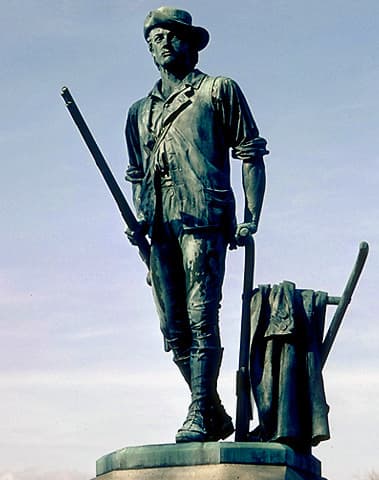
The Concord minutemen exemplified the citizen-soldier ideal: farmers and tradesmen who became fighters when called.
Women of the Revolution
Women like Martha Moulton and Rebecca Barrett shaped April 19 through direct action, not passive observation.
Preservation and Memory
North Bridge and the Old Manse are among the most carefully preserved Revolutionary sites in America.
Military Innovation
The engagement at North Bridge demonstrated new tactical approaches—asymmetric warfare against professional soldiers.
Economic Resistance
The hidden supplies—cannons, powder, shot—represented months of organized colonial procurement and preparation.
Historical Routes
Paul Revere's Midnight Ride Route
Stop 3 of 3