
NJ, USA
Fort Lee
The Revolutionary War history of Fort Lee.
Why Fort Lee Matters
The Cliffs of Decision: Fort Lee and the Revolutionary War's Darkest Hour
On the morning of November 20, 1776, roughly six thousand British and Hessian troops under Lieutenant General Charles Cornwallis began scaling the sheer rock face of the Palisades in the pre-dawn darkness, ascending from the Hudson River toward the flat ground above where the Continental Army's Fort Lee sat largely unprepared. Within hours, the fort would be abandoned, hundreds of pieces of precious equipment lost, and George Washington's army would begin a desperate retreat across New Jersey that nearly ended the American Revolution before it had truly begun. Fort Lee's story is not one of triumph. It is a story of strategic miscalculation, narrow escape, tenacious leadership, and the forging of resolve under catastrophic pressure — the kind of story that reveals far more about the character of the Revolution than any victory ever could.
To understand what happened at Fort Lee, one must first understand why it existed. In the summer of 1776, after the Continental Army evacuated New York City following its defeat at the Battle of Long Island, American commanders confronted a pressing strategic question: how to deny the British Royal Navy control of the Hudson River. If British warships could sail freely up the Hudson, they could sever New England — the cradle of the rebellion — from the middle and southern colonies, splitting the new nation in two. Washington and his generals conceived a plan to block the river using a paired fortification system. Fort Washington, on the high ground of Manhattan's northern tip, would work in concert with a companion fort on the New Jersey Palisades directly across the river. That companion was originally called Fort Constitution, but it was soon renamed Fort Lee in honor of Major General Charles Lee, then one of the most celebrated officers in the Continental Army. The name was chosen specifically to honor General Charles Lee's victory in Charleston, South Carolina — his successful defense of Fort Sullivan in June 1776, which had made him a hero throughout the colonies. At the end of September 1776, Fort Constitution was officially renamed Fort Lee, for General Charles Lee of the Continental Army.
Construction of Fort Lee began in the summer of 1776. In July 1776, General Washington instructed General Hugh Mercer to build Fort Lee on the New Jersey side of the Hudson River. The work fell under the broader supervision of Nathanael Greene, the Rhode Island-born major general whom Washington trusted perhaps more than any other subordinate. Greene, who was largely self-educated in military science and had risen from a Quaker ironworker's son to a commanding general in barely two years, oversaw the building of earthwork fortifications on the bluff overlooking the Hudson. At first, efforts were concentrated close to the water level near Burdett's Landing. Later, fortifications were added atop the bluff under the supervision of Joseph Philips, Battalion Commander of the New Jersey State Militia. The position seemed formidable: the Palisades rose some three hundred feet above the river. The completed fort itself was a square earthworks with four bastions, occupying the neighborhood now defined by Parker Avenue, Cedar and English Streets in Fort Lee.
The original star-shaped Fort Lee was positioned to work in tandem with Fort Washington across the river.
The site on which the fort was built carried its own history. In 1756, Stephen Bourdette had purchased 400 acres of wooded land north of present-day Edgewater; present-day Fort Lee was part of his property.
The stone house Mr. Bourdette built was the only one for nearly a mile around — and this same house later became General George Washington's headquarters during the American Revolution.
The Bourdette's ferry service was taken over by the Army, and Peter Bourdette was forced to vacate his house; although as a patriot he considered it no sacrifice and offered the work of his slaves to General Mercer's construction efforts.
At this stage of the war the ferry operated as a supply line and the only link between Forts Lee and Washington.
Between the twin forts, the Americans deployed a critical line of underwater defenses. Chevaux-de-frise — a medieval defense featuring a log frame and iron-tipped spikes designed to pierce ship bottoms — were sunk in the river between the two forts.
At General Rufus Putnam's suggestion, obstructions were sunk in the river channel between the forts. Sunken ships were also placed in the channel to further narrow the passage. With these barriers in place and artillery fire from both forts, the Americans believed no British warship could pass without sustaining severe damage.
That confidence was tested early. On July 12, Admiral Richard Howe sent two British ships, the Rose and the Phoenix, up the Hudson.
Cannon fire from Fort Washington alone had little effect on their passage; Washington ordered work on Fort Lee to advance as quickly as possible. The ease with which the British warships sailed past the incomplete defenses was a sobering warning — one that, tragically, was not fully heeded. On October 27, two British frigates were heavily damaged by the forts as they provided support for probing attacks on the Fort Washington defenses. The ships, whose guns could not elevate high enough to attack the forts, were saved only after being towed out of the line of fire. That engagement offered a momentary reassurance that the paired fortification system could work, but events would soon prove otherwise.
By mid-August, Sir William Howe, British Commander-in-Chief, had assembled an army of over 31,000 British, Hessian, and loyalist troops on Staten Island. Through the autumn of 1776, Washington's army suffered a grinding series of defeats — Long Island, Kip's Bay, Harlem Heights, White Plains — that pushed the Continentals ever northward on Manhattan. When Howe turned his attention back toward the Hudson, the fate of the twin forts was sealed.
On November 16, 1776, Fort Washington fell in a devastating assault. 8,000 British and Hessian troops attacked some 2,900 American troops holding the fort. When he heard the attack begin, Washington, who had stationed himself across the Hudson River in New Jersey, travelled across the river to personally inspect the fort's defenses. Several officers accompanied Washington, including Generals Israel Putnam, Hugh Mercer, and Nathanael Greene. They convinced Washington to leave the fort just 30 minutes before it was surrounded. The fort's surrender cost the Continental Army dearly: 59 killed, 96 wounded, and 2,837 captured. It was a catastrophe — and it left Fort Lee exposed and strategically useless. As Greene himself later wrote, "The loss of Fort Washington renderd Fort Lee useless."
Washington recognized this immediately. In a letter written to John Hancock on November 19, 1776, the general wrote that "...Fort Lee was always considered as only necessary in conjunction with [Fort Washington]...," and that it would be abandoned as soon as provisions and other supplies were removed. But he was running out of time.
General William Howe ordered General Charles Cornwallis to "clear the rebel troops from New Jersey without a major engagement, and to do it quickly before the weather changed."
The force included Hessian units commanded by Colonel Carl von Donop.
The invasion of New Jersey began the night of November 19–20, when 5,000 British troops ferried across the Hudson on barges and began landing near New Dock Landing. By daylight they had scaled the Palisades six miles north of the fort and begun their march south, hoping to
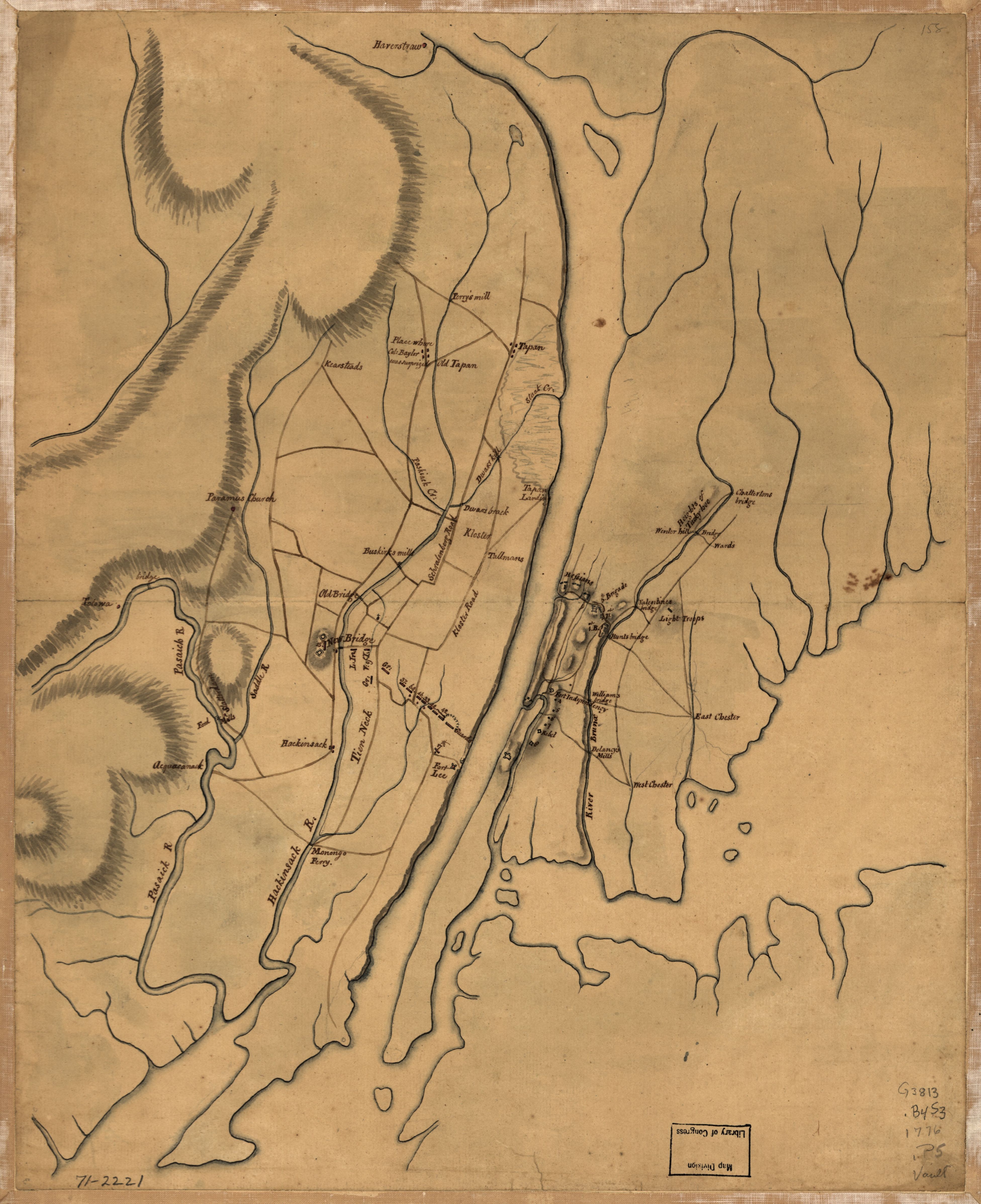
Historical Routes
Washington's Retreat Across New Jersey
Stop 1 of 5