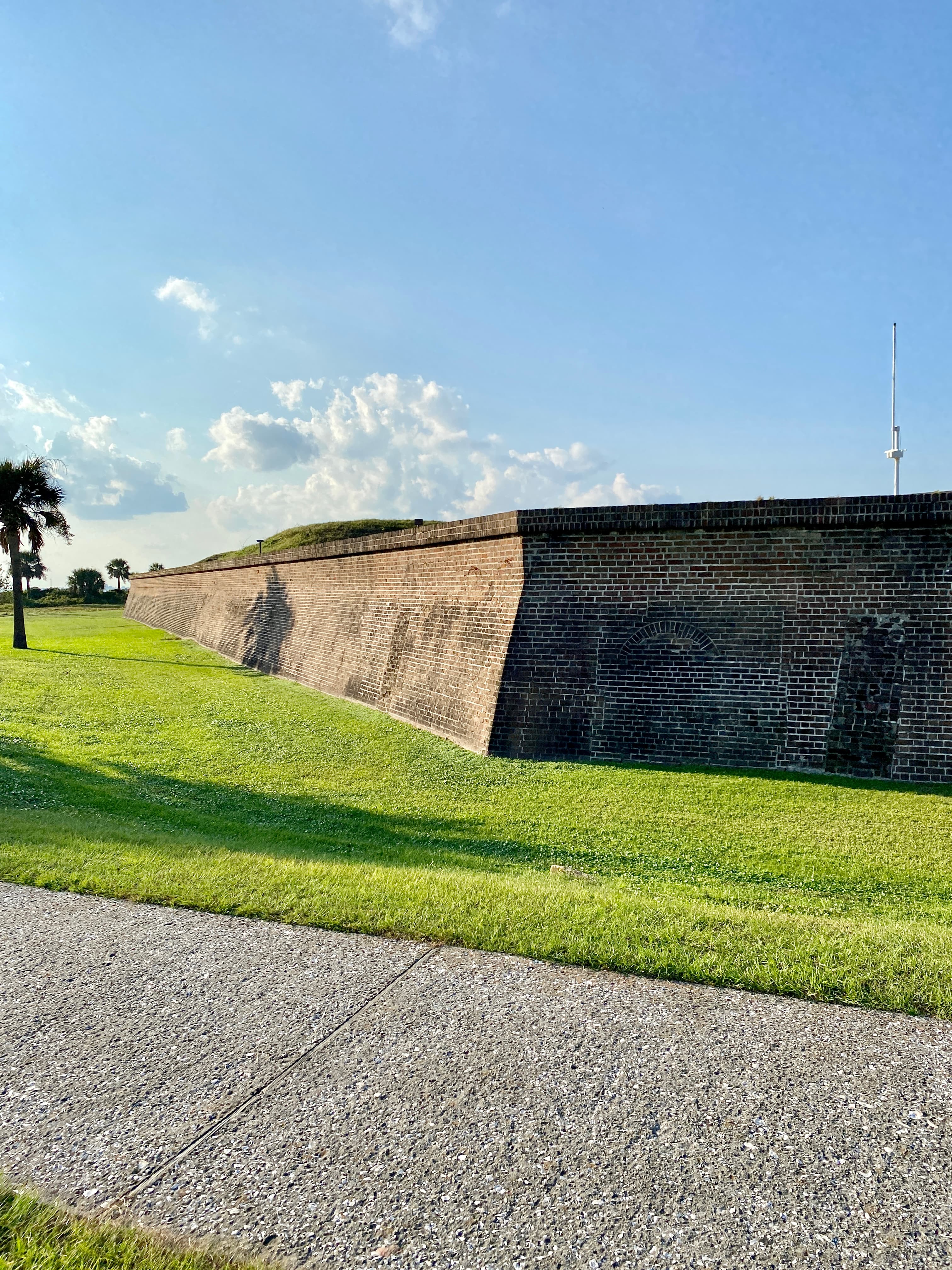
SC, USA
Fort Moultrie
The Revolutionary War history of Fort Moultrie.
Why Fort Moultrie Matters
Fort Moultrie and the Palmetto Republic: Charleston Harbor's Revolutionary Defiance
On the morning of June 28, 1776, the half-finished fort on Sullivan's Island was, by any conventional military measure, an absurdity. Its walls were incomplete. Its garrison was outnumbered. Its commander had been told by a superior officer to abandon it. And yet what happened there that day produced one of the most consequential American victories of the entire Revolutionary War—a victory that saved the South for the patriot cause, gave a fledgling nation a desperately needed symbol of resistance, and planted the palmetto tree permanently in the identity of South Carolina. The story of Fort Moultrie is not simply a story of a single battle; it is a story about improvisation, defiance, and the strange alchemy by which a military embarrassment for the British became a founding myth for the Americans.
To understand what happened at Sullivan's Island, one must first understand what the British intended for Charleston in the spring of 1776. By early that year, British strategic thinking had turned southward. The ministry in London believed that loyalist sentiment ran deep in the southern colonies—particularly in the Carolina backcountry—and that a decisive show of naval force at Charleston, the wealthiest and most important port south of Philadelphia, could rally thousands of King's supporters, split the rebellion geographically, and secure a vital base of operations. To that end, a substantial expeditionary force was assembled: a fleet of warships under Commodore Sir Peter Parker, carrying roughly fifty guns on his flagship Bristol alone, and land forces under General Henry Clinton, who had sailed south from Boston with several regiments and intended to coordinate with loyalist militia. Clinton had sailed south from Boston in January 1776 with a small force to rendezvous off the Cape Fear River in North Carolina with Lord Charles Cornwallis, who sailed with seven regiments from Cork, Ireland.
Upon their meeting at Cape Fear in February 1776, Clinton and Cornwallis learned of the defeat of Loyalists at the Battle of Moores Creek Bridge —a blow that undercut the very premise of the southern expedition. Undeterred, the combined force arrived off the Carolina coast in late May and early June 1776, and the target was clear. Charleston's outer harbor was guarded by Sullivan's Island, a low, sandy barrier island at the harbor's mouth. Whoever held Sullivan's Island controlled access to the city.
The Americans knew this, too, and had been working since early 1776 to erect a fort on the island's southwestern tip. To defend against a British attack, South Carolinians and enslaved Africans built a palmetto-log fort on Sullivan's Island that remained unfinished when the Royal Navy appeared off the Charleston Bar in June 1776. The structure—known simply as Fort Sullivan—was designed by Colonel William Moultrie, a veteran of frontier warfare against the Cherokee and a man whose calm temperament would prove more valuable than any engineering expertise. The fort's design was unorthodox: its walls were constructed from palmetto logs laid in parallel rows, sixteen feet apart, with the space between them filled with sand. The unnamed fort was to be a square with five-hundred-foot-long walls and a bastion at each corner.
The walls were made from palmetto logs twenty feet high and sixteen feet wide, filled with sand, and rose ten feet above the wooden platforms on which the artillery were mounted. Palmetto wood is soft and spongy, nothing like the hardwoods favored in European fortification. To professional military engineers, the idea of building a fort from such material seemed almost negligent. But the soft, fibrous logs would prove to have a remarkable property: rather than splintering under cannon fire, they absorbed the impact. Cannonballs buried themselves in the spongy wood and sand. A hastily erected palisade of thick planks helped guard the powder magazine and unfinished northern walls, while an assortment of thirty-one cannon, ranging from 9- and 12-pounders to a few British 18-pounders and French 26-pounders, dotted the front and rear walls.
The fort's garrison was modest but determined. Colonel Moultrie took command of Sullivan's Island on March 2, 1776, with a garrison of 413 men of the 2nd South Carolina Regiment of Infantry and 22 men of the 4th South Carolina Regiment, artillery. Among the officers who would distinguish themselves that day was Major Francis Marion, then a relatively unknown captain-turned-major in the 2nd South Carolina. Marion commanded the left wing of the fort, in which were emplaced some of the heaviest cannon. He would later earn immortality as the "Swamp Fox," but Sullivan's Island was his first major combat action.
The drama leading up to the battle was nearly as remarkable as the fight itself. Sent by Congress as commander of the newly created Southern Department, Major General Charles Lee was deemed "the first officer in military knowledge and experience" in Washington's recent assessment, although "rather fickle and violent, I fear, in his temper." Lee arrived in Charleston on June 8 with two thousand Continental soldiers from Virginia and North Carolina. When he inspected the unfinished palmetto fort, he was appalled. Nothing worried Lee more than the vulnerability of Moultrie's fort, which he deemed a flimsy palmetto "slaughter pen" for its defenders. He ordered construction of an escape bridge built of empty hogsheads across the Cove, an inlet that separated the island from the mainland. "Sir, when those ships come to lay alongside of your fort," he warned Moultrie, "they will knock it down in half an hour."
Lee urged evacuation. But John Rutledge, the president of South Carolina's revolutionary government, refused to yield the position. President Rutledge specifically ordered Colonel Moultrie to "obey [Lee] in everything, except in leaving Fort Sullivan."
Moultrie's delaying tactics so angered Lee that he decided on June 27 that he would replace Moultrie; the battle began the next day before he could do so.
The British plan was a two-pronged assault. Parker's warships would bombard the fort from the harbor while Clinton's infantry, landed on Long Island (present-day Isle of Palms), would cross Breach Inlet—a narrow channel separating Long Island from Sullivan's Island—and attack the fort's unfinished rear. It had been "confidently reported by the pilots," Clinton wrote, that at ebb tide the two islands were "joined by a ford passable on foot" across Breach Inlet. A closer inspection revealed a channel that even at low water was a hundred yards wide and seven feet deep, not the eighteen inches Clinton expected. This miscalculation would prove fatal to the British plan.
Defending the northern end of Sullivan's Island against possible British attack, eight hundred defenders, including thirty allied Catawba warriors, dug in with two cannons under Colonel William "Old Danger" Thomson.
Thomson's diverse force included his 3rd South Carolina Regiment of rangers, South Carolina state troops, North Carolina regulars, a small detachment of militia, a few artillerymen from the 4th South Carolina Regiment, and the Raccoon, or Foot Rover, company, which included approximately thirty warriors from the Catawba and associated American Indian tribes. Thomson's men constructed br