
28
Jun
1776
Battle of Fort Sullivan (Fort Moultrie)
Fort Moultrie, SC· day date
The Story
**The Battle of Fort Sullivan (Fort Moultrie), June 28, 1776**
By the spring of 1776, the British military had set its sights on the southern colonies, believing that a strong concentration of Loyalist sympathizers in the Carolinas and Georgia could be rallied to help crush the growing rebellion. The strategic port city of Charleston, South Carolina, was a prime target. If the British could seize Charleston, they would gain control of one of the most important harbors in the South and establish a base from which to project power across the region. To that end, the Crown dispatched a joint naval and land force under the command of Commodore Sir Peter Parker, who led a fleet of nine warships, and General Henry Clinton, who commanded a contingent of ground troops. Their objective was to reduce the defenses guarding Charleston Harbor and take the city.
Standing in their way was a hastily constructed fort on Sullivan's Island, a narrow barrier island at the mouth of the harbor. The fort, later renamed Fort Moultrie in honor of its defender, was under the command of Colonel William Moultrie of the 2nd South Carolina Regiment. Moultrie, a seasoned officer with experience in frontier warfare, had overseen the construction of the fort's walls, which were built from palmetto logs and sand — an unconventional choice born more of necessity than engineering theory. Many military observers, including the Continental Army's own General Charles Lee, who had been sent south to oversee Charleston's defenses, doubted whether the fort could withstand a sustained naval bombardment. Lee even considered ordering an evacuation, but Moultrie insisted that his garrison could hold the position.
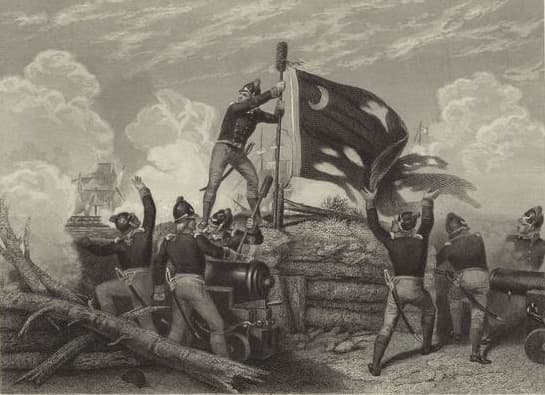
On the morning of June 28, 1776, Parker's fleet, led by his flagship HMS Bristol, moved into position and opened fire on Fort Sullivan at approximately eleven o'clock. What followed was one of the most remarkable engagements of the entire Revolutionary War. The bombardment lasted nearly ten hours, with the British warships unleashing a relentless barrage of cannon fire against the fort. Yet the palmetto log walls, soft and spongy by nature, absorbed the impact of the cannonballs rather than splintering apart as harder timber would have done. The sand packed between the walls further cushioned the blows. The fort held.
Meanwhile, Moultrie's garrison, though vastly outgunned, returned fire with remarkable discipline and accuracy. Their cannonballs struck HMS Bristol more than seventy times, killing or wounding a large portion of her crew and injuring Commodore Parker himself. The frigate HMS Actaeon ran aground on a sandbar during the fighting and could not be freed; her crew was eventually forced to set her ablaze to prevent her capture. At the same time, General Clinton's land force, which had been positioned on nearby Long Island with the intention of crossing over to Sullivan's Island to assault the fort from the rear, found the channel between the two islands unexpectedly deep and impassable. Clinton's troops never joined the battle. By nightfall, Parker ordered the battered fleet to withdraw. The British had suffered approximately 225 casualties, while American losses amounted to just 37 men.
The victory at Fort Sullivan was enormously consequential. It saved Charleston from British occupation for nearly four years, denying the Crown a critical southern stronghold during the war's early and most vulnerable phase. The battle provided a tremendous boost to American morale at a pivotal moment — it occurred just days before the Continental Congress formally adopted the Declaration of Independence on July 4, 1776, and demonstrated that colonial forces could successfully stand against the formidable Royal Navy. Colonel Moultrie became a celebrated hero throughout the colonies, and the fort was renamed in his honor. The palmetto tree, whose humble logs had absorbed the fury of British guns, became an enduring symbol of South Carolina's resilience and still appears on the state flag today. The British would not return to Charleston in force until 1780, when they finally captured the city in one of the war's most devastating American defeats — but the courage shown on Sullivan's Island in June 1776 remained a lasting testament to the determination of the patriot cause.
People Involved
Colonel William Moultrie
Continental Army Colonel
South Carolina colonel who commanded the garrison at Fort Sullivan on June 28, 1776. His calm conduct during the British bombardment and his effective direction of the fort's artillery made the victory possible. The fort was renamed Fort Moultrie in his honor.
Commodore Sir Peter Parker
Royal Navy Commodore
Royal Navy commodore who commanded the British fleet during the June 28, 1776 bombardment of Fort Sullivan. His flagship HMS Bristol was hit more than 70 times. Parker himself was wounded when a fragment tore away part of his clothing. The fleet withdrew having failed completely.
General Henry Clinton
British General
British general who commanded the land force intended to attack Fort Sullivan from Long Island. His troops discovered the crossing channel was impassable at the planned depth and could not support the naval bombardment. Clinton returned in 1780 with a completely different approach and captured Charleston.
Sources for Fort Moultrie