PA, USA
Valley Forge
The Revolutionary War history of Valley Forge.
Why Valley Forge Matters
Valley Forge: The Crucible of an Army and a Nation
When the ragged columns of the Continental Army began filing into the rolling hills along the Schuylkill River on December 19, 1777, they were not marching toward a battle. They were marching toward something far more uncertain — a winter encampment that would test whether the American cause could survive its own internal failures. Valley Forge was never the site of a major engagement with the British. No grand charge or dramatic siege took place on its frozen ground. Yet what happened there over the course of six brutal months proved more consequential than many of the war's pitched battles. It was at Valley Forge that a demoralized, starving, and politically fractured army was remade into a disciplined fighting force capable of winning a war against the most powerful empire on earth.
The decision to encamp at Valley Forge, a modest iron-forging community roughly eighteen miles northwest of British-occupied Philadelphia, was George Washington's, and it was controversial from the start. The Continental Army had just endured a punishing autumn campaign season. The defeats at Brandywine in September and Germantown in October had failed to prevent the British under General William Howe from capturing Philadelphia, the seat of the Continental Congress. The Continental Army that trudged into Valley Forge in December 1777 was demoralized by recent defeats at Brandywine (September 11, 1777), Paoli (September 21), and Germantown (October 4). The nighttime surprise attack at Paoli — sometimes referred to as the Paoli Massacre, in which only 53 Americans perished but Patriot propagandists vilified the tactics employed by the British, who cut men down with bayonets — had further demoralized the troops. Members of Congress had fled to York, Pennsylvania, and public confidence in Washington's leadership was eroding. Some in Congress and even within the officer corps whispered that other generals — particularly Horatio Gates, the hero of Saratoga — might be better suited to command. This political intrigue, known to history as the Conway Cabal after the Irish-born French officer Thomas Conway who helped foment it, shadowed Washington throughout the winter. Though the conspiracy never coalesced into a formal plot to remove him, it reflected a genuine crisis of confidence in the American high command at the very moment the army settled into its winter quarters. The cabal effectively dissolved by spring; Conway resigned his commission in April 1778 after being wounded in a duel with a Washington loyalist, General John Cadwalader.
Washington chose Valley Forge for strategic reasons. The site offered defensible high ground between the Schuylkill River and Valley Creek, close enough to Philadelphia to monitor British movements but far enough to avoid a surprise attack. Washington chose the site for the encampment because it was between the British and the Second Continental Congress in York, as well as supply depots in Reading. Interested parties had suggested other sites for an encampment, including Lancaster, Pennsylvania, and Wilmington, Delaware. Following the inconclusive Battle of Whitemarsh from December 5–8, however, increasing numbers of officers and politicians began to appreciate the need to defend the greater Philadelphia region from British attack. Pennsylvania's political leaders had pressured Washington to keep his army in the field rather than withdraw to more distant and comfortable quarters, and Valley Forge represented a compromise — a position that was militarily sound, if logistically grim. Washington's chief engineer, French Brigadier General Louis Duportail, diligently planned the American encampment around Valley Forge's natural defensive features.
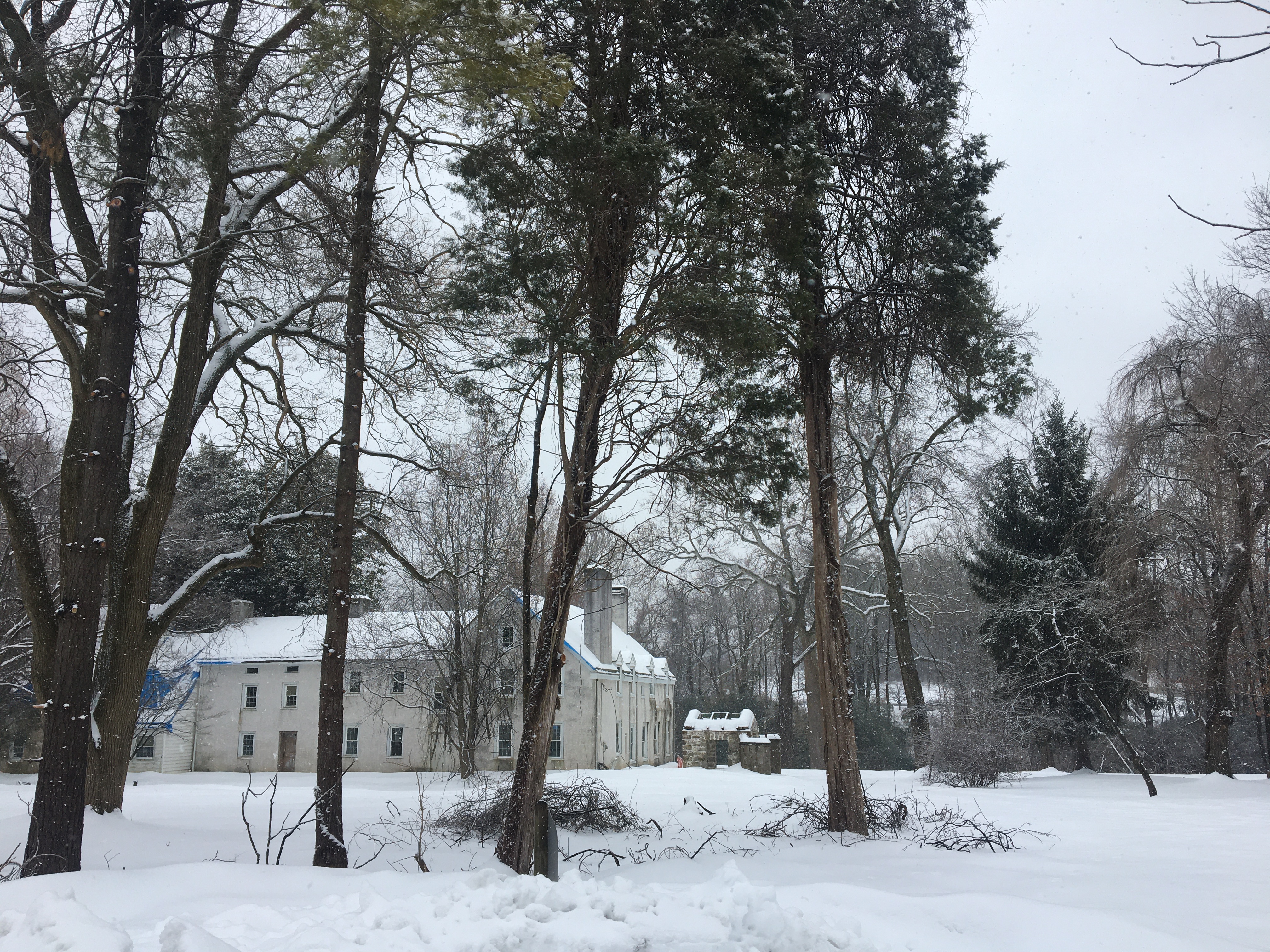
The more than 12,000 soldiers and hundreds of civilians that marched into Valley Forge with the Continental Army on December 19, 1777 made a camp that essentially overnight became the fourth-largest city in the American states at the time. Washington established his headquarters in the Isaac Potts House, a house built about 1773 by a Quaker family who operated the local iron forges and mills. Alexander Hamilton, Baron von Steuben, and the Marquis de Lafayette are among notable Revolutionary War figures who met with Washington in the house.
The army's first task upon arrival was constructing shelter. Washington issued precise orders specifying construction standards: every 12 men would share a 16-by-14-foot log hut with walls six and a half feet high, each with a stone fireplace, and the roof made of wood board.
Each hut was constructed out of logs with the sides sealed with clay; roofs were made of a variety of materials, usually thatched straw or brush, and most huts had dirt floors. Washington offered a reward of twelve dollars to the squad in each regiment that finished its hut in the quickest and most workmanlike manner, and offered one hundred dollars to anyone who could devise a cheaper roofing alternative to scarce boards. In about a month and a half, the soldiers had built nearly 2,000 of these huts to house the army through the winter.
Contrary to the popular image of Valley Forge as a place of howling blizzards, historians note that the winter of 1777–1778 was relatively mild, and not the harshest winter of the Revolutionary War.
The encampment recorded fewer than 10 days of appreciable snowfall; what soldiers actually contended with, day after day, was mud and cold. The suffering at Valley Forge was real, but it came from shortages, overcrowding, and disease, not from the snow. The supply system had collapsed under the mismanagement of the Quartermaster Department. Washington poured his frustration into a letter to Henry Laurens, president of the Continental Congress, on December 23, 1777, warning that unless drastic changes were made, the army faced starvation, dissolution, or dispersal. Washington acted vigorously to relieve the immediate supply crisis by applying to civil authorities at all levels for assistance and dispatching long-range foraging parties, while also seeking more far-reaching remedies. When a congressional investigation committee arrived at camp in late January, Washington presented a comprehensive set of recommendations to put the army on a firmer professional footing.
During the encampment at Valley Forge, an estimated 1,700 to 2,000 soldiers died from disease, possibly exacerbated by malnutrition and cold, wet weather.
Two-thirds of those deaths came not in January or February, but during March, April, and May, when the weather had warmed and food supplies were actually improving. The cold alone wasn't the killer — the accumulated damage of a hard winter was. Influenza, pneumonia, typhus, dysentery, and typhoid fever swept through the overcrowded huts. Washington confronted the threat of smallpox head-on: finding that "between three and four thousand Men had not had the Small Pox" and that the disorder had begun to appear in camp, he ordered immediate mass inoculation.
The program was so successful in controlling smallpox that it held the disease in check at Valley Forge — a bold extension of what historians have recognized as the first large-scale, state-sponsored immunization campaign in American history.
The army at Valley Forge was far more diverse than popular memory often suggests. The American army at Valley Forge comprised an astonishingly diverse population, including men of French and German descent, African Americans, and Native Americans.
In the Continental Army, bound individuals yearning for liberty and wages served alongside freemen in search of a better life; the Continental Army was integrated and included many patriots of African descent.
In addition to Martha Washington joining her husband at his headquarters, an estimated 200 to 400 women followed their husbands or sweethearts to Valley Forge, fulfilling invaluable roles like laundering clothes or bandaging wounds. On January 7, 1778, a group of patriotic Philadelphia women drove ten oxen "fit for slaughtering" into the camp and brought with