SC, USA
Camden
The Revolutionary War history of Camden.
Why Camden Matters
Camden, South Carolina: The Crucible of American Defeat and Resilience
Long before the first musket was fired in anger along its sandy roads, Camden, South Carolina, occupied a place of strategic importance in the colonial backcountry. Founded in 1732 as Fredericksburg Township and later renamed for Charles Pratt, the first Earl of Camden and a champion of colonial rights in Parliament, the town sat at the head of navigation on the Wateree River and served as a vital crossroads linking Charleston to the interior. Originally known also as Pine Tree Hill, the settlement had attracted Quakers and Scots-Irish emigrants from Virginia by the 1750s , and by 1780 it was the oldest and largest town in the Carolina backcountry . That year, it became the linchpin of British strategy in the South — and the site of one of the most devastating American defeats of the entire Revolutionary War. What happened at Camden in the scorching summer of 1780 exposed the fragility of the patriot cause at its lowest ebb, cost the life of one of the Continental Army's most gallant officers, destroyed the reputation of one of its most celebrated generals, and ultimately set the stage for the strategic recalibration that would turn the tide of the war in the Southern theater.
To understand Camden's significance, one must first grasp the dire circumstances facing the American cause in the spring and summer of 1780. Charleston had fallen to British forces under General Sir Henry Clinton on May 12, 1780, in the worst American surrender of the war — over five thousand Continental soldiers captured in a single stroke. With Charleston secured, the British established a network of fortified outposts across South Carolina to pacify the countryside, and Camden became the most important of these inland garrisons. Lord Charles Cornwallis, the aggressive and capable lieutenant general left in command of British forces in the South after Clinton returned to New York, recognized Camden's value as the hub from which British power could radiate into the Carolina interior. British subjugation of the rebel colonies in the South depended on control of outposts and supply depots, and the largest was at Camden, about 115 miles inland from the coast. The town's position allowed control over supply lines, communication routes, and the fertile agricultural land that sustained military operations.
When Cornwallis marched his 2,500 troops into Camden in June 1780, his army encountered no opposition. The British promptly confiscated any property of value, including the opulent Georgian mansion of local merchant and patriot Joseph Kershaw, his mills, and his store. Cornwallis's men fortified the grounds with a stockade wall and five redoubts, and constructed barracks and a hospital, with Kershaw's house serving as headquarters for both Cornwallis and Lieutenant Colonel Francis Lord Rawdon, the British commandant at Camden.
During British occupation, Camden consisted of two city blocks of period homes and military barracks surrounded by a palisade log fence and further protected by five redoubts and three other fortified features — a house, a jail, and a powder magazine — placed strategically from 100 to 1,000 feet outside the town itself. Kershaw himself, who had been elected to the First and Second Provincial Congresses and served as a militia officer seeing action at Purrysburg and Stono Ferry, was captured by the British after the Siege of Charleston and exiled, first to British Honduras and then Bermuda.
The Continental Congress, desperate to recover the South, turned to Major General Horatio Gates, the celebrated "Hero of Saratoga," whose victory over General Burgoyne in 1777 had secured the most important American triumph of the war to that point. Gates received command of the newly reconstituted Southern Department in the summer of 1780 and arrived at Coxe's Mill in North Carolina on July 25 to take charge of the ragged remnants of the southern Continental force. His army was a patchwork: approximately fourteen hundred Maryland and Delaware Continentals — some of the finest regulars in American service — along with a fluctuating mass of Virginia and North Carolina militia. Serving as the senior divisional commander under Gates was Baron Johann de Kalb, a German-born officer who had spent decades in the French army and had traveled to North America in 1768 on a covert mission from the Duc de Choiseul, France's Foreign Minister, to gauge the level of colonial discontent toward Great Britain . De Kalb and more than 1,000 Maryland and Delaware Continentals had left Morristown, New Jersey, on April 16 with orders from General George Washington to reinforce General Benjamin Lincoln in South Carolina, making it as far as North Carolina when word of Charleston's surrender reached them.
Two days after assuming command, Gates ordered his army to take the direct road to Camden, against the advice of his officers, including Colonel Otho Holland Williams, who noted the country they were marching through "was by nature barren, abounding with sandy plains, intersected by swamps, and very thinly inhabited."
As Gates neared Camden, word of his movement reached Cornwallis at his headquarters in Charleston, and the British commander immediately left the city to take the field against Gates.
Both armies executed full-moon night marches on August 15, and the two opposing armies' advance forces literally ran into each other on the Waxhaws Road about eight miles north of Camden at approximately 2:00 AM on August 16.
Continental Colonels Charles Armand and Charles Porterfield clashed and skirmished in the dark with British Lieutenant Colonel Banastre Tarleton, and both sides fell back to regroup.
At first light, the two armies faced each other roughly 200 yards apart beneath the open understory of longleaf pine. The British force of 2,335 troops, commanded by Cornwallis, faced off against the American forces numbering above 3,500, nearly 2,250 of whom were inexperienced Virginia and North Carolina militia. De Kalb's 900 Maryland and Delaware Continentals were arrayed on and to the west of the Waxhaws Road, while to the east were placed 1,800 North Carolina militia, with 700 Virginia militia on their far left.
Both commanders placed their most reliable troops on their right, so that the British regulars under Lieutenant Colonel James Webster faced the weaker Virginia militia. This was a fatal alignment. When the British advanced and presented bayonets, the Virginians immediately turned and ran, and their flight carried to the North Carolina militia in the center of Gates's line as the American position quickly collapsed.
Many men dropped their muskets and fled without having fired a shot.
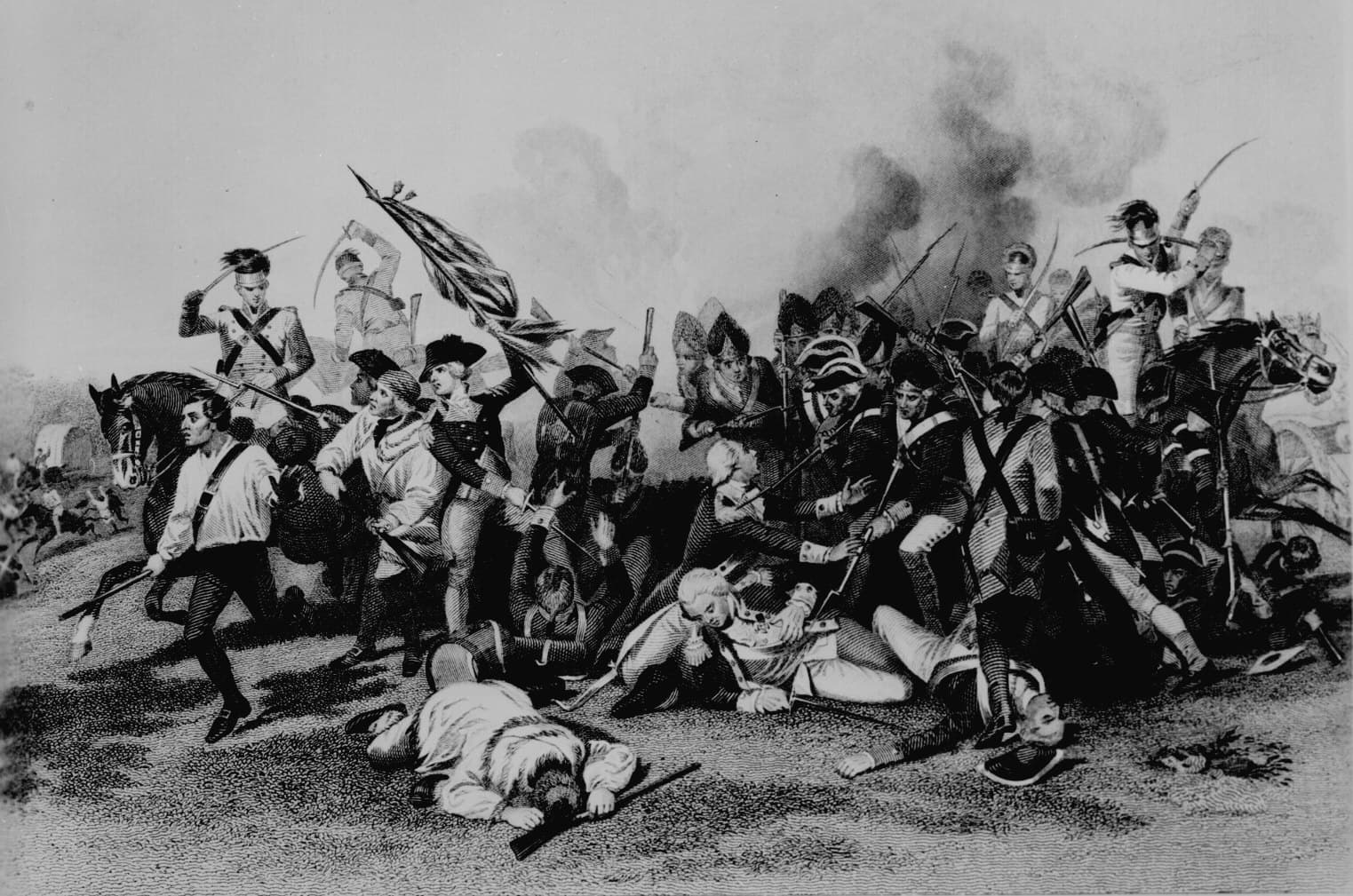
On the right, de Kalb's wing was attacking after receiving the order from Gates; they had no idea how badly things had gone on the left because the dawn's dead calm had left the smoke from artillery and gunfire lingering in a haze under the trees. The Maryland and Delaware regulars twice repulsed Lord Rawdon's Volunteers of Ireland and launched successful counterattacks before Cornwallis rode up and personally rallied his men.
Webster then wheeled left and attacked the flank of the two Continental regiments that had been pressing the