NY, USA
Harlem Heights
The Revolutionary War history of Harlem Heights.
Why Harlem Heights Matters
The Battle for Harlem Heights: Where the Continental Army Found Its Spine
On the morning of September 16, 1776, a ragged line of American soldiers did something they had not done in weeks — they advanced. After a summer of catastrophic defeats, humiliating retreats, and collapsing morale, Continental troops on the rocky, wooded plateau of northern Manhattan turned to face the British army and drove it backward. The engagement that followed, known as the Battle of Harlem Heights, was modest in scale but enormous in psychological consequence. It was the moment when George Washington's battered forces proved — to themselves as much as to anyone — that they could stand against professional soldiers in open combat. To understand why that mattered, one must trace the chain of disasters that brought the Continental Army to Harlem Heights in the first place, and follow the events that radiated outward from that ground in the desperate autumn of 1776.
The story begins with New York City itself, which Washington recognized as the strategic prize the British would seek after their evacuation of Boston in March 1776. Whoever controlled the city controlled the Hudson River, and whoever controlled the Hudson could sever New England from the rest of the colonies. Washington moved his army south and spent the spring and summer fortifying Manhattan, Brooklyn, and the surrounding waterways, but the task was nearly impossible. New York was an island city surrounded by navigable waters dominated by the Royal Navy. When General William Howe landed an enormous British force on Staten Island in July — eventually swelling to some 32,000 troops supported by his brother Admiral Richard Howe's fleet — Washington faced an adversary who could strike almost anywhere along miles of vulnerable coastline. Major General Nathanael Greene, one of Washington's most capable subordinates, fell gravely ill with fever in August, removing from the field the officer who best understood the Brooklyn defenses at the worst possible moment. The Battle of Long Island on August 27 was a rout. Howe executed a brilliant flanking maneuver that crushed the American left, killing or capturing over a thousand men. Only a miraculous nighttime evacuation across the East River on August 29 — carried out in fog and silence by Massachusetts fishermen — saved the army from total destruction.
What followed was a crisis not merely of strategy but of spirit. Washington pulled his forces into Manhattan but struggled to decide whether to defend or abandon the city. Several prominent figures, including Greene and New York's John Jay, advocated burning the city to the ground rather than let the British enjoy its benefits, but Washington laid the question before the Continental Congress, which flatly rejected the idea. His army was melting away through expired enlistments, desertion, and sheer demoralization. By September 12, Washington had convened a council of his generals, and the decision was made to abandon New York City and consolidate on the naturally strong plateau of Harlem Heights at the northern end of the island. The Americans constructed three parallel lines of fortifications across the heights — the first at approximately modern 147th Street with three small redoubts and connecting entrenchments, the second with four redoubts about three-quarters of a mile behind at roughly 153rd Street, and a third line still under construction near 159th Street — sealing off the northern end of Manhattan and protecting both Washington's headquarters and Fort Washington farther north. Greene's division of some 3,300 men guarded the southern face of the heights overlooking a low valley known as the Hollow Way; behind him, Israel Putnam's division of roughly 2,500 held the second line; and Major General Joseph Spencer's troops manned the third.
Washington established his headquarters in the confiscated home of Loyalist Colonel Roger Morris — the Morris mansion, today known as the Morris-Jumel Mansion, built in 1765 on one of the highest points on Manhattan Island. The elevated position gave Washington sweeping views of the Harlem and Hudson rivers and of approaching enemy forces. It is the oldest surviving house in Manhattan and still stands in what is now the Washington Heights neighborhood, a tangible remnant of the crisis that unfolded around it.
On September 15, Howe struck again, landing troops at Kip's Bay on Manhattan's eastern shore. The result was one of the most shameful episodes of the war. Connecticut militia stationed at the landing site broke and fled without firing a meaningful volley after a staggering naval bombardment from five British warships scattered the defenders. In all, some 4,000 British and Hessian troops poured ashore, with 9,000 more landing after the initial force scattered the Americans. Washington, riding toward the sound of the guns, encountered his own men streaming past him in panic. According to one account, an infuriated Washington threw his hat to the ground, shouting, "Good God, are these the troops with which I am to defend America?" It was with some difficulty that his staff convinced the enraged general to withdraw. Yet Howe made a critical error: rather than driving immediately across the island to cut off the American retreat, he paused. Washington had all of his troops moving north along the west side of Manhattan by 4:00 p.m., and they reached the fortifications on Harlem Heights by nightfall.
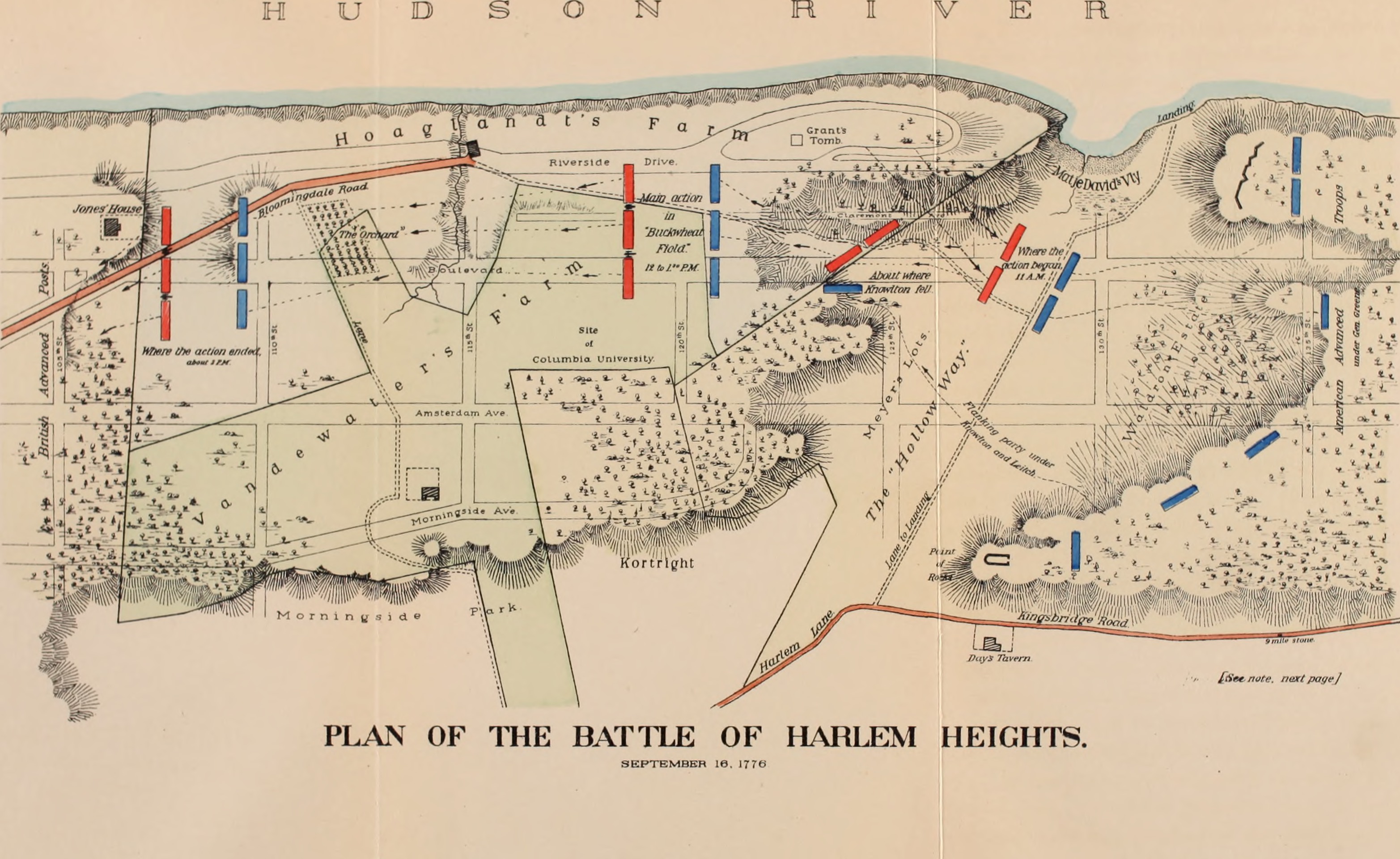
Early on the morning of September 16, Washington was at his desk in the Morris mansion composing a letter to the President of Congress when an alarm went up. He sent a party of 150 rangers under the command of Lieutenant Colonel Thomas Knowlton, along with Adjutant General Joseph Reed, to reconnoiter British positions south of the Hollow Way near Bloomingdale. Knowlton was no ordinary officer. A thirty-five-year-old Connecticut native and veteran of the French and Indian War — during which he had fought against the French and even served in the Siege of Havana against the Spanish — he had distinguished himself at Bunker Hill and earned a reputation as a man who never told his troops "Go on, boys!" but always "Come on, boys!" In August, Washington had personally selected Knowlton to form an elite reconnaissance unit of roughly 130 to 150 hand-picked men and 20 officers drawn from Connecticut, Rhode Island, and Massachusetts regiments. This unit, known as Knowlton's Rangers, was the Continental Army's first organized intelligence service — a fact recognized by the modern U.S. Army, whose intelligence service seal bears the date "1776" in tribute to the Rangers' founding. Among those serving under Knowlton's command was Captain Nathan Hale, a twenty-one-year-old former schoolteacher from Coventry, Connecticut, who had volunteered for a daring espionage mission behind British lines and departed the American encampment at Harlem Heights only days before the battle, disguised as a Dutch schoolmaster.
At daybreak, Knowlton's patrol descended into the Hollow Way and encountered British light infantry pickets from Brigadier Alexander Leslie's brigade. A sharp firefight broke out, and as the outnumbered Rangers fell back toward the American lines, the pursuing British light infantry sounded their bugle horns — not with the call to battle, but with the derisive fox hunting call "Gone Away," the signal given when a fox was in flight and the hounds should give chase. The insult was deliberate, aimed at humiliating the retreating Americans. It had precisely the opposite effect. American officers on the heights were incensed. Washington himself, a lifelong fox hunting man, recognized the taunt for what it was.
Reed reported back to Washington at roughly 9:00 a.m. that he had found Knowlton and observed the British light infantry advancing rapidly northward. Washington resolved to turn the enemy's arrogance against them. He devised a two-pronged plan: a force would engage the British from the front to hold their attention, while Knowlton's Rangers and three companies of Virginia Continentals under Major Andrew Leitch worked their way south around the British right flank to strike from behind. The flanking maneuver went awry when Knowlton's men turned west too early, attacking the British flank rather than their rear and losing the element of surprise. But the combined pressure from the frontal feint and the flanking assault put the overextended British light infantry — who had advanced far beyond their supporting lines — in a perilous position. They found themselves attacked from three sides and began to retreat.
What happened next stunned both armies. British reinforcements arrived from the south with artillery support, and the light infantry and elements of the famed Black Watch Highlanders made a stand in open fields on Morningside Heights — the area that is today the campus of Columbia and Barnard Universities. The Americans, also reinforced as units from multiple states poured into the fight, came on in strength. For roughly two hours, Continental soldiers from New York, New Jersey, Connecticut, Massachusetts, Rhode Island, Pennsylvania, Maryland, and Virginia stood on open ground and exchanged volleys with some of the finest troops in the British army. The Virginia militia — the same men who had fled in disgrace the day before at Kip's Bay — fought steadily and effectively alongside the Northern Rangers, a display of interstate cooperation and recovered courage that went a long way toward restoring the army's faith in itself.
By 3:00 p.m., with British ammunition running short and their troops being pushed back, Washington faced a choice. His men were elated and pressing forward, but the main body of the British army lay not far to the south. Unwilling to risk a general engagement that could destroy his fragile army, Washington called off the pursuit and ordered his troops to withdraw to their own lines. They did so in good order, shouting "Huzzah!" as they fell back through the Hollow Way.
The cost of the engagement was real but not ruinous. American casualties amounted to roughly 30 killed and 100 wounded. British losses were disputed — General Howe officially reported 14 killed and 78 wounded, though a member of his own staff recorded 14 killed and 154 wounded in his diary, and the historian Henry Phelps Johnston, whose 1897 study remains the only detailed monograph on the battle, assessed British losses at 14 killed and 157 wounded. Among the American dead were two officers whose loss Washington keenly felt. Lieutenant Colonel Knowlton fell mortally wounded while rallying his men at the front, and Major Andrew Leitch, commanding the Virginia riflemen, was wounded and died some days later. In his general orders for September 17, Washington mourned Knowlton as "the gallant and brave Colonel Knowlton, who would have been an honor to any country." The death of Knowlton was a blow not only to the army's morale but to the fledgling American intelligence operations, as he had created and led the first such unit at Washington's direction. His loss was compounded just six days later: Nathan Hale, who had slipped behind enemy lines from the Rangers' ranks, was captured in Queens and hanged as a spy on September 22 — America's first spymaster and America's first spy both perished within a single week of each other.
In the American camp, officers noticed a palpable and desperately needed shift in morale. Novice Continentals who had known only defeat were clearly elated that they had, for the first time, put some of the King's best troops to flight. Washington saw that the fight had produced what he called "a surprising and almost incredible effect upon our whole army." His adjutant Reed wrote to his wife that she could "hardly conceive the change it has made in our Army." George Weedon, whose Virginians had coolly exchanged volleys with redcoats in the Hollow Way, offered the most blunt assessment: "Upon the whole, they got cursedly thrashed." It