
MA, USA
Lexington
The Revolutionary War history of Lexington.
Why Lexington Matters
Lexington, Massachusetts: The Ground Where Revolution Became Real
On the morning of April 19, 1775, a loosely assembled group of roughly seventy-seven men stood on a triangular patch of common land in the small farming town of Lexington, Massachusetts — a crossroads community of about 750 people. They were not professional soldiers. They were farmers, artisans, and laborers, many of them related to one another by blood or marriage, most of them bone-tired from a night of waiting and false alarms. The militiamen were part of Lexington's "training band", a local militia organization method dating back to the Puritans, and not a minuteman company. Lexington, unlike other local communities, did not establish a minuteman company, instead maintaining a training band for local defense. Their captain, John Parker, was himself a farmer and mechanic who had been elected to lead them. Parker got his first military experience with the British in the French and Indian War at two of the most important battles of the war, the Siege of Louisburg in 1758 and the Battle of the Plains of Abraham in 1759. He was also the grandfather of the reformer and abolitionist Theodore Parker.
At this point, John Parker was forty-six years old, suffering from tuberculosis and on his death bed. He would die on September 17, 1775 — not quite five months after that fateful morning. Within minutes, they would become the first Americans to face British musket fire in what would grow into a war for independence. What happened on Lexington Green that morning — confused, brief, and bloody — transformed a political crisis into an armed revolution and gave the town a permanent place in the founding story of the United States.
To understand why British regulars and colonial militiamen met on that green, one must look back to the escalating confrontation between Parliament and the Massachusetts colonial assembly throughout 1774 and into 1775. After the Boston Tea Party and the passage of the Coercive Acts — which colonists called the Intolerable Acts — General Thomas Gage, the royal governor and commander of British forces in Boston, found himself presiding over a province in open political rebellion. Town meetings defied his orders. County conventions organized resistance. A shadow government, the Massachusetts Provincial Congress, met in Concord and began stockpiling military supplies. On April 14, 1775, Gage received instructions from Secretary of State William Legge, Earl of Dartmouth, to disarm the rebels and to imprison their leaders. By early spring of 1775, Gage had intelligence that significant stores of arms, powder, and provisions were cached in Concord, about eighteen miles northwest of Boston. He also knew that two of the most prominent leaders of colonial resistance, Samuel Adams and John Hancock, were staying in Lexington, roughly halfway along the route. On the evening of April 18, 1775, John Hancock and Samuel Adams, having attended the Massachusetts Provincial Congress in Concord and wary of returning to Boston, were guests of Rev. Clarke at the Hancock-Clarke House — a parsonage the Reverend John Hancock, grandfather of the American revolutionary leader of the same name, purchased this site in 1699. In 1738 he built this two-story timber-frame house. On the night of April 18, Gage dispatched approximately 700 grenadiers and light infantry under Lieutenant Colonel Francis Smith to march on Concord. Major John Pitcairn of the Royal Marines served as Smith's second-in-command. When alarm guns were heard along the route and the countryside appeared to be on alert, Smith sent Pitcairn ahead with six companies of light infantry to advance rapidly and secure the bridges at Concord, while Smith himself stayed with the slower main body. It was Pitcairn's advance guard — not the full British force — that would reach Lexington Green first.
Word of the British march spread quickly. Dr. Joseph Warren dispatched Paul Revere and William Dawes to ride out and warn the countryside. Revere arrived in Lexington and alerted Hancock and Adams at the Hancock-Clarke parsonage. The alarm was raised, and Parker assembled his militia company on the Common. After several hours of waiting with no sign of the regulars, many of the militiamen retired to nearby Buckman Tavern — a tavern built around 1710 by Benjamin Muzzey, located directly on the Green, which served as the social and commercial center of the village. There, some men had a drink, others took a nap, and all waited anxiously for definite word. Just before sunrise, around 4:30 in the morning, a scout named Thaddeus Bowman brought news that the British were less than half a mile away. The men left the tavern and assembled in two ranks on the Common.
In his deposition of April 25, 1775 — now preserved in the Papers of the Continental Congress at the National Archives — Parker described what happened next in his own words: he had ordered the militia "to meet on the Common in said Lexington, to consult what to do, and concluded not to be discovered, nor meddle or make with said Regular Troops (if they should approach) unless they should insult or molest us and upon their sudden Approach I immediately ordered our Militia to disperse and not to fire." The first shots of the American Revolution rang out at roughly 5:30 in the morning. Who fired the mysterious first shot remains unknown to this day. British light infantry, moving beyond their officers' control, poured fire into the dispersing militia. Within minutes, the skirmish was over.
Eight of Parker's men lay dead or dying, and ten were wounded. Only one British soldier was injured. The dead were: John Brown, Samuel Hadley, Caleb Harrington, Jonathan Harrington, Robert Munroe, Isaac Muzzy, Jonas Parker, and Asahel Porter. Among the fallen, the story of Jonathan Harrington became one of the most enduring of that morning — shot through the chest on the Green, he crawled toward his own home at the edge of the Common and died on his doorstep, within sight of his wife and child. Robert Munroe, at sixty-two the oldest man killed that morning, was an ensign and the highest-ranking officer to fall — and the first American officer killed in the Revolution.
But the story of Lexington on April 19 did not end with the morning's bloodshed. What Captain Parker and his surviving men did next stands as testimony to their courage. Later that day, as the battered British column retreated from Concord back toward Boston, Parker rallied his company and positioned them in an ambush along a rocky hillside near the Lexington-Lincoln border. Nathan Munroe, a veteran of the day's fighting, recalled years later: Parker, "having collected part of his company, I being with them, determined to meet the regulars on their retreat from Concord." This engagement — known as "Parker's Revenge" — bloodied and slowed the retreating British and seriously wounded Lieutenant Colonel Francis Smith himself. The exact site of the ambush was long a matter of speculation until a multi-year archaeological investigation by the National Park Service and the Friends of Minute Man National Park, conducted between 2012 and 2016, confirmed its location through recovered musket balls, geophysical surveys, and archival research. The site is now interpreted as part of Minute Man National Historical Park.
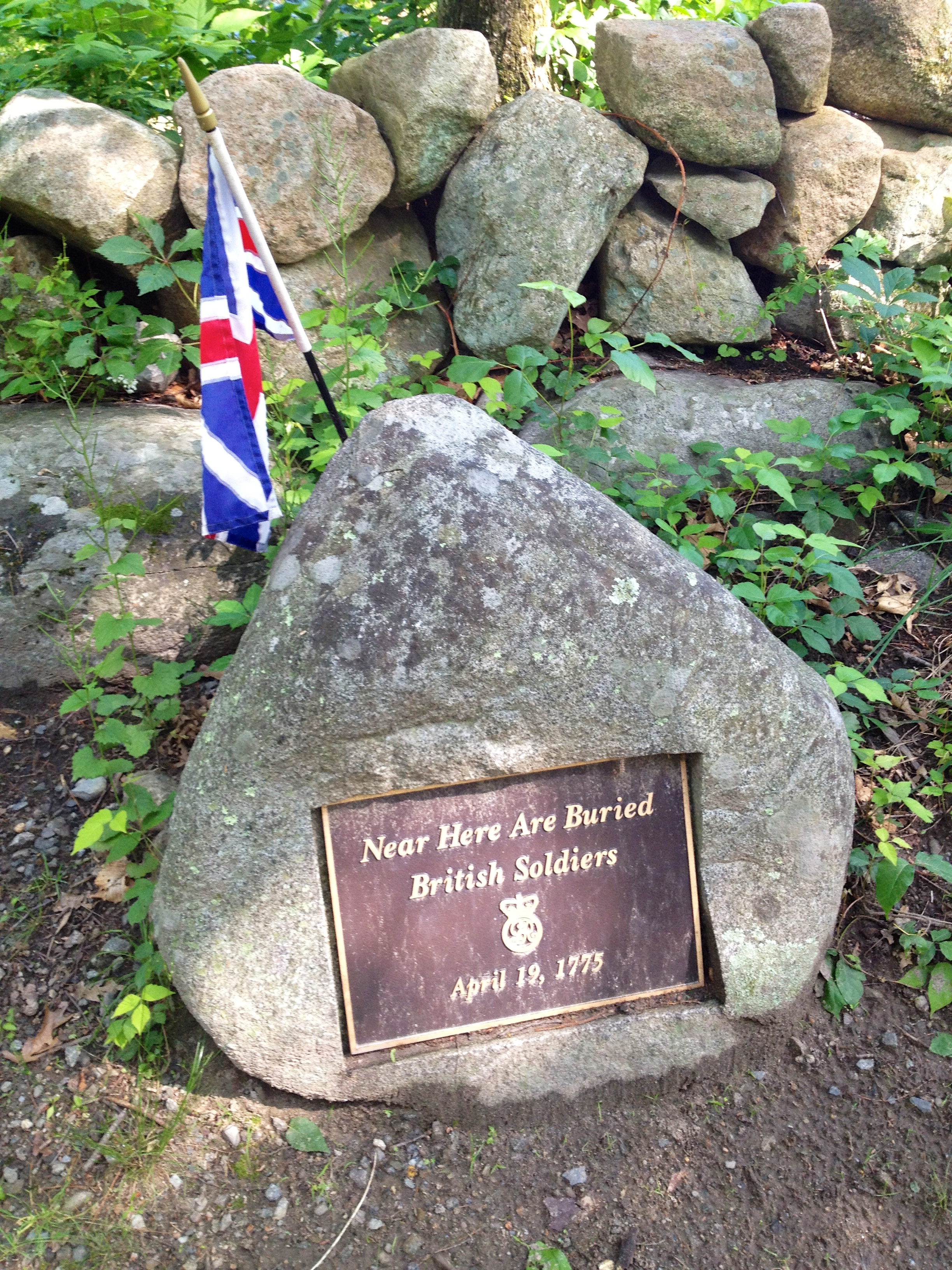
As the British column neared collapse on the road back to Boston, it was saved by the arrival of a relief brigade of roughly one thousand reinforcements under Brigadier General Hugh Percy, who reached the outskirts of Lexington around 2:00 in the afternoon. Percy commandeered the Munroe Tavern — built in 1735, and operated by William Munroe, the orderly sergeant of Parker's own militia company — as his headquarters and field hospital for wounded British soldiers. After more than an hour's rest, the combined British force of some 1,700 men withdrew toward Boston, harassed by militia fire for the remaining miles through Menotomy (now Arlington) and Cambridge. By the end of that long day, the British had suffered 73 killed, 174 wounded, and 53 missing; American losses were 49 killed, 39 wounded, and 5 missing. Over 4,000 colonial militia from dozens of towns had taken the field.
In the days that followed, another battle began — this one fought with words. The Massachusetts Provincial Congress convened on April 22 and immediately ordered depositions from eyewitnesses, determined to establish that the British had
Themes
Liberty and Freedom
Where liberty was first defended with blood
Citizen Soldiers
Birthplace of the minuteman tradition
Enslaved and Free Black Voices
Prince Estabrook was wounded here
Women of the Revolution
Women watched and waited as battle unfolded
Preservation and Memory
Lexington Green is among the best-preserved Revolutionary sites
Historical Routes
Battle Road: Arlington Section
Stop 1 of 3
Paul Revere's Midnight Ride Route
Stop 2 of 3