
NJ, USA
Hackensack
The Revolutionary War history of Hackensack.
Why Hackensack Matters
Hackensack at War: The Crossroads of Revolution in Bergen County
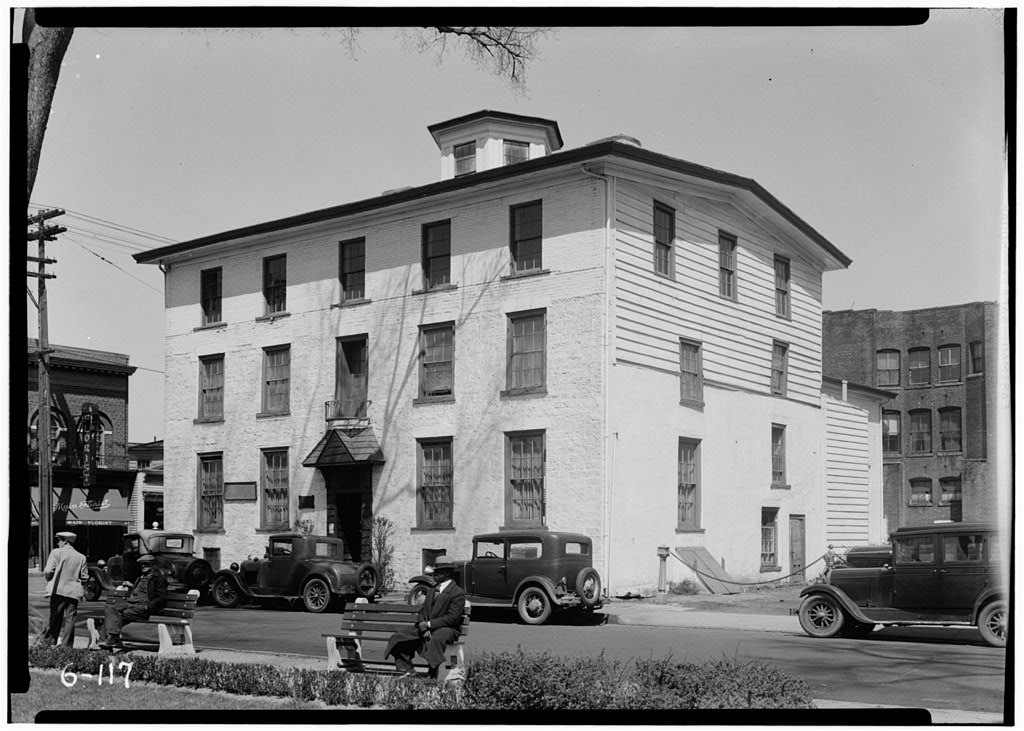
When George Washington rode into Hackensack on the raw afternoon of November 20, 1776, he was a general running out of ground. The previous night, thousands of British and Hessian troops had scaled the Palisades and overwhelmed Fort Lee, scattering its garrison and capturing stores that the Continental Army could not afford to lose. Washington had crossed the Hackensack River to reach the village, and from the stately home of Peter Zabriskie—one of Bergen County's most prominent dwellings—he scratched out desperate dispatches warning the Continental Congress that the situation was dire. Washington had actually established his headquarters at the Zabriskie house, known as Mansion House, as early as November 13, using the days before the British crossing to survey local roads and bridges. Peter Zabriskie had built the home in 1751, and it contained fine appointments including Dutch tile fireplaces depicting biblical scenes; enlarged in 1776, the home was known as Mansion House. The structure would eventually be demolished in 1945.
Zabriskie was one of the driving forces in Bergen County politics and a founder of Queen's College—later Rutgers University.
Hackensack, Tappan, and New Brunswick had all competed to host the new college, and the first meeting of its trustees was held in Hackensack in May 1767, though the trustees ultimately voted in 1771 to locate it in New Brunswick.
While Washington was headquartered at Peter Zabriskie's house, meals were supplied to him from the tavern of Archibald Campbell.
Campbell was born in 1730 on the Isle of Man; he immigrated to Hackensack in 1765. His tavern stood at the corner of what is now Sussex and Main Streets, directly across from the Green. Campbell would prove his patriot loyalty at great personal cost— on March 23, 1780, Campbell was taken prisoner in a British raid on Hackensack but managed to escape.
Campbell died December 29, 1798, age 68, and is buried in the First Reformed Church cemetery.
Thomas Paine, who was a member of the garrison at Fort Lee, marched with the retreating troops through Hackensack and later immortalized the events in The American Crisis. He described how, on the morning of November 20, "an officer arrived with information that the enemy with 200 boats had landed about seven miles above," and General Greene "sent express to General Washington at the town of Hackensack, distant by the way of the ferry = six miles."
According to Washington's secretary, Lieutenant Colonel Robert H. Harrison, an express rider from Orangetown, New York, arrived at Washington's headquarters in Hackensack at 10 a.m., bringing the first news of the British landing above Fort Lee. Washington raced to the scene, and the army's desperate march to secure the New Bridge over the Hackensack River—before the British could cut them off—became a defining moment of the retreat across New Jersey.
On November 20, 1776, Washington led his army into Hackensack, where it camped on The Green as he made the important decision to continue the retreat from overwhelming British and Hessian forces. An eyewitness account preserved by the Reverend Theodore B. Romeyn, a mid-nineteenth-century pastor of the First Church of Hackensack, recorded the scene: it was about dusk when the first of the troops entered Hackensack. "The night was dark, cold and rainy," the account continued, and the soldiers "marched two abreast, looked ragged, some without a shoe to their feet, and most of them wrapped up in their blankets."
Hackensack, the county seat of Bergen County, was not merely a waypoint in Washington's famous retreat across New Jersey. It was a place where the Revolution's survival hung visibly in the balance, where neighbors turned against neighbors with lethal consequences, and where the war's deepest contradictions—liberty proclaimed alongside slavery maintained—played out in miniature over seven agonizing years.
To understand why Hackensack mattered, one must first understand Bergen County on the eve of revolution. The county was one of New Jersey's oldest settled regions, home to Dutch Reformed families who had farmed its river valleys for generations. After November 1776, the Hackensack Valley—located in northeastern New Jersey and Rockland County, New York—lay between the invading British army in New York City and the main Continental defense forces in the Hudson Highlands. Historian Adrian Leiby, in his landmark study The Revolutionary War in the Hackensack Valley (Rutgers University Press), described this territory as the "neutral ground," where Jersey Dutch patriot and Tory troops carried on a five-year war of neighbors between the lines, while the grand armies of Britain and America maneuvered on either side of them.
The depth of Loyalist sympathy in Bergen County cannot be overstated. Revolutionary War historian Todd Braisted, a past president of the Bergen County Historical Society, has noted that "Bergen County was the most loyalist county in the state." The strength of those Tory sentiments was already apparent before the British arrived. When William Franklin, the last royal governor of New Jersey, was arrested by patriots in June 1776 and transported to imprisonment in Connecticut, General Washington instructed the guards not to stop in Hackensack or anywhere in Bergen County, fearing that sympathetic residents would rescue the governor.
It was in the aftermath of the British invasion in late 1776 that Bergen County's Loyalists openly showed themselves. Meeting at New Bridge with New Jersey's highest-ranking Loyalist, Brigadier General Cortland Skinner, those wishing to serve militarily were organized into a corps. The person to lead the new unit was Abraham Van Buskirk, whose land lay on the Teaneck side of New Bridge, while the two senior officers included Major Daniel Isaac Browne, the county clerk who lived next to the courthouse in Hackensack.
Browne's political loyalties became unmistakable when the British arrived in Hackensack on November 21, 1776, and he was commissioned as the first major of the newly raised 4th Battalion, New Jersey Volunteers.
The revolution tore apart even the most sacred community institutions. The First Reformed Church of Hackensack—organized in 1686 and the oldest congregation in Bergen County—saw its members split between the pro-Patriot Coetus faction and the pro-Loyalist Conferentie group, with each holding services at separate times to avoid conflict.
Members of the same families, both Loyalists and Patriots, broke away from each other, and some formed their own churches in other parts of Bergen County.
The war returned to Hackensack with destructive fury in 1780. On the evening of March 22, 1780, a group of approximately 400 British and Hessian soldiers crossed the Hudson River from New York. Heading to attack American troops at Paramus, they passed through Hackensack around 3 a.m. on March 23, where they burned the courthouse and jail, and two houses.
The courthouse had become a military target because Captain Abraham Haring and some twenty-three of his militiamen lay inside, guarding the just-collected tax receipts of Harrington Township. An eyewitness described how "one half of the enemy marched quietly through. When the rear, consisting mostly of Hessians, arrived, they broke open the doors and windows, robbed and plundered, and took prisoners a few peaceable inhabitants, among whom was Mr. Archibald Campbell."
The second courthouse, built in 1734 near the Green, was destroyed; a temporary log courthouse was subsequently erected in Oakland.
After the war, the court temporarily met in the house of Archibald Campbell, and Freeholder Peter Zabriskie later donated land near his Hackensack home for a new courthouse and jail, which opened in 1786.
That same year, Hackensack became the
Historical Routes
Washington's Retreat Across New Jersey
Stop 2 of 5